
Thoughts: GREAT Teachers Have High EQ.
Do you recall the worst teacher or professor you ever had? I remember the worst professor I had as an undergraduate. He taught organic chemistry and obviously was not interested in teaching. He would write all the reactions on the board and mumble as he went along (he even used notes in his left hand while writing on the board with his right – basically transcribing) and never considered whether the material was being understood…and it wasn’t – means on mid-term and final exams were around 35%. This was a new assistant professor who had recently graduated from Stanford and I am quite sure was more focused on getting his research going so he could earn tenure. I have now come across a Biology teacher in my son’s high school who appears to similarly lack skill, talent, understanding and passion for teaching – lacking in both form and function. Thank goodness this teacher is the exception rather than the rule at this school.
Here is how my current experience is going. Teachers who test but don’t teach (sound familiar to you?) My son’s high school biology teacher (actually this department as a whole, but not the rest of the school) has a policy of not returning tests with the questions (this department also does not return quizzes or homework in a timely and useful manner). They simply recite in lecture and test without review, part of the education by single-exposure memorization clique. Oh, and memorize within a day or two a set of (teacher-centric talking point) PowerPoint, the textbook chapter and a study guide that does not get checked. Oblivious to effective teaching style and technique. Thwarting learning and a liking for the subject. Perhaps some teachers think this is defensible, but as a parent I am appalled at this disregard for teaching quality and wasteful attitude towards the opportunity and responsibility to support a student’s learning development. It’s a flaw in an otherwise fantastic school but it’s a painfully sore flaw. The philosophical dilemma is how to remedy this flaw? No, I don’t have an answer. I am hoping for sensibility to rise.
To have this flaw in high school is worse than in college. First, college professors in the US are allowed to choose their grading scheme: some apply a curve with standard deviation distributions and some look for observable cutoffs (I grade using the latter). The elementary and high school teachers I have known apply fixed cutoffs. Therefore, colleges have a way of taking this into account. In elementary and high school, BAD TEACHERS = BAD GRADES – although GOOD TEACHERS does not always nor necessarily correlate with GOOD GRADES. In college, a bad professor experience usually only lasts one quarter or semester. In elementary and high school, it’s usually a whole academic year. Also, college offers teaching assistants and other resources that may potentially make up for poor quality lectures. At Stanford, instructors are reviewed for their teaching ability by the students; I have not seen student reviews conducted in secondary schools (they should but I suspect they are worried what they might discover).
With the gaussian distribution outlook that I usually view things with, BAD TEACHERS are rare (although not non-existent) but so are great teachers. Most teachers are likely one standard deviation within average – there are several possible reasons for this: (a) the teacher is new and gaining experience that will make them better in the future, (b) the teacher gets administrative responsibilities on top of their teaching load and is distracted, (c) there is satisfaction being average (complacency), and (d) the teacher is cruising to retirement and no longer is concerned about their own performance.
What should a parent do in situations like this? There is no easy solution. Sorry if you thought I had one.
Case in reality point for compare and contrast, my son presently has two GREAT TEACHERS, three AVERAGE TEACHERS and just the one BAD (Biology) TEACHER. My son’s Geometry teacher is outstanding and counts as one of the GREAT teachers. He periodically emails parents letting us know how the class is going overall and when to expect gear shifts. He returns corrected tests promptly and has students submit corrections. He also only grades homework for completion rather than correctness and provides access to the answer key after the homework was submitted. He responds to student and parent email quickly with thoughtful feedback. He is accessible for office hours. He offers extra credit work in terms of a challenging problem that students can collaborate on and completion of ALEKS math problems. He appears to be in tune with facilitating and promoting learning across a range of student abilities: group leadership skills and high emotional intelligence. This is a teacher who has passion for his subject as well as teaching for learning. This is college prep.
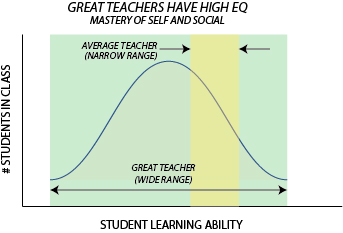
As for the YCISL interpretation of all this, we realize there is a designed difference between YCISL coaching and the mainstream/mainline education. Through YCISL, we want to raise everyone’s learning ability, skill and confidence – not just the most harmonic. We focus on building an appreciation for EQ in both self and social regards. We hope this leads to personal success and happiness.
This will make a fascinating and revealing case study discussion in the YCISL workshop. Maybe we could also do a BAD TEACHER-GOOD TEACHER EMPATHY SKIT EXERCISE? It will be interesting to see whether the students can identify any bad teachers or good teachers to impersonate.
