Design Thinking Approaches to Sustainability in Smart Cities & Communities
With the start of the new CEE 177L Smart Cities & Communities: Sustainability Design Thinking course in about 2 months, I wish to reflect on the methodological thrusts pinned to three design thinking approaches.
- PostIt Brainstorming and seeing what sticks: normal to crazy. Our un-bounded contributory method based on imaginative fast thinking idea generation and capture. The seemingly random yet focused method. Example: the perfect restaurant menu. Amenable to innovation and problem-solving.
- Tailoring to a single Composite Character Profile. Our feature list-based feedback loop method that cycles on lesson-backed iterations of character and product to achieve communicable positioning. The attractant method. Example: the original Macintosh UI. Amenable to early adopter kickstarting.
- A System of Systems: Networking Nodes, Connections & Protocols. The architectural framework method that involves layered designs incorporating data-driven networking essentials such as routing, QoS, validations, performance evaluations, and synchronizations. The navigation method. Example: the perfect hotel. Amenable to interwoven storytelling.
The three above approaches are all connected with the YCISL program and the CEE 176G Sustainability Design Thinking course. I will be looking for fresh, inspired and inspirational outcomes. Let’s hope for creative energy, generational resonance and timely coincidence for each of our design thinking journeys.
Innovation with Sustainability Design Thinking for Smart Cities & Communities
LIVE. WORK. PLAY.
I was pushed to re-design my summer teaching. It was an opportunity to explore a new area. What I’ve done is adopted our past course in Smart Cities & Communities aka SCC which originally had a business case basis to a new course (Smart Cities & Communities: Sustainability Design Thinking) where which takes the design thinking principles & process from my previous course (Sustainability Design Thinking aka SDT) with application to opportunities today, tomorrow and in the next generation.
The basic premise is to design interactive environments and surroundings in a what if? scenario where we practice wishful thinking and put ideas on the path to realization, at least conceptually & visually. The one phrase from the earlier SCC course that I remember is “a system of systems” where the connectivity, awareness and sensitivity to response are the main features of being called “smart.” Where the new SCC course will be an upgrade from the past course perspective is in the use of human-centered feature design specification to enhance user experience through emotional intelligence, creativity and storytelling (three core YCISL elements).
- Emotional Intelligence. What if a smart system offered and evolved with a person? What if we recognize that human awareness and interaction changes with place, time and circumstance? What if we could leverage intrinsic motivation as a user UI/UX layer in the architecture of our smart system?
- Creativity. Our smart system should energize the divergent-convergent thinking cycle involved in smart interaction, guidance and feedback. We can use creativity to promote a person’s appetite for a growth mindset. Creativity, especially in the fast thinking mode, can be used to sustain positivity as a promissory attractant to smart systems.
- Storytelling. A smart system could offer one or more longitudinal temporal pathways through storytelling. Word choice may be important, and so might imagery. One question is whether the story has to be based on reality, or could it be augmented or virtual? Does it matter to you and what we deem acceptable to attain our human behavior change goals?
With the above thoughts, we will conceptualize smart cities and communities innovations as a platform to enhance design thinking skills – hopefully building a memorable starting point through caring for sustainability. The value proposition of this course is the life skill of design thinking, and spreading the YCISL method through attending to where we live, work and play.
Late Work: Empathy, Compassion & Changing Human Behavior

Over the decades, I have learned to write course syllabi in a rubric style. The rubric contains mostly positive attributes of student work, mostly deliverables and expectations of quality and scope. Then there is the section of the rubric that is in anticipation of something unexpected happening. Such as late work. I have a written policy on late work as well as excused vs un-excused absences from class. This is partly based on Stanford’s “Incomplete” grade definition which states:
“I (Incomplete): The ‘I’ is restricted to cases in which the student has satisfactorily completed a substantial part of the coursework. No credit is given until the course is completed and a passing grade received. When a final grade is received, all reference to the initial ‘I’ is removed from the official transcript. ‘I’ grades must be changed to a permanent notation or grade within a maximum of one year. If an incomplete grade is not cleared at the end of one year, it is changed automatically by the Office of the University Registrar to an ‘NP’ (not passed) or ‘NC’ (no credit), as appropriate for the grading method of the course. Students must request an incomplete grade by the last class meeting. Faculty may determine whether to grant the request or not. Faculty are free to determine the conditions under which the incomplete is made up, including setting a deadline of less than one year (but not more than one year). When an incomplete is granted, faculty and students should work closely together to discuss/determine/outline/understand/agree to all of the expectations and conditions for completing work.”
In short, it is a second chance that can be allowed at the instructor’s discretion.
Within a course, my late work policy allows one “mulligan” so long as it is requested by the student within 24 hours of an excused absence. This is similar to the Incomplete definition in that students must request the reprieve and it must be within a reasonable time, and there are conditions attached – somewhat like a sub-contract.
As an educator and a proponent of coaching leadership skills in students, I think this approach is both practical (helps me as instructor to make an assessment even with consideration of late-ness) and impactful where there is hope of future human behavior change as well as shaping a student’s mindset with the display of empathy and compassion. This ties into emotional intelligence, another favorite YCISL concept, where we are thinking about self & social with regard to awareness (cause of the late work) and management (a path forward). Despite the intellectual presence of mind for empathy and compassion, the ability to exercise these behaviors is highly uncertain in the modern world & unreliable in the worldview of leadership.
In my work on design thinking, I continue to champion human-centered awareness and actions. I may be a little late, but I know I’ll keep working on it.
E-Book Idea: The First Resume (and I’m stuck)
I started an e-book based on my CTE mock interview activities earlier this year. The idea was to list some of the most common suggestions I would make regarding the resumes and incorporate YCISL design thinking as explanations for the improvement. I drafted an outline and wrote some content. But I then started to vacillate trying to balance the depth of design thinking – between simple wording of design thinking methodology versus going into detail. I still haven’t decided which structure would work better. Instead, I am writing this wiki entry to list the topics in the hopes that I make a decisive breakthrough. Here goes.
- Timing. Understanding how much time a reader actually looks at a resume. At the mock interviews, I will usually let my eyes scan the resume for about 30 seconds to find the best connection for the interview. However, note that a positive impression is decided within the first 5 seconds of that same period.
- Trust. Building a relationship based on trust connects the mind of the reader with the mind of the applicant. Use words and sentence constructions that relay a feeling of trust. Whether you have earned trust in the past, or you have trusted another person through past interactions.
- Talking Points. In an interview setting, the objective is for the resume to put in the reader’s mind topics to pursue a conversation that reveals suitability. The best talking points should come from the Experience section of the resume. Each talking point should serve as a prompt for possible discussion. A first resume needs about three to five talking points.
- Selectivity. While a resume is largely a historical record of experiences, there is a strategy in being selective for a first resume. The main detail is that the information should be relevant to the position. Use the job description or research the job title to select key words. This conveys awareness and interest.
- Promise and Ask. Communicating a willingness to contribute, grow and learn, and hinting at what motivation or guidance will be required. In addition, an interview involves an exchange of promises and asks so be prepared to also listen for your interviewer’s promise and ask. Feel free to echo the promises and asks to strengthen the tie.
Well, I hope this gets me un-stuck.
Science Fair Research Project Quickstart: The #1 Ground Rule -> Reading
 Following my presentation on Engineering Research Projects this week at Santa Teresa High School, I thought I would architect a model for participants starting from scratch on a project for a science fair. Any science fair. I actually had a hard time finding a perspective that would fit the “Simple, but not Easy” mindset useful for innovative thinking. After a week of pondering, I think I found a way to describe this in a usable manner.
IT’S SIMPLE: The project needs to be focused on RESEARCH. Understand that research leads to contributions to the framework of knowledge, experience and understanding. Think about how you can add to such a framework. Research often leads to incremental innovation, and in extraordinary circumstances quantum innovation that impacts how others think about things, do things, and choose things. Imagine yourself as a change-maker. Research is built on a culture; a culture of curiosity, uncertainty and exploration. Immerse yourself in that culture.
NOT EASY: The seed for a research idea may generally start in two ways: (1) Reading research literature as an extension of class-based learning, and (2) Observing then defining problems then reading the research literature about the problem and existing solutions. No matter what, research excellence requires reading of the literature. And it’s hard work. Getting access to scholarly research literature. Selecting research literature that is within the scope of the research idea. Applying critical thinking to the research literature readings to support and justify the research project.
TIPS:
- Acquire at least 3 scholarly research articles for your collection that are good candidates for your bibliography. Such articles should be “peer-reviewed” and published in well-known research journals. There are web resources that explain how to identify such leading edge research articles. Note that 3 is just a starting point. Eventually aim for more…between 5 and 10 for a good science fair project.
- Select research articles written by researchers at well-known universities or research institutions. What universities have you heard of and may be interested in? Start there. As you look through your search results, certain names will appear numerous times and may be leading researchers in your research area interest. Look up their professional web page for more information on their research program.
- Read the bibliographies of the selected research articles. First, this reveals the quality of the research article itself. Second, other useful research articles may be discovered from this list.
- Use the selected research articles to build the rationale statement for the research project. Cite the research articles, and connect information from the research articles with the research project idea. Association between the idea and published research is a solid way of showing support and justification for the project.
- Read the selected research articles with two purposes in mind. First, especially for a science fair newcomer, the purpose is to gain insight on the scientific research method and become familiarized with terminology, styles and methodology. Second is the extraction of information that supports and justifies the project idea; the extracted information should persuade reviewers, judges, and teachers as well as yourself of the projects worthiness for investment of your time, resources, effort and energy. Research should not be wasteful.
- Pay attention to the titles of the scholarly research articles. This small piece of information is actually HUGE. It will teach you about scope and thrust. Scope describes the boundaries and connections. Thrust hints at the originality and scholarly nature of the investigation. Create a working project title that contains the scope and thrust of your research project idea.
- As a whole, use the selected research articles as models for writing your own eventual research articles. Learn how to justify a research project. See how much detail goes into methodology descriptions. Find styles (eg, tables, charts and more) to present results in revealing ways.
- As the research project idea gains size and traction, keep a list of key words. About 3 to 5. These should match the working project title. The key words list estimates how interesting the project may be, and hints of the potential audience for the research.
- Guard rails for the research project also includes the category and field of study (if the science fair has these set up). These categorizations help shape the research question and the plan for investigation.
- Let’s get started. The simplest way to start is to do a web search engine with “Google Scholar” followed by your topic. Change the search term until the search results provide promising leads.
AVOIDS (INSTEAD FOCUS YOUR ENERGY ON QUALITY RESOURCES):
- Science Buddies or similar educational web sites.
- Kaggle and other similar un-checked repositories.
- Articles without authors and dates, especially those with commercial purpose.
- YouTube videos.
- News media.
Good luck!
Clinic Presentation: Rules Of Creative Engagement For An Engineering Research Project
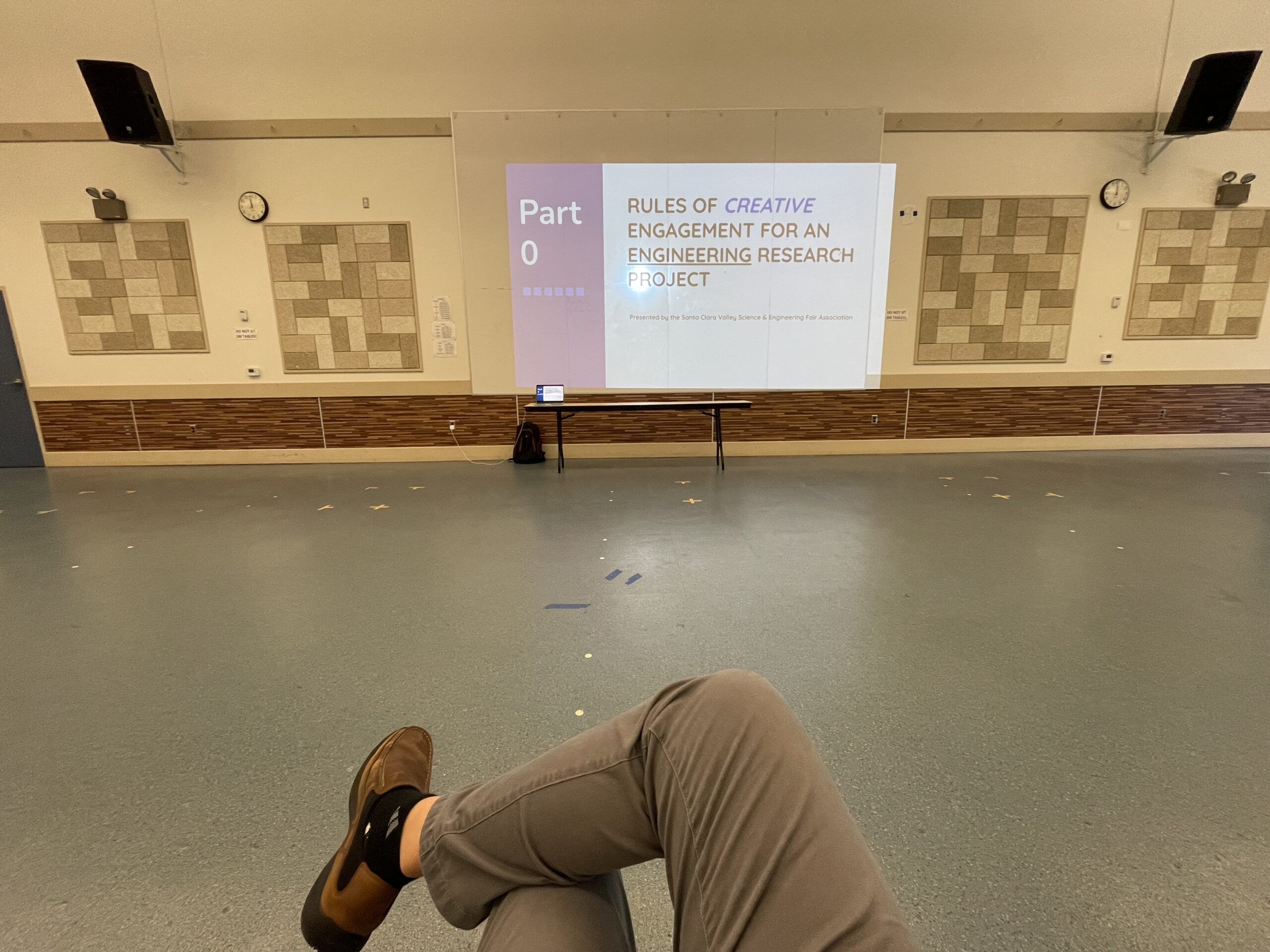 Today, I gave a presentation at a high school in San Jose, CA. The context was as a “clinic” to set up students to participate in the Synopsys Championship (a regional science fair). I pulled in various lessons from my YCISL design thinking program. Writing my notes here because I have a feeling I will be doing this more and more.
The main idea usually behind these clinics is to introduce students to rules and procedures for entering the Synopsys Championship. This particular clinic was requested by a teacher to try to raise overall project “quality” among the students at the school level, and open opportunities for students to pursue competition at the Synopsys Championship.
I worked up a new slide set. It comprised 6 parts (1 slide each). There was just 30 minutes.
- ABOUT THE 2026 SYNOPSYS CHAMPIONSHIP
- 5 RESEARCH PHASES
- THE PLAN & APPROVAL
- EXAMPLE: A DRONE + ARDUINO ENGINEERING PROJECT
- LET’S FREE-FORM BRAINSTORM AN ENGINEERING PROJECT
- THE 8 SECRETS OF (RESEARCH) SUCCESS
I started with a slide about the 2026 Synopsys Championship. It set a target in time and place. Understanding that this would not be a “grab” for most of the students, I attached Tim Brown’s “Sketch Your Neighbor” exercise which is how I usually start YCISL workshops. In terms of EQ, this raised awareness of the other students in the room and pulled mindful focus on what was about to happen in the clinic.
Dipping our feet into engineering research projects, I showed a slide with the YCISL Simple Innovation Framework (adopted for the Sustainability Design Thinking course) with the fives phases of Ideation, Planning, Prototyping, Testing and Launch. This suggested an organized approach to the project work. Further, the idea of iteration as a required part of engineering research was highlighted.
The next slide referenced the Engineering Project Detailed Research Plan that is available for download from the Synopsys Championship website. A completed plan is a necessary submission for an entry application to be approved. Emphasis was on detail, process and due diligence. Boilerplate (necessary for the Open phase of the Gamestorming format that I like to use).
At the mid-point, we got to an example that called on creativity and the imagination. Using my own personal view, the example employed a drone and an Arduino; both devices that I have good experience as a personal hobby as well as in Synopsys Championship project review and judging. Before the presentation had started when I was alone in the meeting room (the Multipurpose Room), I noted various things that I dropped into this part of the presentation. First, I talked about how the room appeared suitable (safety, not FAA-regulated) for indoor drone flight tests given the wide open floor and high ceilings. I also noted a lot of scars on the ceiling panels and mentioned how drones may have been responsible for the damage; the teacher said it may be due to robotics! I felt very good about this improvisational moment with the hope that the students would note things around them as they planned and conducted their research.
The next slide focused on brainstorming…the engineering design of a water bottle. A condensed version of the YCISL Water Bottle Feature List exercise. The twist was having students to pick any topic from their science studies and include it as a feature. One student mentioned “friction” and another “kinematics.” It took just a moment of quiet eye contact after the topic was stated, but it was great to see the Aha! moment on their faces. We also did the sketch step including MVP and MVP+ annotations. This was a great way to approach Silicon Valley-style innovation design.
The wrap-up slide listed 8 attention-to-detail requirements. In a way, it included key gateway information for those students who had found the clinic ideation invigorating and now needed “permission” to dive in. The slide’s title “8 Secrets of (Research) Success” was connected to Richard St John’s “8 Secrets of Success” TED Talk which I said would further help with motivation and purpose.
I am optimistic about the outcome of this clinic.
Warm-Up Project: Clarifying EQ for Teaching

Previously, I wrote about the idea of applying EQ to teaching by an instructor having self-awareness as well as important awareness information about each student, and developing teaching management plans that optimally engaged and educated. I am experimenting with this idea in the Sustainability Design Thinking course. In Summer 2024, I included a warm-up assignment worth 10% of the grade that was functionally about readiness, but was in the form of revealing habits and dynamics. I am about to start the Summer 2025 class tomorrow and there will be a warm-up assignment. Here are some of the main characteristics of the assignment.
- Very short time-line to complete the assignment. This is a background research phase & is more about risk & uncertainty than getting into the teaching groove. The assignment is revealed at the end of the first class meeting and due by the next class meeting.
- Orientation to tools. We use several software platforms in the course. Slack for communication. Notion for our virtual design neighborhood. And Canvas (mainly) for document control. The warm-up assignment includes some interaction with each of these tools.
- Switching mindset. The student mindset I desire is broadly a “fun” mindset where the main expectation is to enjoy the experience. Connected to the fun mindset will be the growth mindset, creative mindset, youth mindset, empathy mindset and more. We start with an icebreaker activity (Sketch Your Neighbor) to establish the “fun” condition then give a “Simple, but not Easy” convergence exercise.
- Simple, but not Easy. My teaching method is modeled after my youth basketball coaching. A small fraction of time is used to describe concepts & give a guided demonstration. The rest of the time is allotted to practice. The warm-up assignment instructions are therefore very simple. There is intentionally much uncertainty in these instructions so that the student needs to manage the risk by calling on their EQ.
- One example is the mini-essay narrative that is required. My not-so-obvious goal is to have them learn to submit the assignment in Canvas…on time. However, in a sleight of hand, I don’t specify a word limit, & tell them to use their own discretion. Uncertainty. Hopefully, they find a comfort zone where they deliver quality work, & use the appropriate quantity.
- Creativity is key to the course. I reward creativity so long as it is relevant to the warm-up assignment…which is human-centered design thinking. There needs to be people in the narrative & an EQ-based explanation why the idea has merit.
- I am somewhat “frank” in the feedback given to the warm-up assignment submissions. This is all for the sake of preparation for success in the main projects in the course. They need to show they have access to and use the tools. They need to share their ideas & focus confidently on the core themes of the course. While this may seem like transparency, I would rather that students are aware of my mindset & reality distortion field that paints my class worldview. A reality distortion field presently dominated by my random & uncertain pottery journey).
To close, best to remind myself that the intention is fun. Fun of learning. And learning of life lessons.
Forgetfulness: Opportunity for Creativity
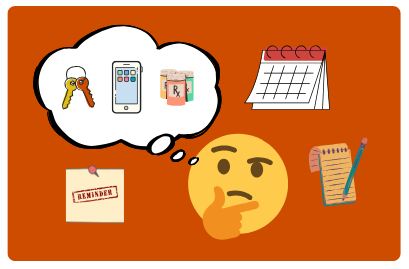
It’s both simple and easy to blame my forgetfulness on age. Then again, I was never good at memorizing which was a disadvantage in school. And these days, forgetting something is a frequent occurrence. I would say I am more forgetful on the short-term memory side of things. One of the more persistent forgetful predicaments is not remembering what I want to say next in a conversation. But I also have started to forget long-term memories that I know had stuck with me for decades…until recently.
There is significant research into dementia. Memory decline may also be related to other health issues. I also believe conditioning for short attention spans weakens the memory faculty. Much of this relates to faster messaging, messaging overload, and complex messaging.
Moving to the idea that forgetfulness may be an opportunity for creativity. Working with memory may be a great opportunity for a design thinking project. There should be an abundance of possible innovations or re-tools of existing solutions. How do you remember where you placed your phone? What study aids do you use? How long does it take you to recall someone’s name?
Do we need technology-assisted solutions or might it be better to just simplify or decongest things we remember?
With regard to technology-based assistance, I remember the advent of digital assistants and the mobile personal organizer functions. Today, there is excitement about Artificial Intelligence. What solution can human-centered design thinking lead to?
If we think about simplification as a habit-based strategy to better memory skills, we could create various composite character profiles to help us apply empathy in our design thinking process. Can we enhance management of our short-term vs long-term memory by using a human-centered approach?
I would also include consideration of health-based changes to strengthen our memory system health and condition. What could we do in the area of lifestyle optimization for garnering memory well-being and resilience?
Interesting. Memory health may be a topic I include in this summer’s Sustainability Design Thinking course.
College Admissions: Engineered or Lucky?

I have been seeing quite a number of college admission essay Instagram shorts lately. It is that time of the year for seniors in high school.
Some are by graduates from colleges and they claim they know what they did to get in. Others are by college admissions staff who describe what they are looking for. These IG shorts are both interesting & informative. But remember that these are their personal stories (ironic that they need to make their IG posts interesting and personal just like they generally advise about college admission essays) & are not engineered solutions. In one respect, these are stories of good luck. Good luck that the essays worked (apparently) for an applicant. Good luck that the college admissions staff got a good essay to read.
I compare this to how I go to a bookstore (yes, there are still good ones around) and browse the stacks. Out of the hundreds of books I may set my eyes on, just a segment gets me curious based on the title and cover design (see Chip Kidd TED Talk for more on this). A handful have enough grab to have me lift the book off the shelf and take a look inside. Circling around, I do assume that all the book authors are capable writers with a compelling storyline (screened by the publisher, I would assume)…enough to justify the effort & economics. It’s just that the match with me is not absolute…it takes luck. Luck that I would even pick it up and take a close look. Luck that I would flip open a particular page and glance at a passage that holds intense interest for me.
The best YCISL-based advice I have with regards to college admissions essays & using design thinking includes:
- Be authentic. Exaggeration or false pretense is a risk to the perception as well as outcome. A staff reader would be lucky to have more than a few exceptionally perfectly well-written professional-level essays. If you write at that exceptionally high level, that’s great. Impressive. Fortunate. But if you are an average compositional writer, create your draft then do what you can to improve on it. Know that even imperfections can be effective – if authentic.
- Be positive. You should feel positive about yourself. You should make the reader feel intrinsically positive…glad they read your essay, want to recommend you, & feel they can trust you. Check your essays for positivity. Manage the positivity level.
- Write about yourself as creatively as you would paint a portrait of yourself. Think art appreciation. Think how you would represent yourself in artistic imagery. Show self-awareness & self-management. Use details wisely.
So do check out these IG short videos if you think you need inspiration. Just understand these are not formulas. They are stories. The people are not engineers. They are storytellers telling you about their good luck. Enjoy the experience.
PS. You may find Richard St John’s 8 Secrets of Success a better source of inspiration than IG for your college admission essays.
Creativity & College Applications
It’s college application time again (at least for the US). I am thinking a little deeper about it this time around because my niece has just begun her senior high school year and will be working on her applications soon. She has her sights set on studying business.
Here are a few thoughts that may help the college application mindset.
-
- Believe that colleges know what they are doing when it comes to admission decisions. The admissions staff are experienced at what they do & they have developed instincts that influence their preferences.
- Use the college application essays as avenues to connect on a human-to-human level. Express your qualities & values in a relatable & interesting manner. Detail the setting & actions to vividly assist the reader’s imagination.
- Seek feedback before submitting your application. Is there enough detail? Is your story compelling? Does it feel authentic?
These are pretty simple suggestions. But as in the YCISL belief in “Simple, but not Easy” it will take work to optimize the college application with emotional intelligence, design thinking & creative energy.