
Category: Thoughts
Framework: The YCISL Assemblage
I’ve been thinking about the relationship between creativity, innovation and leadership that is the skeletal framework of the youth development program. I wanted to portray the concept that the workshop is intended to draw out and characterize one’s creativity (the raw material) and develop it into useful product (the action) in order to create (proof of) leadership (the result). “Teaching” will be minimal and focused mainly on the development stage. However, most of the instructional effort will actually be on removing barriers to creativity and getting ideas flowing.
So, I’ve drawn up a schematic that I have titled “The YCISL Assemblage.” It is a high-level and simple view of the framework that the YCISL program is founded upon. The annotations on the right include (a) a simple title that differentiates the various stages, (b) the “::” (double colon) to show the “is to” relationship, and (c) the meaning within the YCISL framework.
– I have labelled “Your Mind” as “The Safe” because it is a storage area where others cannot tell what is inside unless you show them. Things do move in and out, and can get mixed together once inside (or get separated).
– the Creativity is represented as a cloud to recognize the tendency to expand (and merge) when it is free to develop. It is a raw material and, depending on how it is positioned, is the potential energy from which great ideas and products can grow.
– the Innovation box (perhaps often perceived as a black box) has the aim to create something significant, impactful and life-changing; hence, if all this is achieved, then leadership arises.
– what I did not portray truthfully in this diagram is the directionality and “activation energy” requirement. With regards to directionality, this process does not usually run linear. And the “activation energy” needed to get from one stage to another must be available -> it’s not all downhill.

Question: How do you behave when something unexpected happens in a project?
Projects often don’t go according to the first plan. How do you adapt to changes (team, requirements, competitive landscape, budget…)? Do you use your instincts or is there a formula?
We should enhance the project (or assignment) by doing something unexpected and challenging. Will students change direction, start from scratch, give up, argue or find a workaround efficiently?
Question: Where do you do your best thinking?
My daughter studies with her iPod on – I used to do the same (with my Sony Walkman) – but it probably contributes to her slower pace. Does it affect her retention rate too? I don’t know. Anyway, when you get away from school learning, there are probably times when creative thinking emerges. Short spurts of creative imagination probably lead to nowhere and are easily forgotten, but sometimes you might just get into one of those really deep moments and think that you’re a genius. I get my best ideas in the shower (can you think of another place besides the bathroom where you get 10 minutes or more of privacy…every day?). Sometimes, I get good ideas on my commute (if I’m alone and the radio isn’t on). Where do you get your best ideas? The strength of our program is that we create that moment of privacy and make it long enough to get somewhere. As icing to this experience, we enlist peers and counselors as a focus group to give you feedback.
Seafood Watch
A good case study of a sustainability public awareness/public education (PAPE) program may be the Seafood Watch program headed by the Monterey Bay Aquarium. This may be a good role model for students to use in developing their own PAPE programs.
Perhaps we could even arrange a visit to the MBA.
Is there a Chinese language equivalent?
http://www.montereybayaquarium.org/cr/seafoodwatch.aspx
The Seafood Watch-Whole Foods seafood labeling program is a good example of a partnership to expand information utility.
The 50 Most Innovative Companies 2010 (Bloomberg Businessweek)
This is a useful reference (but really reflects business trends as opposed to individual traits)…
http://www.businessweek.com/interactive_reports/innovative_companies_2010.html?chan=magazine+channel_special+report
Apple is ranked #1. Google is #2. (Surprisingly) Microsoft is #3.
Amazon’s ranking at #6 is informative in that it is more challenging to distinguish innovative processes (Amazon’s forté) as opposed to innovative products (eg, Apple’s and Google’s forté).
Interestingly, if you compare this list with this article about Singapore having “government policies and corporate performance most encouraging to innovation”, no Singapore company is on the top 50 innovative companies list. Again, this reinforces the notion that if you focus on companies for innovation, you miss (and forget about) a lot of other innovation activity that is happening from personal levels. This supports the thought that youth are a tremendous innovation resource and largely un-recognized/un-respected.
Invention vs Innovation
It is useful to define (and distinguish) the terms “invention” and “innovation.” It would also be useful to help clarify that “invention” tends to be absolute whereas there are many grades of “innovation” – false (just not widely known or previously failed), incremental vs whole.
invent (in·vent)
verb
create or design (something that has not existed before ); be the originator of
innovate (in·no·vate)
verb
make changes in something established, especially by introducing new methods, ideas, or products
An interesting exercise might be to put up an innovation scale and stick up images of various inventions and innovations – the aim is to scope the scale. Does an environment that achieves 100 small innovations (locally adopted) compare with that which achieves a single 1-in-a-hundred years (global shifting) innovation?
Definitions obtained from oxforddictionaries.com.
TEDTalk: Tim Brown on creativity and play
Some great exercises to delve into creativity in a playful manner. I think the “draw your neighbor” and “30 circles” exercises are fun and easy.
The Finger Blaster is something I could perhaps design an exercise for.

Tim Brown is the CEO of innovation and design firm IDEO, taking an approach to design that digs deeper than the surface. Having taken over from founder David E. Kelley, Tim Brown carries forward the firm’s mission of fusing design, business and social studies to come up with deeply researched, deeply understood designs and ideas — they call it “design thinking.”
Leadership by Age Stages
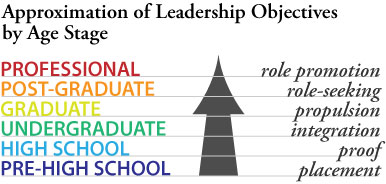
Earlier this week, I was composing a web page for the first CSDGC Youth Leadership program: Next Generation Creativity, Innovation and Sustainable Leadership (YCISL) workshop – we’re looking at August 15-24, 2010 presently. As usual, I worked up an eye-catching graphic to serve as the centerpiece of this web page. It is based on a schematic I have on my office whiteboard that lays out a progression of changing leadership objectives starting from youth and ending at professionals. It is an approximation by age group (although I actually use mostly educational status in this graphic) of what the objectives are most likely to be in order for those designing leadership development programs to be addressing these needs.
On Creativity, Innovation & Sustainable Leadership
In my current situation at Stanford University, I am able to observe many streamlets of efforts to discover knowledge and hence exert leadership. As you would expect, there are students, researchers and even administrators engaged in this endeavor. More curious, I see a multitude of centers and institutes formed at Stanford, and other universities around the US and the rest of the world. In this academic universe, there is much discussion circulating around the topics of creativity, innovation and leadership, and often I find myself with a view that there is so much more to learn, and a long way to go to get it right.
Myself, I am also highly dedicated to education. At one level is the university setting where I teach knowledge-based courses, and also design and execute programs to instill useful interactive skills. Having school-aged children of my own, I have several avenues of becoming involved with youth: from judging at science fairs to coaching youth basketball and being on academic committees. My own elementary and high school experience was fascinating and memorable; highly unique and enlightening.
So, I am going to use this web site to compile articles, resources and thoughts relevant to youth creativity, innovation and sustainable leadership. I expect it will become quite a hodge-podge, but I will also attempt to tie things together periodically with impressions and supported viewpoints as a result of this effort. And I am happy to share these with others.
