
Category: Ideas
Design Thinking Approaches to Sustainability in Smart Cities & Communities
With the start of the new CEE 177L Smart Cities & Communities: Sustainability Design Thinking course in about 2 months, I wish to reflect on the methodological thrusts pinned to three design thinking approaches.
- PostIt Brainstorming and seeing what sticks: normal to crazy. Our un-bounded contributory method based on imaginative fast thinking idea generation and capture. The seemingly random yet focused method. Example: the perfect restaurant menu. Amenable to innovation and problem-solving.
- Tailoring to a single Composite Character Profile. Our feature list-based feedback loop method that cycles on lesson-backed iterations of character and product to achieve communicable positioning. The attractant method. Example: the original Macintosh UI. Amenable to early adopter kickstarting.
- A System of Systems: Networking Nodes, Connections & Protocols. The architectural framework method that involves layered designs incorporating data-driven networking essentials such as routing, QoS, validations, performance evaluations, and synchronizations. The navigation method. Example: the perfect hotel. Amenable to interwoven storytelling.
The three above approaches are all connected with the YCISL program and the CEE 176G Sustainability Design Thinking course. I will be looking for fresh, inspired and inspirational outcomes. Let’s hope for creative energy, generational resonance and timely coincidence for each of our design thinking journeys.
Innovation with Sustainability Design Thinking for Smart Cities & Communities
LIVE. WORK. PLAY.
I was pushed to re-design my summer teaching. It was an opportunity to explore a new area. What I’ve done is adopted our past course in Smart Cities & Communities aka SCC which originally had a business case basis to a new course (Smart Cities & Communities: Sustainability Design Thinking) where which takes the design thinking principles & process from my previous course (Sustainability Design Thinking aka SDT) with application to opportunities today, tomorrow and in the next generation.
The basic premise is to design interactive environments and surroundings in a what if? scenario where we practice wishful thinking and put ideas on the path to realization, at least conceptually & visually. The one phrase from the earlier SCC course that I remember is “a system of systems” where the connectivity, awareness and sensitivity to response are the main features of being called “smart.” Where the new SCC course will be an upgrade from the past course perspective is in the use of human-centered feature design specification to enhance user experience through emotional intelligence, creativity and storytelling (three core YCISL elements).
- Emotional Intelligence. What if a smart system offered and evolved with a person? What if we recognize that human awareness and interaction changes with place, time and circumstance? What if we could leverage intrinsic motivation as a user UI/UX layer in the architecture of our smart system?
- Creativity. Our smart system should energize the divergent-convergent thinking cycle involved in smart interaction, guidance and feedback. We can use creativity to promote a person’s appetite for a growth mindset. Creativity, especially in the fast thinking mode, can be used to sustain positivity as a promissory attractant to smart systems.
- Storytelling. A smart system could offer one or more longitudinal temporal pathways through storytelling. Word choice may be important, and so might imagery. One question is whether the story has to be based on reality, or could it be augmented or virtual? Does it matter to you and what we deem acceptable to attain our human behavior change goals?
With the above thoughts, we will conceptualize smart cities and communities innovations as a platform to enhance design thinking skills – hopefully building a memorable starting point through caring for sustainability. The value proposition of this course is the life skill of design thinking, and spreading the YCISL method through attending to where we live, work and play.
E-Book Idea: The First Resume (and I’m stuck)
I started an e-book based on my CTE mock interview activities earlier this year. The idea was to list some of the most common suggestions I would make regarding the resumes and incorporate YCISL design thinking as explanations for the improvement. I drafted an outline and wrote some content. But I then started to vacillate trying to balance the depth of design thinking – between simple wording of design thinking methodology versus going into detail. I still haven’t decided which structure would work better. Instead, I am writing this wiki entry to list the topics in the hopes that I make a decisive breakthrough. Here goes.
- Timing. Understanding how much time a reader actually looks at a resume. At the mock interviews, I will usually let my eyes scan the resume for about 30 seconds to find the best connection for the interview. However, note that a positive impression is decided within the first 5 seconds of that same period.
- Trust. Building a relationship based on trust connects the mind of the reader with the mind of the applicant. Use words and sentence constructions that relay a feeling of trust. Whether you have earned trust in the past, or you have trusted another person through past interactions.
- Talking Points. In an interview setting, the objective is for the resume to put in the reader’s mind topics to pursue a conversation that reveals suitability. The best talking points should come from the Experience section of the resume. Each talking point should serve as a prompt for possible discussion. A first resume needs about three to five talking points.
- Selectivity. While a resume is largely a historical record of experiences, there is a strategy in being selective for a first resume. The main detail is that the information should be relevant to the position. Use the job description or research the job title to select key words. This conveys awareness and interest.
- Promise and Ask. Communicating a willingness to contribute, grow and learn, and hinting at what motivation or guidance will be required. In addition, an interview involves an exchange of promises and asks so be prepared to also listen for your interviewer’s promise and ask. Feel free to echo the promises and asks to strengthen the tie.
Well, I hope this gets me un-stuck.
Science Fair Research Project Quickstart: The #1 Ground Rule -> Reading
 Following my presentation on Engineering Research Projects this week at Santa Teresa High School, I thought I would architect a model for participants starting from scratch on a project for a science fair. Any science fair. I actually had a hard time finding a perspective that would fit the “Simple, but not Easy” mindset useful for innovative thinking. After a week of pondering, I think I found a way to describe this in a usable manner.
IT’S SIMPLE: The project needs to be focused on RESEARCH. Understand that research leads to contributions to the framework of knowledge, experience and understanding. Think about how you can add to such a framework. Research often leads to incremental innovation, and in extraordinary circumstances quantum innovation that impacts how others think about things, do things, and choose things. Imagine yourself as a change-maker. Research is built on a culture; a culture of curiosity, uncertainty and exploration. Immerse yourself in that culture.
NOT EASY: The seed for a research idea may generally start in two ways: (1) Reading research literature as an extension of class-based learning, and (2) Observing then defining problems then reading the research literature about the problem and existing solutions. No matter what, research excellence requires reading of the literature. And it’s hard work. Getting access to scholarly research literature. Selecting research literature that is within the scope of the research idea. Applying critical thinking to the research literature readings to support and justify the research project.
TIPS:
- Acquire at least 3 scholarly research articles for your collection that are good candidates for your bibliography. Such articles should be “peer-reviewed” and published in well-known research journals. There are web resources that explain how to identify such leading edge research articles. Note that 3 is just a starting point. Eventually aim for more…between 5 and 10 for a good science fair project.
- Select research articles written by researchers at well-known universities or research institutions. What universities have you heard of and may be interested in? Start there. As you look through your search results, certain names will appear numerous times and may be leading researchers in your research area interest. Look up their professional web page for more information on their research program.
- Read the bibliographies of the selected research articles. First, this reveals the quality of the research article itself. Second, other useful research articles may be discovered from this list.
- Use the selected research articles to build the rationale statement for the research project. Cite the research articles, and connect information from the research articles with the research project idea. Association between the idea and published research is a solid way of showing support and justification for the project.
- Read the selected research articles with two purposes in mind. First, especially for a science fair newcomer, the purpose is to gain insight on the scientific research method and become familiarized with terminology, styles and methodology. Second is the extraction of information that supports and justifies the project idea; the extracted information should persuade reviewers, judges, and teachers as well as yourself of the projects worthiness for investment of your time, resources, effort and energy. Research should not be wasteful.
- Pay attention to the titles of the scholarly research articles. This small piece of information is actually HUGE. It will teach you about scope and thrust. Scope describes the boundaries and connections. Thrust hints at the originality and scholarly nature of the investigation. Create a working project title that contains the scope and thrust of your research project idea.
- As a whole, use the selected research articles as models for writing your own eventual research articles. Learn how to justify a research project. See how much detail goes into methodology descriptions. Find styles (eg, tables, charts and more) to present results in revealing ways.
- As the research project idea gains size and traction, keep a list of key words. About 3 to 5. These should match the working project title. The key words list estimates how interesting the project may be, and hints of the potential audience for the research.
- Guard rails for the research project also includes the category and field of study (if the science fair has these set up). These categorizations help shape the research question and the plan for investigation.
- Let’s get started. The simplest way to start is to do a web search engine with “Google Scholar” followed by your topic. Change the search term until the search results provide promising leads.
AVOIDS (INSTEAD FOCUS YOUR ENERGY ON QUALITY RESOURCES):
- Science Buddies or similar educational web sites.
- Kaggle and other similar un-checked repositories.
- Articles without authors and dates, especially those with commercial purpose.
- YouTube videos.
- News media.
Good luck!
Advice for a Youth Preparing Their First Resume
I am slowly working through another YCISL mini e-book. It is based on my volunteering with the Sequoia Union High School District Career Technical Education (CTE) program where I participate in mock job interviews. In these activities, I get to see students’ resumes…usually their first. I use these resumes to come up with talking points related to the interview, but also give feedback on the resume quality.
So the e-book I am working on now is about the basics of putting together a resume. A first resume. The SUHSD students are fortunate to have gained some work experience through their CTE program. Still, they (like many others who work on their resumes) need guidance for fundamental readability in their resume as well as communicating positive fitting attributes.
I have a plan to ask some of my contacts to contribute their reflection on their first resume, and to share their wisdom & experience. I’ve already asked some of my Singapore Stanford Partnership students, but will also include YCISL and Stanford connections.
Can you recall your first resume? What do you wish you knew then?
For me – and in light of my present design thinking enlightenment – I think white space is under-appreciated in a first resume. A first resume might have little content to include. However, little content has a tendency to end up being superfluous in order to impersonate extensive experience & abilities. The result is little to no white space. And this can be a problem because (1) it makes it harder for the reader to match the applicant to the job, & (2) the applicant appears unable to exercise restraint & be organized. One example of poor white space management is when paragraph formatting including indentation is inconsistent.
Thoughts: What makes me smile?
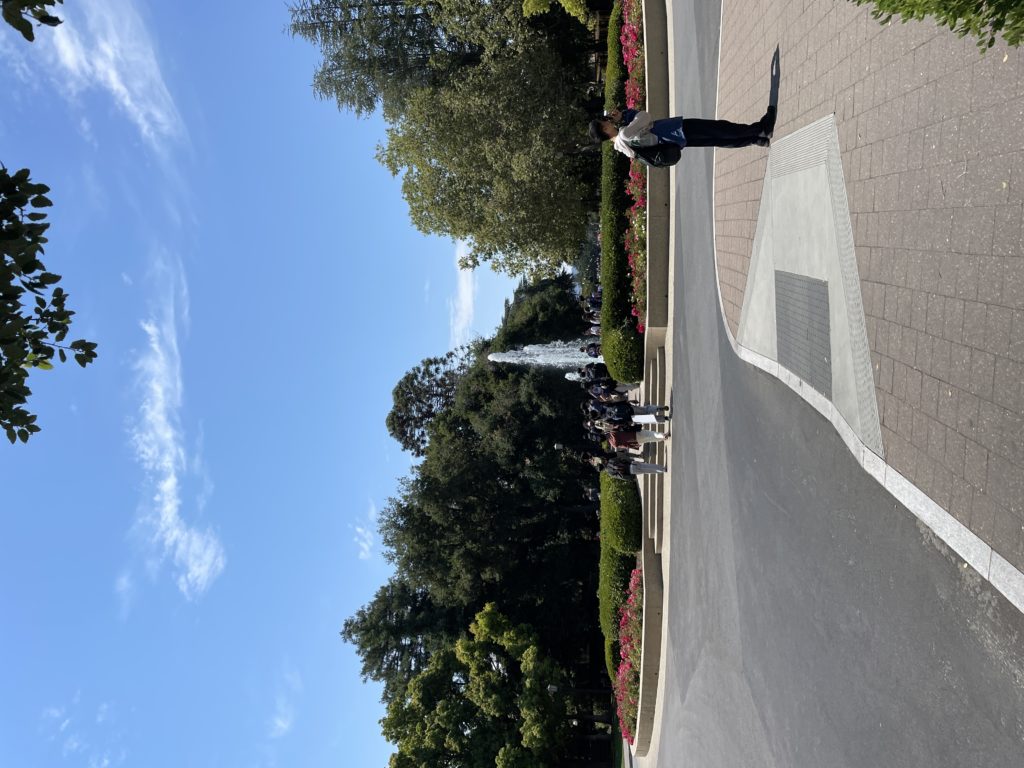
Last week, I was on a walking tour with a group of visiting high school students when one of them asked me “Why are you always smiling?” At that moment, many thoughts quickly crossed my mind, but the immediate and strategic answer was to say I was gaining a lot from the interactions with the group. I was still in the mode of emphasizing positivity as a competitive advantage when it came to design thinking.
Ah, positivity. That factor that has been embedded in the YCISL for a long time with wisdom-ful quotes from Shawn Achor and Alison Ledgerwood. The element that I say drives our ideation to success. The persuasive embrace that we can put in place for little cost, but likely with a lot of effort.
But today, I am feeling a little sad. The title of this wiki entry was going to be “I am sad” at first, but with a little pushing and pulling mindfully, I came up with “What makes me smile?” Fortunately, the present state of sadness is not unfamiliar, and so I know I have managed through it before…several times. I guess that resonates with my YCISL by-line of “Life Lessons in EQ.”
For YCISL maybe 7 years ago, I added a slide to my slide deck about “No-Cost Sources of Positivity.” Everything on that slide usually does make me smile. But I think if I added a slide that had the heading “What makes me smile?”…what would be on that slide?
- My Family. The most organic aspect of life & living. Recalling good memories. Being together. Doing things together.
- Flowering. Signs of new, growth, & hope.
- A Good Beverage. Especially a beverage that meets or exceeds my expectations and needs.
- Ice Cream. Often anything sweet. Perhaps indulgent too. And the sensory aspects of color, cooling, taste, etc.
- Inventing. Experiencing the intrinsic motivation of mastery, control & purpose. Solving problems through reasoning, creativity & resourcefulness.
Well, that’s the first draft. We’ll see what I get into my slide deck. What makes you smile?
The DezignBläst Projects
A couple of days ago, I uploaded the syllabus for Summer Quarter 2024 CEE 176G/276G Sustainability Design Thinking onto syllabus.stanford.edu. For that syllabus, I included a section on the design projects in the course. This was based on the design of and experiences with the project assignments in Summer 2023 and Winter 2024. The descriptions are intentionally brief and written in an academic bulletin style.
Design Project 1: Independent Project. Emphasis on learning the systematic design thinking process, & changing human behavior. Ideation and design of a single product to influence an individual’s sustainability behavior & mindset. Delivery of a presentation & spec sheet.
Design Project 2: Team Project. Emphasis on supporting programs & initiatives that promote sustainable behaviors within a community. Ideation & prototyping of a space, service, activity or program. Involves interacting with others using interviews & surveys to identify opportunities & resources. Delivery of a presentation & spec sheet.
Design Project 3: Independent or Team Project. Emphasis on sustainability in the future. Design using anticipation of needs & innovative technologies in the future. Involves rapid prototyping & human-centered storytelling. Delivery of a presentation & spec sheet.
I like to think there is YCISL-style design thinking in these concept statements about the assignments. The Who? element is answered by the words “Independent” or “Team.” The Emphasis Areas summarily describe the What? of the course content. The When? is subtle in that we specify “future” in Design Project 3 leaving the other projects more in the now. And the deliverables of the presentation and spec sheet give us the How? the design thinking journey will be communicated for evaluation. Hopefully, the When? & Why? are apparent from the teaching part of the class.
This is just further evidence that design thinking (as well as emotional intelligence) is essential to teaching design. I feel it helps me in building courses that are consistent with Stanford’s reputation for entrepreneurship and innovation. Should design thinking perhaps be a component of teacher education? I’ve always wanted to try a teacher workshop for the YCISL creativity program.
Getting Started: The IB Extended Essay
I am preparing for an upcoming Popcorn with Colin where students at an IB school have been invited to discuss their ideas for an extended essay. The IB Extended Essay “…is an independent, self-directed piece of research, finishing with a 4,000-word paper” and a mandatory part of the IB Diploma program. I have an interest in this activity because I was an IB Diploma student when I was in high school, and still have vivid memories of my extended essay project work.
The plan for the Popcorn session is to open with a discussion about “what is research?” for the purpose of shared viewpoints and expectations.
Then we would move into a reveal-type segment where we explore the ideas that the students have for their extended essays. We would tease these ideas for creativity, connectedness & design thinking. Our discussion about creativity could look into personal curiosity, originality & innovation where concepts such as comfort zone, out-of-the-box thinking, and uncertainty. Connectedness would deal with awareness of published scholarly literature as well as personal experience, and how to support/justify a research project. And design thinking would be about sketching a human-centered problem statement and vision using the YCISL Innovators Toolkit method.
The third component of our session would be on the suggestion of the need for a research plan & the design elements; this is intended to encourage good documentation habits as well as methodical forward-thinking skills.
That’s probably plenty for our 90-minute session where I hope to have plenty of reciprocal learning.
Teaching: Sustainability Design Thinking (Part 4)
It’s been a couple of days since I initially wrote up some notes about preparing to co-teach Sustainability Design Thinking this summer. Another thought just popped up. It relates to the YCISL equation:
KI + EI -> LI
For this equation, we posit that the limiting factor is EI (emotional intelligence) which explains why there is so little LI (leadership intelligence) around. KI (knowledge intelligence) is relatively abundant, but variable in quantity and quality (thinking for a moment about Salman Khan’s idea about teaching for mastery as well as Jef Raskin’s thoughts about issues with knowledge).
That said, if we are to push EQ with regards to the course, we need to utilize the students’ existing KI as a base resource. There are two channels we could use: (1) academic learning, especially recent learning, and (2) personal experience. We should have students list their academic topics in the past year (active recall) and significant personal experiences in the past few months (waggle dance reasoning). Students could then research any of the items on the list to deepen their understanding. This may quickly lead to a useful KI so that we can move on to focus on EI.
DEZIGNBLÄST: A YCISL Internship Framework for Sustainability Design Thinking
 In 2021, students in the YCISL Design Thinking Incubator workshop series were given the context of a design thinking firm with a Design Innovation Division in which they were interns. Their task was to produce concept proposals along a Sustainable Futures Initiative theme that would be vetted internally for potential presentation to prospective clients. This fictional design firm’s name was DezignBläst.
“As a part of our sustainable futures initiative, all concepts must promote sustainability features that enhance personal well-being. We are seeking ideas that persuasively shift human behavior and push the boundaries of people’s imaginations.”
The students were given a Request for Proposals (RFP) which contained a brief set of instructions about the scope and requirements.
We are planning to call upon the DezignBläst framework for the Sustainability Design Thinking course this summer at Stanford. This is to get students out of a perfunctory classroom mode of predictability into an innovation-oriented exploration field of uncertainty & potential surprises.
Tying in to the SUHSD mock interviews that I recently participated in, there is one goal where each student could insert a distinctive description of their course experience into their resume. This is about a student’s design thinking journey and a record of the life lessons they gain along the way. This is a story about growth, purpose and good memories.
