
The Element: How Finding Your Passion Changes Everything
I recently finished reading “The Element: How Finding Your Passion Changes Everything” by Ken Robinson. I had very much looked forward to reading this book after seeing the video titled “How schools stifle creativity” at http://edition.cnn.com/2009/OPINION/11/03/robinson.schools.stifle.creativity/index.html. This book was certainly well written and captivating through its illustrative technique of using real world examples, many of which were based on well known people.
Favorite Insights:
p. 238: “Children learn best when they learn from each other and when their teachers are learning with them.” This makes so much sense and yet most of school is about linear and mostly unidirectional information flow.
p, 67: “You can think of creativity as applied imagination.” There is a followup statement that links creativity, as opposed to imagination, with value. However, I would think that imagination is a prerequisite for creativity, not a form of it. Therefore, I would suggest that imagination has value as well but less perceptible in the adult realm.
p. 77: “Creative insights often come in nonlinear ways, through seeing connections and similarities between things that we hadn’t noticed before.” This is something that instructors need to be aware of and incorporate in their design style.
pp. 179-183: Four roles of mentors: recognition, encouragement, facilitating, stretching. I wonder whether there is a necessary sequence or relative magnitude for these roles to be optimally effective.
p. 90: “One of the strongest signs of being in the zone is a sense of freedom and of authenticity.” This backs up the notion of having a youth creativity and leadership workshop that is free-form.
2010 Synopsys Championship
Just got back from judging at the 2010 Synopsys Championship in San Jose, California. As in for many years, I was part of a group judging team entries from the East Side Union High School District. I have a couple of new observations from this event. First, I applied my interest in creativity, innovation and leadership in judging this time. Out of 25 team projects, about half were what I would deem creative meaning they were not typical science fair material. About 3 came across as innovative meaning they had chosen a timely topic (which helps quite a bit), thought about the impact, and incorporated a personal interest angle. What occurred to me strongest though was the ease of collaboration (especially with our top team selection) perhaps due to the youthful age category. The social knit of high school teams is probably very different (more friendly) from those of older (college) students and working professionals. The associated bond and trust probably lends itself to greater creativity and, with the proper guidance, distinctive innovation.
My second observation concerns the entries from the Latino College Preparatory Academy (San Jose). It was a meaningful contrast to many science fair projects that had access to ample resources. It demonstrated that the passion for science can be found and fostered even in resource-poor circumstances, and that with encouragement and experienced mentoring, an opportunity to move on to the next level of competition may be well within reach.
21st Annual National Service-Learning Conference
From browsing the Sir Ken Robinson web site, I came across a link to the National Service-Learning Conference, an event organized by the National Youth Leadership Council. The next session will be on March 24-27, 2010 in San Jose, California. The program guide lists, among other things, Ken Robinson as one of the keynote speakers, and several environmentally-themed events.
Imagine it! – Post-It Challenge
Here’s a video documenting an exercise presented by Tina Seelig (Executive Director, STVP, Stanford). This is an example of one of the creativity/entrepreneurship team challenges that Dr. Seelig poses to students in her class at Stanford. You can find a broader description of the challenges in Chapter 1 Buy One, Get Two Free of her book “What I Wish I Knew When I Was 20.”
Leadership by Age Stages
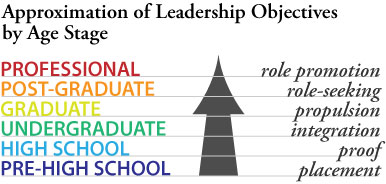
Earlier this week, I was composing a web page for the first CSDGC Youth Leadership program: Next Generation Creativity, Innovation and Sustainable Leadership (YCISL) workshop – we’re looking at August 15-24, 2010 presently. As usual, I worked up an eye-catching graphic to serve as the centerpiece of this web page. It is based on a schematic I have on my office whiteboard that lays out a progression of changing leadership objectives starting from youth and ending at professionals. It is an approximation by age group (although I actually use mostly educational status in this graphic) of what the objectives are most likely to be in order for those designing leadership development programs to be addressing these needs.
On Creativity, Innovation & Sustainable Leadership
In my current situation at Stanford University, I am able to observe many streamlets of efforts to discover knowledge and hence exert leadership. As you would expect, there are students, researchers and even administrators engaged in this endeavor. More curious, I see a multitude of centers and institutes formed at Stanford, and other universities around the US and the rest of the world. In this academic universe, there is much discussion circulating around the topics of creativity, innovation and leadership, and often I find myself with a view that there is so much more to learn, and a long way to go to get it right.
Myself, I am also highly dedicated to education. At one level is the university setting where I teach knowledge-based courses, and also design and execute programs to instill useful interactive skills. Having school-aged children of my own, I have several avenues of becoming involved with youth: from judging at science fairs to coaching youth basketball and being on academic committees. My own elementary and high school experience was fascinating and memorable; highly unique and enlightening.
So, I am going to use this web site to compile articles, resources and thoughts relevant to youth creativity, innovation and sustainable leadership. I expect it will become quite a hodge-podge, but I will also attempt to tie things together periodically with impressions and supported viewpoints as a result of this effort. And I am happy to share these with others.
