Category: Books
QED: YCISL Fun, Form & Function (Audio)
YCISL Media
Audio recording of a reading of the e-book “QED: YCISL Fun, Form & Function” by Colin Ong, PhD
Posted: March 26, 2023
Format & Size: MP3 Audio. 14 MB.
Duration: ~14 minutes.
Language: English.
Copyright © 2023. Stanford University YCISL Program.
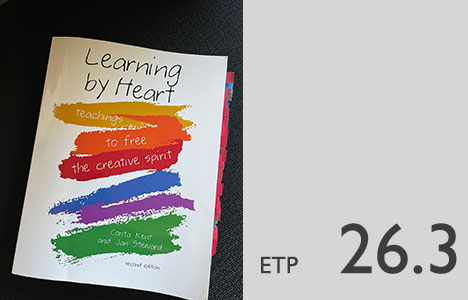
BOOK: “Learning by Heart” by Corita Kent and Jan Steward, Second Edition
I was sparked to learn more about Corita Kent from a section of Austin Kleon’s book “Keep Going.” I watched a bunch of YouTube videos (eg, Art + Life Rules from a Nun) and wandered through the Corita Art Center website. Already fascinated by the art, mindset & story, I ordered the book “Learning by Heart” from Amazon.com. I learned a lot from this book & have some notes to share here especially in the YCISL context.
- “Looking is the beginning of seeing.” p.33. This is meaningful to me because I often go from one place to another without being aware or appreciative. I often think back a minute or two, and wonder where I had just been. More of a blank than a blur. I think this is a good reason to have photo essay & video assignments in the YCISL program: taking a blur and trying to sharpen the important parts. Even in a more focused design thinking state of mind, this expression helps remind us to practice divergent thinking (look) & convergent thinking (see): we can look through Corita Kent’s Finder to quickly find a variety of framed content, stories & perspectives, then choose one to evaluate for a closer look (our prototyping phase).
- “The concepts of limitation, structure, and boundary are sometimes looked on as inhibitors of our creative energy.” p. 82. I am particular excited to see the phrase “creative energy” because that is one of the concepts that YCISL started with. This also connects with our use of Gamestorming where we have the Open phase which is made up things like “limitation, structure, and boundary.” Creative energy really comes into play mainly in the Explore phase. Still, remember that creative energy can be applied in the Open and Close phases if we choose: we can be creative about setting the rules (eg, our YCISL ping pong exercise) & reaching closure (eg, our YCISL launch presentations).
- “Every child is creative – until the time when teachers, parents and other adults in her world begin to patiently explain the way things should be, what connections can or can’t be made.” p. 104. This reminds me of Sir Ken Robinson’s TEDTalk “Schools Kill Creativity” and the idea that creativity is suppressed starting early in life. I like the graphical image of creativity conjured by the word “connections” where our creativity process really is about making connections – demonstrated by our YCISL Fast Thinking exercises especially the Associative Architecture “What do cows drink?” question.
- “PLORK…we need a third word – one which combines the two concepts and allows us to recognize them together as one responsible act necessary for human advancement.” p. 159. In the YCISL program, the words “fun” and “party” are introduced in at the start of the workshops with the intention of setting the senses & mindsets to a dynamic mode. The combination of play & work also reminds me of Tim Brown’s “Tales of Creativity & Play” where he says “And if you’re starting a design firm, let’s say, then you probably also want to create a place where people have the same kind of security. Where they have the same kind of security to take risks. Maybe have the same kind of security to play.”
- Immaculate Heart College Art Department Rules. p. 176. Also known as the 10 Rules Poster. I am surprised by the absence of an explanation of these rules in the book. I imagine these reflected the mindset expectations in that college setting. Still, we can gain wisdom by connecting these rules to our own settings. In particular, note the rule “The only rule is work” in large type, serif type and bold type for obvious emphasis. This attaches to many ideas quoted in YCISL that it takes work, often “hard” work, to be creatively productive.

BOOK: Keep Going by Austin Kleon
It’s been a while since I finished reading a book all the way to the end – without skipping anything. “Keep Going” by Austin Kleon (2019) follows “Steal Like An Artist” and “Show Your Work” which I have reviewed previously in this wiki. His idea of separate analog and digital workspaces has been a concept that I bring up in YCISL workshops frequently to help students understand that there are two (or more) modes to make creative thinking work – such as in our divergent-convergent thinking exercise. The analog connects to the divergent thinking creative side whereas the digital connects to the convergent thinking focus side. This incidentally connected well when I read (actually I listened to the audiobook) of “Thinking, Fast & Slow” by Daniel Kahneman where he describes two systems that operate together to enable our thinking.
“Keep Going” continues the series in his concise and practical, personal and reflective style. The overall theme relates to a sort of biorhythm where his creativity vibrance rises and ebbs, and the resonance he has found in the personal stories of other creative artists to help him “keep going.”
“Lots of people want to be the noun without doing the verb.” Sad, but true. In the various frameworks we display in the YCISL, we have nodes with labels (the nouns) connected by actions (the verbs). This is especially embodied in the emotional intelligence framework where our awareness is connected by management. We also present design thinking as an exercise focused on both form (noun) and function (verb) in order to be compelling and complete. In terms of practice, think of the noun and verb as a pair and be creatively quick in coupling them. This would make an interesting YCISL exercise. For example, I could show a noun then have students come up with three verbs for that noun. The reverse of giving a verb or two, and asking students for a noun to match may also be good for thinking agility.
“One of my art heroes was a nun.” To me, this may be my most fascinating discovery in this book. After reading about her in the book, I Googled Corita Kent and found a treasure trove of things I could use in the YCISL program: (1) Immaculate Heart College Art Department Rules, (2) “You are who we love.” A collaborative poem for Corita Day posted online at corita.org website, (3) the Corita Kent Art Collection, (4) the Finder, a simple tool used in “experimentation” to frame views, and (5) the term “Plork” combining the words “work” and “play” and describing the resulting emotional uplift [reminds me of Richard St John’s TEDTalk where he says “It’s all hard work. Nothing comes easily. But I have a lot of fun.”]
“In an age obsessed with speed, slowing down requires special training.” In the basketball training paradigm that we use in YCISL, this means being able to switch modes – between ball handler and supporter, or between offense and defense. Speed (and focus) can be critical in some situations, whereas slowing down (assessment) is needed in others. In a reverse way, the YCISL also emphasizes a need to be able to engage in fast creative thinking in problem solving because education generally teaches us to store and recall.
“To slow down and pay attention to your world, pick up a pencil and a piece of paper and start drawing what you see.” The YCISL ITW workshops have been using drawing as a means to express the design thinking form and function. Perhaps more in line with Kleon’s “what you see” motive, we can use the drawing method in a problem statement finding exercise which would promote the attention to the world (or worldview) that we need. Does this have the same meaning as “Stop and smell the roses”?
“What you choose to pay attention to is the stuff your life and work will be made of.” The idea of listening filters and fidelity is something learned from “Understanding Other People” by Beverly D. Flaxington, and is the premise behind our workshop exercise in learning to turn off listening filters and fully listen to the information being transmitted. Paying attention to certain things and not paying attention to others is our way of filtering and prioritizing. How the rules of those filters are written and ordered affect our perception and consequently influences our mindsets and behavior. More importantly, our mannerisms and behaviors reflect these filters and shape our identity.
“Of course, to change your mind is to do some real thinking.” How do I know if I am doing some real thinking? I’m not sure, but I hope that I am able to do it at least some of the time. Personally, I am open to changing my mind as well as others changing their minds – so long as it isn’t in a vacillating manner or with ill intent. So long as the change is based appropriately in intelligent and intellectual navigation, it should be expected and welcomed. This connects with our YCISL interest in the growth mindset where we are open to new ideas and experiences that may turn out to be good or may turn out to be bad or non-events. But recognizing that real thinking is “hard work”, it might not be available all the time – although we should train ourselves to build stamina for it. In YCISL, I think our prototyping exercises and the concept of iteration strengthen us in mindset, skills and abilities so that changing our mind is practically normal and necessary with no dings on our self-confidence and sense of direction.
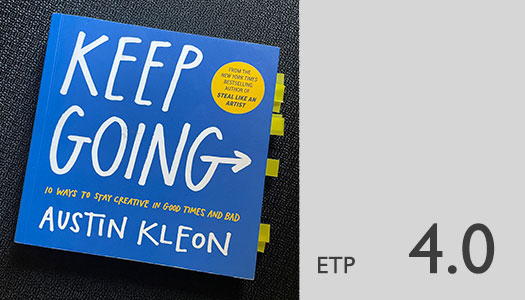
Why is the ETP relatively low? I didn’t mark as many parts of the book as compared to Kleon’s other two books. And what I did mark was isolated between pages 65 and 136, a total of 71 pages out of a 201 page book. Then again, the mark for Corita Kent would get a 10x impact factor (if I had such a factor) which makes me super grateful for this book. I recall my thinking being sidetracked in the latter part of the book a couple of times in a way that I started feeling disagreeable. The language used in the treatment of Marie Kondo’s tidying method pinged of singularity (eg, the use of the negativity words “propaganda”, “mania” and “fetishize” in a single sentence) and blocked my search for practical extensibility. It was good and interesting storytelling in the latter part of the book…the fresh air and the walks etc…but I was no longer on the same journey. I became a spectator. Oh well.
BOOK: The Japanese Mind by Roger J. Davies and Osamu Ikeno (Eds.)
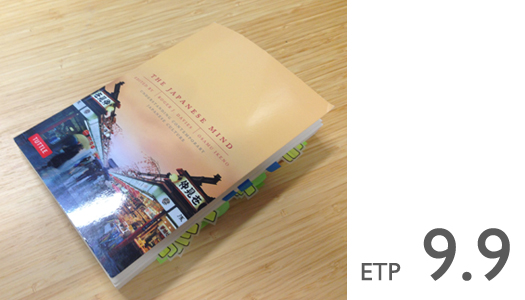
I discovered this book while searching for tourist-type guides to Japan. It is a great find and became my primary read immediately. This is a collection of essays – each of which contain reflections on the Japanese culture, sometimes in comparison to Western culture. “The Japanese Mind” in fact contains a series of student essays (that feel were smoothed out by the editors, Davies and Ikeno) which each generally contain insights, meanings and socio-cultural influence. Reading this book was a marvelous learning experience and will add emphasis on cultural viewpoints to our YCISL workshop.
“Ambiguity is thus indispensable for maintaining harmony in Japanese life, where it has the quality of compromise.” I usually associate “ambiguity” with negative consequences (specifically in the context of Outliers by Malcolm Gladwell and Geerte Hofstede’s Cultural Dimensions), but now can appreciate the relation to positive influences such as harmony and compromise. It is fascinating to think of ambiguity as a skill where one has to be facile in both creating it and dealing with it.
“Silence can also be considered a kind of ambiguity.” In our YCISL workshops, silence usually feels awkward to me but it happens especially at the start of the workshop. In my next workshop, I will think more carefully about the meaning behind the silence and whether it provides any hints to the students’ mindsets.
“As a result, there is a constant emphasis on other people’s feelings in Japan, and parents try to teach their children from a very early age to be sensitive to this information.” While YCISL includes exercises to practice assertiveness, our desire to grow emotional intelligence fits well with any tendency to be highly (or even overly) considerate of the feelings of another person. We can look at this from the perspective of training skilled empathy which includes awareness as well as self-control and sensitivity.
“Until they graduate from elementary school, they are generally not completely conscious of these vertical relationships. However, as soon as they enter junior high school, they are expected to confirm to this rigid system.” This suggests that the timing of YCISL intervention at early high school is perfect. Parents and teachers need to believe that when creative behavior, motivation and productivity are desired, the vertical relationships need to be relaxed.
“Simplicity and elegance are often considered two of the essential aesthetic qualities of Japanese culture, and they have been important features of Japanese life since ancient times.” I would like to try to emphasize simplicity and elegance in all YCISL activities – from our concepts and exercises to the projects and lessons. With these two attributes, we can expect greater teamwork and leadership as well as clearer purpose and deeper passion.
“However, this also inspired a positive attitude toward such desolation in treasuring the beauty that was out of sight.” Being able to value things not in plain sight is a key to innovative thinking. In the case of prototyping where we understand the practical advantages of “fail early, fail fast” and moving on despite obstacles and failures, deriving a positive attitude in these situations is a valuable skill in creating unique solutions in problem-solving.
“Although millions of people continue to learn calligraphy, tea ceremony, and flower arrangement, most do so not to develop their own distinct inner sense of beauty but simply as an imitation of models.” In YCISL, we should seek to develop this inner sense of beauty as part of our exploration for creative energy; this is possible in YCISL because we do not have a rigid model.
Book: Gong Hyo-jin’s Notebook
My addiction to Korean Dramas continues. I am presently watching “Pasta” which stars Gong Hyo-jin (공효진). Great series for me since I enjoy anything featuring restaurants, food and cooking.
This led me to “Gong Hyo-jin’s Notebook” which I understand to be a collection of essays about her personal viewpoints and practical efforts regarding environmental sustainability. I’ve tried to see whether this book can be purchased in the US and whether there is even an English language version – but I did not find any leads. I certainly would like to be able to read it. [10/30/14 Found a way to get this book. Looking forward to getting it. Memo to self: add photo of the book to this entry when I get it.]
I will instead rely on a couple of articles to base my thoughts as to how it connects with YCISL.
1. From http://www.koreatimes.co.kr/www/news/art/2010/12/135_78554.html: “It may be hard to think of the environment when you talk about actresses. But I thought the small steps I take with other people can become a great achievement in the future,” King [sic] wrote in the preface.
2. From http://english.chosun.com/site/data/html_dir/2011/02/25/2011022501237.html: In a conversation with the author in a theater on Feb. 19, Kong said, “I felt that if someone who likes what I do tries to do the same even just a little bit, the world can change. I hope there’ll be more consensus about environment protection in Korea so that I can publish sequel after sequel.”
Connections to YCISL: From both these quotes, emotional intelligence is evidently growing; there are strong indications of personal awareness and personal management. Her statements speak to her desire for social awareness and social management. She is particularly skilled at Reflection, and Your Personal Story. I also see an aptitude for Problem-solving and her embrace of a life purpose. Her concern for environmental protection aligns well with our YCISL sustainability platform.
I am also curious about whether this book will be a good model for the YCISL workshop photo essay exercise.
Her Wikipedia entry (http://en.wikipedia.org/wiki/Gong_Hyo-jin) also mentions a part of her life (high school age) in Brisbane, Australia. I wonder how that might have influenced her to be reflective and grateful. I lived for 2 years (grammar school age) in Melbourne, Australia and that had a tremendous influence on me.
Update 11/11/14: The book arrived from Aladdin (http://www.aladin.co.kr). Fortunately, a colleague will help with translation but just from browsing the photos and drawings, the depth of critical thinking and personal reflection is apparent. I’ve flagged several sections for translation and look forward to learning her ideas.

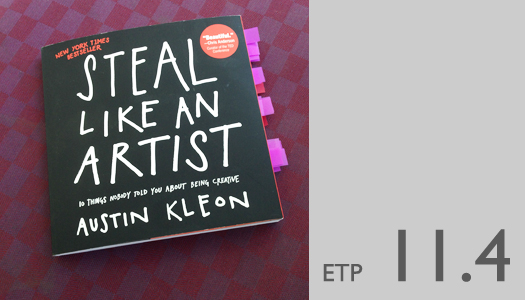
BOOK: Steal Like An Artist by Austin Kleon
In case you want to know, I recommend putting “Show Your Work” at the top of your reading list and adding “Steal Like An Artist” to the same list but not necessarily at the top. The messages in “Show Your Work” just seemed more actionable and resonating – and that’s what I was expecting from books with action-oriented self-help titles.
The format of the two books are similar with enlightening quotes and imaginative graphics. Since I read “Show Your Work” first, “Steal Like An Artist” felt less invigorating. My bad. Certainly not Kleon’s fault since this is how good sequels go. Case in point: sometimes, I start to watch a TV series in a later season, then I start watching earlier seasons (thanks Netflix and Hulu) – sometimes the earlier seasons have rougher edges.
I found the description of his analog and digital division in his workspace interesting and wonder if the YCISL Photo Essay project should have an analog-digital cycle – for the sake of limiting excessive use of DELETE for part of this creative and reflective exercise.
I also liked his Deleted Scenes section of the book which might play in to the PostIt brainstorming part of the workshop.
One quote from the book I will share: “The classroom is a wonderful, if artificial, place: Your professor gets paid to pay attention to your ideas, and your classmates are paying to pay attention to your ideas. Never again in your life will you have such a captive audience.” I think Kleon is talking only about college so I am wondering to what extent I can promote this setting in the YCISL workshops to enrich the high school experience. The aim is to get the students to feel invested but perhaps there are other incentives besides money that could be leveraged. Certainly at the end of the workshop with product rollouts, we have a “captive audience” but is there more I can do to optimize the experience?
BOOK: Show Your Work by Austin Kleon
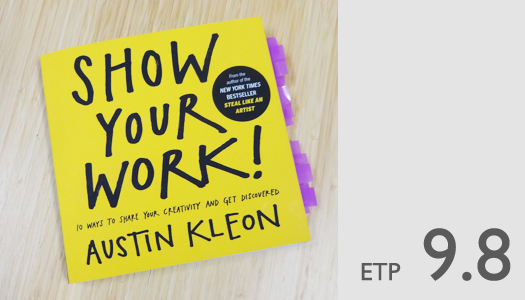
Highly recommended book. Watch his TED Talk too.
This is one type of book I very much enjoy to read. Very much to the point with touches of personal revelation. What makes it a great read is the resonation of ideas – there’s no mire of detail (or a need for it) to justify the points he makes. It’s essentially a list of life lessons he feels worth sharing and presents in a takeaway message format. I am going to try to fit several of the things I learned from this book into the YCISL workshop. Note that I also have his book “Steal Like an Artist” and expect I will learn more useful things from that.
Remember that quite a bit of YCISL comes from self-help writings aimed at adults and I try to transfer to a youth context. Here are some of my favorite parts of the book that work with the YCISL program…
– THINK PROCESS, NOT PRODUCT. This is his chapter 2 title and it coincides exactly with how I coach innovation – train for innovation as a process (way of doing things) and not as a product (an outcome that may or may not happen).
–Become a Documentarian of What You Do. In this section, he writes “Write your thoughts down in a notebook, or speak them into an audio recorder. Keep a scrapbook. Take a lot of photographs of your work at different stages in your process.” In YCISL, we promote these ideas through our photo essay and personal journal activities.
–Always be sure to run everything you share with others through The “So What?” Test. I think this is good advice EXCEPT during brainstorming. In brainstorming, treat all ideas as equal and let them all out. It’s like the voice drills of ridiculous noises one might make before singing or making a speech (yes, I’m thinking High School Musical). But get that “So What?” filter running in all the other processes. Use it in prototyping to find the tracks you may want to run on. Use it in testing to empathize with users and anyone else who will be in contact with your product. I will also add that you should use it in user support.
–Every client presentation, every personal essay, every cover letter, every fund-raising request––they’re all pitches. In YCISL, we follow this perspective through our “Your Personal Story” and elevator pitch activities. Not only is there a lot of possible uses for pitches, there is a lesson about readiness and anticipation, an elevated (and hopefully excited) state for ideas and work. In this state, it is waiting for the opportunity to become part of a longer chain of events.
–Teaching people doesn’t subtract value from what you do, it actually adds to it. Teaching doesn’t have to be a career. In a creativity and innovation context, teaching is the core of leadership. It is part of a growth mindset.
– Yet a life of creativity is all about change––moving forward, taking chances, exploring new frontiers. Change isn’t always about moving forward but it is about being willing to be agile and applying divergent thinking to complement logical deductive convergent reasoning. Sometimes, you have to retreat a little to find a strong base (think lessons from Jeff Raskin about citation). Sometimes, you have to look left and right before crossing. And occasionally look behind you. Also, remember the movement pattern within the exploration section of the Gamestorming framework.
Note too that the style of this writing is worth promoting as a YCISL Your Personal Story style in that the personal story is interwoven with snippets from other personal stories.
BOOK: How to Fail at Almost Everything and Still Win Big: Kind of the Story of My Life by Scott Adams
This book was quite different from the others I usually read and comment on. I liked it because it contained the author’s own personal experiences and these experiences were things that I am interested in. Well, at least the first half of the book did (and I would recommend reading this book for this part). The second half felt – let’s just call it – less personal, more library-like.
The topic of failing and still finding ways to succeed (and find fulfillment and happiness) is a major premise in YCISL. Scott Adams in “How to Fail at Almost Everything and Still Win Big: Kind of the Story of My Life” (2013) tells his personal story about the various paths he has taken, and analyzed what has succeeded and what has failed. He relates personal conclusions from his first-hand experience which I found substantive in life lessons. I would assume his messages are aimed at an adult audience but I think with a little reflection, they would become valuable messages for youth.
Here is a list of notes from my reading (selected 17 points from 115 total highlights – just too easy in the Kindle format):
1. “The most important metric to track is your personal energy.”
2. “It seemed as if other people were benefiting greatly from the wisdom of their friends and families.”
3. “Realistically, most people have poor filters for sorting truth from fiction, and there’s no objective way to know if you’re particularly good at it or not.”
4. “Failure always brings something valuable with it.”
5. “My hypothesis is that passionate people are more likely to take big risks in the pursuit of unlikely goals, and so you would expect to see more failures and more huge successes among the passionate.”
6. “Success causes passion more than passion causes success.”
7. “Good ideas have no value because the world already has too many of them. The market rewards execution, not ideas.”
8. “This was about the time I started to understand that timing is often the biggest component of success.”
9. “The systems-driven people have found a way to look at the familiar in new and more useful ways.”
10. “I know from experience that trying to be creative in the mid-afternoon is a waste of time.”
11. “One helpful rule of thumb for knowing where you might have a little extra talent is to consider what you were obsessively doing before you were ten years old. There’s a strong connection between what interests you and what you’re good at.”
12.”Small successes can grow into big ones, but failures rarely grow into successes.”
13. “Several years ago I gave a talk to a fifth-grade class. I started by asking them to finish my sentence. The sentence was ‘If you play a slot machine long enough, eventually you will…’ The class yelled out in unison ‘WIN!'”
14. “Positivity is far more than a mental preference. It changes your brain, literally, and it changes the people around you. It’s the nearest thing we have to magic.”
15. “Try to get in the habit of asking yourself how you can turn your interesting experiences into story form.”
16. “Another common trick is to hum the first part of the ‘Happy Birthday’ song and then speak in your normal voice right after.”
17. “The only reasonable goal in life is maximizing your total lifetime experience of something called happiness.”

Book: How to Deliver a TED Talk by Jeremey Donovan
Just finished reading this book. Thoughts coming soon…
Book: inGenius by Tina Seelig
Just recently finished reading the book “inGenius” by Tina Seelig. As a follow-up to the author’s previous book “What I Wish I Knew When I Was 20,” this book had contrasting style and voice. inGenius read like a journalistic article (although I know a lot of the content came from personal experience) and felt like a report in narrative rather than the inspirational feel of the earlier book. Actually, the titles of the book suggested as much to me before I started reading the second book. Nonetheless, it was a good read and several useful lessons were found that I have already used in the YCISL.
(1) One of the skills that one has an opportunity to and should develop at a young age is to ask questions. Partly to balance the thinking that goes on in a “give me the answer” school environment but also to be able to frame problems. On page 19, the author relates how two seemingly identical question can lead to very different thinking and answers. If one can conjure up questions like a chess player rapidly conjures up possible chess moves, reframing problems will be a valuable skill and asset.
(2) One exercise that I have already carried out with several groups (even one group of school headmasters and district directors) is the birthday line up exercise described on page 49. I’ve run this with middle school students and high school students as well. It works great as an icebreaker and an example of teamwork. As a kickoff to a workshop, it also helps set ground rules such as “It’s ok to ask questions” and “You only have the instructions I gave you already – nothing else. So listen carefully.”
(3) On page 129, the author writes “Many rules are designed with the goal of improving performance, but they actually do the opposite.” While many of us can probably tell of an instance where this has happened (even at Stanford!), I don’t think a disregard for rules is called for – even when creativity is desired. I consider myself a rules-based thinker and this has served me well. From being a computer and IT expert to a sports player and coach, I know that rules are the means to advance. As an extreme example to balance the initial premise, one could say that “creativity is like daydreaming which is idling.” In my view, creativity needs to be applied to the rules of innovation (the game – reminds me to recommend checking out the book “GameStorming”) in order to accomplish things – decision making, leadership, productivity, and others. Perhaps it is poorly designed rules that are the problem, not simply having rules. Try setting up email filters in your email client to sort and filter, and you might have a good idea of how to set up effective rule sets.
(4) I appreciated the reference to Tom Wujec’s “Marshmallow Challenge” on page 144 as one of my mentors who had done this exercise in Seelig’s class brought it into a YCISL workshop in 2012. I’ve run this exercise three more times – with my middle school students as well as another group of high school students – and have made modifications to the exercise. Perhaps I was buying weak spaghetti but the marshmallow was a massive downer – except when the students wanted to eat them up (better than them eating the uncooked spaghetti!). So, I have modified the exercise such that each team gets a mailing label and has to design a flag on it to attach to their structure – and the height of the tower is measured by the distance between the surface and this flag. The flag lends an opportunity to personalize the tower and represents the focal point of their effort. Of course, the lightweight nature of the label compared to the marshmallow avoided the potential tipping disaster. In my YCISL exercises, I prefer to set the success to failure probability about 2:1 in favor of success. I found that the marshmallow (at least in a timed situation) put failure in 2:1 favor. Another modification that I tested a few times was to make the objective to build a tower that touches the ceiling of the room. I was looking for a change in teamwork dynamics and spatial design. More on that in another entry at another time.