
Category: Thoughts
Exercise: Fast Ideas from User Frustration
Grab any item. Try to use it. How could it be better? If nothing comes to mind within 15 seconds, move on to another item.
In everyday use of many items, we often wish that our experience could be better. From things in the house such as getting nice sheets from the plastic wrap roll (I just tried this morning and the cut is never clean, and sometimes I cut my fingers) to things outside such as elevators. I particularly dislike using virtual keyboards on the iPhone, Apple TV and devices with similar interfaces. Also on this list is how often keys and remote controls get lost.
So has any solution come to mind when you are in such a situation? Also think about whether the same solution has come to mind each time you’ve used the same product. If no solution has flashed to mind, ask yourself why. Keep a list of these items and your findings.

China Daily: Inspired mother pioneers freestyle education
The YCISL concept positions personal development education in tandem with traditional memorization-based mass youth education. The article “Inspired mother pioneers freestyle education” written by Deng Zhangyu and published October 7, 2014 in the China Daily (http://usa.chinadaily.com.cn/epaper/2014-10/07/content_18702170.htm) shares perspectives in the development of the Ririxin School in Beijing.
This school was spotlighted in 2011 in various articles (e.g., http://english.sina.com/china/p/2011/0922/399232.html) as a growing home school phenomenon offering priorities that align with personal development and growth as opposed to test-based gated streaming schooling.
I have known families who have chosen to home school as well as schools that support home school families. There are also schools that position themselves away from a rat race mentality and emphasize personal well-being and life purpose. It is fortunate to have these options to the mainstream number-based (your identification number, zip code, test scores, GPA, fiscally-dependent and extrinsically motivated) factories.
I hope to establish contact and exchange ideas with the leaders at Ririxin School.
Key Lessons (quotes from the news article and my comments):
– “Playing is the way children get to know the world.” (Quote of Zhang Dongqing). Play is a great way to promote learning (even memorization) – perhaps as a supplement. As an example, . In YCISL, we see play as a great way to explore creativity and fast thinking. When we think of play, we usually think of freestyle play (e.g., at a playground), but we can also benefit from formalized play such as that in the Gamestorming model or sports or games.
– “…staff at Ririxin are friends with their pupils.” The relationship between teacher and student is complex, especially in Asian culture. Even in mainstream schools today in several Asian countries, teachers are almost like (understanding) parents to their students. In YCISL, I portray myself as a parent and coach. Friendship is something that potentially develops as a result but I feel is not a necessary starting ingredient.
– “Kids are like seeds.” This idea sets the stage for organic growth where students discover their individual potential and ability to rise to challenges and occasions.
– “Zhang’s mission is to help make children become what they want to be instead of modeling them into a same person.” For anyone who tends a garden, you would understand that you can focus your good intentions to help shape good outcomes but there is little hope in planning every detail in growth.
– “…they imposed ideas on them and killed their creativity.” This is consistent with the messages we are hearing about US and European as well as Asian schools. And how this continues today as common practice shows we need to actively intervene in this loss. Our YCISL program therefore emphasizes simple exercises that can be practiced routinely to build strength for personal development…and ultimate retain facile creativity.
– “…her second daughter knows who she is and what she wants, is more confident and has a passion for art.” In our YCISL framework, knowing yourself should be coupled with composing and maintaining your personal story.
– “A better education enables a person to be a more complete one, rich in emotion and creativity.” (Quote of Zhang Dongqing). I think a better education is a more complete one. Education today satisfies its mission of identifying the best memorizers. It is due time to re-scope the meaning and goals of education and implement the means.
– “…but today it’s easy to get knowledge.” Unfortunately, institutional knowledge isn’t pure (even textbooks) and has a tendency to be misunderstood and misinterpreted. And with many forms of the same knowledge, it’s not easy to efficiently gain knowledge. The challenge is to invest time to gain experiential knowledge, and cultivate a love for lifelong learning. Knowledge will have the most value under these circumstances.
http://www.ririxinschool.com/#
Ririxin School, 日日新学堂
Woquyuan, Xiaoshahecun, Shahezhen, Changping District, Beijing, China, 102206
地址:北京市昌平区沙河镇小沙河村渥丘园
Email: ririxin@126.com
WSJ: Fighting the Internet Invasion of Childhood
This entry refers to the article “Fighting the Internet Invasion of Childhood” by Martin Kutnowski in the WSJ on Wednesday September 10, 2014 on page A13 (Opinion section).
Reading about the efforts that Kutnowski has made to ameliorate the negative impacts of accessing the Internet is interesting and sparks my empathy as a parent. From my perspective, the Internet, especially in its early adopter days, was a research and academic tool with its main feature being communication innovation. These were its best days which are now faded because of the extensive pollution that it now carries – like river basins overcome by industrial waste. The Internet poses relatively minuscule benefit today thanks partly to the push to monetize its access and use. That is a major reason why the Internet is a negative factor in childhood development – in academics, family and social ways.
I like how Kutnowski describes his strategy to program his wireless modem (router actually, I would presume) to set access enabled times. Hopefully, he has learned how to program restricted web sites and read router logs too. I’m not sure why he uses “hacking” to describe what he did with the modem; perhaps its because he was not aware this was necessary in the parenting skill set.
I like too that he shares his experiences upon returning home, at dinner, and play time. This is really good insight into the parent experience and can help youth appreciate the experimental nature of parenting. As we read about the experimental trials in this story, we learn that the parent needs to build and maintain intrinsic motivation. But what’s important to remember is that intrinsic motivation comes from advancement in mastery, autonomy and purpose. An empathetic positive and growth mindset also helps with sustaining this motivation between the parent-child pair.
What is concerning though in this story is the fear (as suggested by words such as “parasitic”, “zombies” and “shudder”) that is cast over the condition of internet addiction, and it would be far more beneficial if the parent could, using intrinsic motivation, make childhood far more resilient by enhancing the positive mindset in his children so that the internet is supportive rather than invasive.
WSJ: The Best Language for Math
This entry refers to the article “The Best Language for Math” by Sue Shellenbarger in the WSJ on Wednesday September 10, 2014 on page D1-D2 (Personal Journal section).
Misguided “glass half empty” mindset comes to mind when I read this article. Building “numeracy in small children” is not to be admired – it is another one of those despicable pressures that deprives children of their creative opportunities and development. Think about it: who is concerned? It’s adults. Do children care? Not one bit.
People who cite rankings in international achievement tests are similar to those who care about and cite university rankings. Both types of rankings are trivial and lack meaning. They are multivariate sets of functions with inconsistent variable sets. As if the education paradigm is the sole predictor of academic achievement. As if a top-ranked university is suitable for everyone.
Researchers should be looking at the needs for customization in education – especially in cores subjects such as math and language – rather than choking creativity out of early childhood education. Such customization should promote finding learning PREFERENCES, and after that, it’s PRACTICE that makes the difference (this is greatly affected by the availability of tutoring and after-school programs in the countries compared in the article).
How much does it matter that 27 is written as twenty-seven in English? How do YOU add two numbers? “32+17=49” or “thirty-two plus seventeen equals forty-nine”? The difference between these two approaches reminds me of the consequences of the shift from numerical math lessons to verbalized math lessons.
Move along. Nothing to see here.
WSJ: “Revisiting Teenage Dreams”
In the Personal Journal section of today’s WSJ (Wednesday August 20, 2014), there is an article by Sue Shellenbarger titled “Teenage Dreams, 10 Years Later” (http://online.wsj.com/articles/advice-to-my-teenage-self-1408490144#) which describes lessons learned from people watching videos they made during their senior year in high school – about their goals. In the article, this is called a “message to to my future self” and the students view their videos 10 years later.
We use videos of “graduating” students in YCISL too. At the end of every YCISL workshop, the students are provided a video camera to record thoughts from their visit – from the time they arrived at Stanford and through the workshop. Each student is allotted 15 seconds. All instructors and mentors move out of sight and earshot. The main purpose of the video is to remind the students of the parts of the experience that excited them. It is intended to serve as a reference point for them.
Somewhat in the vein of Tina Seelig’s “What I Wish I Knew When I Was 20,” this WSJ article lists several “wisdoms” that the alums shared after watching their videos including:
– “Broaden your definition of success.” This is not as easy as it sounds. “Hindsight is 20-20” comes to mind – it is relatively easy thinking of regrets but how easy is it to think 10 years (or even days) out from now? Just as Richard St. John’s TED Talk title advises us “Success is a continuous journey” – and one should look for success (and happiness as well as opportunities for gratefulness) all along that journey.
– “It’s OK not to know what you want to do.” This should not mean that one does not have to think about their direction, strategy and goals. It basically recognizes that a change of plan is all right. A better way to put this is to “Think about what you want to do.” In YCISL, we recommend engaging in the elements of Daniel Pink’s Intrinsic Motivation – pursuing mastery, allowing for autonomy, and embracing a purpose. To address the article’s statement that “Often, young adults don’t find a clear purpose for years after graduating,” you don’t find a purpose (you find a passion), you define and embrace your purpose. And you start at the placement stage of the YCISL leadership model.
– “Don’t worry too much.” The article mentions that “a positive attitude helps.” in YCISL, we believe that positivity accelerates creative thinking and discuss how kids worry less than adults using Tim Brown’s TED Talk “Tales of Creativity & Play.” If high school students are worrying too much, they learned it from adults (see “The Importance of Childs Play” by Lenore Skenazy, WSJ 1/27/12).
– “Focus less on success and more on failing well.” There are more factors involved here than a simple thread of failures leading to success. There are support and timing factors, as well as competitive advantage and opportunity. A connecting-the-dots (successes, failures and corrective actions) agility is needed.
Supplement: Prepping for YCISL (White Paper Series)
This is a supplement to the YCISL White Paper titled “Prepping for YCISL: Go for Breadth” which was recently posted to the CSDGC Youth Leadership web page. That white paper discusses the YCISL Leadership Objective of “Placement” and how prospective YCISL students can get ready for a future workshop at Stanford which focuses on the Leadership Objective of “Proof.”
This wiki entry shares some ideas on candidates for “Placement” and hopes to demonstrate a systematic seed and branch approach to surveying the opportunity landscape.
EXAMPLE 1
Seed: MUSIC
Primary Branches: Piano, Violin, Viola, Cello, Guitar, Flute, Singing, Songwriting, …
Secondary Branches: Musical genres
Tertiary Branches: Solo vs Duet/Quartet/Band/Chamber Orchestra/Symphony/Choir…
Quaternary Branches: For fun, amateur performance, competitive performance, professional performance.
EXAMPLE 2
Seed: SPORTS
Primary Branches: Swimming, Basketball, Soccer, Tennis, Golf, …
Secondary Branches: Self-taught, Lessons, Matches, Competitions, Leagues
Tertiary Branches: Spectator, Solo Participant, Team Participant, League Participant, Commentator, Writer, Coach, Referee/Umpire/Official, …
Quaternary Branches: For fun, amateur, competitor, professional
EXAMPLE 3
Seed: FOOD
Primary Branches:
Traverse these trees and you may come up with a compelling scene in your personal story.
Are You a Supportive Role Model-Parent? Your Child is Watching You.
One of the things I often discuss with colleagues and visitors is the importance of a support structure to a student’s success. No one does it alone. Support is an essential success factor. The support structure starts with the home environment and the relationships therein, but also includes the school, community and social environments as influential contributors. This entry looks at the home environment (especially the parent-child interface) and asks simple sample questions to induce parents to reflect on the type of role model they are to their child. The answers to these questions and others similar to them can lead to insight about the nature of the communication filters between parents and their children. These communication filters form whenever your child is watching you – whether you are conscious about it or not.
1. Do you share interests with your child?
A. Constantly.
B. When I can.
C. We have nothing in common.
Reflection: Is there anything that bonds?
2. Do you make any sounds/noise at night after your child has gone to bed?
A. No.
B. Just a little soft white noise.
C. Yes, loud noises including television, radio, laundry machine or hairdryer.
Reflection: Is there sensitivity?
3. Does your child eat your cooking?
A. Yes, and he/she enjoys it.
B. Yes, but it’s a struggle.
C. No.
Reflection: Is there cooperation?
4. Does your child offer to help you?
A. Yes.
B. Sometimes.
C. Don’t recall.
Reflection: Is there opportunity?
5. Do you make your bed in the morning?
A. Yes.
B. Sort of.
C. Who cares?
Reflection: What organizational impression do you leave?
6. When it’s time for your child to do homework, do you…
A. find something quiet to do and help when asked?
B. go about with your usual activity (talk on the phone, watch television, …)
C. interrupt your child about something not related to homework?
Reflection: Is there time management?
7. Do you drive at the speed limit?
A. Yes.
B. No more than 5 mph above the posted speed limit.
C. Never notice it.
Reflection: How do you prioritize?
8. Do you make a complete stop at a STOP sign?
A. Yes.
B. Rolling stop.
C. What’s a STOP sign?
Reflection: What is your attitude?
9. My emotional intelligence is a key factor in my relationship with my child.
A. Agree.
B. Sometimes.
C. What emotional intelligence?
Reflection: Is there anything more important in your life?
10. My parent-child relationship provides me with feelings of deep intrinsic motivation.
A. Agree.
B. Sometimes.
C. Cash incentives work better.
Q: Do you feel organically rewarded?
Note: Treat these questions as seriously as you choose. Laugh at them if you wish (I think humor is an effective way of communicating ideas). Create additional questions for yourself or to share with other parents. Reflect on any time you may be making a observational impression on your child. The questions above are not meant to be scope-defining, definitive, exhaustive, or even generalized. I’m just trying to inspire self-critical thought for continuing professional (parent) development.
Another note: This entry marks the start of the YCISL Parent-Student Toolkit.
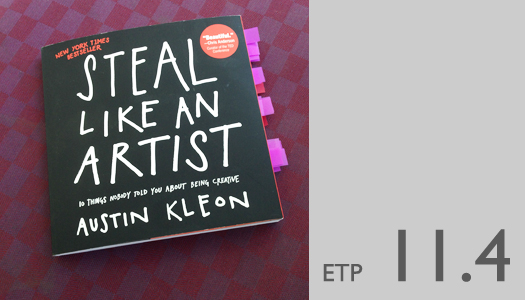
BOOK: Steal Like An Artist by Austin Kleon
In case you want to know, I recommend putting “Show Your Work” at the top of your reading list and adding “Steal Like An Artist” to the same list but not necessarily at the top. The messages in “Show Your Work” just seemed more actionable and resonating – and that’s what I was expecting from books with action-oriented self-help titles.
The format of the two books are similar with enlightening quotes and imaginative graphics. Since I read “Show Your Work” first, “Steal Like An Artist” felt less invigorating. My bad. Certainly not Kleon’s fault since this is how good sequels go. Case in point: sometimes, I start to watch a TV series in a later season, then I start watching earlier seasons (thanks Netflix and Hulu) – sometimes the earlier seasons have rougher edges.
I found the description of his analog and digital division in his workspace interesting and wonder if the YCISL Photo Essay project should have an analog-digital cycle – for the sake of limiting excessive use of DELETE for part of this creative and reflective exercise.
I also liked his Deleted Scenes section of the book which might play in to the PostIt brainstorming part of the workshop.
One quote from the book I will share: “The classroom is a wonderful, if artificial, place: Your professor gets paid to pay attention to your ideas, and your classmates are paying to pay attention to your ideas. Never again in your life will you have such a captive audience.” I think Kleon is talking only about college so I am wondering to what extent I can promote this setting in the YCISL workshops to enrich the high school experience. The aim is to get the students to feel invested but perhaps there are other incentives besides money that could be leveraged. Certainly at the end of the workshop with product rollouts, we have a “captive audience” but is there more I can do to optimize the experience?
Viewing Education as a Parent
One of the things that I am able to do is look at education from more perspectives and with more experience than most people. I have been in an educational setting for all but a few years of my life – as a student and an educator. I would also add the perspective I gained as a science fair judge. I also have been viewing education from an involved parent perspective – all the way from pre-school to university. Pulling together my thoughts on education has been one of the main drivers for me developing the YCISL. In this entry, I form a compare and contrast perspective on education.
Like most things, education is average and that is what it aims for. In a broad generality, educational quality seems to be stretched out along a gaussian distribution with a peak mostly around the middle (I am not stating this as a fact, more of a likelihood based on personal observation). And I am not referring to just the US educational system but inclusive of all education around the world. If one isolated just the US, I would also guess that it would have its own gaussian distribution (i.e., bell curve too but perhaps shifted along the x-scale).
An interesting dynamic though is that the distribution isn’t just ordinarily diffusive with socioeconomic forces at play, but there are temporary forces that push the quality up and down. One current up-pushing force is the budding growth of online content providing supplementary learning and reinforcement opportunities; this force will continue as we try to figure out how to make it better and format it for better learning. One down-pushing force is the emphasis on flat standards.
BOOK: How to Fail at Almost Everything and Still Win Big: Kind of the Story of My Life by Scott Adams
This book was quite different from the others I usually read and comment on. I liked it because it contained the author’s own personal experiences and these experiences were things that I am interested in. Well, at least the first half of the book did (and I would recommend reading this book for this part). The second half felt – let’s just call it – less personal, more library-like.
The topic of failing and still finding ways to succeed (and find fulfillment and happiness) is a major premise in YCISL. Scott Adams in “How to Fail at Almost Everything and Still Win Big: Kind of the Story of My Life” (2013) tells his personal story about the various paths he has taken, and analyzed what has succeeded and what has failed. He relates personal conclusions from his first-hand experience which I found substantive in life lessons. I would assume his messages are aimed at an adult audience but I think with a little reflection, they would become valuable messages for youth.
Here is a list of notes from my reading (selected 17 points from 115 total highlights – just too easy in the Kindle format):
1. “The most important metric to track is your personal energy.”
2. “It seemed as if other people were benefiting greatly from the wisdom of their friends and families.”
3. “Realistically, most people have poor filters for sorting truth from fiction, and there’s no objective way to know if you’re particularly good at it or not.”
4. “Failure always brings something valuable with it.”
5. “My hypothesis is that passionate people are more likely to take big risks in the pursuit of unlikely goals, and so you would expect to see more failures and more huge successes among the passionate.”
6. “Success causes passion more than passion causes success.”
7. “Good ideas have no value because the world already has too many of them. The market rewards execution, not ideas.”
8. “This was about the time I started to understand that timing is often the biggest component of success.”
9. “The systems-driven people have found a way to look at the familiar in new and more useful ways.”
10. “I know from experience that trying to be creative in the mid-afternoon is a waste of time.”
11. “One helpful rule of thumb for knowing where you might have a little extra talent is to consider what you were obsessively doing before you were ten years old. There’s a strong connection between what interests you and what you’re good at.”
12.”Small successes can grow into big ones, but failures rarely grow into successes.”
13. “Several years ago I gave a talk to a fifth-grade class. I started by asking them to finish my sentence. The sentence was ‘If you play a slot machine long enough, eventually you will…’ The class yelled out in unison ‘WIN!'”
14. “Positivity is far more than a mental preference. It changes your brain, literally, and it changes the people around you. It’s the nearest thing we have to magic.”
15. “Try to get in the habit of asking yourself how you can turn your interesting experiences into story form.”
16. “Another common trick is to hum the first part of the ‘Happy Birthday’ song and then speak in your normal voice right after.”
17. “The only reasonable goal in life is maximizing your total lifetime experience of something called happiness.”

