
Category: Activity
Innovation with Sustainability Design Thinking for Smart Cities & Communities
LIVE. WORK. PLAY.
I was pushed to re-design my summer teaching. It was an opportunity to explore a new area. What I’ve done is adopted our past course in Smart Cities & Communities aka SCC which originally had a business case basis to a new course (Smart Cities & Communities: Sustainability Design Thinking) where which takes the design thinking principles & process from my previous course (Sustainability Design Thinking aka SDT) with application to opportunities today, tomorrow and in the next generation.
The basic premise is to design interactive environments and surroundings in a what if? scenario where we practice wishful thinking and put ideas on the path to realization, at least conceptually & visually. The one phrase from the earlier SCC course that I remember is “a system of systems” where the connectivity, awareness and sensitivity to response are the main features of being called “smart.” Where the new SCC course will be an upgrade from the past course perspective is in the use of human-centered feature design specification to enhance user experience through emotional intelligence, creativity and storytelling (three core YCISL elements).
- Emotional Intelligence. What if a smart system offered and evolved with a person? What if we recognize that human awareness and interaction changes with place, time and circumstance? What if we could leverage intrinsic motivation as a user UI/UX layer in the architecture of our smart system?
- Creativity. Our smart system should energize the divergent-convergent thinking cycle involved in smart interaction, guidance and feedback. We can use creativity to promote a person’s appetite for a growth mindset. Creativity, especially in the fast thinking mode, can be used to sustain positivity as a promissory attractant to smart systems.
- Storytelling. A smart system could offer one or more longitudinal temporal pathways through storytelling. Word choice may be important, and so might imagery. One question is whether the story has to be based on reality, or could it be augmented or virtual? Does it matter to you and what we deem acceptable to attain our human behavior change goals?
With the above thoughts, we will conceptualize smart cities and communities innovations as a platform to enhance design thinking skills – hopefully building a memorable starting point through caring for sustainability. The value proposition of this course is the life skill of design thinking, and spreading the YCISL method through attending to where we live, work and play.
Clinic Presentation: Rules Of Creative Engagement For An Engineering Research Project
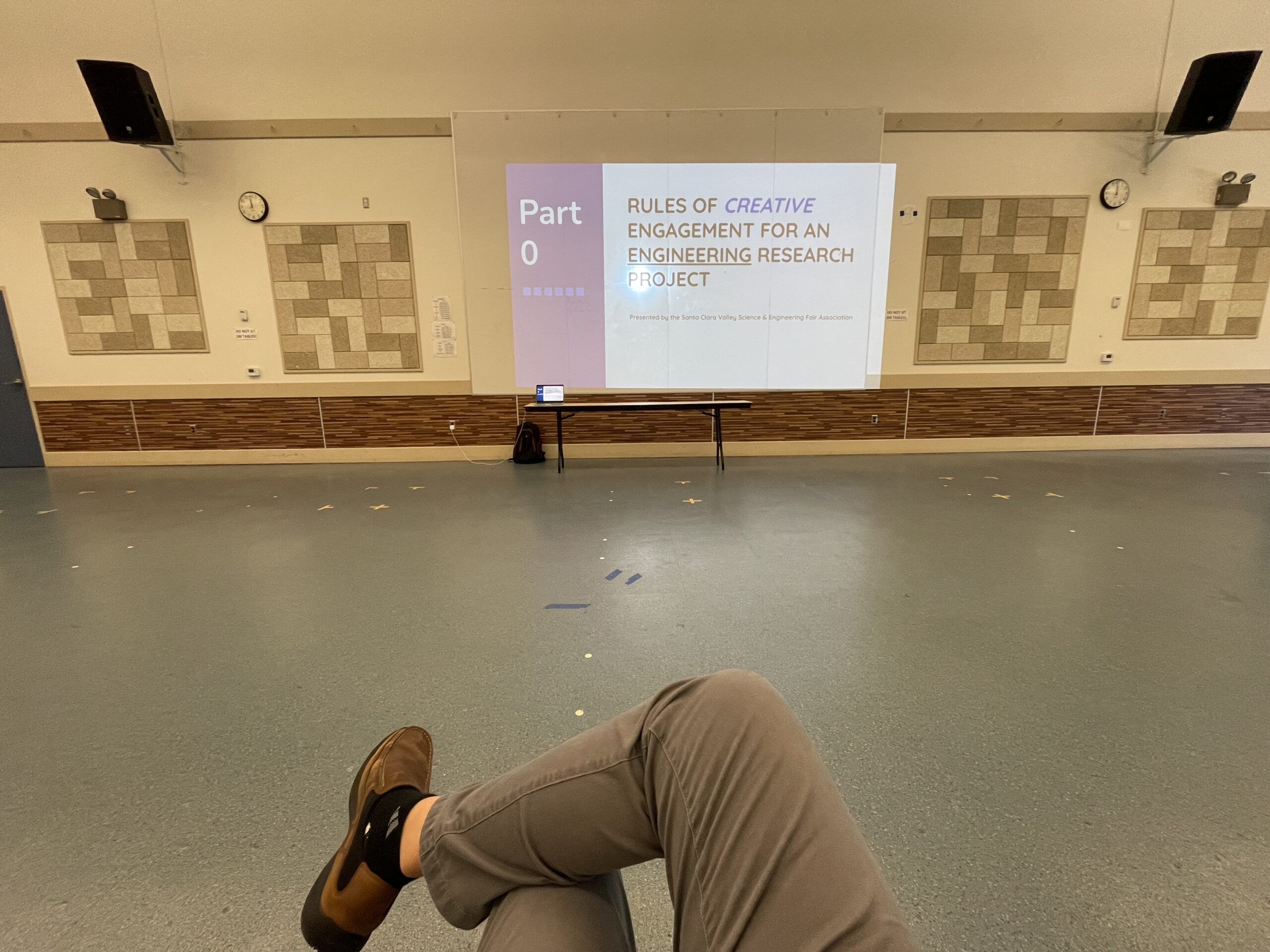 Today, I gave a presentation at a high school in San Jose, CA. The context was as a “clinic” to set up students to participate in the Synopsys Championship (a regional science fair). I pulled in various lessons from my YCISL design thinking program. Writing my notes here because I have a feeling I will be doing this more and more.
The main idea usually behind these clinics is to introduce students to rules and procedures for entering the Synopsys Championship. This particular clinic was requested by a teacher to try to raise overall project “quality” among the students at the school level, and open opportunities for students to pursue competition at the Synopsys Championship.
I worked up a new slide set. It comprised 6 parts (1 slide each). There was just 30 minutes.
- ABOUT THE 2026 SYNOPSYS CHAMPIONSHIP
- 5 RESEARCH PHASES
- THE PLAN & APPROVAL
- EXAMPLE: A DRONE + ARDUINO ENGINEERING PROJECT
- LET’S FREE-FORM BRAINSTORM AN ENGINEERING PROJECT
- THE 8 SECRETS OF (RESEARCH) SUCCESS
I started with a slide about the 2026 Synopsys Championship. It set a target in time and place. Understanding that this would not be a “grab” for most of the students, I attached Tim Brown’s “Sketch Your Neighbor” exercise which is how I usually start YCISL workshops. In terms of EQ, this raised awareness of the other students in the room and pulled mindful focus on what was about to happen in the clinic.
Dipping our feet into engineering research projects, I showed a slide with the YCISL Simple Innovation Framework (adopted for the Sustainability Design Thinking course) with the fives phases of Ideation, Planning, Prototyping, Testing and Launch. This suggested an organized approach to the project work. Further, the idea of iteration as a required part of engineering research was highlighted.
The next slide referenced the Engineering Project Detailed Research Plan that is available for download from the Synopsys Championship website. A completed plan is a necessary submission for an entry application to be approved. Emphasis was on detail, process and due diligence. Boilerplate (necessary for the Open phase of the Gamestorming format that I like to use).
At the mid-point, we got to an example that called on creativity and the imagination. Using my own personal view, the example employed a drone and an Arduino; both devices that I have good experience as a personal hobby as well as in Synopsys Championship project review and judging. Before the presentation had started when I was alone in the meeting room (the Multipurpose Room), I noted various things that I dropped into this part of the presentation. First, I talked about how the room appeared suitable (safety, not FAA-regulated) for indoor drone flight tests given the wide open floor and high ceilings. I also noted a lot of scars on the ceiling panels and mentioned how drones may have been responsible for the damage; the teacher said it may be due to robotics! I felt very good about this improvisational moment with the hope that the students would note things around them as they planned and conducted their research.
The next slide focused on brainstorming…the engineering design of a water bottle. A condensed version of the YCISL Water Bottle Feature List exercise. The twist was having students to pick any topic from their science studies and include it as a feature. One student mentioned “friction” and another “kinematics.” It took just a moment of quiet eye contact after the topic was stated, but it was great to see the Aha! moment on their faces. We also did the sketch step including MVP and MVP+ annotations. This was a great way to approach Silicon Valley-style innovation design.
The wrap-up slide listed 8 attention-to-detail requirements. In a way, it included key gateway information for those students who had found the clinic ideation invigorating and now needed “permission” to dive in. The slide’s title “8 Secrets of (Research) Success” was connected to Richard St John’s “8 Secrets of Success” TED Talk which I said would further help with motivation and purpose.
I am optimistic about the outcome of this clinic.
YCISL Returns to On-campus with a “Popcorn with Colin”
 Last week, I hosted a group of high school students from Kanagawa Prefecture for the first on-campus YCISL program since 2019. And it was the first “Popcorn with Colin” session at Stanford; previously, PwC had only been online through Zoom in response to the pivot to remote education.
In this PwC, the focus was on Creativity, Uncertainty, & Real-World Problem-Solving. When I was ideating in preparation, I thought about two aspects of creativity application that sets Stanford-style education apart. The first is the concept of uncertainty – which I learned most when teaching environmental toxicology (ETox is full of uncertainty…and risk). Uncertainty was also a talking point early in YCISL taking Geert Hofstede cultural dimension examples from the book “Outliers” by Malcolm Gladwell (it was one of the books in the Stanford freshman orientation Three Books program in 2009). So, this PwC started on the topic of uncertainty – in everyday as well as academic terms.
The second concept introduced in the PwC was Real-World Problem-Solving. I recalled examples from various Stanford environmental courses where problem assignments are designed with intentional incompleteness – just like in the real-world where there are numerous gaps or questionable information. The idea was for students to learn to make guesses or estimates to come up with justified and plausible solutions. This approach to academic coursework aligns with high-level research where knowledge extensions and connections are made and tested.
With the above concepts set in a Stanford context, the students were then pulled into the YCISL-style of playful creativity. We started with the fast thinking exercises (“What do cows drink?”) then moved into the 30 circles exercise to demonstrate imaginative agility as well as transfer from mind to paper. We ended our creativity fun-fest with the Human Knot exercise to immersively showcase group problem-solving.
To complete the circle, I introduced a variation of the Design Sprint exercise just completed in the Sustainability Design Thinking course; partly to share what happened in an actual Stanford course, and partly to get the students to apply creativity, uncertainty, & real-world problem solving to a forward-thinking problem that may affect even their own future. In my view, this turned out to be very resonating as it brought in some of my latest thinking & experiences, & tasked the students with brainstorming along a timeline. The temporal flow was sweet.
This was a great way to get back to on-campus YCISL activity.
Getting Started: The IB Extended Essay
I am preparing for an upcoming Popcorn with Colin where students at an IB school have been invited to discuss their ideas for an extended essay. The IB Extended Essay “…is an independent, self-directed piece of research, finishing with a 4,000-word paper” and a mandatory part of the IB Diploma program. I have an interest in this activity because I was an IB Diploma student when I was in high school, and still have vivid memories of my extended essay project work.
The plan for the Popcorn session is to open with a discussion about “what is research?” for the purpose of shared viewpoints and expectations.
Then we would move into a reveal-type segment where we explore the ideas that the students have for their extended essays. We would tease these ideas for creativity, connectedness & design thinking. Our discussion about creativity could look into personal curiosity, originality & innovation where concepts such as comfort zone, out-of-the-box thinking, and uncertainty. Connectedness would deal with awareness of published scholarly literature as well as personal experience, and how to support/justify a research project. And design thinking would be about sketching a human-centered problem statement and vision using the YCISL Innovators Toolkit method.
The third component of our session would be on the suggestion of the need for a research plan & the design elements; this is intended to encourage good documentation habits as well as methodical forward-thinking skills.
That’s probably plenty for our 90-minute session where I hope to have plenty of reciprocal learning.
Teaching: Sustainability Design Thinking (Part 4)
It’s been a couple of days since I initially wrote up some notes about preparing to co-teach Sustainability Design Thinking this summer. Another thought just popped up. It relates to the YCISL equation:
KI + EI -> LI
For this equation, we posit that the limiting factor is EI (emotional intelligence) which explains why there is so little LI (leadership intelligence) around. KI (knowledge intelligence) is relatively abundant, but variable in quantity and quality (thinking for a moment about Salman Khan’s idea about teaching for mastery as well as Jef Raskin’s thoughts about issues with knowledge).
That said, if we are to push EQ with regards to the course, we need to utilize the students’ existing KI as a base resource. There are two channels we could use: (1) academic learning, especially recent learning, and (2) personal experience. We should have students list their academic topics in the past year (active recall) and significant personal experiences in the past few months (waggle dance reasoning). Students could then research any of the items on the list to deepen their understanding. This may quickly lead to a useful KI so that we can move on to focus on EI.
DEZIGNBLÄST: A YCISL Internship Framework for Sustainability Design Thinking
 In 2021, students in the YCISL Design Thinking Incubator workshop series were given the context of a design thinking firm with a Design Innovation Division in which they were interns. Their task was to produce concept proposals along a Sustainable Futures Initiative theme that would be vetted internally for potential presentation to prospective clients. This fictional design firm’s name was DezignBläst.
“As a part of our sustainable futures initiative, all concepts must promote sustainability features that enhance personal well-being. We are seeking ideas that persuasively shift human behavior and push the boundaries of people’s imaginations.”
The students were given a Request for Proposals (RFP) which contained a brief set of instructions about the scope and requirements.
We are planning to call upon the DezignBläst framework for the Sustainability Design Thinking course this summer at Stanford. This is to get students out of a perfunctory classroom mode of predictability into an innovation-oriented exploration field of uncertainty & potential surprises.
Tying in to the SUHSD mock interviews that I recently participated in, there is one goal where each student could insert a distinctive description of their course experience into their resume. This is about a student’s design thinking journey and a record of the life lessons they gain along the way. This is a story about growth, purpose and good memories.
Teaching: Sustainability Design Thinking (Part 3)
In Part 2 of this teaching reflection, I had mentioned individual and team as groupings for assignments. There is also the possibility of pairings – in terms of fixed pairs, or speed dating-type pairs where changes in the pairing are made quickly. Pairings could be even more interesting if there was not just equity and parity in the pairings, but we could have intentional mentor-mentee setups.
But the grouping I wanted to really add for consideration in this course is a “committee” comprising students and instructors would serve as mentors. We could form committees of students where they would be responsible for organization and execution. This experience would involved design thinking at a very different level and allow for leadership as well as interpersonal group dynamics lessons.
In YCISL, we formed a committee for the Sustainability in Education Roundtable (oooh, could we have a student-organized roundtable please? Pretty please?). We have also included in our YCISL program proposals, the idea of an editorial committee to publish mini-conference proceedings. This would help us as well to deliver a reference from which we could design accurate and precise resume statements about a student’s experience in this course (use asking-questions design thinking).
Teaching: Sustainability Design Thinking (Part 2)
I have written before how EQ should be used in preparing for and opening a course. Here are more thoughts as I design think what I would like to contribute to the Sustainability Design Thinking course this summer.
We could start with a pre-arrival survey like we have used in past YCISL workshops. This is mainly to raise potential talking points, but can also be used to set expectations using Adora Svitak’s reciprocal learning model.
Along with a topical overview, the instructors should communicate to students the work characteristics (form and load) and performance expectations. We could use the DezignBläst RFP from past YCISL workshops. For most students, this scenario should put them in an unfamiliar position and will reflect their EQ.
The students should be able to communicate to instructors early their learning preferences as well as strengths and weaknesses (academic knowledge as well as skillsets).
The type of work we require for the course should be different from their past experience to provide the opportunity to grow and learn. As in the Richard Nixon quote I have used of late in YCISL workshops, “Each day a chance to do something memorable for someone.” This short idea is full of EQ with timing, awareness and action. Students should be coached for success on their sense of timing and timeliness, a divergent-convergent thinking ability to assess awareness, and a 5-second rule propensity for EQ-rich action.
I imagine there will be a variety of assignments:
- in-class quick challenges such as the 30 circles test or water bottle feature list exercise.
- overnight individual or team observational and inspirational efforts to exercise Corita Kent’s “Look & See” and practice converging or merging ideas for innovative solutions.
- 1 week or longer development efforts that involve iteration and feedback loops.
- One or more term-long deliverables such as a video or portfolio package to give a memorialized close to the gamestorming framework of the course.
- In a way, we could also ask the students to reflect on their personal story or brand identity. We could perform mindfulness exercises to train the mind to navigate and explore their imagination. Very non-academic. Potently life-changing.
I hope these ideas will make it daylight. Right now, I am just imagining what we could do to make the course very forward looking.
Teaching: Sustainability Design Thinking (Part 1)
I have been invited to be co-instructor for the course CEE 176G/276G Sustainability Design Thinking in Summer Term 2023 at Stanford. This is not a new connection, but I will have greater-than-before involvement with instruction this time. I thought I would write three ideas for my part of this course.
- Engagement of the EQ (awareness and action) senses in design thinking projects with sustainability in mind.
- The concept of nudging into sustainability at an angle to be persuasive and human behavior changing will be explored.
- The Art of Environmental Sustainability Communication. Using the idea of “Sustainability has a PR Problem,” we can get students to practice communicating ideas over various modes. Perhaps we could use the YCISL DezignBläst framework for students to practice writing proposals for sustainability products, spaces & services.
These components will involve creativity where we will hope and expect that students can advance through rapid prototyping and brainstorming, and develop their design thinking skillset.
Quickstart: Activities for the High School Resume
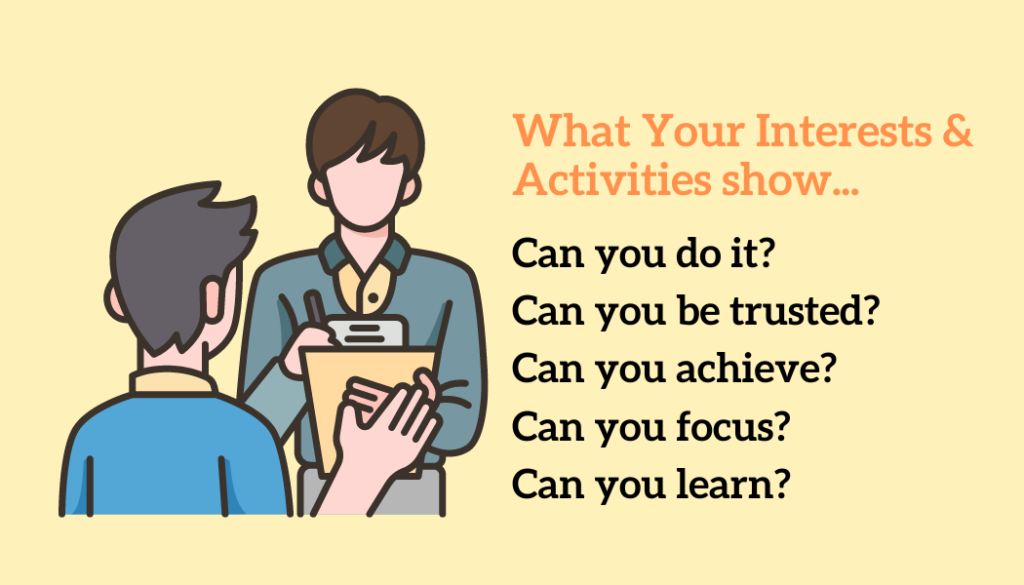 This week, I participated as a volunteer mock interviewer for high school students in Career Technical Education programs offered through the Sequoia Union High School District. I met with 7 students in total that day. We practiced engaging in a discussion about skills and experience as well as reviewing a resume.
As I reflect on that experience, one of the main talking points was the listing of interests and activities. This really gets to the core of the YCISL program with the Proof stage representing the high school level of the YCISL leadership objectives. First, let’s list 20 ideas for interests and activities that could be on a high school student’s resume as Proof.
1. Sports (Recreational)
2. Sports (Competitive)
3. Community Service/Volunteer Work
4. Tutoring
5. Clubs
6. Science, Math & Engineering Competition
7. Fundraising
8. Work/Internship/Shadow
9. Music (Individual/Group)
10. Art/Graphics/Photography
11. Drama/Acting
12. Social Media/Blogging/Vlogging
13. Video Production
14. Writing (Technical)
15. Writing (Non-Technical)
16. Journalism/Newspaper/Yearbook
17. Travel
18. Computer Programming
19. Website Design
20. Small Business Entrepreneur
Next, so that any of these interests or activities become a part of your personal story, practice EQ and asking-questions design thinking so that you can include it in your storytelling resume. As an example, one of the students I met at the SUHSD interviews had included an experience where he helped an aunt with a catering business at an event. His resume had only functional points describing his role. We discussed the scene and activity to color the story. We started with Who? What? Where? When? Why? and How? Then I asked about anything particularly memorable or an opportune learning or growth opportunity. Finally, we talked about the emotional senses before, during and after the event to gauge motivation and mindfulness. If we had more time, we probably could have gone deeper to find the hook words, keywords and action words that best represent this experience on the resume.
By this method of developing a mind view, I hope high school students can find more value in their early experiences and discover memorable moments of success and happiness for their personal story.
