
Category: Articles
WSJ: Partners in Blood
Few organizations in Silicon Valley implode like Theranos has. [There also was Solyndra.] But Theranos is a good case example for the innovation process for the YCISL program. This entry is based on the article “Partners in Blood” by John Carreyrou published in the Saturday/Sunday May 19-20 issue of the WSJ (Review section).
The article describes ultimately poor leadership skills on the part of two main characters in the Theranos story: Elizabeth Holmes and Ramesh Balwani.
By YCISL measures, they actually did a great job at problem-setting, brainstorming, and elevator pitch. They should also be given credit for product development with regards to setting a very compelling feature list.
However, there are two parts of the innovation leadership process that seem to not have been done according to Silicon Valley standards. One is the testing and readiness step. Alpha and beta testing must have revealed serious problems with what they had developed. Once the product was put in the hands of a real user, QA, QC, LIMS and all other lab protocols should have alerted everyone to problems.
The other step that went awry is prototyping. In YCISL, we emphasize “fail early, fail fast” in the prototype stage but Theranos kept developing a product past prototyping with showstopper failings. Any skilled analytical chemist would not trust data from small sample size due to the amplified issues with the “scientific method” including sampling error, sample contamination, sample preservation, and the conditioning of analytical instrument detectors. What Theranos did is an error usually made (but eventually understood) by first-time science fair students. The real failing here however is the denial of the flaws, and the inability of investors to resist the obvious fib. Fuel to the fire.
The lesson for YCISL is to be disciplined during the prototyping stage and even the testing stage. Be honest with yourself. Be willing to embrace failure and learn from it. Be comfortable starting again – Silicon Valley style.
Follow-on: I decided to re-read Jeff Raskin’s “HOLES IN THE HISTORIES” to remind myself how it only takes one acceptable “authority” to build a consensus resulting in fact but not truth. Theranos’ lie may have started as a small seemingly-manageable one, but one can imagine it getting out of hand once one investor bought in. At some point, people chose not to check primary sources and relied on secondary sources. People bought into the “fact” but took the truth for granted. Raskin also writes on DELIBERATE MISREPRESENTATION and the “reality distortion field” that Steve Jobs is closely associated with. This is a leadership “disease” which has spread widely and we should address by instilling stronger EQ in youth leadership.
WSJ: Advice to New Grads: Scale or Bail
As I make final preparations for my YCISL workshop this weekend with undergraduate students from the City University of Hong Kong, I read “Advice to New Grads: Scale or Bail” by Andy Kessler in today’s WSJ (Opinion Section in Monday May 21 21, 2018 issue; Inside View column) looking for spreadable wisdom from the author’s perspective.
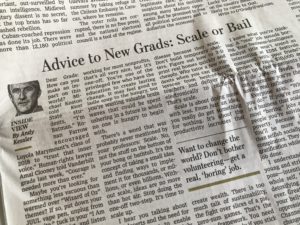
I thought it started off well, pulling in the advice that commencement speakers are giving at this year’s college graduations. Kessler’s main idea appears to be one of “scale” where the number of users are in the “thousands, or millions, or even billions.” His point about “Scale is about doing more with less” is quite inspiring – although I feel he needed the word “proportionally” in there.
To me, this resonates with Rory Sutherland’s point about “Stuff that has a big effect” and “Stuff that costs a lot of money” where there is opportunity to do “stuff” with big effect but costs little or no money. I think the key word here though is “opportunity” and it seems Kessler discounts opportunities and pathways (eg, “Stop doing one-off volunteering” and use of the word “Bail” in the title). It’s not that his advice is incorrect; it’s just that this advice itself doesn’t scale. It’s binary and not integrative. Innovation is about taking on uncertainty and risk. There is no guarantee.
Bottom line is that problems are everywhere and occurring all the time. Problem-solving – with huge (emotional) impact and rewards – spans all scales and requires action-takers willing to accept the possible outcomes. I think this article needs some framing correction for the social awareness component of EQ so that today’s graduates would be more willing to challenge their abilities and dynamically work with expectations on all scales.
CNBC: The world’s richest self-made woman shares her No. 1 key to success
I read an article on AsiaOne titled “The world’s richest self-made woman shares her No. 1 key to success” (by Serena Lin, dated May 8, 2018 on CNBC.com) which tells a story of Zhou Qunfei. For context, this was on CNBC.com in their Leadership section.
This story seems like a good one to touch on several YCISL ideas.
- For YCISL, we view success as having many forms (just as we do for leadership and sustainability) and perhaps the least encouraged way is on the level of attained wealth. As I scan the story, I see success in (a) how she pursued her dream of starting a business, and (b) how she teamed with relatives. Her personal commitment to perseverance is also a success.
- As we learn from Shawn Achor, we should place happiness before success. In the story, neither “happy” or “happiness” or anything similar are mentioned. Did she sacrifice happiness or has she not yet found any?
- The use of “self-made” in the article’s story seems incorrect. The article touches on several instances in which her support network kicked in. The fact that she started a family watch lens workshop shows that there was a support network. So too are her daughter and Motorola. Given this, I would have liked to have read about how she has shown gratitude to her supporters.
- In YCISL, we train in “fail early, fail fast” and discuss how one of Silicon Valley’s key strengths is the embrace of failure (or failing well) and one’s ability to rebound with learned lessons from failure. The part of the story where she is contemplating jumping from a train platform illustrates the opposite.
- There are two photos of Zhou with wide smiles. Applying Guy Kawasaki’s lessons on real smiles (ie, associated with positive mindset), I wonder whether she has a positive and growth mindset – which I consider critical elements on leadership.
Overall, I feel it’s a good Your Personal Story. It starts with a strong reflection of the past (especially a series of good decisions that seems like she would make again if she had to), an identity in the present (such as Brother Fei), and…ok, the story is missing a message to her future self. Almost there.
How Much Homework Is Enough? Depends Who You Ask

I probably should read “You, Your Child, and School: Navigate Your Way to the Best Education” by Sir Ken Robinson [published March 2018]. In a short cut way, I scanned through an “adapted excerpt” on the Education Week web site titled “How Much Homework Is Enough? Depends Who You Ask” which was linked from Sir Ken Robinson’s FaceBook feed – and to which I posted a comment (my first time ever, btw).
My comment read “The title and article suggests that the problem is quantity. I would posit that the bigger problem is actually quality. Repetition and application is part of learning for most students…and using the learned knowledge outside of a classroom setting is useful practice towards a lifelong love of learning. However, there is clearly an attempt at substituting quality with quantity. So basically we have a lot of homework with low value and little motivational factoring.”
I kept it quite brief, and had a few drafts before clicking to post. School homework is a touchy subject for many people, and I have commented on this topic from the start of this wiki, particularly stirred by Alfie Kohn’s “The Homework Myth” which I had read in 2011. Since that time, I have taken a critical eye of the homework that my kids have had to do. In my assessment, most of it was junk quality (the meaning of junk here is similar to how it might be used for junk food and junk bonds, or one man’s junk is another man’s treasure). It’s consumable by the masses, but the benefits and circumstances are iffy.
What is the meaning of homework (I am asking this in the same philosophical mood as the question about the meaning of life)? In my view, homework today is a tool of convenience for the education system. Their primary purpose is to differentiate students and justify the education system. But it can be so much more…more fulfilling, more motivating, more purposeful, more about growth and more embraceable.
The typical mode of homework operations reminds me of the criticisms raised by Adora Svitak in her 2010 TED Talk “What adults can learn from kids” in which she touches on reciprocal learning. Is there reciprocity in homework? Nope. From what I’ve observed, teachers are on a mission to get through the curriculum and show grades along the way. Checking homework is a chore (often caffeine-fed) to teachers and for many subjects, it boils down to comparing a homework to an answer guide. That is one of the consequences of the volume of homework that is addressed in the Education Week article.
I think it’s fairly obvious that the problem is the quality of homework. There is a massive QUANTITY of homework because the QUALITY is absent. The quantity is there to compensate for the inability to design homework to optimize for active recall, short and long-term retention, and individual needs. Further, homework perpetuates the problem of the focus on memorization by requiring only convergent thinking (aka logical deductive reasoning). To become a more sophisticated element of learning, homework needs to include divergent thinking in the process. Get that Growth Mindset (tip of the hat to Carol Dweck) into the mix. Train the students to make assumptions and give it a go. Explore the impossible and possible together.
What if teachers were required to design or re-design homework assignments on a regular basis? That is, they would be limited on how much they could rely on textbooks, the internet and other teachers. They would also not be allowed to re-use a portion of their homework from the past. Make it acceptable for the homework assignment to be imperfect. In fact, make sure the students understand that the homework is imperfect and have them deal with it. How enlightening would that be?
I think re-inventing homework needs to be a project that a team needs to work on in future YCISL workshops.
WSJ: Schools As ‘Maker Spaces’
In the WSJ’s The Future of Everything section on Saturday April 21, 2018, I noticed an article titled “Schools As ‘Maker Spaces” by Leigh Kamping Carder. The article is brief, but it does point to several important ideas when it comes to introducing creativity to elementary and middle school students.
- “…cues from Silicon Valley’s startup incubators.” A better model than a startup incubator may be a research laboratory where experimental skills are nurtured. Students should pick up skills which can be reproduced and improved over time. A laboratory may capture a youth’s imagination more vividly than an incubator.
- “…flexible work groups.” This is definitely worth exploring further. Flexible workspaces as well as collaboration groups are primers to creative productivity. One could also extend flexibility to the work styles, communication channels and oversight. Encourage divergent thinking.
- “Maker Spaces.” At Stanford, we have the d.School, Product Realization Labs and the create:space. They’re spaces which provides nodes to creative activity. Within each node are sub-nodes which include the equipment (a 3D printer was mentioned in the article) and other tools necessary for the activity. How are these nodes being connected?
- “Educators are still learning how students can best benefit from such spaces.” Let the experimental design begin.
WSJ: District Drops Plan to Name School After Blackstone CEO
A page A3 article titled “District Drops Plan to Name School After Blackstone CEO” by Tawnell D. Hobbs appears in the April 13, 2018 of the WSJ. I am in the process of wrapping up composition of a YCISL white paper on adding Philanthropy to the YCISL program as a platform and cause.
The article reports on some gesticulation over a $25 million gift to a public school. This incident is interesting in that it highlights the distinctive features of conditional vs un-conditional philanthropic gifts of the monetary kind. For this conditional gift which involved naming and re-naming, a blanket of negative emotion was thrown on and it is certain that all named stakeholders (community members, the school board, the donor, and all other parties enabling the transaction) have had their positivity sucked out of them. Applying the lesson from Alison Ledgerwood’s TEDx Talk “Getting stuck in the negatives (and how to get unstuck)”: there was a framing problem for this particular gift and getting into the negative will have a lasting impact outweighing a series of positives. That’s too bad.
Could the gift have been framed in an un-conditional manner and the re-naming of the school be floated as a possible sign of gratitude? Should the re-naming of the school have been just one of the options that came up as a result of brainstorming ways to show gratitude? Could that brainstorming have been done in a way that all stakeholders respect the ideas expressed? What kind of prototyping of the most promising ideas could have been done? Do people prototype philanthropic ideas (I don’t know) or is this usually set up with pre-set extrinsic motivators to draw in donors? How do you decide what the best “skin” is to wrap around the engineering/design/architecture so that the beneficiaries and overseers will focus on the positives? How (timing, content and attributes) was the donation articulated? Did all stakeholders understand the PROMISE and the ASK?
I am wondering whether the lessons we incorporate into and attempt to impart through the YCISL program can help our students navigate through philanthropy projects and build LI (Leadership Intelligence). Maybe. I can’t wait to try it this summer.
WSJ: The Gatekeeper Tests
The lead article in the Review section of the Wall Street Journal published Saturday/Sunday, March 10-11, 2018 is titled “The Gatekeeper Tests” and written by Nathan Kuncel and Paul Sackett. This article essentially supports the use of SAT and ACT in college admissions. Personally, I believe it is time for a ground-up replacement of these tests and find it no surprise that the credits/disclosure section of this article indicates “In the past they have received research funding from the College Board.” The article is adapted from a publication Kuncel and Sackett authored.
This article is sectioned into myths and research-based arguments why they are misconceived. My read of this article gave me a feeling that the arguments have good intentions (justifying current practice) but lack full perspective. From the use of the words “research” and “facts”, it is clear their perspective is defensive.
Many of us know that GRADES DON’T MATTER. I would add that SAT/ACT/AP scores mean even less. This ties in well with another WSJ article that I have just commented on titled ” More Companies Teach Workers What Colleges Don’t.” In that comment, I posted a simple graphic that shows the balance of college graduates vs pre-college graduates going into the workforce. The main effect of pushing more students to college creates the greatest economic benefit for test providers (I would have named College Board specifically if I were just focused on US college admissions). Viewed as an exercise in mass action, more college applicants (and more applications thanks to technology) means more test fees. A higher level of competitiveness also results in more repeated testing -> higher fee revenue from each test taker. Just like an argument I saw for supporting the income tax preparation industry, I would believe that the college admission testing industry is on a roll (let’s also include test prep as well as college application counseling services). I am look forward to more colleges making the SAT and ACT optional.
OK, now to my views of the myths.
Myth: Tests Only Predict First-Year Grades. Successful SAT/ACT test takers are largely likely to be successful GRE/GMAT/LSAT/MCAT etc test takers. Test taking is a skill and scales from low to high. Test taking skills can also influence college course grades which rely wholly or heavily on proctored tests (as opposed to take-home finals, papers and presentations). The authors point to evidence that high test scores are predictors of several forms of outstanding achievement; there is no mention of how many high test score students end up with lower college measures and outcomes (remember the effect of students finding themselves average in college because of the selectivity in the admission process). Consider too how students with low Math and Analytical test scores may avoid STEM majors. How too to rationalize foreign students who are able to game the tests by conditioning?; I have read elsewhere about how the college drop-out rate for foreign students is increasing.
Myth: Tests Are Not Related to Success in the Real World. College admission tests measure convergent thinking. They are mostly made up of multiple choice questions – and even when there are other question formats, the key is simply to deduce the right answer (even in the essay). In YCISL, we emphasize the practice of preceding convergent thinking with divergent thinking, and repeating the cycle. Our program also positions real world success as being largely determined by fast thinking (improvisational) skills as well as emotional intelligence which are certainly not what these tests are testing.
Myth: Beyond A Certain Point, Higher Scores Don’t Matter. Higher scores really only matter to one group of people – college admissions staff. And the reason is to cut the workload down in the face of soaring numbers of applications due to the ease of applying thanks to technology and a larger proportion of many countries’ population aiming for college. When I interview students for on-campus jobs, I don’t ask for test scores (they don’t even put it on their resumes). Faculty seeking PhD students for their research groups couldn’t care less. An even when I worked in the tech industry, the interview never touched on test scores. You can’t even use GPAs any more either. So for all practical real world post-college purposes, test scores are buried history.
Myth: Common Alternatives to Tests Are More Useful. It is a pity that the authors discount letters of recommendations, personal statements and interviews in favor of test scores. They seem to miss the modern purpose of the college experience and the importance of self-fulfillment. They are stuck on older indicators of career success such as those mentioned in Ken Robinson’s TEDTalk about time of the Industrial Revolution. One is more likely to find a nugget among those with compelling personal stories (a topic in the YCISL program) than among test scores that measure a specific cohort on a specific date and less so between cohorts. Students would benefit more from self-presentation skills than test scores.
Myth: Tests Are Just Measures of Social Class. This is better phrased as a null hypothesis “Social Class has no influence on test scores” because if you look hard enough, you will likely see pockets of it. But the causation-correlation connection is weak because we also know that students from outside the US social structure have a propensity to ace the SAT tests. This could be due to grit (taken from the title of Angela Lee Duckworth’s TEDTalk) due to the higher barrier that foreign students perceive. Foreign applicants may also have an advantage due to the rigor of their education culture. Even within the US, I would hazard a guess that there are a measurable number of students who aced the SAT without any special prep.
Myth: Test Prep and Coaching Produce Large Score Gains. If we view tests like the SAT and ACT as IQ test derivatives then score gains are unlikely to come from test prep and coaching. But if you put all the factors discussed above together, they are not perfect IQ tests because there is an element of endurance and focus in taking these tests. And how do you build up endurance and help focus? You take practice tests and get someone to shift your viewpoint on test problems you can’t seem to get focus on. Again, these are test taking skills.
Myth: Tests Prevent Diversity in Admissions. Entering college cohorts are becoming diverse despite test scores and not because of them. There is a variety of options open to admissions staff to create the diversity. At my own college, we are quick to mention the presence of scholar athletes. And you may have heard about the legal actions being taken against Harvard. Test scores are a source of frustration.
I would disagree that such standardized test scores are “invaluable” and “effective” – we are just waiting for a revolution – one in which such tests are demoted to where they really belong. It is time to innovate and leverage intrinsic motivation in how we help willing students to pursue their passions for learning and self-development. Let’s get a system which helps you find the right college instead of keeping you in the dark.
WSJ: Work Before Fun? That Might Not Always Be Best
In the Wealth Management section of the Monday October 23, 2017 issue of the WSJ, Demetria Gallegos wrote the article “Work Before Fun? That Might Not Always Be Best” which cites a research article in Psychological Science by O’Brien & Roney (2017) titled “Worth the Wait? Leisure Can Be Just as Enjoyable With Work Left Undone.” My commentary and analysis is based on the WSJ article by Gallegos and the research article’s abstract.
This topic reminds me of Shawn Achor’s question about the order of success and happiness, and the overall subject of positivity as related to productivity. The difference may be that Achor focuses on the pursuit of success and happiness, whereas O’Brien and Roney are looking at the pursuit of fun and work. Both are looking to produce productivity gain.
But what if we took a fuzzy view of work/fun? That is, what if work and fun were not neat packages that could only be sequentially ordered? For example, what if work and fun could be in parallel? Yes, have fun doing your work. This is an idea I remember from Richard St. John’s “8 Secrets of Success” and I think is closely linked to the motivational feeling of purpose. In YCISL, most of our activities are framed as games – to promote the “fun factor” which I have learned from coaching youth.
We could also extend this thought to having work paired with fun. Not all work has to be paired (there are some things we have to do that we might not feel that it is fun) but we can influence productivity by selectively choosing specific tasks to have a fun component. In the chemistry analogies I like to use, work could be bonded to fun and it doesn’t have to be just a 1:1 combination. If I could bring in Daniel Pink’s ideas on intrinsic motivation, we could try to bond mastery, autonomy and purpose to work in order to gain that significant and sustainable productivity gain.
While these latter views of the work-fun system are more complex, I feel that a sequential order for work and fun (as designed in the published study) is not a sustainable solution. The actual problem may be bureaucratic policies that only measure work (at work) and try to stifle fun (at work) – to borrow from our basic program premise that schools stifle creativity.
WSJ: Feeling Stuck? Write Yourself a New Job Description
In the Personal Journal section of the Wednesday August 12, 2015 issue of the WSJ, Sue Shellenbarger wrote the article “Feeling Stuck? Write Yourself a New Job Description” which touches on a “sense of meaning and purpose” – thus connecting to this year’s YCISL workshop theme of Purpose. The article also mentions “intrinsic motivation” as a “hiring draw” for employers. This fits in well with what I have learned from Daniel Pink’s description about intrinsic motivation. The article also contains other YCISL keywords such as “coaching” and “fulfilling.”
The takeaway lesson from this article for YCISL is about the process of redesigning what we do – and to put this in the youth context. In the workplace, adults can discuss changes with supervisors – but the opportunities to do this are likely quite spread apart (e.g. at annual performance reviews) and need a good elevator pitch behind it (and a supervisor with the requisite understanding and influence). Focusing on youth though, we can develop YCISL exercises to practice the work redesign process – as training as well as in school or at home. What if our students could discuss a personal redesign with their parents, bringing up things that they really want to do and managing tasks that are less fulfilling? What if school counsellors actually took personal interest in students and discussed changes needed to heighten sense of meaning and purpose in school? What if schools tapped on intrinsic motivation to make education more intrinsically motivating?
For the YCISL workshops, we could add this as a topic (or a feature) to the elevator pitch exercise and have our students show emotional leadership to the idea they pitch.
WSJ: Does Technology Belong in Classroom Instruction?
In today’s (Monday March 11, 2015) edition of the WSJ, there is a Technology section with an article addressing the question “Does Technology Belong in Classroom Instruction?” with the Yes argument provided by Lisa Nielsen and the No argument provided by José Antonio Bowen.
Let’s reflect on this question in the YCISL context especially our problem (that schools stifle creativity) and our program emphasis areas.
The prime question is whether technology, as it is applied in schools, enhances creativity and provides opportunities to develop personal skills. Let’s focus on five electronics-enabled technologies that are in current adoption in schools:
1. Computers. Out of the five selected (electronic) technologies, computers have had the longest run in schools so far. Computers are major investments in terms of initial capital as well as ongoing maintenance. Early on, computer companies often donated computers to schools and parents volunteered to maintain them. Their impact on creativity is mixed. On one hand, they are big-pipe sources of knowledge and viewpoints; on the other, they have become tools on which we lay and express our thoughts and ideas as well as analyze data.
2. Tablets. Lighter backpacks are the main benefit of tablets. With respect to creativity, I think they are at a disadvantage to computers because of their smaller screen and higher difficulty in user input (much easier to swipe and tap, than to draw or type). Obviously so, they are handier for searching/researching big-pipe sources of knowledge and viewpoints; although not a particularly good solution as an alternative to printed textbooks because of their limited screen size.
3. Interactive Whiteboards. In concept, this technology certainly belongs in classrooms. However, their performance and ROI is so below potential. Remember “Under-promise and Over-deliver”? Compared to modern whiteboards which can be as long as the length of walls in a room, the limited screen size of interactive whiteboards is a disadvantage when it comes to promoting creative exploration in a classroom. Sure, interactive whiteboards are useful when putting up PowerPoint presentations and annotating them, but can they replace the analog alternative altogether? No, they can’t. So the result is an additional expense rather than an alternative expense, and a significantly higher maintenance cost – all with a limited lifetime and shorter replacement cycle. And there are the health issues.
4. Class Web Portals. As a parent of school children, I have used a few Class Web Portals before. I think they have gotten better in terms of learning curve. The early problem was that schools and teachers only half-committed to these portals so information was split and not replicated between paper and web. So students and parents had to check two sources of classroom information and collate on their own with no way of being certain of full-picture accuracy. So assignments were missed or students needed twice the time to get homework done. My guess is that the learning curve has gotten easier as more HCI technique is incorporated as well as teachers, parents and students becoming more accustomed to interacting with classroom web portals. I have also experienced Stanford’s Coursework portal which is quite good and useful; I especially like that students can upload assignments and the server clocks the time that an assignment was submitted. However, with regards to creativity, I have not yet detected any features that help educators or students interact creatively. Maybe in the future.
5. eBooks. There are eBook devices whose clarity and readability are great advantages. But these devices are not making headway into schools. Instead, tablets with eBook apps are common. eBooks as data downloads are also growing. eBooks tied to publisher web portals are also an interesting concept and have potential to enhance creative and critical thinking. The barrier is the monetization: eBooks (especially textbooks) are not cost-effective and do not possess the advantages of printed books. Like tablets, their main advantage is lighter backpacks (and fixed space requirement) but they are not fully-competent replacements for printed textbooks. That is why I purchase the printed textbook (use at home) in addition to eBooks (use at school) for some school subjects such as history and biology.
In my view, technology will “belong” in the classroom – one day in the future when it is more mature. Presently, it has too many kinks and disadvantages and the expense is unjustifiable because product developers are in the early stages still. Remember when a 20 MB hard disk cost $1,000+? We can get a more reliable 120 GB solid state drive now for around $100.
Let’s gather educators to brainstorm ways to leverage creativity from classroom technology first then develop and reveal a true solution with the promise of replacing paper and pen, chalk and chalkboard, printed books and handouts. Let’s innovate.
