Category: Activity
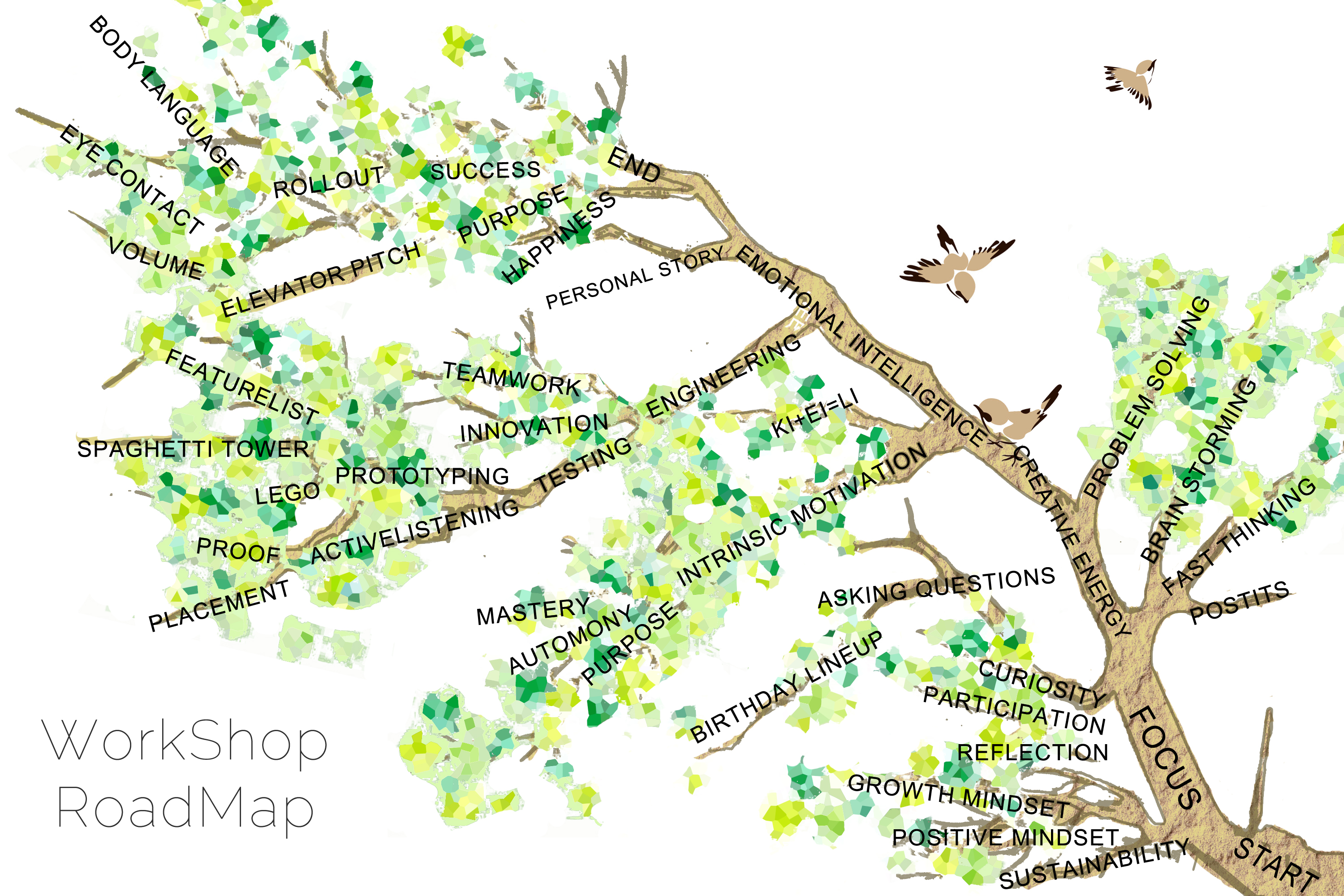
Mentor Exercise: Map Our Workshop
The main idea is to graphically list all the topics (life lessons, messages, activities, etc) into a map and perhaps show connections to our themes. Mentor Sophie designed the following based on the Wasedajuku March 2015 YCISL Workshop.
Activity: The Thomas Interview
While YCISL emphasizes “Your Personal Story” as a theme, it may be worthwhile to develop an exercise where one develops a personal story of another person through an interview. The interview would involve questions based on a variety of YCISL topics such as “Purpose” and “Motivation.” Through such an exercise, students would learn to frame their personal story using the YCISL elements and appreciate the directions that can be taken.
Exercise: A Message To My Future Self
Earlier, I had made an entry on a WSJ article titled “Revisiting Teenage Dreams” where students watched video messages to themselves that they had recorded while in high school. At that time, I compared it to the end-of-workshop videos that the YCISL participants recorded to capture the thoughts that have inspired them from their Stanford experience.
We have now implemented a new workshop exercise called “A Message To My Future Self” in which students make a video message to themselves – to be viewed 5 years later or beyond. We also created a companion exercise called “A Message To My Past Self” in which students look back and reflect in written form on advice they would give themselves; a sort of lessons learned exercise. This is all tied in under our “Your Personal Story” theme.
In the AMTMSF exercise, we provided prompts with a couple of PowerPoint slides:
1. To say at the start of the video…
hi! my name is [name]
i am from [home]
today is [date]
i am [age] years old.
this is a message to my future self.
2. Possible things to talk about…
who i hope to be.
what i hope to find.
what i hope to do.
what i hope to have.
what i hope to accomplish.
what i hope to achieve.
what i hope to be remembered for.
how i plan to get there.
As with all YCISL exercises, we hope that all students will think more deeply over time about the thoughts raised by this exercise. Some of the students were able to be very thoughtful despite the short preparation time, whereas others could not put themselves in the necessary frame of mind. As we continue this exercise, I hope to find common threads that we can engrain into the YCISL program to encourage more consideration and discussion.
Game/Activity: The Pocket Search & Life’s Journey
Main idea: In life, we search for things and if we are narrowly focused at the time, we pass by many things without much notice if any at all. This exercise is intended to encourage reflection when our mind is searching for something. It is intended to touch on times of failure/emptiness, distraction, incidents and success/goal-reaching.
This exercise involves placing items in the pockets of a piece of clothing – the more pockets and more types of pockets (front, back, zippered, etc), the better. Another person is told to find a particular item which is in one of the pockets. For each pocket searched, the second person must take a moment to capture their feelings/emotions. The range of results could be:
(1) finding the item on the first look…was this luck or fate? What might happen when you try again with another piece of clothing? Could you repeat the success on the first try?
(2) the item in the pocket searched was not the item being sought after…how do you value the item that was found? Do you disregard it and keep looking for the item you are supposed to find? Or do you think about how it might be useful in another context? Or do you think about changing what you want to search for?
(3) finding the item after looking through two or more pockets…do you feel validated? Did you feel that maintaining hope was at your core? Did you become more or less optimistic with each pocket you had to search? What satisfaction did you feel when you found the item? Do you remember the moment you found the item or the sequence of moments that led up to the discovery?
(4) finding nothing in the pocket (empty pocket)…is there a feeling of hope because you eliminated one of the pockets or is there a feeling of emptiness? How eager are you to move on the next pocket? How is your positive mindset?
Since this is still in the experimental design stage, expect there to be better ways to tie in with the YCISL program. At this point, it seems that this activity provides a framework onto which we can attach a variety of life lesson reflective questions. Note to self: establish positive mindset before starting the activity.
Material list:
One article of clothing with many pockets (e.g., jacket, five-pocket jeans especially with zippered pockets)
Assortment of articles (the more obtuse, the better for diversion purposes)
Journal for reflection

Supplement: Prepping for YCISL (White Paper Series)
This is a supplement to the YCISL White Paper titled “Prepping for YCISL: Go for Breadth” which was recently posted to the CSDGC Youth Leadership web page. That white paper discusses the YCISL Leadership Objective of “Placement” and how prospective YCISL students can get ready for a future workshop at Stanford which focuses on the Leadership Objective of “Proof.”
This wiki entry shares some ideas on candidates for “Placement” and hopes to demonstrate a systematic seed and branch approach to surveying the opportunity landscape.
EXAMPLE 1
Seed: MUSIC
Primary Branches: Piano, Violin, Viola, Cello, Guitar, Flute, Singing, Songwriting, …
Secondary Branches: Musical genres
Tertiary Branches: Solo vs Duet/Quartet/Band/Chamber Orchestra/Symphony/Choir…
Quaternary Branches: For fun, amateur performance, competitive performance, professional performance.
EXAMPLE 2
Seed: SPORTS
Primary Branches: Swimming, Basketball, Soccer, Tennis, Golf, …
Secondary Branches: Self-taught, Lessons, Matches, Competitions, Leagues
Tertiary Branches: Spectator, Solo Participant, Team Participant, League Participant, Commentator, Writer, Coach, Referee/Umpire/Official, …
Quaternary Branches: For fun, amateur, competitor, professional
EXAMPLE 3
Seed: FOOD
Primary Branches:
Traverse these trees and you may come up with a compelling scene in your personal story.
ACTIVITY: Filtering at the Early Prototyping Stage
Prototyping is the second stage of the YCISL simple innovation framework. In this stage, you select some of the best candidates from the brainstorming stage and try to construct simple models or simulations of the select ideas in order to quickly identify weaknesses, challenges and problems associated with each of the prototyping candidates. This is in line with the “Fail early, fail fast” mindset we apply in our workshops. The aim is to advance just one of the prototyping candidates to the engineering level.
However, this is also a good time to document the main advantages of each of the prototyping candidates as well. The potential distance and impact of each prototype candidate are valuable considerations and will help maintain a positive mindset as development continues. Therefore, a technique for early prototyping is proposed where the positive aspects (“praises”) and negative aspects (“criticisms”) are extracted and sorted into their respective boxes. For prototyping, we are usually looking for prospective showstoppers, dead-ends and oopsie daisies! These will be dropped into the CRITICISMS box but this box will also contain the lesser risk and lower severity issues – and this whole box should be saved for later in the testing and readiness stages. This late engineering stage will be where the user guide and other “accident avoidance” strategies will be developed to steer the user away from or around known issues – or fixes could be developed if there is an opportunity.
The other aspect of the PRAISES-CRITICISMS filtering is the collection of the positive aspects (“motivators”) which move the work forward. Prioritization is needed for this box but comparative analysis of the PRAISES box for each prototyping candidate will help provide guidance on the risk-benefit and competitive advantage. The PRAISES BOX can be used in the mid-prototyping stage where the team can evaluate how fantastic a feature can be (e.g., battery life which could be good, better and wow!) Remember that the aim of prototyping is to find the most compelling product to solve the problem and invest the most resources in getting the product to be successful and displacing existing alternatives.
In sum, a PRAISES-CRITICISMS filter is recommended in early prototyping to help weight the benefits of advancing prototyping candidates, set the criteria for early failure and build a bank for late engineering testing and readiness.

Exercise: Teamwork & Self-Training
In my workshops, I describe the process I learned to coach the basketball free throw. I use it to frame the workshop goals where I aim to coach techniques and mindsets, and encourage “players” to practice on their own to get ready for the game. In this process, there’s the setup first, followed by the action then the endpoint check; this is how each component of the workshop is delivered.
As a teamwork exercise for the workshop, I am thinking we could have a team free throw contest but allow a period of time for the team to work on their free throwing skills first. The idea is for those who feel they have the better shooting skill to coach others. This will require team leadership as well as coaching skills. Group dynamics will likely also be a factor.
The simple contest will be to see how many shots a team can make in an allotted amount of time (this could vary as well). We could have one or two setups (I am thinking of getting indoor mini hoops with foam balls but we could just as easily do this outdoors with real basketballs on a regular basketball court).
Exercise: Adaptation of the 30 Circles Test
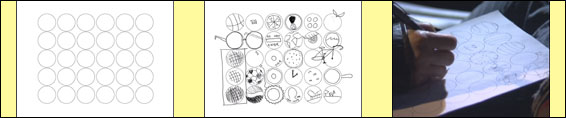
If you’ve seen the video “Tales of Creativity and Play” of a talk by Tim Brown at the 2008 Art Center Design Conference (aka Sound Play) – that is available as a TED Talk at http://www.ted.com/talks/tim_brown_on_creativity_and_play.html, then you may remember the 30 Circles Test that the audience took part in. Following the 30 Circles Test, Brown remarks “And one of the things we tend to do as adults, again, is we edit things. We stop ourselves from doing things. We self-edit as we’re having ideas.” This is certainly something we can apply to youth creativity and in this post, I describe an early attempt to adapt this exercise for youth. But first, credit for the original test goes to Robert McKim, Professor Emeritus of Stanford’s Department of Mechanical Engineering who is credited with being “a pioneer in experiential psychology in design.”
The following is a set of screen captures from the Tim Brown Ted Talk video showing from left to right: the starting sheet of paper with circles pre-printed, an example of a completed sheet, and an audience member working on their sheet.
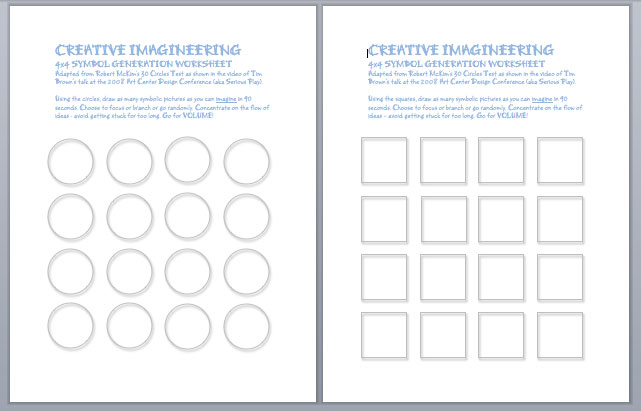
For the YCISL, I have created a sheet that has just 16 shapes (in a 4×4 matrix layout) instead of 30. On one side of the sheet is rubric with the matrix of circles. On the flip side is the same rubric with a matrix of squares. I also left relatively more space between the shapes to allow for extensions to the shape as opposed to only drawing within the shape. Making the shapes in MS Word, each shape is in a medium gray line with no fill and a drop shadow of the same color as the line – this to give a depth feel and encourage 3-D imagination.
Each side is titled at the top “Creative Imagineering” with the subtitle “4×4 Symbol Generation Worksheet.” I borrow the term “imagineering” to show that this activity exercises the imagination and requires some engineering to make it appear on the sheet of paper. The creative part is the participant choosing how to fill in the sheet – in sets or with randomness or with some other variation. I also include “Symbol” to indicate that a detailed and accurate representation is not necessary and rawness to the images is acceptable. Here is the rubric for the circle side of the sheet: “Using the circles, draw as many symbolic pictures as you can imagine in 90 seconds. Choose to focus or branch or go randomly. Concentrate on the flow of ideas – avoid getting stuck for too long. Go for VOLUME!”
Why the reduced number of shapes? It was partly because it was closer to any expectation of the number of shapes that a youth would be able to complete in the given time – thus greater potential satisfaction for the user in doing this exercise. This positions the exercise as a positive achievement and a result of flourishing imagination. The numerical total also somewhat coincides with the youth age range; we could say that a 16 year old or older, with their greater exposure to life, may be able to come up with 16 filled shapes. Then an approximate target of one shape per year of age could be posited to the group as a reference index. Lastly, the symmetrical layout allows for multiple directions in approaching and filling in the matrix with minimal bias – eg, inside out, outside in, diagonally, etc. You get it if you play Bingo.
This sheet may change as I observe the outcomes of exercises with this sheet.
Lastly, I let the students in my class today make paper airplanes with the used sheet of paper which plays into the exercise where students symbolically let their ideas “take flight.” More on that another time.
Notes on Coaching the 90-Second Elevator Pitch to Youth, Part One
Spurred initially by the WSJ article “”The Most Awkward Meeting: New Elevators Sort Employees, Foiling Manners And Face Time,” one of the skills that I have been coaching and promoting is the 90-Second Elevator Pitch. During my visit earlier this year to Singapore Polytechnic, I introduced the exercise using the Monterey Bay Aquarium Seafood Watch fold-out card as a starting point. At that time, I learned it was critical to keep myself (the one providing the instructions for the exercise) separate from the one receiving the pitch (so I had the teachers get involved as the listeners). We then conducted a brief 90-second elevator pitch exercise in the June YCISL workshop.
This week, I had the opportunity to include it in the middle school elective I am offering. The students are 11 to 13 year olds. Two weeks ago, I introduced PostIt brainstorming exercises, the last of which was ideas to make their school better. This week, I had them select one of the ideas and elaborate on it so that it could become a 90-second elevator pitch – to the school principal! They have two 40 minute weekly class sessions to work on this then they will present in the third session. This entry includes a description of what we did in the first session, and I will update later on our progress and results.
We started out the session by watching three television commercials on YouTube. I started out with the VW-Star Wars (child in a Darth Vader costume) commercial. Students then chose the Keyboard Cat’s Wonderful Pistachios Commercial, and the ShamWOOHOO commercial (a parody of a real commercial – but this was a great choice as it emphasized the main ideas for the next part). Television commercials are of comparable time lengths and almost definitely contain an attention-grabbing component. And by having students suggest a couple to watch, I hoped that this would activate their attention.
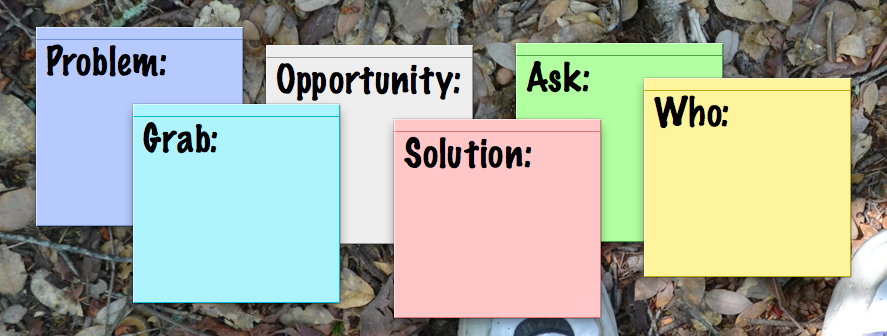
I then listed six words that I wanted them to write separately on PostIt notes: Grab, Problem, Solution, Opportunity, Who, Ask. I extracted these terms from the Garage Technology Ventures’ “Writing a Compelling Executive Summary” – except I substituted “Who” for “Team.” These words were guides for the content they had to create. There was no particular sequence that they had to follow. They could fill in PostIts as the relevant thought came to them.
When they had created their notes on each of the PostIts, they were instructed to play with the sequence and consider the flow. They naturally asked whether they should start with the Grab. We then thought back to the commercials we had watched earlier, and discovered that the Grab did not have to go first. Thus, they were to experiment by reading to themselves various sequences of the notes.
They then took turns doing a stand-up dry run (90-second rule enforced). They were welcome to just read from their notes. Like with working on a jigsaw puzzle, we were checking out how the pieces fit. Feedback from the audience was welcome (at least when I work on a jigsaw puzzle, I usually ask for help/another perspective). Yes, kids can be cruel to other kids (especially classmates) but it is better in this case to get the criticism early (fail fast, fail early) – because there are many options to make the presentation work better and each student did not have time to become too attached to a particular approach and therefore take negative feedback to heart and become discouraged. This reminds me of a couple of books I read in which there are passages describing how a comedian would try out new material in a small, practically informal, group setting first before using it in a production setting. They will return next week to polish their presentation.
Exercise: Name Scramble for Warm-up
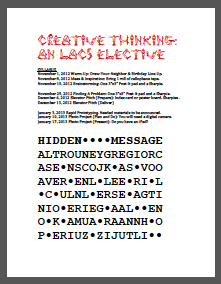 For a middle school elective course on creative thinking that I am teaching, I came up with a (hardly unique) exercise to warm-up the students to the subject.
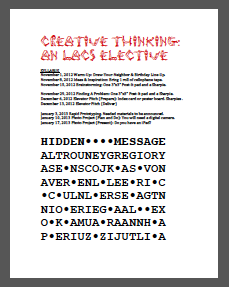
On the syllabus sheet that was waiting for them at each seat was a “Hidden Message” puzzle. The benefit of such an approach is that a student can start on something when they enter the classroom (and when they come in at different times, it is good to have something ready for them to do – I learned this from Challenger School where students start on work that is on the board when they enter the classroom first thing in the morning – they go directly to the classroom from drop-off).
There are no specific instructions; just the title “Hidden Message.” So, as expected, students are drawn to this puzzle (rather than the syllabus) and ask about it. I say that they should try to solve it. Some will ask what they should do; in response, I ask them what they think they need to do. To keep them on task and engaged, I provide hints as needed (maybe every 30 seconds or so).
For this puzzle, I took the name roster and inserted letters that spelled “CREATIVE THINKING.” Then I added dots to make the puzzle into an even-width shape. The name roster uses the possibility that they know each others’ names already or recognize their own name first. For a mixed level class such as this, the students needed a hint that this involved their names; they asked whether they could ask each other for their names and I reminded them there were no specific instructions so were free to use whatever method they could think of. So, they started talking – but the social dynamics provided some foil where some students were not cooperative – so workarounds or negotiation became involved.
The puzzle was solved within 15 minutes which is just right for a warm-up.