
Category: Activity
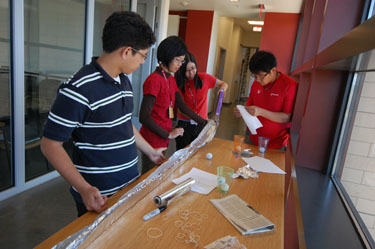
Exercise: Team Design Challenge var.1 – Chute Races
TEAM DESIGN CHALLENGE: ALUMINUM FOIL CHUTE RACES
This is partly a recount of the team design challenge from June 2011. It is also an opportunity to think why we do this exercise, and variations that are consistent with the objectives.
WHY?
To provide engaged team atmosphere.
To test team dynamics under time-constrained conditions.
To experience rapid team idea exchange, design and decision-making.
For the teambuilding lessons.
To create an impromptu structure of leadership and functional responsibilities.
To focus on blend of instant creativity and teamwork.
To work with basic (on-hand) materials.
Sometimes, when you’re given a small window of opportunity to prove or demonstrate something, you have to build that thing with just the materials at hand and with only your instinct about whether it will work. Think MacGyver. Think Top Chef Quickfire Challenge.
HOW?
Students will not be given the details of this exercise until the start of the time slot.
Time slot will be 3 hours: 15 minutes explanation, 30 minutes brainstorming and design, 1 hour construction, 1 hour set-up and execution, 15 minutes discussion.
The aim will be to design a chute using some basic materials.
Last year’s materials: aluminum foil (1 roll), elastic bands (1 box), paper clips (1 box), tape (1 roll), cup (1 ea), golf balls (4 ea), string (1 ball).
Materials are open to variation.
Examples: water instead of golf balls; chute must have Y- junction; baseball instead of golf ball; curvature (spiral, bend or mole-hill); ramp-jump; jump and land in receptacle (eg, a bucket).
Assignment: Photo Essay (Formalization)
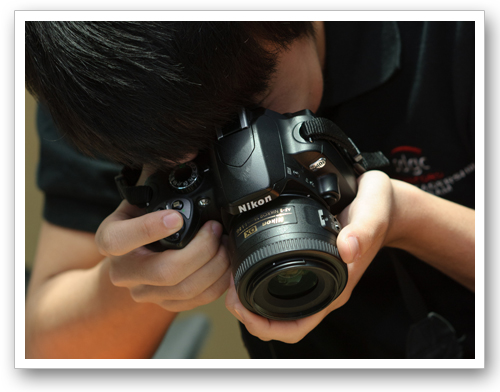
Almost a year ago, I made an entry alluding to Praveena Sridhar’s photo essay and a few ideas of what a Photo Essay assignment could be on. First, I just realized that the entry did not have specific detail on the assignment. Second, I did not elaborate on Praveena’s Photo Essay.
Here are the notes I have shared with my interns:
WHY?
Demonstrate a documentation method.
Encourage reflection.
Use photos to record things that might be missed the first time.
Long-term record.
Pictures are worth a thousand words.
Photos show perspectives.
Use photos to reflect personal viewpoint.
Taking photos is a creative exercise.
A collection of photos can be set along a theme.
A themed photo essay can be persuasive.
The theme can be “vertical” or “lateral” or perhaps both.
The product should be personal and contribute student’s personal identity “un-generic.”
Can be used as point of discussion in personal statements or interviews.
The combination of pictures and words is an effective start for future use. The words capture facts and emotions of the moment. The picture makes the overall exercise sustainable into the future
HOW?
Students will be introduced to the idea of a photo essay.
Students will be shown Praveena’s photo essay as an example. http://www.indiawaterportal.org/blog/praveena/8064
I will show two or three photo essays from last year’s group.
We will discuss the intellectual as well as emotional value of Praveena’s photo essay on Water Loss.
Students will be oriented to the photo essay assignment (separate document).
Mentors may help students develop theme ideas – using questions.
Mentors may only superficially help students with content – again, using questions.
Photo essay exhibition is intended for students to share and exchange perspectives.
Promote understanding. Minimize judging.
Exercise: 90-Second “Elevator” Pitch

I mentioned the 90-second elevator pitch idea in an earlier entry based on my reading of “The Most Awkward Meeting: New Elevators Sort Employees, Foiling Manners And Face Time” that was published in the WSJ (http://online.wsj.com/article/SB10001424052748703509104576331044032063796.html).
Here is an attempt to formalize an exercise that could fit into one of the pre-speaker “mental wake-up/warm-up” workshop slot that have been under consideration.
PURPOSE: to get students to focus on the most important points, to think on their feet, and have a sense of time when they are trying to persuade someone. They need to appreciate that they need to grab attention and that once they have it, they only have it for a short time. [Aside: this makes me think of another WSJ article (April 24, 2012 issue) I just read “What Cocktail Parties Teach Us” by Melinda Beck (http://online.wsj.com/article/SB10001424052702303459004577361850069498164.html) where the term “cocktail-party effect” is used to describe how the “auditory complex boosts some sounds to help the brain prioritize what’s important.” I’ll reflect on the significance of this in another entry but suffice it say that one needs to gain the FULL attention of the listener to have an effective pitch experience.]
1. We will do this in teams. Whether we use the Project Studio teams, or some other team formation (for variety) is up for consideration. For example, if the number of members in each Project Studio team is quite different, it might be prudent to re-sort the teams so the number of people of team is the same – mainly to make sure we have the best chance of getting through the exercise.
2. Put an assortment of products into a box – one for each participant. Each participant will draw out an item and that becomes their product (or idea) to pitch. Perhaps include an option to employ something of their own.
3. What kind of products? Junk? The hottest gadgets? Weird things? I’ll get back to you on this.
4. After selecting the item, the “pitcher” will have 15 minutes to map out their pitch. I would suggest that the pitch includes a grab, a short set of feature highlights and differentiators, why people are going to be enchanted by it, and how there is competitive advantage. Of course, the pitcher should also use visual clues to steer their pitch as needed. For example, if eye contact is not attained or is lost (looks at watch, smiles at someone else), then it might be time to jump to Plan B or the next grabber.
5. The pitch. Will need some sort of timer, probably in view of the audience but not the pitcher (or maybe both actors).
6. Feedback. The pitchee should give a quick , spontaneous and genuine response when the time is up. It could be something like “I’ll take 100!” or “Send me your business plan” or “Come to my office later and tell me more” or …
7. Maybe we should video these interactions on an iPad for later review?
Module: Our Guest Answers Your Questions
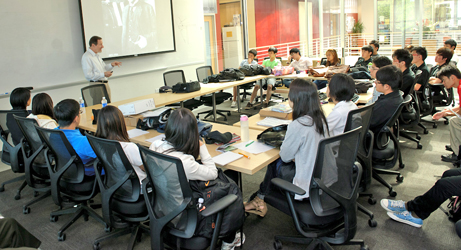
Imagine you’re in a school lecture: how likely are you to ask a question? Imagine you’re competing in a science fair: how likely are you to have prepared your presentation with the help of questions? Just what opportunities are there for youth to learn to ask questions and ask them well? Not many really. Youth are taught mainly to provide answers. But the skill of asking questions, especially creative ones, is critical for discovery, innovation and leadership.
In a university setting, creative questioning sadly does not become a significant opportunity until graduate school. So, one of the skills our youth program would like to impart to youth is thinking of and asking good questions. First, it would help to know what kind of questions are at one’s disposal:
(a) clarification – perhaps the easiest because it safely stays within current scope and can cycle on itself until full clarity is reached.
(b) extension or tangent – the question could suggest a further conclusion or further work. Ask if it is useful to the discussion.
(c) speculation or propositional – the question could suggest an alternate interpretation or conclusion that has yet to be supported. Some element of risk but potentially impressive. Demonstrates vertical thinking.
(d) connecting – the question could ask whether the topic at hand is connected to another topic that was not presented. Demonstrates lateral thinking.
(e) gap-filling – the question could ask about the existence of missing information or if/when a gap might be filled.
(f) philosophical – especially useful in data-driven communications is to look for the intangible forces behind a work. For example, ask who would benefit from a product or new knowledge, or how a paradigm might shift as a result of the new findings or strategies.
(g) critical – a difficult question to frame because of potential misunderstanding and conflict. Requires experienced questioning skill.
Now down to the practical application of this to a YCISL workshop. We could have a guest speaker prepare just a few minutes introduction or none at all. It would be entirely up to the audience of students to ask questions to drive the conversation. This is consistent with the desires to: (a) facilitate bi-directional flow of ideas and thoughts, (b) encourage students to discover by asking questions, (c) ease the pressure on speakers to formally prepare material or topics for their session, and (d) encourage spontaneity.
For this to work, we would need a good moderator. We might videotape such a session so the students can (a) review how they asked the question, (b) gauge the speaker’s reaction, (c) listen to the response elicited by the question, and (d) gauge the audience’s reaction to the resulting question-answer exchange.
And I should mention why I even considered such a module. It’s because I have observed how some students might not get connected with a speaker because (a) they are the silent type, (b) they are worried about how they will be perceived by their interaction, and (c) they are worried that their knowledge about the subject matter is novice and potentially annoying to the speaker. By putting the responsibility to drive the conversation on the students (and having a speaker who is open to questions), we can demonstrate to the students the importance of asking good questions.
Opportunity: A Day in the World
Just got around to browsing the May 2012 issue of Popular Photography, and the Editor’s Letter by Miriam Leuchter has caused a spark. It describes the “A Day in the World” project which is similar in concept to the “A Day in the Life of…” series of books that enraptured me back in the mid-1980s starting with the A Day in the Life of America [honestly, I know I bought one of the books in the series but can’t find it presently; no matter].
At this time where digital photography and near instantaneous sharing of such photos is possible, it is truly exciting to see this project concept return. It is happening in a new age of crowdsourcing and eBooks which will be deeply transforming to the original idea.
For the record, this is some of what is found at the organizer’s web site (http://www.aday.org):
Capture daily life
On May 15th we ask you to photograph what is close to you. Upload a photo, share it, compare it and join others all around the world doing the same. Let a part of your life inspire generations to come.
Photographing the world on a single day
Together we will photograph what our lives look like on May 15th 2012. Our goal is to inspire perspectives on humankind – today and tomorrow.
An event for everyone, everywhere
Professionals, amateurs, school children, farmers, social media fans, astronauts, office workers and you. Cell phone camera, Hasselblad, home made or borrowed. We are looking for the perspectives of everyone who enjoys photography!
Picture today, inspire tomorrow
All images will be displayed online for you and everyone to explore. Some of them will be selected for a book, A Day In the World, others in digital exhibitions. Every single one will be saved for future research and inspiration.
Our YCISL Photo Essay assignment is but a tiny version of this project, but I feel that this is a germane opportunity for the SP 2011 students to participate and expand on what they experienced from their YCISL workshop. I will encourage them to enroll and submit photographs – and suggest if they need it to reflect on something significant to them on that day.
Modules: Transitions
One idea for the next modules is to demonstrate the link between (1) creativity and innovation, and (2) innovation and leadership. This will reinforce the link and provide practice in connecting the pairs. As with a basketball drill, we could start with beginner/easy drills, and include optional steps to make it more challenging, if desired.
Modules: Prototyping

One of the products from this program will be lesson modules that can be applied in workshops as well as at alumni events (as follow-on sharing). I am not considering selling modules to 3rd parties since quality control and experience may be off-base.
The first module that I am working on is one which is based on the pocket guides developed by the SeafoodWatch program of the Monterey Bay Aquarium. I remember how this seemingly simple printed material had such an influential piece of sustainability knowledge contained within. It certainly promotes the desired human behavior and makes it easier to sustain the behavior.
I intend to introduce this module initially during my alumni visit to SP, and apply it to one or more of the Summer 2012 workshops. I think this module contains all the elements we desire to apply: knowledge, communication, persuasion, utility, access, competitive, scalable, directional, and not least of all, affordable to produce.
In a way, I have prototyped the experience by working on my own portable pocket guide and I have been carrying it around in my wallet for several months now, and even occasionally pulled it out to show people. As a prototype, such a card is a great conversation piece and a simple way to start introducing an idea.
For this module at the start, we will need materials and a way to design the layout (hand drawn/sketched or computer-generated?). One should probably then engage in a brief brainstorming/sandbox exercise to divergently think of possible topics. Then would come the prototype designs (including how to fold; the final product should be professionally printed). One should then carry around the prototype and perform focus group use to get feedback.
One could even practice how to get the topic that is on the card into a conversation to give oneself the guerrilla marketing edge and create the opportunity to pull out the card.
This has made me think about the Chinese language iPad app that Prof Leckie just showed me this week. What would be the competitive advantage/weakness of this wallet-fitting card? People still carry business cards, so card carrying doesn’t seem to be disappearing.
UPDATE: I recently went for a visit to Singapore Polytechnic – mainly to followup with students who attended the June 2011 workshop – and had the opportunity to test the exercise in quick-designing pocket guides such as those mentioned above. The group consisted of about 13 students of the forthcoming June 2012 group, and 9 students of the June 2011 group. I started by handing out the SeafoodWatch pocket guides as a reference point. Then I explained that the objective of the exercise was to design your own pocket guide. Each person in the group had 15 minutes to design a pocket guide, thinking up a topic, figuring out the folded layout and drawing on a piece of paper. 15 minutes is hardly enough to complete the pocket guide, and so after 15 minutes the work-in-progress was passed to another student – whose job was to finish off the card – which included figuring out the idea of the card and filling the rest of the content. After another 15 minutes, the pocket guide was passed to another student who was given 15 minutes to analyze the card and come up with a 15 second pitch (i.e., something to say about the card and interest a passer-by). SP staff took turns being the casual passer-by and each student took turns making their 15 second pitch. We made remarks about eye-contact, grabbing interest and covering the most relevant feature – within the 15 seconds which is about the time limit a stranger might allow – if all goes well. We made observations how our passer-by actors reacted to the pitch – with positive interaction (i.e., taking hold of the card) or disinterest (e.g., lost eye contact). This exercise demonstrated:
(a) how a small object (i.e., the pocket guide) can be used to advance an idea,
(b) seat-of-the-pants design keeps the overall theme simple enough to be able to collaborate with others (i.e., the second designer and the pitcher),
(c) that focus is critical when pitching an idea to a stranger,
(d) the process of extending an idea (second designer) also requires creativity,
(e) always have an idea (or a few) at the ready in case an opportunity arises suddenly.
Based on this experience, we could use this exercise for open house events as a way of showing how creativity, ideation, design, readiness and delivery have to come together. And when the delivery is “pitch-perfect” and shows personal commitment to the idea, leadership comes through.
Speakers: A Focus on Eye-Openers
Advice for Prospective Speakers: Select topics that are eye-openers for the students.
Two possible approaches:
(1) The curtain pulls back on the stage. Describe a setting and storyline that builds from nothing, and makes the viewers eyes dart all over, wanting to take it all in.
(2) Looking at something in a different way. Sometimes, one gets used to how something appears without really looking at new details.
Life Lessons from Going Through a Car Purchase Decision-making Experience
I am thinking about a car purchase again – it’s one of those life phases that one goes in and out at fairly regular intervals. There’s a life lesson in there – about making decisions, compromising, prioritizing, and moving ahead. For cars, I rate Safety as #1. Comfort and reliability are the next most important criteria for me. There’s utility, convenience and road visibility as well that I would call priorities. Then, cost-to-own, fuel efficiency, looks and power are towards the tail end – something has to be at the bottom of the list!
It’s tough enough to prioritize these factors, but there are complications/tough challenges still:
(1) How do you match these priorities with the car? Just about every auto manufacturer does not make Safety their #1 priority [they have a list too]. It’s probably somewhere around #5 or so. How do you make a decision when priorities are not in-synch?
(2) If the purchase involves two decision-makers, how do you proceed with a purchase where the priority list does not EXACTLY match?
For the YCISL, we could focus on computers or digital cameras – or anything the participants would care to suggest. There are decision-making lessons in this exercise, but there are various other skills and attitudes to be assessed.
Basic Thinking Question: What are _____ going to look like in x years?
One of the basic questions one could pose to stimulate brainstorming and critical thinking is…
“What is [name your product/thing] join to look like in x years?” The answer could be in terms of form or function or both.
This question is related to another that I would like workshop participants to ask themselves…
“Where do you see yourself in x years?”
For the purpose of sharing insight in the workshop setting, the “product/thing” question would likely be more fun and participants may be more open to sharing thoughts.
So, for example, one could open conversation by asking “What are the streets in your city going to look like in 10 years?” I thought of this question because of the several instances that I am familiar where dirt roads have become busy thoroughfares. For those who experience “dirt roads” presently, I am wondering whether they can imagine traffic lights, pedestrian crossings, street lights, good drainage, no pot holes, cat eye reflectors, handicap accessible curb ramps (including those bumpy pads) pedestrian walk/don’t walk lights, walk chirping sounds, and so on (there are so many amazing things about cutting edge streets these days). Even the transformation to LED traffic lights has been quite amazing. Even if the participant lives in an area where the streets already have these features, what else could be done?
For the YCISL workshop, the question I would ask would have the students think about it for 24 hours, perhaps make it part of the photo blog exercise and look around the Stanford campus or elsewhere.
Perhaps, it could something simple like “staircases” (and they could look around various buildings on campus) or “windows.” On the personal product side, we could do digital cameras or personal computers.
