
Category: News
WSJ: “SAT Reboot Revives 1600, Encourages Guessing”
Recently, I commented on an article about a group of colleges not requiring SAT and/or ACT test scores as part of the application process. And today (March 6, 2014) in the Wall Street Journal, the article “SAT Reboot Revives 1600, Encourages Guessing” by Douglas Belkin, Caroline Porter and Stephanie Banchero reports on a monumental reshaping of the SAT – under the influence of several forces including (1) competition from the ACT, (2) shifting demographics of test-takers, and (3) demand for alignment with school learning.
One major change is no longer requiring the essay while also redirecting the essay focus. This reminds me to recall the paragraph from the Wikipedia entry for the SAT which tells how meaningless the essay portion of the SAT is.
Other changes are planned for focus and scope of SAT questions, and adjusting scoring so incorrect answers does not result in a deduction. In general, these are welcome changes and hopefully positive in its purpose for college admissions screening.
The College Board appears to be forecasting that its future lies in less competitive regions and school districts – an attempt to extend scope perhaps to the fast growing segment of borderline students. That is how the marketing features of this new product seems to line up.
Therefore, top universities should now feel more free to de-emphasize the SAT in favor of the personal statement and perhaps add a soft skills component evaluation (possible because of the lower stress one might expect from a less challenging SAT). Stanford already is doing this – it already expects valedictorian status, leadership experience and world view. Perhaps this is an opportunity for top universities to collaborate on a SAT replacement – one which seeks the personalities and mindsets of those who have been successful at the top end of intelligence and intellect – and will be the workforce leaders of the future.
Wouldn’t it be interesting to have students design such a test?
Perhaps for YCISL, we could have students design a test that they think would be most useful for college screening… by students, for students.
“Defining Promise: Optional Standardized Testing Policies In American College And University Admissions”
This is a quick acknowledgement of a paper by William C. Hiss and Valerie W. Franks (http://www.nacacnet.org/research/research-data/nacac-research/Documents/DefiningPromise.pdf) as well as a KQED audio interview hosted by Michael Krasny (http://www.kqed.org/a/forum/R201402210930) which suggests that applicants to colleges should have an option to not submit SAT and/or ACT scores as part of their admission application.
I highlight this work because it is a fact that SAT and ACT testing are of little educational value and, as concluded in the study by Hiss and Franks, have little relation to a college student’s graduation success. However, this conclusion is of no surprise and the study would have perhaps been more enlightening if it had used a null hypothesis instead where they look for zero correlation between SAT/ACT test scores and college academic outcomes.
I view SAT and ACT testing organizations simply as businesses that provide an increasingly obsolete service and are fighting for survival (in the same vein that Kodak went through) – although test prep is rising as a new mass production business with significant financial stakes; a symbiosis of sorts. Historically, the analytics these tests provided were useful but we now know that a portion of test takers are able to game this system and measurement of academic strength needs to also include soft skills. An agreeable facet to the discussion on the KQED radio show is that college admissions offices should feel free to treat SAT/ACT scores as they see fit. There should be no hard and fast rule that SAT/ACT scores should be a specific part of the admission decision. Perhaps these testing organizations could rise to the occasion and offer analytics of the applicant’s statement of purpose or interview.
This study also focuses on the use of SAT and ACT scores in the college admissions process. But standardized testing has also infested the rest of primary and secondary education in the US and one can simply view the SAT/ACT tests as the final episode of pre-college educational assessment. I view this as the result of testing organizations trying to appear relevant – how else can one explain that a sensible examination system has not arisen in the US when it exists in many other parts of the world? So in order for SAT/ACT to become a non-factor and allowed to fade into memory, it needs to be cleared from the entire educational chain.
Actually, I can accept SAT/ACT as a fixture in the Proof stage of youth leadership development. Not requiring these scores for admission applications can be a distinctive marketing feature for the colleges that choose to go that route. However, such a feature does not seem to me to have any competitive advantage because the upside for admitted students will balance with the downside for the peer group. The argument that High School GPA would be a more reliable filter is not convincing since this statistic is cumulative and does not account for learning styles and differences (especially where a student’s learning style does not match what the school offers).
So, perhaps the best approach would be for high school educators to insist that testing agencies supplement the tests with personality and soft skills components, so that each student can decide which post-high school path is the best one for them. Use the SAT/ACT to create opportunities, not limit them.
WSJ: “Higher Learning, Meet Lower Job Prospects”
Today’s WSJ Opinion section (dated February 5, 2013) has an article titled “Higher Learning, Meet Lower Job Prospects” by Jane S. Shaw. Early on in the article, the idea is posed that “The problem, he suggested, might be that many academic disciplines have no real practical applications” and “…state funding incentives should encourage areas of study that align with the job market.” I can see how someone could think this…but they are way off the bullseye. One does not have to think hard to understand that yes, tertiary education involving practical training is needed BUT it should be in a separate stream from the high intellectual achievement institutions. Polytechnics are examples of institutions that serve the practical application market and it fits well with students whose strengths are in practical work. This concept has been around for decades but because of competitive fervor to get into a top ranked university or college, many students are finding themselves stuck in the wrong place partly because of a lack of options to suit their talent. But leave your top universities alone (and let them figure out how they want to address the market demand from both students and the workplace) and promote intellectual curiosity.
This article could be used to help reinforce the following YCISL premises:
1. find joy in learning – adults want to force youth to get as uptight and extrinsically motivated about money as they are – even before they start earning any.
2. embrace opportunity – universities are being held as scapegoats as secondary education continues to deteriorate.
3. focus on the now – universities’ performances are improperly measured in part by their graduate’s employment as well as starting salaries.
Undergraduate education (at least in the US) encourages exploration of new fields of knowledge and finding depth in the wells of knowledge (“Integration” in the YCISL framework). One just has to compare what students get out of high school (“Proof” in the YCISL framework) then are asked to do in college to realize that this is the main benefit of the latter. Graduate school is where critical thinking kicks in where ideas are extended, defended and tested; this is where expertise kicks in (“Propulsion” in the YCISL framework). Don’t complicate the “Integration” phase by introducing the distraction of the job market and careers – which is highly unpredictable. Integration is difficult enough to handle in a new learning environment (where suddenly most students find they are average).
Lesson: Getting Through a “Blunder-Storm”
When I was working at Handspring, we had a fair number of technology blunders such as cheap paint that would scratch easily, dead screen LEDs, electrical problems, wrong software versions getting released, and lost user data. You hope to catch most during alpha development and fix most by the end of beta testing. Always, some things would be let through. As a longtime Apple product consumer, I have seen a similar share of technology blunders which also seemed forgive-able because Apple was a champ at compatibility testing and I knew that it was impossible to test every possible combination of Apple and 3rd party products. But it is with extreme disappointment that I view Apple’s release of iOS 6 for the iPad – and just because I thought Apple had mastered the art of new product experience (sometimes called the out-of-box experience or OOBE). The Map app is one such blunder which has set Apple’s reputation back significantly. It’s received quite a lot of press but I had not realized the enormity of its impact until I actually applied the iOS 6 update. It first begs the question why everyone in the approval line allowed this Map app to get into public release and hands (even a beta test should have revealed this showstopper). Not only is Apple’s iPad engineering group in question here, the management is also is in serious doubt. Is this just an aberration or a sign of an overall cultural degradation? Using Google Maps from a web browser isn’t really a solution because all the 3rd party apps which rely on the built-in Map engine have also been taken down as well. It just so happens that I use quite a few iPad apps that use the Map engine: Yelp, OpenTable, Redfin, Zillow, Hotels.com, TruxMap, TripAdvisor,… and the vulnerability is now clear to developers. I could accept it as an oversight I suppose – if it wasn’t for the Microsoft-esque addition of a VIP “non-feature” in the iPad Mail app. Perhaps the iOS 6 Product Manager went on medical leave at some critical juncture? Problem is I don’t see (at this moment) a way out – except to get my hands on an iPad which still has iOS 5.
Below are screen shots of maps from the Redfin app using iOS 6 (top) and Google Maps from Safari (bottom) for the same neighborhood in Davis, CA. Two areas are mis-spelled – “ALHAMBRE” and “COTTEGES.” For full disclosure, I did find that Google Maps mis-places the pin for the Frontier Fertilizer Superfund site in Davis (right over someone’s home a little to the north; so it’s not perfect) but Apple’s Map app doesn’t locate it at all (useless).


I would characterize this as a “blunder-storm” where enough has happened that it calls a lot of intangible qualities into question. For YCISL, it would be great to simulate such a situation and work out how to approach, get through, get past or get around this problem. There’s probably no shortage of blunder-storms in the news at any given time, so we could do a real world analysis, or create a hypothetical scenario. There are probably good lessons to be learned from this for innovation and leadership.
So if anyone of any influence on this Map app is reading this, take a page out of the NFL Referee “blunder-storm” and do what’s best for your fans.
After-thought: I did experience a worse experience in an update recently. The Bay Area News iPad app, in an update, became totally unusable where the layout became tedious and links went to the wrong article. How does this stuff make it through beta and readiness engineering? And yes, the solution (just as is Apple’s) was to use the web browser version. It looks like this app has been updated and the link problem has been fixed. Layout still awful though.
Update: Just saw an article in the BayAreaNews iPad app titled “Major management shakeup at Apple” by Patrick May (originally published 10/29 /12) which announced the departure of Senior VP of iOS Software Scott Forstall from Apple. I have no idea whether this action will close the loop on the problems discussed, but I hope the culture can be restored and rescued (hint: Airport Utility 6.x).
WSJ: Why Our Innovators Traffic in Trifles
In the Saturday/Sunday July7-8, 2012 issue of the WSJ, there is an article titled “Why Our Innovators Traffic in Trifles” by Nicholas Carr on page C2 (article can be found online at http://online.wsj.com/article/SB10001424052702304141204577508820786062502.html).
The article addresses the immense public awareness and awe surrounding incremental innovations such as Instagram. Carr writes “What we are seeing is not a slowdown in the pace of innovation but a shift in its focus.” He adds “We are getting precisely the kind of innovation that we desire – and deserve.” He points to Maslow’s “hierarchy of needs” and suggests we are experiencing a progression in human desires.
But really, I only heard about Instagram when Facebook offered to acquire them. Even then, I would estimate 98% or more of us look at Instagram’s user interface level to assign a level of innovation quality. How innovative is the whole product from design level to architecture level to structural coding etc? I can’t tell you. Could you? I did, however, work with the Blazer team when Bluelark was acquired by Handspring and the web browser app would become central to the Treo. I knew of its server-side features, its security issues, interface challenges and user experience aims. This level of detail allowed me to appreciate the innovative qualities of the product and process. So, can innovation be judged by the user interface and interaction alone? The answer, broadly speaking is “Yes, but not well.”
I’ve long held the definition that innovation is a term that should exclusively be associated with inventions that had a massively influential effect on life. Some of the best examples are flight, fire, the computer and the pencil. However, now that I think more about innovation as a process than an object, there is room for incremental innovation – for those who have gone through the same process as for true innovation – and yielded something that is unique and provides a valued alternative to existing solutions. By thinking of innovation as a process, we can make it accessible to youth and provide lessons in creative thinking.
And to Carr’s point about focus, innovation is really a matter of perspective and the level of fascination that is realized. While the truest innovations affect all, most of what is held as innovation today is held so by adult eyes and their focal control. At best, these are quasi-innovations – objects that have unique life-changing qualities but only upon a limited segment of people. Therefore, I am looking forward to helping define innovation for the youth segment and differentiating it from the “trifle” that has filled our lives.
WSJ: Interior Gardens Hit the Wall but Don’t Forget to Water Them

This article (WSJ May 30, 2012, Personal section) reminded me of Rik Juan Yikai’s design of a green office divider. I am going to order a few of the Wally Ones by the Woolly Pocket Garden Company: one to try out in my office, and the others to inspire similar thinking in a YCISL exercise, perhaps rapid visualization and prototyping. We can look at the feature set as well as the challenges that must have been faced in the design. Will we be able to detect any issues that were not addressed? The blend of garden greenery, home decor, architectural feature (uses wall space which is often ample in a home) and recycled material serves as a good case study for the YCISL.
Quotable: WSJ Article “How Not to Ruin a Swimming Prodigy”
Tucked away in the Sports section of the May 30, 2012 WSJ (yes, I read the Sports section of the WSJ), is an article by Matthew Futterman about one coach’s successful style which incorporates adaptation in order to maintain an element of fun in practice. In the end, the element of fun extends the training and achieves more than if the drills were fixed. To a degree, the coach allows some elective participation but this seems to have resulted in a greater focus on the outcome. In swimming as much as in any other sport I can think of, the swimmer must come up for air and periodically think about how much more they need to put in to reach the goal. To the YCISL, this style of training with an element of fun is one I would care to embrace.
Here is some extracted text that impresses me…
As a coach, however, Schmitz stands out for a devotion to rest and play. No less important than his swimmers’ splits is whether they are having fun inside and outside the natatorium. At practice, if the kids seem spent, he’ll end the workout midway through and start a game of water polo. “He’s a fun loving kid, he laughs with them, he plays loud music,” said D.A. Franklin, Missy’s mother.
Schmitz’s swimmers also go through a structured dry land practice twice a week that focuses on building core strength and athleticism. “Looking at a black line all day, every day gets awfully dull,” he said.
Even when it comes to improving form—something other coaches regard as a strict science—Schmitz believes in the art of play. Sometimes, in fact, he orders his charges into the deep end for a session of vertical kicking, with the aim of lifting their torsos out of the water.
“A lot of this is about simply playing around in the water,” he said. “That’s what kids do naturally, and the play engages the mind and gives the swimmer the tools to figure out the right way to move their body.”
Thoughts: A Flurry of WSJ Articles on Innovation
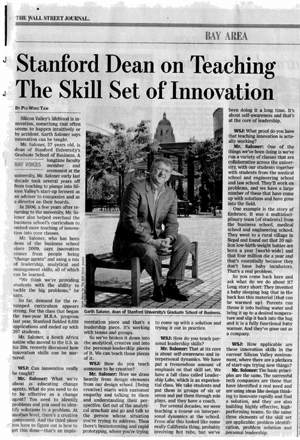
Several articles appeared in the WSJ recently on the topic of “Innovation.” To start, the May 23, 2012 WSJ has an article titled “You Call That Innovation?” written by Leslie Kwoh that describes how “innovation” is an overused term (practically “ubiquitous”) often indicating an intended direction rather than an achievement. Even in the event of accomplished change, the result is usually at best “invention” rather than true innovation (e.g., electricity, flight and my personal favorite, the pencil). The distortion of the term is perhaps understandable with b-schools believing that they can teach innovation (see B-Schools’ Innovation Rush” by Melissa Korn) and stretching the realm to encompass incremental change in order to attract students and provide modern examples for academic learning. Look too at the WSJ May 17, 2012 (Bay Area) issue which has an article titled “Stanford Dean on Teaching the Skill Set of Innovation” by Pui-Wing Tam which reports an interview with Stanford GSB Dean Garth Saloner. The interview discusses the components of the innovation curriculum which is similar on the surface to the components covered by our YCISL program. However, the basic premises and approach are fairly dissimilar. The Stanford GSB approach is based on a belief that innovation is a skill that can be “nurtured.” YCISL treats innovation as a process that can be manifested if chosen; similar to experimental technique. Our YCISL framework also takes a view that creativity, the predominant energy for innovation (our process), is present in everyone and can be made into a journey by anyone who has their barriers lowered. Not focusing on financial outcome is also a key YCISL premise (utilizing intrinsic motivation) and advantage.
Design Challenge: Paper Planes

In today’s WSJ (Thursday May 17, 2012), there is an article titled “Paper Plane Champ Watches His Record Fly, Fly Away” about a controversy in the competitive paper plane world. This reminded me of a time someone suggested that a paper plane exercise could serve as a basis for a YCISL exercise.
The article mentions an iPad app – which I have downloaded. The base version of the app shows how to fold three types of paper planes: Stunt (flips), Dart (distance), Eagle (hang time).
This also reminds me of a scene where kids throw paper planes off a building where the paper has something written in it.
I am thinking that we would use such an exercise for younger students, or perhaps a preview event. Three attempts? Three paper planes? Team or individual?
Could we use recycled material for this exercise? Would newspaper work? Could we use aluminum foil that has been used previously in the chute exercise?
Perhaps as a parallel type exercise, students could design a trebuchet or crossbow or a stomp rocket or a finger blaster or a mentor rocket (reminder, use eye protection).
Could this be set up as a fundraising competition (like a walkathon) where a person is sponsored by the number of paper airplanes made or the time a plane hangs in the air or the distance it flies?
Article link: http://online.wsj.com/article/SB10001424052702303879604577408194095860860.html
WSJ: School-Test Backlash Grows
In the May 16, 2012 issue of the WSJ, there is an article that echoes once again the frustration felt about education in the US.
The article starts with “The increasing role of standardized testing in U.S. classrooms is triggering pockets of rebellion across the country from school officials, teachers and parents who say the system is stifling teaching and learning.” It describes attitudes towards standardized testing and propagates the image that US education is in a mess, and going in circles – all true, but again lacking in a promising outcome (what does being absent from standardized testing accomplish?)
As I view it, the problem is NOT standardized testing – in the form of an annual assessment so that useful feedback can be gathered – it’s the paucity of design and useful data that defeats the humanitarian purpose of the exercise. For example, why is there not a balance between the current IQ-based assessment and an EQ-based assessment which together would better predict successful and meaningful learning? Why is the focus on how much knowledge/information a student can absorb and regurgitate? That is a recipe for an experiment with no controls, no frame or reference. In other words, production of useless data. Even worse, that useless data influences actions.
Annual standardized testing would be very useful in comparing educational productivity across cultures and other divides; and may direct our attention to systems that work better (although I don’t think anyone is using this method). Rather, I question the need for continuous assessment where every minute assignment has to result in a letter grade – that is what has taken the creativity out of learning, and the trend to grade lower and lower grades (in some cases, Kindergarten now) has made clear that this is educational bureaucracy’s focused goal.
I can accept that schools are knowledge transfer centers and that is what they strive to excel at. What is disappointing is the intrusive nature of the educational system which over-reaches by assigning useless and time-based homework as if intentionally aiming to prevent integration with real life. The school’s job could be better – to inspire students to want to learn outside of school times, to relate to the experience out of school, and to learn through self-awareness and other EQ qualities.
Put in the YCISL framework, it appears that while there is creative and critical thinking being exercise (our energy), it is fettered and too weak to make it all the way through the innovation process to create cases of successful leadership. This innovation step must be in a true quantum nature, and not incremental because of compromise.
Article link: http://online.wsj.com/article/SB10001424052702303505504577406603829668714.html
