
Category: People
James Veitch: This is what happens when you reply to spam email (TEDTalk)
Watch the video for the humor. Commiserate in the vengeance exacted on an email spammer. But hear what was discovered when someone opted for the “crazy” option. It’s the extraordinary tale that connects yet another dot.
In the PostIt brainstorming exercise we have in YCISL workshops, we position our ideas along a normal to crazy axis. We view the crazy end as the area with the greatest opportunity for creative challenge and outcome.
In his December 2015 TED Talk, James Veitch spins his story about toying with email scammers. It’s a great story but I especially was struck by how this got started – with him almost by instinct tapping the delete button which is conditioned behavior for many of us, but instead deciding to see what would happen if he responded. What seemed to have ensued was highly creative thinking.
“I thought, I could just delete this. Or I could do what I think we’ve all always wanted to do.”
How often has this sort of choice come across our minds? How fast have we been to self-check ourselves and do the thing that we have short-circuited our thinking for the sake of convenience and saving time?
What about when we are shopping in a supermarket? With all the product choices on a shelf (at an instant) and the change in choices (over longer time periods) which we sometimes register – not to mention reshuffling (over medium time periods), have we conditioned ourselves to have “tunnel vision” when selecting products? And when we do notice a new competing product, we ask the “what if?” question to check whether we might be making a mistake.
For YCISL, we should consider our behavior when our our path gives us choices. Are we being “mindful” at these paths or do we become engrossed by the past or future?
What exercise can we conduct to illuminate our tendencies and train our behavior to be more mindful?
TED Radio Hour: The Source Of Creativity
It’s been a while since I have found something from TED provoking enough to comment on in this wiki. To some degree, the WSJ Personal Journal has been publishing articles on topics seemingly more relevant to the YCISL program, but I also feel the TED topics have become un-connectable; they are about personal experiences (yes, a good thing!) but not in a way that leads to connect-the-dots. So to my bemusement I now feel wont to comment here on “The Source of Creativity” which was the topic of the TED Radio Hour on October 3, 2014 (this was the original broadcast date, but it caught my attention now because it was re-broadcast in September 2015 and I happened to look for some podcasts to listen to on a long drive) and hosted by Guy Raz. I am particularly bemused because it refers to a collection of years past TED Talks (including one of my favorites by Ken Robinson) which goes to show how enduringly meaningful the older TED Talks are.
So if this is just a collection of older TED Talks, why not just listen to those TED Talks? It’s because the connections to past TED Talks is selective. These sound bites supported live interviews with those speakers and provided updates on their thoughts – further deepening the significance of the original TED Talks. I especially enjoyed listening to the part with Gillian Lynne which made Ken Robinson’s story about her become even better.
Besides being obviously in the Ken Robinson Fan Club, I would also mention that I found the part of the show with Sting also meaningful. In fact, in the week since listening to this show, I have referred to a point in this interview in two conversations with colleagues and it relates to the YCISL. There is reference to “a deeper place” and “comfort in being who I am” which comes from revisiting youth. This works with the YCISL exercise of “A Message to My Past Self” which is by natural perception deeper and vivid than the future outlook. This is motivating reason to work on reflections on the past – lessons learned and acceptance of paths chosen. For YCISL, KI, EI and LI all come from what Sting talks about in the interview. There is a struggle to maintain creativity, but strength from re-connecting with the past can help reinvigorate that creativity which can be smothered by C-R-A-P (reference to Richard St. John, btw).
Bottom line: yes, I recommend listening to this podcast. I plan to listen to it a few more times because I think I will learn more every time.
WSJ: Feeling Stuck? Write Yourself a New Job Description
In the Personal Journal section of the Wednesday August 12, 2015 issue of the WSJ, Sue Shellenbarger wrote the article “Feeling Stuck? Write Yourself a New Job Description” which touches on a “sense of meaning and purpose” – thus connecting to this year’s YCISL workshop theme of Purpose. The article also mentions “intrinsic motivation” as a “hiring draw” for employers. This fits in well with what I have learned from Daniel Pink’s description about intrinsic motivation. The article also contains other YCISL keywords such as “coaching” and “fulfilling.”
The takeaway lesson from this article for YCISL is about the process of redesigning what we do – and to put this in the youth context. In the workplace, adults can discuss changes with supervisors – but the opportunities to do this are likely quite spread apart (e.g. at annual performance reviews) and need a good elevator pitch behind it (and a supervisor with the requisite understanding and influence). Focusing on youth though, we can develop YCISL exercises to practice the work redesign process – as training as well as in school or at home. What if our students could discuss a personal redesign with their parents, bringing up things that they really want to do and managing tasks that are less fulfilling? What if school counsellors actually took personal interest in students and discussed changes needed to heighten sense of meaning and purpose in school? What if schools tapped on intrinsic motivation to make education more intrinsically motivating?
For the YCISL workshops, we could add this as a topic (or a feature) to the elevator pitch exercise and have our students show emotional leadership to the idea they pitch.
WSJ: Lee Kuan Yew, Singapore’s Founding Father, Dies at 91
Because the “L” in YCISL stands for Leadership, I will make a note of the passing of Lee Kuan Yew, the first Prime Minister of Singapore. Although the YCISL program does not look to adults as leadership role models, there are quite a few valuable leadership life lessons that can be identified from Mr. Lee’s career. Although there are many news articles being published on this, I will use the WSJ article “Lee Kuan Yew, Singapore’s Founding Father, Dies at 91” published March 22, 2015 as a reference point in order to highlight the YCISL topics.
The greatest leaders are those who reach back to their youth life experience to make their marks as adults. Their success is undoubtedly connected to the influence that youthful optimism and imagination had on their thinking and motivation. Their soft skills strength likely began development in their youth and they sustained growth of these skills.
But more than that (and as pointed out in this WSJ article), Mr. Lee succeeded despite criticism – the type of scathing adult criticism we discuss in YCISL that deters people from being expressively creative and optimistically motivated. He demonstrated high emotional intelligence, and understood how to balance and shift priorities in order to repeatedly attain visionary results.
No other political figure that I can think of has ever exhibited the same high level of commitment and enthusiasm. “Father Figure” comes to mind and that is also a core element of YCISL which is based largely on parental skills, emotions and thinking. A belief in intrinsic motivation (let’s call this in-mot from now on) was strong in particular because of the attention paid to mastery, autonomy and purpose – fostering it in himself and sharing it with his people; this is evident in the economic, social and educational accomplishments and gains experienced during his presence. And all this was achieved in the model of a start-up – few resources, little capital and a team of people who believed and shared a vision.
Well done, Mr. Lee.
Book: Gong Hyo-jin’s Notebook
My addiction to Korean Dramas continues. I am presently watching “Pasta” which stars Gong Hyo-jin (공효진). Great series for me since I enjoy anything featuring restaurants, food and cooking.
This led me to “Gong Hyo-jin’s Notebook” which I understand to be a collection of essays about her personal viewpoints and practical efforts regarding environmental sustainability. I’ve tried to see whether this book can be purchased in the US and whether there is even an English language version – but I did not find any leads. I certainly would like to be able to read it. [10/30/14 Found a way to get this book. Looking forward to getting it. Memo to self: add photo of the book to this entry when I get it.]
I will instead rely on a couple of articles to base my thoughts as to how it connects with YCISL.
1. From http://www.koreatimes.co.kr/www/news/art/2010/12/135_78554.html: “It may be hard to think of the environment when you talk about actresses. But I thought the small steps I take with other people can become a great achievement in the future,” King [sic] wrote in the preface.
2. From http://english.chosun.com/site/data/html_dir/2011/02/25/2011022501237.html: In a conversation with the author in a theater on Feb. 19, Kong said, “I felt that if someone who likes what I do tries to do the same even just a little bit, the world can change. I hope there’ll be more consensus about environment protection in Korea so that I can publish sequel after sequel.”
Connections to YCISL: From both these quotes, emotional intelligence is evidently growing; there are strong indications of personal awareness and personal management. Her statements speak to her desire for social awareness and social management. She is particularly skilled at Reflection, and Your Personal Story. I also see an aptitude for Problem-solving and her embrace of a life purpose. Her concern for environmental protection aligns well with our YCISL sustainability platform.
I am also curious about whether this book will be a good model for the YCISL workshop photo essay exercise.
Her Wikipedia entry (http://en.wikipedia.org/wiki/Gong_Hyo-jin) also mentions a part of her life (high school age) in Brisbane, Australia. I wonder how that might have influenced her to be reflective and grateful. I lived for 2 years (grammar school age) in Melbourne, Australia and that had a tremendous influence on me.
Update 11/11/14: The book arrived from Aladdin (http://www.aladin.co.kr). Fortunately, a colleague will help with translation but just from browsing the photos and drawings, the depth of critical thinking and personal reflection is apparent. I’ve flagged several sections for translation and look forward to learning her ideas.

Chosun Ilbo: High-Schoolers Say Money Key to Happiness

I have recently been developing an interest in South Korean culture especially how it might relate to the YCISL principles. Thinking back, there was a Time magazine article (“Teacher, Leave Those Kids Alone” by Amanda Ripley) from 2011 that first pulled my attention to the life a South Korean student might have; it was about the influence of hagwons (after-school tutoring programs). Around the same time, I was in discussion with an organizer to bring a group of South Korean high school students for a YCISL workshop. More recently, I entered some thoughts on the mindset of Ku Hye-sun (구혜선) and how it relates to the YCISL model.
The article discussed here is “High-Schoolers Say Money Key to Happiness” (no author attributed) published on The Chosun Ilbo website on June 6, 2014 (http://english.chosun.com/site/data/html_dir/2014/06/06/2014060600493.html). The title ties in well with YCISL’s focus on high school and happiness, but the article also cites data for elementary and middle school students. The article describes the results of a poll of 6,946 students on the most important factor for happiness (let’s assume this question was posed as pertaining to personal happiness):
Elementary School Students: Harmony in the family 43.6%, Good health 20.6%, Freedom 13%
Middle School Students: Harmony at home 23.5%, Good grades 15.4%
High School Students: Money 19.2%, Good grades 18.7%, Harmony in the family 17.5%, Freedom 13%
I feel that these results are a reflection of the strong shared family values in Korea and perhaps also the result of the practical “fear” mindset that takes hold as youth get older. The encouraging side is that the younger students held “harmony” highest which sets up the challenge as one of preservation as opposed to substitution (similar to how we wish to preserve creativity in youth in YCISL). It would be interesting to also know whether “Money” stays a top factor (or even stands out more) to happiness into tertiary education ages and beyond. Then again, the idea of money leading to happiness is not unique to South Korea. It is also a major perception problem in the US and other countries; the family or societal pressure might be different, but the message is still the same.
Let’s also consider information from OECD PISA on student happiness. Referring to Figure III.1.2 on page 32 of “PISA 2012 Results: Ready to Learn (Volume III): Students’ Engagement, Drive and Self-Beliefs” (DOI:10.1787/9789264201170-5-en), we find that Korea (let’s assume South Korea) ranks lowest out of 65 participating countries at just below 60% on this chart of “Percentage of students who report being happy at school.” [For context, note that PISA participants are between the ages of 15 years 3 months and 16 years 2 months, and the chart totals the students who answered “Agree” or “Strongly Agree” to the statement “I feel happy at school.”] Is this surprising? Not really because I think Koreans are very honest with their familial emotions and are not “happy” because they have less time to be in “harmony” with the family – and so the data should not be construed as showing that the students are un-happy with the school, just un-happy when they are at school which deprives them of time with the family to fulfill filial needs. We can speculatively contrast this with the US which ranked just 16 spots higher at about 80% and in the below average section along with Korea. What reasons do US students have to be un-happy about school? There is likely to be a wider assortment of reasons as compared to Korea because there is less purpose emphasized about secondary school education in the US, and so the reasoning and reference standards behind answering this question is likely different. More significant to consider is whether a lack of happiness at school correlates with motivation.
Malaysia is ranked 6th and Singapore 12th on this chart – relatively high. Using my Malaysia and Singapore background, I can see how these two countries ranked relatively high. In Malaysia, pressure on school grades to get into university is only moderate (low compared to Korea, Taiwan, China, India, US, etc); so a student has opportunity to think about life and their expectations. In Singapore, anxiety about school performance is intense but there is less anxiety about life, tertiary education and career opportunities as compared to other countries.
So the lesson for me to learn here is that youth need to be coached to better understand happiness (and positivity) and to develop exercises towards this aim. This should be tied in to intrinsic motivation practices which de-emphasize the growth of money-related fears.
“Turn that frown upside down.” Let me start by thinking about the song “Happy (행복했을까)” by my latest favorite artiste Ku Hye-sun. Except for the “사랑” which I have learned from Korean dramas, I repeatedly listen to this song not for its lyrics but because of its soothing and hopeful feel. You could contrast this to the so popular “Happy” by Pharrell Williams or “Koi Suru Fortune Cookie” by AKB48. I’m not sure presently where to start on developing the practical exercise, but I have ideas on what the ingredients should be so that it has lasting flavor and healthy benefit. Let the experimental design begin!
Related Articles:
“Korean Children Unhappiest in OECD Despite Material Wealth” (no author attributed) published on The Chosun Ilbo web site on May 7, 2012 (http://english.chosun.com/site/data/html_dir/2012/05/07/2012050700775.html)
“An Assault Upon Our Children: South Korea’s Education System Hurts Students” by Se-Woong Koo published on The New York Times web site on August 1, 2014http://www.nytimes.com/2014/08/02/opinion/sunday/south-koreas-education-system-hurts-students.html?_r=0)
“Korean students least happy in OECD” by Lee-Hyo-sik published on The Korea Times web site on May 4, 2011 (http://www.koreatimes.co.kr/www/news/nation/2011/05/113_86432.html)
“Poll: Are Singaporeans least happy?” by Alexandra Hoegberg published on the CNN web site on December 21, 2012 (http://edition.cnn.com/2012/12/21/world/asia/singapore-least-happy/).
People: An Amazing Youthful Growth and Emotionally-Intelligent Mindset – Ku Hye-sun
Few things in life resonate so powerfully.
My curiosity started out from the luminous talent I observed on the Korean tv drama “Boys Over Flowers” – not just acting, but also other remarkable talents, skills and traits that I could see – it drew my attention to actress Ku Hye-sun (구혜선) whereupon I learned of her record of creative skills and accomplishments. From this, I also am sensing her high emotional intelligence that has led to her continuing leadership experience and growth (e.g., sign language, music and art abilities). What setting and circumstance gives rise to such a meaningful personal philosophy and mindset? Most relevant to YCISL, she appears to be a person who is highly attuned to the “Your Personal Story” concept which serves as an exceptional example for our students.
The following is the information I found on the web that to me demonstrates her youthful growth-driven and intrinsically-motivated mindset.
1. Quoted from the Wikipedia entry for Ku Hye-sun (August 24, 2014):
“What is most important is to become the winner at the end/ultimately/finally. Right now is not the time to feel accomplished for what project is doing well or making that as a life’s goal. To me, what is more important is what kind of person I will live as and remembered. In my 20’s, a big hit came my way through BOF. But, I cannot be just stuck there. I felt that I need to mold/make myself even better and live my life even better. That is my life’s goal.”
She truly embraces the idea that success is a continuous journey (credit to Richard St. John for this idea). Her growth mindset is particularly clear and impressive. And she masterfully does it through intrinsic motivation.
2. Quoted from an article titled “More Than Just a Pretty Face” written by Claire Lee on WSJ.com (http://blogs.wsj.com/scene/2012/12/28/more-than-just-a-pretty-face/) based on an interview with Ku Hye-sun:
“I’m obsessed with documenting my ideas—all of my ideas. Whenever I get ideas for my art works, I either have to write them down or draw something right away. When I think of random melodies, I have to write a score on the spot. Otherwise I’d soon forget, and that’s the last thing that I want.”
“Everything that I do aside from acting and directing—painting, composing, singing and writing—is in fact what I’ve been doing all my life, ever since I was a kid. I started painting lessons when I was 6. Throughout my childhood I thought I’d become an artist one day. When I was in high school, I’d send scores of my own music to entertainment agencies in the hopes of becoming a singer. I had about 100 songs written when I turned 20. One of the reasons why I enjoy filmmaking is because I get to incorporate all of these things, music, art and writing, into one piece of work.”
She is a skilled practitioner in creativity and reflection, and her advantage is that she started from young and has managed uncertainty very well.
3. I listened to some of her musical composition from her Sketchbook “Breath” release – particularly the instrumental piano piece “The Sound of Rain at Night” which to me is an interesting aural parallel to the (visual) photo essay activity that we do in YCISL workshops. [I have also now listened to her “Happy” song many times too]. The focus that comes with her emotional artistry is remarkable. She shows mastery at the integration level of the YCISL leadership stage model.
To date, this is the first person I have found to embody the personal strengths discussed in YCISL. I hope to find more instances of people so exemplary in the YCISL ideals, especially those who possess youthful optimism like Ku Hye-sun. Having references such as this will be very beneficial to our young students.
4. [Added October 16, 2014] More of Ku Hye-sun’s positive and growth mindset is evident in an interview for Woman Chosun (original Korean source: http://woman.chosun.com/magazine/viewArticle.do?atCode=1650; English translation available at http://loveghs.wordpress.com/2013/05/28/interview-woman-chosun-interview-with-ku-hye-sun/). Several of her thoughts stand out:
“I don’t think I get special inspiration. I just get it through my daily life.” Ideas come to us often times when we’re not focused on a particular problem and are more involved in routine activities. I get ideas when driving on the freeway. From this, we understand that inspiration is accessible by all.
“But, since I was able to tell my story, I felt I should take some losses.” Being able to share your personal story is an opportunity and victory in itself. Whether the storytelling influences the person hearing the story is not the only measure of success.
“But, for me, just the fact that something that I made came out to the world feels successful.” Simply going through the creativity and innovation process can yield the intrinsic motivation to continue. Valuable lessons in leadership can be added to the personal story.
“I am just going on my own path.” One’s personal story is like walking a path. There may be company along parts of the way while some parts might be travelled alone. What is observed or experienced is deeply personal, and a mindset that accepts that yields the positivity and growth one needs to feel intrinsically motivated.
“I give myself chances and I forgive myself.” Make the choices with confidence and feel that you are your own best leader understanding that mistakes can happen along the way.
From the above (translated) quotes, it is clear that she is intrinsically motivated to develop her personal story. What a remarkable role model for youth.
Are You a Supportive Role Model-Parent? Your Child is Watching You.
One of the things I often discuss with colleagues and visitors is the importance of a support structure to a student’s success. No one does it alone. Support is an essential success factor. The support structure starts with the home environment and the relationships therein, but also includes the school, community and social environments as influential contributors. This entry looks at the home environment (especially the parent-child interface) and asks simple sample questions to induce parents to reflect on the type of role model they are to their child. The answers to these questions and others similar to them can lead to insight about the nature of the communication filters between parents and their children. These communication filters form whenever your child is watching you – whether you are conscious about it or not.
1. Do you share interests with your child?
A. Constantly.
B. When I can.
C. We have nothing in common.
Reflection: Is there anything that bonds?
2. Do you make any sounds/noise at night after your child has gone to bed?
A. No.
B. Just a little soft white noise.
C. Yes, loud noises including television, radio, laundry machine or hairdryer.
Reflection: Is there sensitivity?
3. Does your child eat your cooking?
A. Yes, and he/she enjoys it.
B. Yes, but it’s a struggle.
C. No.
Reflection: Is there cooperation?
4. Does your child offer to help you?
A. Yes.
B. Sometimes.
C. Don’t recall.
Reflection: Is there opportunity?
5. Do you make your bed in the morning?
A. Yes.
B. Sort of.
C. Who cares?
Reflection: What organizational impression do you leave?
6. When it’s time for your child to do homework, do you…
A. find something quiet to do and help when asked?
B. go about with your usual activity (talk on the phone, watch television, …)
C. interrupt your child about something not related to homework?
Reflection: Is there time management?
7. Do you drive at the speed limit?
A. Yes.
B. No more than 5 mph above the posted speed limit.
C. Never notice it.
Reflection: How do you prioritize?
8. Do you make a complete stop at a STOP sign?
A. Yes.
B. Rolling stop.
C. What’s a STOP sign?
Reflection: What is your attitude?
9. My emotional intelligence is a key factor in my relationship with my child.
A. Agree.
B. Sometimes.
C. What emotional intelligence?
Reflection: Is there anything more important in your life?
10. My parent-child relationship provides me with feelings of deep intrinsic motivation.
A. Agree.
B. Sometimes.
C. Cash incentives work better.
Q: Do you feel organically rewarded?
Note: Treat these questions as seriously as you choose. Laugh at them if you wish (I think humor is an effective way of communicating ideas). Create additional questions for yourself or to share with other parents. Reflect on any time you may be making a observational impression on your child. The questions above are not meant to be scope-defining, definitive, exhaustive, or even generalized. I’m just trying to inspire self-critical thought for continuing professional (parent) development.
Another note: This entry marks the start of the YCISL Parent-Student Toolkit.
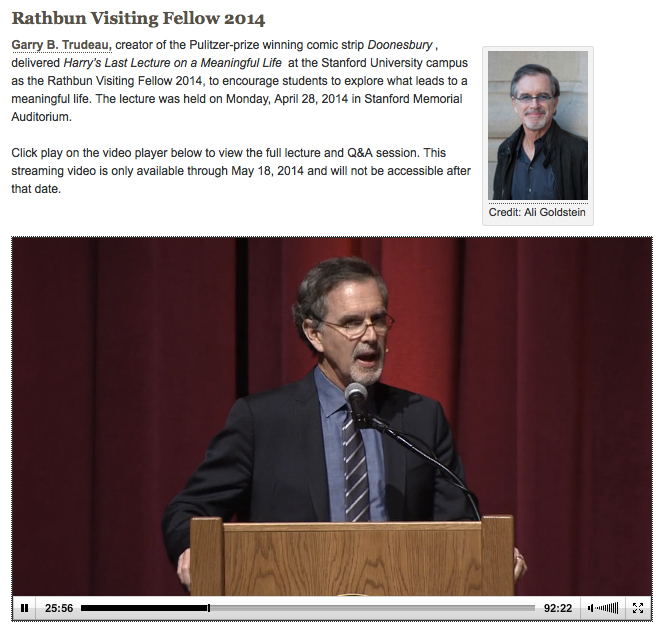
LECTURE: 2014 “Harry’s Last Lecture on a Meaningful Life” by Garry B. Trudeau
On April 28, 2014, cartoonist Garry Trudeau, creator of Doonesbury, gave the fifth guest lecture in the series “Harry’s Last Lecture on a Meaningful Life.” I watched the video at http://www.stanford.edu/group/religiouslife/cgi-bin/wordpress/programs/rathbun/ but understand that it would only be posted online until May 18, 2014. The lecture was reported by Stanford News here. This entry contains a few notes I made while watching the video.
Overall, I found the lecture to be an informative personal story with many agreeable observations about generational change.
– “…I gave no serious thought as to whether the work was either useful or meaningful in any way…” Commentary: “serious thought” would be something that an older person might have come up with which would have resulted in less productivity, satisfaction and success. This alludes to the fear mindset that adults fall into. His youth focused on the intrinsic motivation (autonomy, mastery and purpose) and fear about it as a career did not enter his mind at the start (it might have stepped into his parents’ minds though).
– “…it was my perspective they were interested in – my generational identity…” Commentary: one of the YCISL take-home messages is to use youth (your generational knowledge) as an advantage.
– “I didn’t know any better.” Commentary: Another take on how adults filter out many options because of a pile of prior negative experiences.
– “In college, there’s very little downside.” Commentary: Balance is key in college. If you can manage the coursework that will get you the diploma at the end, then any free time (and there’s quite a lot compared to high school) can be used to get involved in differentiating pursuits – and develop that EQ.
– “…but the whole dynamic has been speeded up.” Commentary: And there are a lot more traps along the way. Speed may also be reducing intrinsic motivation.
– “We start telling stories almost as soon as we speak.” Commentary: Evidence of creative energy in early childhood. Then adults get in the way.
– “…the opposite of comedy is not seriousness, it’s despair.” Commentary: Finding such useful perspectives is probably a key differentiator between people who succeed or fail in the same pursuit.
Jennifer Senior: For parents, happiness is a very high bar (TED Talk)
This talk shares Jennifer Senior’s thoughts on emotional ups and downs of being a parent. This touches on our YCISL framework where part of our objective is to deliver messages via proxy that are often filtered in direct parent-child communication.
Jennifer Senior introduces herself as the mother of a 6 year old. She advances thoughts specifically about feelings of anxiety that overcome parents. It is unfortunate that she positions this situation as a crisis – signs of a fixed mindset as opposed to a growth mindset. With a growth mindset, she might perceive the situation from a more positive standpoint. Consequently, she might understand that this is a learning experience and with a love for life-long learning, she will find intrinsic motivation (remember Daniel Pink’s mastery, autonomy and purpose?) which might make this responsibility less inconvenient.
There is no single correct interpretation of this situation. I am confident approximately half of ALL parents (regardless of class, culture and means) feel that they are in varying degrees of a crisis or close to it – the cohort that this speaker has identified. But that is to say that there is another half that is finding sensibility, fulfillment and unparalleled joy, and want more! Having and raising children is the ultimate life experience, and one should not expect a categorically unified experience for all parents. There is no comparison to the “stress” level of non-parents – an apple and oranges comparison.
To borrow a thought from another TED Talk title “Should you live for your résumé … or your eulogy?” by David Brooks: parenting should not be judged by day-to-day results but the outcome with which the parent will be remembered. It is the long-term effect of communication and active listening that makes parenting so vital and distinctive. We emphasize this through our YCISL program. Parenting is a leadership role where KI + EI = LI is as relevant as anywhere else.
