
Category: People
BOOK: How to Fail at Almost Everything and Still Win Big: Kind of the Story of My Life by Scott Adams
This book was quite different from the others I usually read and comment on. I liked it because it contained the author’s own personal experiences and these experiences were things that I am interested in. Well, at least the first half of the book did (and I would recommend reading this book for this part). The second half felt – let’s just call it – less personal, more library-like.
The topic of failing and still finding ways to succeed (and find fulfillment and happiness) is a major premise in YCISL. Scott Adams in “How to Fail at Almost Everything and Still Win Big: Kind of the Story of My Life” (2013) tells his personal story about the various paths he has taken, and analyzed what has succeeded and what has failed. He relates personal conclusions from his first-hand experience which I found substantive in life lessons. I would assume his messages are aimed at an adult audience but I think with a little reflection, they would become valuable messages for youth.
Here is a list of notes from my reading (selected 17 points from 115 total highlights – just too easy in the Kindle format):
1. “The most important metric to track is your personal energy.”
2. “It seemed as if other people were benefiting greatly from the wisdom of their friends and families.”
3. “Realistically, most people have poor filters for sorting truth from fiction, and there’s no objective way to know if you’re particularly good at it or not.”
4. “Failure always brings something valuable with it.”
5. “My hypothesis is that passionate people are more likely to take big risks in the pursuit of unlikely goals, and so you would expect to see more failures and more huge successes among the passionate.”
6. “Success causes passion more than passion causes success.”
7. “Good ideas have no value because the world already has too many of them. The market rewards execution, not ideas.”
8. “This was about the time I started to understand that timing is often the biggest component of success.”
9. “The systems-driven people have found a way to look at the familiar in new and more useful ways.”
10. “I know from experience that trying to be creative in the mid-afternoon is a waste of time.”
11. “One helpful rule of thumb for knowing where you might have a little extra talent is to consider what you were obsessively doing before you were ten years old. There’s a strong connection between what interests you and what you’re good at.”
12.”Small successes can grow into big ones, but failures rarely grow into successes.”
13. “Several years ago I gave a talk to a fifth-grade class. I started by asking them to finish my sentence. The sentence was ‘If you play a slot machine long enough, eventually you will…’ The class yelled out in unison ‘WIN!'”
14. “Positivity is far more than a mental preference. It changes your brain, literally, and it changes the people around you. It’s the nearest thing we have to magic.”
15. “Try to get in the habit of asking yourself how you can turn your interesting experiences into story form.”
16. “Another common trick is to hum the first part of the ‘Happy Birthday’ song and then speak in your normal voice right after.”
17. “The only reasonable goal in life is maximizing your total lifetime experience of something called happiness.”

Quotable: WSJ Article “How Not to Ruin a Swimming Prodigy”
Tucked away in the Sports section of the May 30, 2012 WSJ (yes, I read the Sports section of the WSJ), is an article by Matthew Futterman about one coach’s successful style which incorporates adaptation in order to maintain an element of fun in practice. In the end, the element of fun extends the training and achieves more than if the drills were fixed. To a degree, the coach allows some elective participation but this seems to have resulted in a greater focus on the outcome. In swimming as much as in any other sport I can think of, the swimmer must come up for air and periodically think about how much more they need to put in to reach the goal. To the YCISL, this style of training with an element of fun is one I would care to embrace.
Here is some extracted text that impresses me…
As a coach, however, Schmitz stands out for a devotion to rest and play. No less important than his swimmers’ splits is whether they are having fun inside and outside the natatorium. At practice, if the kids seem spent, he’ll end the workout midway through and start a game of water polo. “He’s a fun loving kid, he laughs with them, he plays loud music,” said D.A. Franklin, Missy’s mother.
Schmitz’s swimmers also go through a structured dry land practice twice a week that focuses on building core strength and athleticism. “Looking at a black line all day, every day gets awfully dull,” he said.
Even when it comes to improving form—something other coaches regard as a strict science—Schmitz believes in the art of play. Sometimes, in fact, he orders his charges into the deep end for a session of vertical kicking, with the aim of lifting their torsos out of the water.
“A lot of this is about simply playing around in the water,” he said. “That’s what kids do naturally, and the play engages the mind and gives the swimmer the tools to figure out the right way to move their body.”
Stanford Report: Where does that creative spark come from? Stanford’s Tina Seelig has some ideas
This article in the Stanford Report promotes Tina Seelig’s new book “inGenius: A Crash Course on Creativity” and makes connections to her class (possibly MS&E 277: Creativity and Innovation).
Personally, I prefer the title of the prior book “What I Wish I Knew When I Was 20: A Crash Course on Making Your Place in the World” which effused purpose, inclusiveness, accessibility and timing – all important persuasive and attractive elements.
Still, I am optimistic that I will find the new book a worthwhile read. I am looking forward to finding how her new insights can help improve the CSDGC Youth Development Program. My contribution to creativity and innovation through the YCISL program would be to cast intervention to creativity-poor education earlier in the process.
ExploreCourses Course Listing: MS&E 277: Creativity and Innovation
Factors that promote and inhibit creativity of individuals, teams, and organizations. Creativity tools, assessment metrics, and exercises; workshops, field trips, and case studies. Each student completes an individual creativity portfolio and participates in a long-term team project. Enrollment limited to 32. Admission by application. See http://creativity.stanford.edu.
Terms: Spr | Units: 4 | Grading: Letter (ABCD/NP)
Instructors: Seelig, T. (PI)
Article link: http://news.stanford.edu/news/2012/april/ingenius-seelig-creativity-043012.html
Book: Enchantment by Guy Kawasaki
I just finished reading “Enchantment: The Art of Changing Hearts, Minds, and Actions” by Guy Kawasaki. It joins my collection of Could-Not-Put-It-Down books. It was overall a fluid and well-structured treatise filled with practical suggestions and insightful observations on behaviors that trigger responses of inner attraction and appeal. (Underlines are my way of “sucking up.” Read the book and you’ll get the idea!)
[I will digress for a moment to put enchantment in terms of the ion attraction models that I am familiar with. If two bodies are at infinite distance apart, there is theoretically zero attraction. At any real distance however there is some level of attraction (think exponential decay, approaching but never reaching zero). As the bodies get closer, there is an increase in attraction. At some point, the bodies are close enough to be involved in some weak holding pattern (the outer layer of influence -> speaking in 2d but we could just as readily say outer sphere for a 3d model). Closer still, the bodies interact and actually form a strong bond (high energy) and deviation becomes limited (an inner layer that is somewhat structured and ordered). If the resulting proximity of the bodies can result in a reaction, then the two bodies might transform into a new entity (hopefully stable) OR if there is a propensity for it, a smaller body might bind in the inner channels of the larger body.]
So how did that relate to the book at hand? Enchantment discusses a phenomenon like the inner layer bonding. Enchantment happens at a point at which reactions are likely to occur and there is a level of fixation. But the bodies need to get close enough, through the outer layer – and in a realistic scenario there will be many competing bodies that will serve to thwart bodies reaching the inner layer level (unless sheer Brownian motion or physical momentum causes an actual or near collision).
Time to list my favorite parts of the book:
(1) I found Chapter 2 How to Achieve Likability – Make Crow’s-Feet a great way to show that Enchantment is a genuine and honest pursuit. You can think about your own likability as shown by your muscle behavior, or detecting other’s likability. Likability may be difficult for some to pervade or one may have a phobia about putting forth a likable personality. However, understanding that Likability is an early step to achieving a connection will help our students find an opportunity to even “step into the ring” to start their journey of innovation and leadership.
(2) Chapter 5’s discussion about the “First Follower” is worth presenting to our students.Working in teams in a school (where social structures generally guarantee the availability of first followers), it would be useful to begin the presentation of a new product or idea by having a first follower become engaged in plain sight of potential additional followers. [Quick digression: I guess this has started to get me to think about Flash Mob Dancing – what an exhilarating phenomenon!]
(3) In Chapter 8 How to Use Push Technology, I like the section on Email. Perhaps I will try it by composing an email to Guy Kawasaki, and see if this works for me (I realize mileage may vary). In particular, I like the advice to “Keep it to six sentences.” This is highly consistent with how I have created assignments in my teaching career. When I design an assignment or question, I am looking for an initial response showing that the student is revealing thoughts in an appropriate direction. I would prefer to leave it to the student to determine the depth to which they would go to be satisfied, and develop their answer in a short form just to convince me that that is where they are headed.
I would close by noting that there are many useful tips in this book that could potentially fit into the YCISL content and benefit the participants. These tips could help inspire us to create some great modules. However, the book does seem to weigh closer to adults so some refining or contextual adjustment may be necessary but when it comes to life lessons, there is great value that Guy Kawasaki has shared.
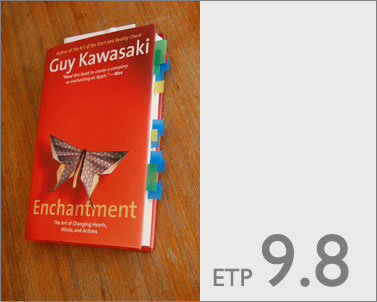
I am also quite excited to start a new analysis based on the fact that for the books I am reading in printed format, I am attaching PostIt tags when I find something that I may want to go back to because it might contribute to the YCISL program. Enchantment received 18 tags. For an 184 page book, that becomes an Earned Tag Percentage (ETP) of 9.8 (divide tags by number of pages then multiply by 100). I am also attaching a photo of the book with its tags showing, and will retroactively update earlier wiki entries with photos and their ETPs. What fun!
News: U.S. Drafts Abdul-Jabbar as a Cultural Ambassador
Interesting news story recently. Here is an excerpt from the NY Times article on it…
“Abdul-Jabbar was named a United States cultural ambassador Wednesday, with a mission of promoting education, racial tolerance and cultural understanding among young people around the world.”
This appears to me to be another interesting avenue in which youth around the world can get engaged in an age-appropriate context. Similar in motive to the YCISL, but a different approach. I hope it doesn’t get over-commercialized or politicized.
Reference: http://www.nytimes.com/2012/01/19/sports/basketball/nba-basketball-roundup.html
Michelle Kaufmann Studio
I looked up Michelle Kaufmann because she and her work was mentioned in a Seth Godin TEDTalk. Actually, it was the photo of a home designed by her (or her firm) in Godin’s slide set that caught my eye and moved me to Google her. The Michelle Kaufmann Studio home page opens with the (vision) statement “Sustainability isn’t just about the way we build. It is a state of mind. Good design embodies, inspires and nurtures that way of thinking and living.”
Especially useful to the sustainability theme of the YCISL are the “Eco Principles” at http://michellekaufmann.com/category/green-living/eco-principles-green-living/ which include:
EcoPrinciple One: Thoughtful Design
EcoPrinciple Two: Efficient Materials
EcoPrinciple Three: Energy Conservation
EcoPrinciple Four: Water Efficiency
EcoPrinciple Five: Healthy Spaces
EcoPrinciple Six: Systems Built

Education Nation 2.0 (Roundtable at Stanford)

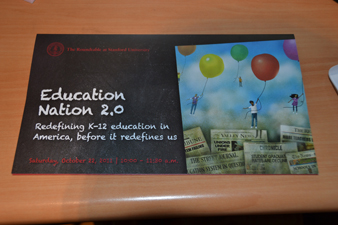
I attended a Roundtable discussion at Stanford titled “Education Nation 2.0: Redefining K-12 education in America, before it redefines us” on October 22, 2011. There were 6 panelists (John Hennessy, Cory Booker, Reed Hastings, Salman Khan, Kim Smith and Claude Steele). and 1 moderator (Charlie Rose). It was held in conjunction with Reunion Homecoming which resulted in (what seemed to be) the majority of the audience being alumni. I was interested in the direction that the education reform movement was taking. The discussion was generally a high level discussion of trends in the reform movement (charter schools, technology, improved teacher education) and therefore gravitated towards solutions and visions. Each panelist brought a unique perspective but the most interesting was from Salman Khan whose vision has obviously kept pace with the adoption of his wares; he suggested promoting customized individual learning pace (which really extends to an individual learning plan) and access to topics not traditionally found in the classroom (mentioned proteonomics). Khan’s contribution has immersed him in education and it is now extended globally (presumably where web access is available). He made one spot-on comment about the true universal purpose of education and that was to enable a person to pursue a “productive and happy life.”
Overall, there was an interesting exchange of viewpoints, ideas and anecdotes, but I felt the problem was incompletely defined in scope so the discussion felt quantized. The panelists were mostly looking inward (the “me” issue that I am reading about presently in Understanding Other People: The Five Secrets to Human Behavior by Beverly Flaxington) and did not seem to have an outward view where they could identify reasons other countries were more “successful” than the US. Also, private schools and home schooling were not specifically in the scope of discussion (although the proposed solutions were actually close parallels: private schools<->charter schools and self-paced learning<->home schooling.
How could this information be applied to YCISL? We could talk about the use of technology and even that of Khan Academy as a resource model (especially as an innovation in education – perhaps extensible to sustainability education albeit interactive and responsive). I could also mention that youth need to drive the issue as well be the innovators in education – because, as YCISL teaches, adults are restrained in their creativity. We could have an exercise where students create a new protocol and purpose for schools – dreaming of a school where the pursuit of a productive and happy life is championed (this is the global scale problem).
http://www.stanford.edu/roundtable/
http://www.stanford.edu/roundtable/webcast/
Rory Sutherland: Sweat the small stuff (TED Talk)
This is the second TED Talk by Rory Sutherland I have seen. One of the key points is that those who are focused on the “strategy” (ie, the large, expensive stuff) tend to forget the details – partly because it is beneath them to work on the details. The result then is (often) that grand solutions are created that do not work. I particularly like his simple graphic that places “Stuff that costs a lot of money” vs “Stuff that has a big effect.” His main point is that not enough attention is given to the quadrant that is high on “Stuff that has a big effect” and low on “Stuff that costs a lot of money”, and that this poses a lost opportunity. In general (and what is signified by the quadrant large in both these aspects), large organizations look for large projects that depend on large projects – but they don’t bother with the details ending up with wasted effort. Then there are the large budget things with little impact – consultancy. He argues that we need to dedicate more energy to low cost-big effect quadrant.
Just how does this mesh with the YCISL? Actually, low cost-big effect is the perfect focal point for youth [How many youth have large budgets?] Not having had a big budget project previously is an advantage that youth have large claim to, and youth in general have not yet learned to spend on a big budget. If we focus youth creativity, we can increase the chances of reaching a big effect without the big budget.
This video: http://www.ted.com/talks/rory_sutherland_sweat_the_small_stuff.html
Previous video: http://www.ted.com/talks/rory_sutherland_life_lessons_from_an_ad_man.html
Leadership through promotion: evangelism
My first encounter with this term was when I applied for a job at Apple, and learned that Guy Kawasaki was an Apple Evangelist.
