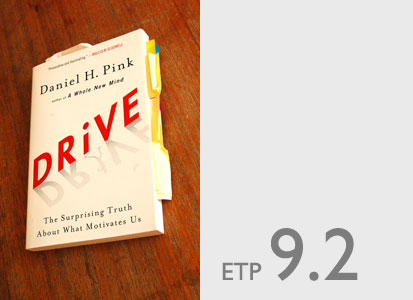
Book: Drive by Daniel Pink
This is the entry to review my thoughts on the book “Drive” by Daniel H. Pink. I found the writing style highly persuasive and engaging. For the YCISL workshop, there is quite a lot to relay [in fact, I did use several topics from this book in the June 2011 workshop].
The main idea that comes through is that intrinsic motivation is very powerful and enduring. While extrinsic motivators such as cash incentives can result in increased yield, its effects are temporary and decline in peak performance with every use – like with rechargeable batteries. Extrinsic motivators also include punitive actions which are equally unsustainable and ineffective.
For our YCISL context, particularly notable is the section “Type I for Parents and Educators: Ten Ideas for Helping Our Kids.” The idea of a DIY Report Card is interesting in the sense it might have a positive motivational effect (traditional report cards would have, I would hazard to guess, about a 50-50 chance of being motivational – because of the limitations to standardization) with little downside. Pink states that “Good grades become a reward for compliance – but don’t have much to do with learning.” I’m not sure I would agree with exactly with how Pink proposes it should be done – his description sounds like an adult workplace performance review – another thing not to expose to youth. What if the report card, for say an elementary student, was done within the framework of a SkillScan card sort? Analyze how the cards get sorted at the start and the end of a term, and see if there is a correlation to the teaching effectiveness and student behavior.
Other notables:
(1) In the section “Words”, page 138: “And a powerful way to provide that context is to spend a little less time telling how and a little more time showing why.” I should constantly remind myself of this point. I am very focused on the typical failure to show “how” because of the attention paid to “Here’s point A, and there’s Point B”; to keep my message engaging, I need to periodically remind ourselves of “why.”
(2) In the section”Purpose”, page 130: If so, when am I going to do something that matters? When am I going to live my best life? When am I going to make a difference in the world?” The author’s point is that motivation is suppressed in adults to the point that delay after delay is the norm in leveraging that motivation. This suppression of course is that which we experience as children in our learning environments, and carries on in adult life in various other forms.
(3) In the section “Oxygen of the Soul”, page 127: “The days that people make progress are the days they feel most motivated and engaged.” Also, “You start to get ashamed that you’re doing is childish” <- this second quote is attributed to Mihaly Csikszentmihalyi.
(4) In the section “Type I and Type X”, page 75: “Type X behavior is fueled more by extrinsic desires than intrinsic ones.” And “For Type I’s, the main motivator is the freedom, challenge, and purpose of the undertaking itself; any other gains are welcome, but mainly as a bonus.”
(5) The Three Elements are “AUTONOMY”, “MASTERY” and “PURPOSE.” I would call these the ideals for motivation.
(6) The Four Essentials of Autonomy are “TASK”, “TIME”, “TECHNIQUE” and “TEAM.” I would call these the ingredients that need to be assembled into an engagement in order to attain the Three Elements.
(7) Motivation 1.0 to 2.0 to 3.0: overall, I am not certain that version 3.0 is going to supplant version 2.0, and even whether version 3.0 is real or better or even an actual stepping stone (maybe it’s actually an alpha or beta version currently?). There is mention on page 19 about version 2.1. Perhaps for the time being, we would be better off using version 2.1 and waiting for version 3.1 instead of jumping into 3.0? Version numbers aside, it would seem that we want to focus on the features of 2.0 we should retain, and add a digestible set of new features – in order to design a new way of doing things. Granted this isn’t “disruptive” which is how some people think things should be done (aka the grass is always greener on the other side).