
Thought: Are Jigsaw Puzzles Good for Training Divergent-Convergent Thinking and Creativity?
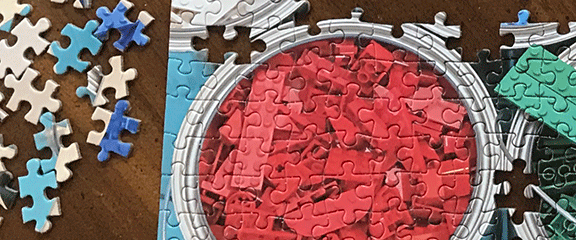
One of my newest obsessive hobbies is now jigsaw puzzles. After completing about 10 puzzles in the past 3 months, I have begun to wonder whether jigsaw puzzles build creativity and are a good example of an activity that uses divergent-convergent thinking. Could a jigsaw puzzle exercise be designed for YCISL workshops just like how we have a Lego activity to demonstrate rapid team prototyping?
Putting together jigsaw puzzles involves creative energy because there are many solution paths and solution strategies. Also, there are multiple and switchable directions: finding a piece that fits a hole or edge(s), or finding a hole or edge that fits the piece you have picked up. There are trial-and-error methods as well as visualization methods that involve rapid eye movement. There is not only shape matching. One could involve color matching as hints. So even though the end result should be the same assembled puzzle (assuming you finish the puzzle), there is a creative element because of the variations that are essentially guaranteed; even if I were to solve the puzzle twice, it is improbable that the exact same solution path would be repeated – and think of the probability that the same time-based profile would be repeated.
Let us also consider how jigsaw puzzles would make a good model for training divergent-convergent thinking. Usually, the jigsaw puzzle pieces have some sort of distinguishable pattern based on the number and directionality of the tabs and slots. These are sortable features and are part of my strategy. So given a particular hole or edge waiting to be connected with a piece, there are certain piece patterns that could be fit and other patterns that could be deductively reasoned not to be a fit candidate. So we can select several candidates to fit a position – this would be the divergent thinking step. We could choose two or more candidates for a hole using the criteria of the moment. We would start our convergent step by selecting a candidate piece and trying to attach it. If there is a perfect fit, great! (but sometimes it is a fake fit), and if that piece was not the right fit, then we would go back to the pool of candidates or create a new pool of candidates (if we learned something from that non-fit attempt where we figured the pool was not going to work). The big bonus of using jigsaw puzzles to model divergent-convergent thinking is the fast thinking cycle aspect because the divergent-convergent thinking steps are usually repeated in clusters. These clusters could be sized by varying the time periods spent on finding matches.
With the creativity and divergent-convergent aspects confirmed, what fun ways might there be to make this worthy of a workshop workout? The first round might involve individual efforts establishing the time periods of sustainable puzzle solving (ie, how long before you need to take a break and rest the mind and eyes?) The next level might be a team effort to reflect interpersonal communication and group dynamics skills. A trick version might be to include a piece that doesn’t actually belong.
The jigsaw puzzle lessons would be compared to real world problems where the pieces may or may not be at our disposal, and we have to practice divergent-convergent thinking with an understanding that the final product may be quite different from what we expected at the start.
Fun. Can’t wait to try it. Now if only I can figure out a version of this that would work over Zoom.
