
Category: Thoughts
Book: Understanding Other People by Beverly D. Flaxington
Just finished reading the book “Understanding Other People: The Five Secrets to Human Behavior” by Beverly D. Flaxington. The byline on the front cover says “How to stop being frustrated by the actions of others and start taking charge of your own life – and reactions.” It seemed like a promising resource with potential lessons for youth, especially those who may be encountering significant adult pressure. Can you imagine a youth trying to communicate with their parents or teachers, but having to deal with the “filters” described in this book? (Note: I think “filter” is not the best term since it implies a consistent loss of information processing whereas I feel it may be more a matter of translation or interpretation fidelity/efficiency at play). The premises from this book are:
1. It’s All About Me. To be able to view things from different perspectives is very important, especially with regards to innovation and leadership. However, there are times when “me” is an essential motivator and the “me” (or “us”) perspective matters the most.
2. Behavioral Styles Come Between Us. Recognition of behavioral styles is essential in any new situation. In a negotiating or mission critical scenario, it may be necessary to put aside prejudice against a certain behavior type; but an appreciation for behavior compatibility is crucial for healthy and productive teams.
3. Values Speak Louder. Values tend to intangible and difficult to identify accurately. Therefore, some latitude or additional data to analyze may be necessary before trying to rationalize a reason for a conflict. A values difference is quite easy to imagine as being an impediment in a youth-adult situation. Even if the youth has role models, it is difficult to list accurately the values that are being adopted.
4. Don’t Assume I Know What You Mean. Youth may be so anxious about being in the presence of adults that they don’t invest much time in setting context. They either want to get the encounter over with as quick as possible because of shyness/fear, or they want to get back to their friends or something they would rather be doing. It may therefore fall on the adult to encourage the youth to provide context.
5. I’m Okay; You Are Most Definitely NOT Okay. This is perfect advice for the adult who is interacting with youth. Critical judgement is definitely not the right message to send to youth when they are making their best effort. Makes me think about the frame of mind judges in a Science Fair should be in (they’ve already invested much of their time into the project before presentation day).
For the YCISL program, I think the above premises can be used to design an exercise (to be described later) to help youth become more confident in asking questions (a skill that should be nurtured as early in life as intelligently possible, but as we know often gets suppressed in school and at home ). Skilled question-asking is a powerful mode of communication and enables highly interactive discussions. Questions allow leeway in interpretation and (in network-speak) error-checking, and promote interaction continuity. It also has utility in innovation and leadership.
http://www.understandingotherpeople.com

Education Nation 2.0 (Roundtable at Stanford)

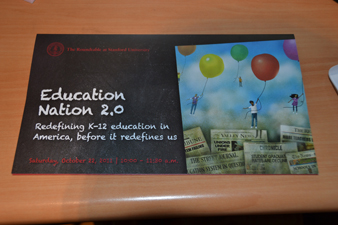
I attended a Roundtable discussion at Stanford titled “Education Nation 2.0: Redefining K-12 education in America, before it redefines us” on October 22, 2011. There were 6 panelists (John Hennessy, Cory Booker, Reed Hastings, Salman Khan, Kim Smith and Claude Steele). and 1 moderator (Charlie Rose). It was held in conjunction with Reunion Homecoming which resulted in (what seemed to be) the majority of the audience being alumni. I was interested in the direction that the education reform movement was taking. The discussion was generally a high level discussion of trends in the reform movement (charter schools, technology, improved teacher education) and therefore gravitated towards solutions and visions. Each panelist brought a unique perspective but the most interesting was from Salman Khan whose vision has obviously kept pace with the adoption of his wares; he suggested promoting customized individual learning pace (which really extends to an individual learning plan) and access to topics not traditionally found in the classroom (mentioned proteonomics). Khan’s contribution has immersed him in education and it is now extended globally (presumably where web access is available). He made one spot-on comment about the true universal purpose of education and that was to enable a person to pursue a “productive and happy life.”
Overall, there was an interesting exchange of viewpoints, ideas and anecdotes, but I felt the problem was incompletely defined in scope so the discussion felt quantized. The panelists were mostly looking inward (the “me” issue that I am reading about presently in Understanding Other People: The Five Secrets to Human Behavior by Beverly Flaxington) and did not seem to have an outward view where they could identify reasons other countries were more “successful” than the US. Also, private schools and home schooling were not specifically in the scope of discussion (although the proposed solutions were actually close parallels: private schools<->charter schools and self-paced learning<->home schooling.
How could this information be applied to YCISL? We could talk about the use of technology and even that of Khan Academy as a resource model (especially as an innovation in education – perhaps extensible to sustainability education albeit interactive and responsive). I could also mention that youth need to drive the issue as well be the innovators in education – because, as YCISL teaches, adults are restrained in their creativity. We could have an exercise where students create a new protocol and purpose for schools – dreaming of a school where the pursuit of a productive and happy life is championed (this is the global scale problem).
http://www.stanford.edu/roundtable/
http://www.stanford.edu/roundtable/webcast/
Sunni Brown: Doodlers, Unite! (TED Talk 2011)
Just watched the TED Talk video by Sunni Brown (one of the authors of the book “Gamestorming”) about the benefits of doodling. They key point is that it helps retention and promotes creative thinking. According to Brown, this is an instinct that gets suppressed with age (social pressure) – sound familiar? This somewhat relates to the face-sketching and Lego Design-Build exercises we already have, but I think we could come up with a true doodling exercise to fit into our YCISL program. Specifically, we should encourage students to doodle (sketch) while listening to something (possibly unrelated). One idea is to have them doodle while listening to a TED Talk video. I would like to have them possibly sketch a map of their Stanford tour, then while listening to something else have them doodle on their map – in the hopes of creative embellishment of the map.
TED Talk Video: http://www.ted.com/talks/sunni_brown.html
Sunni Brown web site: http://sunnibrown.com/
Thoughts: What Should Youth Know About Copyright, Trademarks and Patents?
When one innovates, one should consider legal protection of intellectual property through use of copyright, trademarks, patents or other methods. In the case of youth, one might naively think that products they create are not of potentially high value and therefore, legal protection is not necessary. I was just reminded of the copyright notice I placed in my first software product CatTrack II back in 1988. While I never considered that the software would be a huge commercial success, I wanted to be sure that the work was not copied without due credit – just as I had learned about for journal publications and citations.
Remembering that a principal tenet of the YCISL program is to remain unencumbered by adult frameworks, it is probably adequate to (1) demonstrate how to attach such protection and (2) only use personal property and resources for direct product development – and not discuss the battles associated with intellectual property protection. After all, part of the purpose of intellectual property protection in the adult business world is intended to stifle competition rather than to amass resources to find the best solution. I would hope in the future that the counterproductive application of intellectual property protection as it is framed today fades in favor of a more team-like approach where all that matters is finding the solution especially to some of the world’s most urgent problems.
Lesson Framework: Unfamiliar, Out of the Comfort Zone, Think Out of the Box
Most of the workshop content should be aligned or sourced from familiar ground (eg, something you can do at your school) in order to fuel creativity and drive innovation, but there is also benefit to incorporating some thinking and experience from new and unfamiliar realms (but still from the appropriate age context). I was thinking about the Redesign Quick Challenge guideline I drafted around a beverage taste test concept. This comes from my exposure to flavor chemistry and the taste tests that are part of the research I observed at UC Davis. I also am incorporating the focus group method that I observed at Handspring. This demonstrates that incidental experiences can contribute to new ideas.
Two other well known phrases associated with working in unfamiliar settings are “Out of the Comfort Zone” and “Think Out of the Box.” These phrases can be described in more consequential terms: what is the point of being out of the comfort zone, or thinking out of the box?
Thoughts: What can I say about “Risk”?
In my course Environmental Toxicants, we discuss risk:
(1) Risk Compared to Uncertainty. There is high risk with high uncertainty. Therefore, to go towards less risk, we need to have less uncertainty (ie, more information). When we are being innovative, there will usually be some significant amount of risk because we cannot instantaneously gather all the information needed to make it work. We don’t know whether enough users will adopt it (as an example).
(2) Risk Compared to Failure. We sometimes worry about the risk of failure. This requires risk management to navigate out of the direction of failure. We can anticipate the riskiest factors and try to minimize their influence on failure.
(3) Perceived Risk. Different stakeholders might have different perceptions of risk. For example, different customers might perceive that adoption of a product of technology presents a risk to their business. They estimate the risk based on how they believe the change would affect their business. In the YCISL context, a school administrator might base his/her judgment of allowing the students’ product from being placed in school on perceived risk.
(4) Acceptable Risk. Almost all the time, change involves some level of risk but in search of a solution, some level of risk becomes deemed acceptable. When a company releases a new product, there is always a risk of a field failure or market rejection (for example). For the YCISL, we must show that leadership involves taking on risk (in a managed approach) and learning from failures as well as the successes.
Book: Uncertainty Avoidance in “Outliers”
In “Outliers” by Malcolm Gladwell, Singapore is listed as the “culture best able to tolerate ambiguity”, or the country with the lowest UNCERTAINTY AVOIDANCE. This led me to http://www.geerthofstede.nl where we find more detail about this and other cultural features (termed “cultural dimensions” when quantified on a relative scale).
Uncertainty Avoidance
Uncertainty avoidance deals with a society’s tolerance for uncertainty and ambiguity. It indicates to what extent a culture programs its members to feel either uncomfortable or comfortable in unstructured situations. Unstructured situations are novel, unknown, surprising, different from usual. Uncertainty avoiding cultures try to minimize the possibility of such situations by strict laws and rules, safety and security measures, and on the philosophical and religious level by a belief in absolute Truth: “there can only be one Truth and we have it”. People in uncertainty avoiding countries are also more emotional, and motivated by inner nervous energy. The opposite type, uncertainty accepting cultures, are more tolerant of opinions different from what they are used to; they try to have as few rules as possible, and on the philosophical and religious level they are relativist and allow many currents to flow side by side. People within these cultures are more phlegmatic and contemplative, and not expected by their environment to express emotions.
Also from the website…”Because values are acquired in childhood, national cultures are remarkably stable over time; national values change is a matter of generations. What we see changing around us, in response to changing circumstances are practices: symbols, heroes and rituals, leaving the underlying values untouched.”
In this search, I also found CultureGPS (http://www.culturegps.com) by sales-genetics (http://www.sales-genetics.com) and downloaded it onto my iPad via the App Store.
Perhaps it would be an interesting exercise to show the values of the various cultural dimensions and see if they are expected among the youth participants. It would also be interesting to see whether aiming change at youth (by youth and among youth) has greater influence on promoting a value change.
Uncertainty Avoidance, Power Distance and Individualism Values from CultureGPS Lite (listed in order; downloaded 5/4/11; no version number):
| Country | UA | PDI | IDV | Comments |
| US | 46 | 40 | 91 | high IDV; depend on yourself |
| China | 40 | 80 | 20 | |
| Malaysia | 36 | 104 | 26 | high PDI; little leadership transfer? |
| Singapore | 8 | 74 | 20 | |
| India | 40 | 77 | 48 | |
| Taiwan | 69 | 58 | 17 | |
| Japan | 92 | 54 | 46 | very high UA; follow procedure |
Thoughts: On the Skill of Interpretation
Is there a more important, fundamental and useful skill than interpretation? How many people understand this importance and dedicate much of their (brain) energy into optimizing their interpretation skill?
Starting on the level of computers – drawing from some notes I made for my lectures on Environmental Informatics, we can compare and contrast syntactic interoperability and semantic interoperability – extending it to human communications (not necessarily human-to-human linguistics). The syntactic type simply requires channels for communications and flow in those channels. The semantic type extends this by requiring that the information exchange have unambiguous meaning. Human-computer interaction is largely semantic, although the semantic weight is more on the programming end (have to follow the computer language reference model), and there is significant syntactic weight on the user end (ie, the computer program doesn’t check whether you understood the information).
There are various human-to-human interpretation frameworks we can also consider. At the most familiar level, there is communication between different languages or dialects – we train ourselves to become familiar with the syntax, and a small portion eventually become acquainted with the semantics. Even within the same language, there can be significant variability in interpreted meaning and sometimes it is due to cultural constraints where direct meaning is not permitted (see description of KAL 801 crash by Malcolm Gladwell in his book “Outliers”, Chapter 7).
I would also note, as another example, the art/skill of data interpretation that scientists are regularly engaged in. In the aqueous geochemical computer modeling that I was engaged in, interpretation of numeric output was (and still is) subject to limits of confidence. Take for example, calculated saturation indices for multi-component systems – it was impossible to predict with absolute confidence whether precipitation would occur, lest a supersaturation condition. This relates to the relationship between uncertainty and risk; risk is greatest when there is maximum uncertainty. Similarly, we find ourselves with divergent (but hotly contested) interpretations of earth temperature data, amidst close-to-maximum risk and uncertainty.
OK, back to the topic of youth and leadership. How do we think youth perform with regards to managing information streamed to them via various channels (eg, in school by lecture, in school by books, through the broadcast media, through the internet, from friends and family)? Do they interpret efficiently and with accurate meaning? Do youth develop good reference frameworks that both interpret and filter well?
As an example, think about communication between a parent and his/her newborn child. The child often cries and/or screams to communicate something, whereas the parent utilizes “baby talk”. There is something instinctual and yet highly ambiguous about this. From this starting point, we must realize that youth interpretation skills need to be developed – but like creativity, do we squander the opportunity?
The Sustainable Leadership that is one of the objectives of this program relies heavily on highly developed interpretation skills. At the highest level, a leader needs to be able to communicate (vision, tasks, …) with others and learn (from colleagues, staff, …) from others. So, in order for youth to achieve sustainable (ie, long term and developing) leadership, one should understand the importance of interpretation – and we can do that by encouraging creative interpretation of things they observe (eg, the divergence test described in “Outliers”).
Thoughts: Questions About Change
Sometimes, the best point from which to start brainstorming is with a question (other times, it might be with a problem definition). The question could be self-directed such as…
If I could change one thing at [work, home, school], it would be… Then we would probably want to add “…because…” just so we understand the motivation.
We could also make this question a little more sophisticated (maybe follow our innovation theme) and ask…
I could make [this, that] significantly better by…
The issue with self-directed questions is that they may hinge on one’s focus on personal limitations. It would be an interesting comparative exercise perhaps to also ask the question…
They could have done [this, that] better if…
Perhaps we could roll this into a quick creative exercise where one gets to critique someone else’s work as well as their own.
Here’s an idea: create a new label for a drink (I’m drinking a Tejava at the moment). OK, let’s expand on this idea. We could have a selection of beverages and each team could select one. The team would taste the beverage themselves, then brainstorm and design a new label, attaching it to the bottle. Another team, acting as a focus group would taste the beverage with the new label on it then comment on how well the new label works.
After such an exercise, we should discuss how such an understanding of labeling could be applied to a sustainability-themed product.
This might seem like a marketing exercise, but it really is about persuasion (psychology) – and psychology is really the most applicable tool in advancing sustainability (or most issues for that matter). Sometimes, sustainability isn’t a large enough issue to persuasively alter behavior (on a dominant scale) so it might have to be associated with something else (money, prestige, health, eg).
Lessons: The Power of…
Based on the phrase “The Power of Observation” (which is one of the ideas to be employed in the Compare and Contrast exercise), we could create a series of skills titled “The Power of…” Other “vectors” that we could construct:
“The Power of Communication”…what you can achieve by communicating well (includes preparation, delivery and follow through)
“The Power of Service”…finding motivation to do something.
I’ll have to think up of some more.
