
Category: Planning
Design Thinking Approaches to Sustainability in Smart Cities & Communities
With the start of the new CEE 177L Smart Cities & Communities: Sustainability Design Thinking course in about 2 months, I wish to reflect on the methodological thrusts pinned to three design thinking approaches.
- PostIt Brainstorming and seeing what sticks: normal to crazy. Our un-bounded contributory method based on imaginative fast thinking idea generation and capture. The seemingly random yet focused method. Example: the perfect restaurant menu. Amenable to innovation and problem-solving.
- Tailoring to a single Composite Character Profile. Our feature list-based feedback loop method that cycles on lesson-backed iterations of character and product to achieve communicable positioning. The attractant method. Example: the original Macintosh UI. Amenable to early adopter kickstarting.
- A System of Systems: Networking Nodes, Connections & Protocols. The architectural framework method that involves layered designs incorporating data-driven networking essentials such as routing, QoS, validations, performance evaluations, and synchronizations. The navigation method. Example: the perfect hotel. Amenable to interwoven storytelling.
The three above approaches are all connected with the YCISL program and the CEE 176G Sustainability Design Thinking course. I will be looking for fresh, inspired and inspirational outcomes. Let’s hope for creative energy, generational resonance and timely coincidence for each of our design thinking journeys.
E-Book Idea: The First Resume (and I’m stuck)
I started an e-book based on my CTE mock interview activities earlier this year. The idea was to list some of the most common suggestions I would make regarding the resumes and incorporate YCISL design thinking as explanations for the improvement. I drafted an outline and wrote some content. But I then started to vacillate trying to balance the depth of design thinking – between simple wording of design thinking methodology versus going into detail. I still haven’t decided which structure would work better. Instead, I am writing this wiki entry to list the topics in the hopes that I make a decisive breakthrough. Here goes.
- Timing. Understanding how much time a reader actually looks at a resume. At the mock interviews, I will usually let my eyes scan the resume for about 30 seconds to find the best connection for the interview. However, note that a positive impression is decided within the first 5 seconds of that same period.
- Trust. Building a relationship based on trust connects the mind of the reader with the mind of the applicant. Use words and sentence constructions that relay a feeling of trust. Whether you have earned trust in the past, or you have trusted another person through past interactions.
- Talking Points. In an interview setting, the objective is for the resume to put in the reader’s mind topics to pursue a conversation that reveals suitability. The best talking points should come from the Experience section of the resume. Each talking point should serve as a prompt for possible discussion. A first resume needs about three to five talking points.
- Selectivity. While a resume is largely a historical record of experiences, there is a strategy in being selective for a first resume. The main detail is that the information should be relevant to the position. Use the job description or research the job title to select key words. This conveys awareness and interest.
- Promise and Ask. Communicating a willingness to contribute, grow and learn, and hinting at what motivation or guidance will be required. In addition, an interview involves an exchange of promises and asks so be prepared to also listen for your interviewer’s promise and ask. Feel free to echo the promises and asks to strengthen the tie.
Well, I hope this gets me un-stuck.
Teaching: Sustainability Design Thinking (IntroSem)
“BE INSPIRED BY WHAT EXISTS”
Stanford has a program called IntroSems. “IntroSems are an excellent opportunity to interact in small, discussion-based seminars with some of the Stanford’s most esteemed and talented professors and instructors.” A version of our Sustainability Design Thinking course was given in Spring 2024. We will have the last class meeting of the term later today, & it seems that a reflection may be a useful exercise.
From a high level, the IntroSems version of the course (CEE 11Q) has involved more visualization which resulted in more discussion. The Winter 2019 version (CEE 176G/276G) had a similarly small class size (~7 or 8 students), but the group dynamics was different. CEE 11Q distinctly dug deeper into shared issues, whereas the other course spanned a more diverse range of issues. Having a DCI student in the Winter course added to that stretch. The question though is whether Sustainability Design Thinking is academically effective as an IntroSems course.
From two instances of assignments so far this term in CEE 11Q, the design thinking personal reflections (a mini-essay) have been more encouraging relative to the Winter course reflections. A few excerpts from CEE 11Q:
“…be inspired by what exists…” Inspiration is key to launching in the course project work. Students should recognize & be comfortable with inspiration – to exercise the GROWTH MINDSET.
“Thinking about the amount of things this process can be applied to excites me a lot.” While we can be academically critical & analytical about existing sustainable behaviors, the life lesson from this course involves feeling ready to apply the design thinking process to future projects & challenges – as part of YOUR PERSONAL STORY.
“…the most important part of the design thinking process for this project was empathizing.” Empathy threads our entire design thinking process so that we have awareness structure & confidence for action – to strengthen our EMOTIONAL INTELLIGENCE.
The focal proposition of an IntroSems course to be formative & feed on curiosity makes for a good introductory course. It’s like a “lite” version of our other course. So now I am curious whether we need an advanced version of the course?
The DezignBläst Projects
A couple of days ago, I uploaded the syllabus for Summer Quarter 2024 CEE 176G/276G Sustainability Design Thinking onto syllabus.stanford.edu. For that syllabus, I included a section on the design projects in the course. This was based on the design of and experiences with the project assignments in Summer 2023 and Winter 2024. The descriptions are intentionally brief and written in an academic bulletin style.
Design Project 1: Independent Project. Emphasis on learning the systematic design thinking process, & changing human behavior. Ideation and design of a single product to influence an individual’s sustainability behavior & mindset. Delivery of a presentation & spec sheet.
Design Project 2: Team Project. Emphasis on supporting programs & initiatives that promote sustainable behaviors within a community. Ideation & prototyping of a space, service, activity or program. Involves interacting with others using interviews & surveys to identify opportunities & resources. Delivery of a presentation & spec sheet.
Design Project 3: Independent or Team Project. Emphasis on sustainability in the future. Design using anticipation of needs & innovative technologies in the future. Involves rapid prototyping & human-centered storytelling. Delivery of a presentation & spec sheet.
I like to think there is YCISL-style design thinking in these concept statements about the assignments. The Who? element is answered by the words “Independent” or “Team.” The Emphasis Areas summarily describe the What? of the course content. The When? is subtle in that we specify “future” in Design Project 3 leaving the other projects more in the now. And the deliverables of the presentation and spec sheet give us the How? the design thinking journey will be communicated for evaluation. Hopefully, the When? & Why? are apparent from the teaching part of the class.
This is just further evidence that design thinking (as well as emotional intelligence) is essential to teaching design. I feel it helps me in building courses that are consistent with Stanford’s reputation for entrepreneurship and innovation. Should design thinking perhaps be a component of teacher education? I’ve always wanted to try a teacher workshop for the YCISL creativity program.
Teaching: Sustainability Design Thinking (Part 3)
In Part 2 of this teaching reflection, I had mentioned individual and team as groupings for assignments. There is also the possibility of pairings – in terms of fixed pairs, or speed dating-type pairs where changes in the pairing are made quickly. Pairings could be even more interesting if there was not just equity and parity in the pairings, but we could have intentional mentor-mentee setups.
But the grouping I wanted to really add for consideration in this course is a “committee” comprising students and instructors would serve as mentors. We could form committees of students where they would be responsible for organization and execution. This experience would involved design thinking at a very different level and allow for leadership as well as interpersonal group dynamics lessons.
In YCISL, we formed a committee for the Sustainability in Education Roundtable (oooh, could we have a student-organized roundtable please? Pretty please?). We have also included in our YCISL program proposals, the idea of an editorial committee to publish mini-conference proceedings. This would help us as well to deliver a reference from which we could design accurate and precise resume statements about a student’s experience in this course (use asking-questions design thinking).
Teaching: Sustainability Design Thinking (Part 2)
I have written before how EQ should be used in preparing for and opening a course. Here are more thoughts as I design think what I would like to contribute to the Sustainability Design Thinking course this summer.
We could start with a pre-arrival survey like we have used in past YCISL workshops. This is mainly to raise potential talking points, but can also be used to set expectations using Adora Svitak’s reciprocal learning model.
Along with a topical overview, the instructors should communicate to students the work characteristics (form and load) and performance expectations. We could use the DezignBläst RFP from past YCISL workshops. For most students, this scenario should put them in an unfamiliar position and will reflect their EQ.
The students should be able to communicate to instructors early their learning preferences as well as strengths and weaknesses (academic knowledge as well as skillsets).
The type of work we require for the course should be different from their past experience to provide the opportunity to grow and learn. As in the Richard Nixon quote I have used of late in YCISL workshops, “Each day a chance to do something memorable for someone.” This short idea is full of EQ with timing, awareness and action. Students should be coached for success on their sense of timing and timeliness, a divergent-convergent thinking ability to assess awareness, and a 5-second rule propensity for EQ-rich action.
I imagine there will be a variety of assignments:
- in-class quick challenges such as the 30 circles test or water bottle feature list exercise.
- overnight individual or team observational and inspirational efforts to exercise Corita Kent’s “Look & See” and practice converging or merging ideas for innovative solutions.
- 1 week or longer development efforts that involve iteration and feedback loops.
- One or more term-long deliverables such as a video or portfolio package to give a memorialized close to the gamestorming framework of the course.
- In a way, we could also ask the students to reflect on their personal story or brand identity. We could perform mindfulness exercises to train the mind to navigate and explore their imagination. Very non-academic. Potently life-changing.
I hope these ideas will make it daylight. Right now, I am just imagining what we could do to make the course very forward looking.
Teaching: Sustainability Design Thinking (Part 1)
I have been invited to be co-instructor for the course CEE 176G/276G Sustainability Design Thinking in Summer Term 2023 at Stanford. This is not a new connection, but I will have greater-than-before involvement with instruction this time. I thought I would write three ideas for my part of this course.
- Engagement of the EQ (awareness and action) senses in design thinking projects with sustainability in mind.
- The concept of nudging into sustainability at an angle to be persuasive and human behavior changing will be explored.
- The Art of Environmental Sustainability Communication. Using the idea of “Sustainability has a PR Problem,” we can get students to practice communicating ideas over various modes. Perhaps we could use the YCISL DezignBläst framework for students to practice writing proposals for sustainability products, spaces & services.
These components will involve creativity where we will hope and expect that students can advance through rapid prototyping and brainstorming, and develop their design thinking skillset.
Question: How to Get an Internship (with the YCISL)?
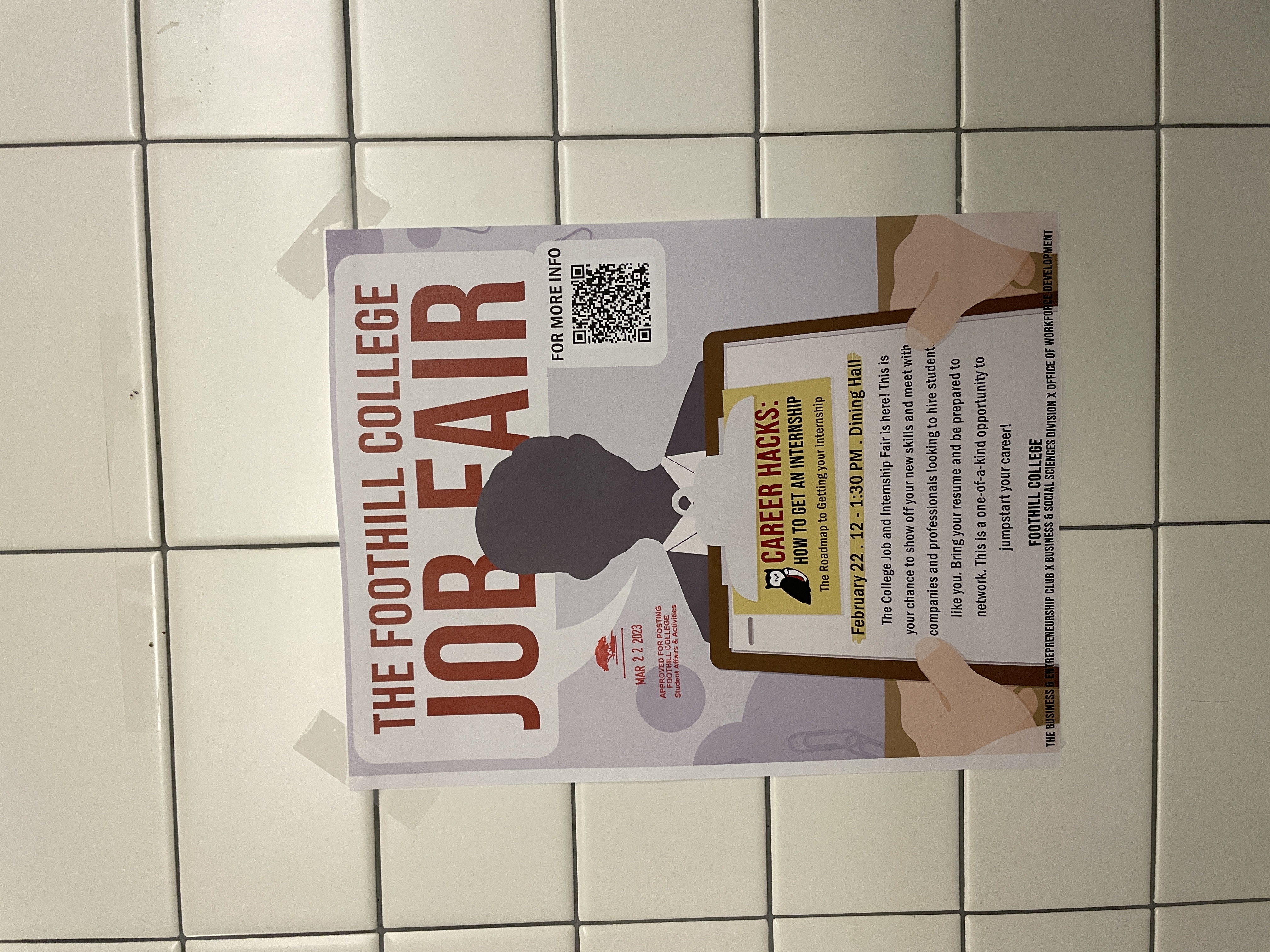
While at the Mock Interviews at Foothill College last week, I noticed a flyer about “How to Get an Internship.” I snapped a photo of the flyer. I have some thoughts to share about what factors were involved in selecting mentor interns for the YCISL program. But first, I will disclose that I got my first internship as a junior undergraduate in college…and it wasn’t as simple as sending an email with a resume attachment. It took a lot of legwork and communication. It worked out great in the end because this was the start of my path to a PhD.
Then there was the hard work (and luck) to get a postdoctoral research position (an internship by form and function) at Stanford University where I was fortunate to build my career of about 30 years. For this opportunity, I mainly credit (a) timing & timeliness which is mostly in the form of luck, and (b) a personality matching click which is difficult to predict. If I had to highlight three specific factors, I would list preparation (resume and past work), good listening and response skills, and authentic interest. But I am just guessing.
I will now reflect on 5 things that I favor when I search for mentor interns for the YCISL program. This list is in the order that the factor runs through my brain…
- Resume. Stanford students applying for a YCISL internship would upload their resume (and cover letter) onto Stanford’s Career Center Jobs database (currently Handshake). Non-Stanford students (usually high school students) would be asked to email me a resume. I would usually take two quick scans of the resume: first for an overall style to reflect on attentiveness to detail, and second for…
- Experience, Interests & Activities. I specifically look for hooks with the activities that I have planned for the YCISL program or would make for talking points in an interview. I would especially note engagement in group activities as well as vivid detail.
- Cover Letter. I look upon the cover letter as an indicator of the ability to collect and communicate thoughts lucidly and to-the-point. Word choice and persuasive language are key. Humility is also appreciated. Usually about one or two applications per season get rejected because of an un-compelling cover letter.
- Personality. The resume and cover letter can hint at the personality, but it really comes down to the interview. First impression is really important, and this might include dress, eye contact and the first spoken words. Beyond the first impression which usually takes about 1 minute, I try to drive a conversation using the talking points and observe responsiveness and soft skills.
- Connection. A connection to Stanford University was usually required. That was an easy one for Stanford student applicants, but high school student applicants were often family of colleagues through my Stanford work, or had attended Stanford programs in the past. I used this as a means to make sure Stanford culture was an inherent ingredient of our YCISL mentor staff.
To summarize, there are two parts: the remote pitch with the resume and cover letter, and the in-person pitch with the interview. For me, I was looking for trustworthy and dependable interns with initiative and motivation so that I could focus on the students in the program. It worked out well.
Idea: Desktop Wallpaper Design Divergent-Convergent Thinking Exercise
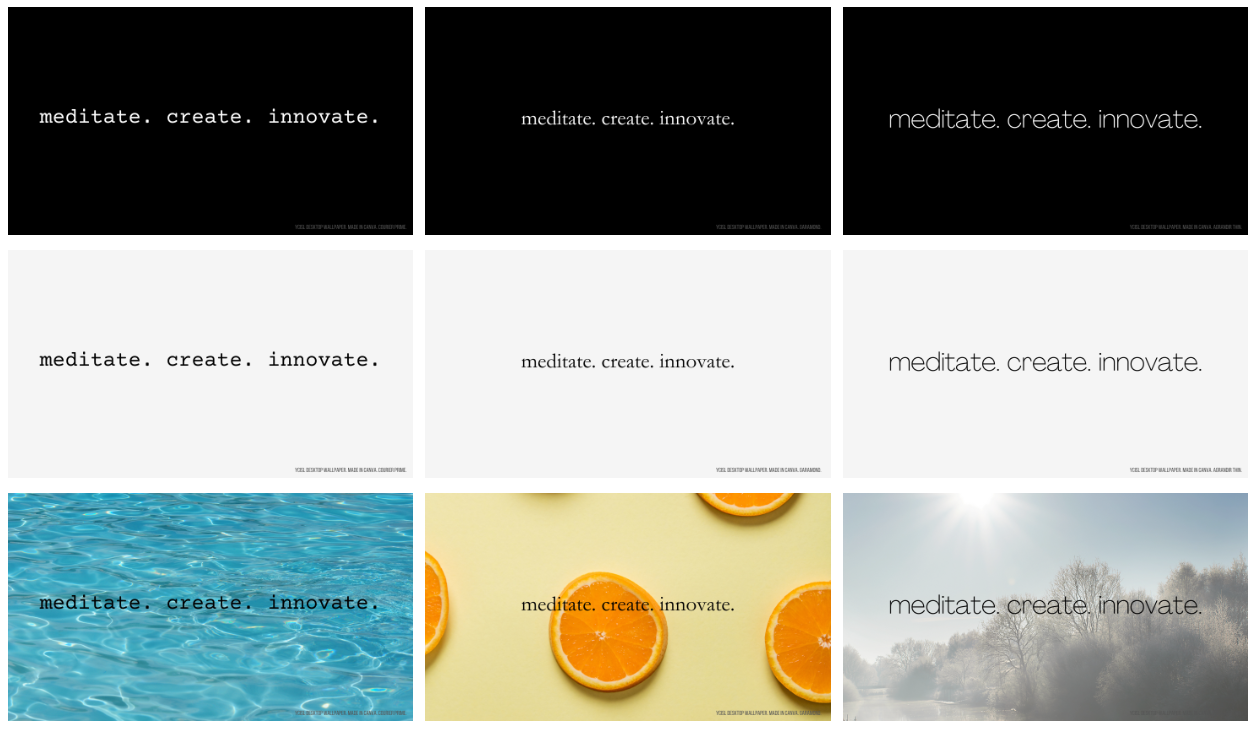 I have an idea for a YCISL Divergent-Convergent Thinking Exercise. Along with DCT, this exercise also involves brainstorming, rapid prototyping, fast thinking, design thinking, creativity and eq. We could also add an elevator pitch component with storytelling and your personal story elements.
Overview: In Canva, create a desktop wallpaper. We could assign various scenarios based on purpose and context.
Instructions: Divergent Phase: In Canva, set up a blank desktop wallpaper template. Add your text. Play with the font styles coming up with various prototypes. With the font prototypes, play with various color schemes for the text and monochrome background. As a last step, create versions with background images. Convergent Phase: Identify up to three prototypes that you think resonate the most. The criteria are up to you. Pitch Phase (optional): Design a 90-second elevator pitch around these selected prototypes providing a feature list, a story and an explanation of how it connects to your personal story. Assess the level of creativity, growth and mindfulness involved in this exercise.
I may have a chance to try this exercise out this summer in Sustainability Design Thinking. In the meantime, I will describe my experience reflected by the 9 designs in the gallery above in this wiki entry.
- I started off with a black background to have lower computer screen glare. I also think a black background has a sophisticated vibe.
- I chose three words related to the YCISL and intentionally selected words that rhymed so that they bounce around in the head together. I also feel the expression has a connected 3-step progression so there is an element of active listening (hearing, listening & understanding) involved.
- I actually created 16 prototypes based on font type. The three font types shown in the gallery at the top are Courier Prime, Garamond and Agrandir Thin representing the more common type styles.
- I then made a copy of the set of 16 prototypes and changed the background to white. As I started working on this WordPress entry, I found that I preferred having some contrast between the wiki image and the wiki background, and made another set with an off-white background (#f5f5f5). I feel both the white and off-white background sets work well. Putting a little red, blue or green tint would have been an interesting expansion, but I didn’t do it. That’s because I like to design exercises with sets of 3, and the 3rd step in this exercise is to…
- Use images for the background. Again, I did actually create 16 prototypes with various backgrounds, and the three shown in the gallery above are just by chance the ones for the three basic font typefaces. Still, I like the variability represented here where the water has a cool and dynamic feel, the orange slices image touches most of our senses, and the scenery background denotes place and time.
Another important note is that even with 16 font typefaces and three variations on the background, there is learning happening in this exercise. Preferences, new ideas and intrinsic motivation are being exposed. So if there is enough time in this exercise to conduct a second DCT cycle, that would be consistent with the way we do the Spaghetti Tower Marshmallow exercise (“Fail Early, Fail Fast”) as part of rapid prototyping.
A Note to Self: About Hard Work
On my way to play some tennis this morning, I came up with an idea for the next YCISL e-book. It’s about Hard Work. The idea springs from Alison Ledgerwood’s 2013 TEDxUCDavis Talk “Getting stuck in the negatives (and how to get unstuck)” which was somewhere along the way re-titled to “A simple trick to improve positive thinking.” In that talk, she says “We literally have to work harder to see the upside of things.” That statement links to another which I do find more resonating which is “It’s all hard work. Nothing comes easily” – spoken by Richard St. John in his 2005 TED Talk “8 Secrets of Success,” but credited to Rupert Murdoch through an interview.
So I think I will work on an e-book with maybe eight examples of creativity and hard work.
- “We literally have to work harder to see the upside of things.” Alison Ledgerwood. TEDxUCDavis. 2013.
- “It’s all hard work. Nothing comes easily.” Richard St. John. TED. 2005.
- “It’s very, very simple to get what you want. But it’s not easy.” Mel Robbins. TEDxSF. 2011.
- Work = Force x Distance. An equation to describe the Growth Mindset. The YCISL Personal Story & Roadmap.
- Push. Pull. Center. Mindfulness. Sweat Equity. Stress & Strain. About YCISL EQ.
- Active Listening. Filters. A YCISL conversational topic.
- “Must try harder.” Sir Ken Robinson. TED. 2006.
- Creativity. Fast Thinking. Divergent-Convergent Thinking. Self-Edit. Self-Doubt. The YCISL Creativity Model.
That’s probably enough for the kind of short e-book I have been publishing. Hopefully, I can make it interesting for readers. The structure goes from ideas to concepts to a model.
Looking forward to getting started.
