
Category: Thoughts
The Straits Times: 6 in 10 S’porean households recycle weekly, though misconceptions about the process remain: Surveys
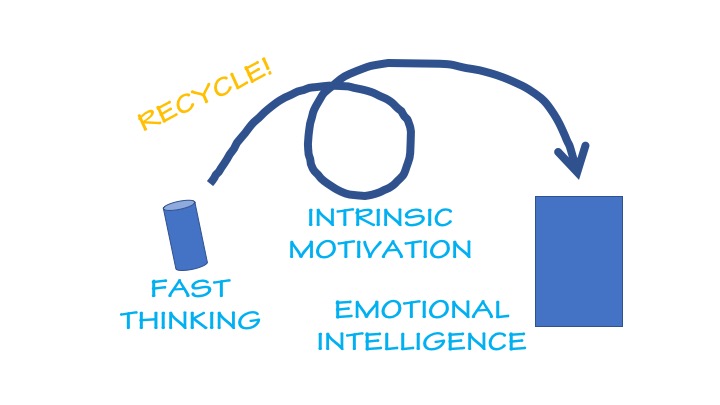 Household recycling is still an immature process – meaning plenty of confusion, indifference and emotional un-intelligence. This The Straits Times article by Ng Huiwen published on April 29, 2019 titled “6 in 10 S’porean households recycle weekly, though misconceptions about the process remain: Surveys” reminds me of my own household’s behavior with respect to recycling as well as how government policies keep getting in the way of creating sustainable recycling behavior (eg, the plastic bag ban). Thus with the condition of wanting so much more out of a good cause, we can possibly take on this problem scope for the YCISL workshop team projects.
TUNING THE RECYCLING MINDSET
Purpose: To design solutions utilizing YCISL strengths that enable optimizable recycling behavior in homes.
How: For this pilot-level project, team projects will be required to include fast-thinking conditioning, instrinsic motivation leveraging, and emotional intelligence smart-ness.
Methodology: Team products could be service-oriented, educational (various media or channels), interfacial (eg, using HCI), interactive (eg, with feedback), gadget (something to install or carry) or programmatic (crowd-sourced or information campaign). To optimize, make it simple AND easy.
Rules (who needs rules?): No financial aspect will be considered.
Teams and the Universal Issue of Sustainability
In the YCISL framework, I position Sustainability as a universal issue meaning that it affects everyone, should be on everyone’s mind, and requires everyone’s active input and feedback. In modern times, environmental sustainability fits this “universal” theme but we could think of sustainable human health, agricultural sustainability and sustainable education as universal causes that should engage everyone. The “SL” in our acronym stands for sustainable leadership – based on the idea that everyone is in a leadership position and there is a general need to train and strengthen EQ to garner higher quality leadership.
I am writing this entry in thought to my reading of Stanford’s latest Vision Initiatives in Research. My worldview on this includes the Sustainable Urban Systems program that I helped put together in a proposal several years ago as well as the YCISL idea of sustainability as a universal issue. From this, I have few thoughts on how to put together teams and what to list as the principal tasks. For our YCISL project teams to be successful in product realization with sustainability as a feature, these team strategies may be useful.
- Form multidisciplinary teams with cross-functional competencies. I learned this at Handspring. The team should represent the various functions that move the product forward. Participation by representatives may vary at each development stage or even within a stage – which is where cross-functionality comes in. Representation from each function is also critical to ask questions from diverse perspectives (eg, from the testing part of our YCISL workshop) as well as to share insight and ideas (eg, from our PostIt brainstorming part of our YCISL workshop). And in most situations, an experienced project manager is needed to keep everything upright and progressing.
- Strive for team emotional intelligence (an extension of individual EQ). Our EQ framework comprises self and social components. In the YCISL, we start with the self by defining our Personal Story in order to build our identity, and understanding EQ life lessons that we can apply to continuously training ourselves. Teams should communicate a collective Personal Story and develop a singular image of their identity (eg, purpose, energy, direction, shape and function). We also work on the social by energetically activating ourselves to connect new experiences, skills and ideas using a growth mindset (teams need to maintain positivity and productivity).
- Using the Gamestorming format, teams should engage in the OPEN then move on to the EXPLORE with the known parameters of when and how to CLOSE. Iteration is key to the team process as is fail early, fail fast (the virtual reset button), and the divergent-convergent thinking loop.
Paper Airplanes & A Reveal of Our Problem-Solving Mindset
I re-watched Tim Brown’s Tales of Creativity & Play this morning, and the part with the Finger Blaster had me wanting to incorporate something similar into the YCISL workshops. I also had just watched a TED video “How To Make Applying For Jobs Less Painful” by Priyanka Jain in which she showed a clapping test to reveal a thinking trait. This has me again wanting to demonstrate the spectrum of approaches any given group naturally takes to tackle a problem (and how education, let’s say a typical classroom, is herded to take just one approach). So here is an idea for a workshop exercise using paper to make paper airplanes.

I am assuming that for any given group that paper airplane-making skills are widely spread. Some may already know how to make a paper airplane. A few may know how to make sophisticated ones that fly far or can do acrobatics. Most will likely know how to make the simple paper airplane that fly a relatively short distance compared to the current record of 220′ 10″!
For this exercise, we provide one sheet of paper to each participant. They start by writing their name on the paper for post-flight identification. The participants are then simply instructed to build a paper airplane with their sheet of paper and we will see whose flies the farthest. No other instructions.
They will be given 10 minutes to do this. After that, it will be time to fly their creations.
I hope to observe a wide range of approaches to this task such as:
- folding using their existing knowledge about paper airplanes, if any
- doing some independent research such as checking the WWW
- asking someone for help or advice
- just watching someone else and copying
- forming a collaboration and working together
Then we fly and see whose flies the farthest. Just as we do with the Spaghetti Tower Marshmallow exercise, we could do multiple rounds of this and look for learning through iteration. Will they change folding technique or will they take a different approach?
Each of the approaches reveals how one’s mindset is currently geared to problem-solving. The three main lessons (phrased as questions) are:
- Does your leadership worldview include other people (collaborator, advisor, teacher, etc)?
- Do you have a trusted growth mindset that takes you out of your comfort zone? Or do you tend to play it safe?
- Are you comfortable learning more about yourself (self-awareness) and how you approach problem-solving (self-management)? Are there any issues that can be addressed?
College Admissions & the Parent Reality Distortion Field
Having spent many years in university as a student and working at one, my worldview on college admissions has suddenly gotten very interesting (forehead-slapping kind of interesting). And it’s got a Shakespearean twist with certain actors (the fools) getting agitated over their own reality distortion field having a moment of clarity.
Really. There are no rules to college admissions. A simple, but not easy concept for people to fathom. Thus, we are witnessing in the news media stream reports of a variety of parental gaffs. The current spotlight is on the celebrity parents who fell for the (bad) college counseling advice and, as (bad) parents, put their child at risk.
I also am now seeing reports of lawsuits which are exposing “glass half empty” parents who need something to blame for their insecurity. They should come to grips with the fact that every “failure” is a learning opportunity and to value it. Would they rather have had their borderline child get accepted in the more competitive (reach) college and subject them to the trauma of being in the lowest quartile? Is dropping out an option they’re willing to risk? How about becoming a “C” student?
And there was a LinkedIn post by an executive who is a parent of a soon-to-be preschooler (let’s make this parent category #3 where the parents are still quite some distance from thinking about college). There is a lot of good advice in the article especially about making the best with failures because we all experience it with some frequency. However, it does not evaluate the current college admission news-front holistically and from within the storm.
And let’s not forget the parents who retain college admissions consulting services and SAT/ACT prep. Are these really “fair” advantages since they are not evenly available and used? Do they provide a true impression of the student?
Lastly, what about the parents of students admitted “through extraordinary channels” who are not in the current dragnet? What should we do about them?
As far as my YCISL worldview goes, this is a teaching opportunity for parents. This is a pivotal historical moment where we can choose to recognize that parents need help understanding their responsibilities in this process better. Can we have a revolution that lays out what college admissions really is? This is what I am asking myself with regards to the YCISL program. Could I leverage my contact with youth to get them to tell their parents what college admissions is really about? Can we use our lessons in active listening, emotional intelligence, Your Personal Story, leadership, elevator pitch and divergent-convergent thinking to get parents out of their reality distortion field?
Top 3 Tips for Parents in the College Admissions Phase
- The SAT/ACT results are useful only to college admissions staff who need some excuse to cut their stack of applications. They do not provide an indication of an applicant’s intelligence or intellect or likelihood for academic success. No instructor ever sees these scores when they teach a course. These tests are as meaningless to parents as the commercial college rankings. Be thankful that there are test-optional applications available now.
- GPA is almost as short-lived and meaningless as SAT/ACT scores. It is another way to reduce college admissions staff workload. GPA is a cumulative reflection of circumstance and academic resonance. A high school GPA is especially a cruel joke because of the varying GPA scale from student to student (and in college, there is a similar fuzziness due to how A+ grades are distributed and weighted).
- There are no guarantees – for admission, for academic success in college, and for career paths. Quite the opposite. It’s about revealing one’s character and characteristics under varying conditions of uncertainty. And the benefit of all this is the exploration, discovery and story-building of a meaningful life.
WSJ: AP Tests Are Still a Great American Equalizer
In the Letters to the Editor section of today’s (Saturday March 2, 2019) WSJ, there are two letters from AP subject teachers which support an earlier WSJ article titled “AP Tests Are Still a Great American Equalizer” by Caitlin Macy in the Review section on February 23, 2019.
I have made my position on the SAT and AP tests clear in a blog entry from about a year ago (WSJ: The Gatekeeper Tests). The tests and the educational activity that serves them should be thrown out – and it seems from the Macy article, there is noticeable movement in that direction. I am heartened to hear that there is a crack in the SAT/AP shield (yes, a shield analogy because it is an industry that will kick and flail to keep itself alive). And the schools that Macy points to as embracing competition are, in my view, waiting to see how the early adopters react. Remind yourself about print photography.
If there is too much pride to adopt the IB, why not develop something to replace AP that deals with the shortcomings? The Letters to the Editors that I referred to at the beginning give a clue to part of the answer. Teachers who teach AP classes are endeared to them. They just don’t know or can’t imagine better (nod to Steve Jobs’ quote of “A lot of times, people don’t know what they want until you show it to them.“) What if high school teachers (or even let’s say AP teachers) get course reviews like college professors do? What are they going to say are the reasons for critiques? Pretty easy to guess they will point to the AP curriculum or AP test. What else is there if all they are trying to do is “teach to the test.” And if we want to have faces for the AP curriculum and test, we will need to take a closer look at the qualifications of the AP committees. Guess what you will find (or even better, go ahead and look it up).
The following are my thoughts on parts of the original essay and the subsequent letters…
“I still believe that AP courses are one of the greatest preparations for college life whether or not the student actually receives placement.” Paul Pomeroy, Letters to the Editor
My thought: AP courses are taught in a high school framework and format. There is minimal semblance to a college course. For a subject such as AP Psychology, I have always advised taking it in college…the professor will usually incorporate the latest research and provide expert perspective and analysis. The college course has more chance of being inspirational and life-changing.
“If private schools opt out of AP tests, what is their alternative measure to assess learning growth?” Dileep Rajan, Letters to the Editor
My thought: Well, there’s the IB for a start. And there’s opportunity to create a 2-year high school curriculum, like A-level and IB, that extends the existing high school Honors course so that students learn more and are better prepared for the leap to college (a YCISL objective). Close those year-over-year gaps that Salman Khan has talked about.
“…enabling students to save semesters of tuition fees.” Caitlin Macy, Review Essay
My thought: You might want to check that. AP credit in college means you cannot take a course or two. It typically doesn’t contribute to the units counted towards the degree. Colleges still want you to pay for the full ride.
“While public schools nationwide continue to embrace competition, private schools seem increasingly uncomfortable with it.” Caitlin Macy, Review Essay
My thought: Wishful thinking. My worldview sees private schools as agile, willing to be a part of the proof-of-concept, and engaging in timely problem-solving. Public services tend to have much greater inertia and lower tolerance for risk and failure (and in YCISL, we see value and advantage in failure and accepting risk).
“For students in underserved communities, the APs can be a way out precisely because they are nationally recognized.” Caitlin Macy, Review Essay
My thought: And where are they going? This reminds me of the low rating that the US has in Geert Hofstede’s Cultural Dimensions for LTO (long-term orientation). For how long do most AP students hold on to their AP experience? Ever brought it up at a cocktail party or during a date? (And that was a nod to Sir Ken Robinson’s “If you’re at a dinner party, and you say you work in education — actually, you’re not often at dinner parties, frankly.“)
Shark Tank’s Best Pitches Explained By the Cast | Vanity Fair
I came across a YouTube video this morning titled “Shark Tank’s Best Pitches Explained By the Cast | Vanity Fair” which made me think about the YCISL program. I have watched Shark Tank on television and YouTube before (just a few times), and attended a local Dolphin Tank event (similar concept but for youth). Mostly, I don’t connect Shark Tank to the YCISL program because of the weight given towards money (investments from the Sharks as well as the definition of the problem and success); it makes for compelling television viewing, I understand.
What I did get reminded of though is that the YCISL program is about porting adult frameworks and concepts to a youth context. YCISL is about attenuating “Play” to boost creative energy and the intrinsic motivation to sustain that energy. And from that video, it’s interesting to see the port connection.
- Know Your Numbers -> Elevator Pitch. “Know your numbers” is not so much a point about being a vessel for financial information, but more about being prepared (a state of readiness) with an elevator pitch that is emotionally intelligent. Know your target audience and be prepared to make a memorable impression. For an elevator pitch, having an idea of reaction buttons to press help too (not that you should press every button).
- Be Creative -> Creative Energy. In YCISL, we show our model where creative energy is at the base of innovation and leadership. For most though, one’s creative energy level is unknown (having been stifled by education) and untrained (not readily accessible or appropriately applied). On Shark Tank, the creativity in the pitches are in the person, product and pitch. In YCISL therefore, we emphasize exercises that expose creative energy levels and aiming that energy.
- Have “Chutzpah” -> Positivity. YCISL touches on positivity in several ways using examples from Shawn Achor (better productivity) and Alison Ledgerwood (framing). There is also a needed element of confidence that I draw from Mel Robbins. We ask our workshop project teams to ensure positivity when working together. We look for simple techniques that effect positive alignment.
- Problem Solver -> Project Studio. The YCISL innovation premise is based on solving problems. We search through personally-experienced problems as well as problems from one’s worldview and observations to select one to use for the workshop Project Studio. Our Project Studio exercise is done in a team to render normalization to the problem to remind us that a good solution has the potential for wide adoption and multiple applications beyond the original worldview. Picking a problem isn’t as easy as it sounds, and in YCISL we emphasize the basics of formulating a problem statement – for visionary inclusion and team alignment.
- Motivate Others -> Intrinsic Motivation (Self+Others). From Dan Pink, we understand that motivation has a sustainability issue. In YCISL, we recommend leveraging intrinsic motivation given limited resources (especially the case for youth). We also examine approaches to imparting intrinsic motivation in one’s self as well as to others (team and users). This is one of the critical leadership skills that we seek to develop through our program.
- Listen to Diverse Opinions -> Active Listening and Growth Mindset. To listen, we need to listen well and the skill of active listening is key to Shark Tank as well as innovator and leader roles. Unlike the make-it-or-break-it tone in Shark Tank, we moderate discussion in YCISL so that there is sequential exchange (like in Adora Svitak’s reciprocal learning), checkpoints and learning. From that, we can feed the growth mindset that we expect in a creative and decision-making setting. We also learn to train fast thinking and the cycle of divergent-convergent thinking. Subsequent to this process, we also learn about weighing competitive advantage and thriving through de minimis risk and initially huge uncertainty conditions.
This reflection years after YCISL started has been quite satisfying. I hope it will help further development of our concepts, ideas and products.
YCISL Team Project: Disrupting Human Behavior
One of the challenges that we have discussed in the YCISL workshops is changing human behavior. From ideas of the growth mindset (Dweck) to Simple, But Not Easy (Robbins), we know that changing human behavior like a disruptor requires a high level of mindful and persuasive creativity. We would need to leverage the sense of “new” (linked to the Try Something New workshop idea) and a worldview-framed story.
I am therefore considering the design of a YCISL team project with the theme “Disrupting Human Behavior” whereby teams have to realize a product that opens a new and competitively compelling path towards a sustainable objective.
The project would require a clear path and powerful messaging. Competitive advantage (just like in our Elevator Pitch exercise) would need to be awesome – as would ask and promise.
To be ultimately challenging, the teams would have to make (influence) other participants in the workshop willing to try the new path and consider sticking with it. It would have to be something workshop participants are actually doing at the start of the workshop – and would change their behavior by the end of the workshop.
How hard would that be?
What’s the plan for YCISL 2019?
The December break was a good time to come up with ideas for the 2019 YCISL workshops.
- A Symposium on Inspiring Cases of Youth Creativity, Innovation and Leadership. The schedule would involve research & development of a TED-style talk on a selected person, place or event. The selected case would have to exemplify the YCISL principles of EQ, intrinsic motivation and creative energy. Presentations could also make commentary on other YCISL topics including positivity, fast thinking, problem-solving, gratitude, teamwork/teambuilding, brand identity, and your personal story.
- Team Project on EQ-fying Schools, Classrooms & Learning. Exploring a range of solutions to quality of engagement in Education. Particular focus in the first year will be on classroom OOBE (first impressions for the students and teacher). The aim will be to create an EQ-based familiarization between students and teachers in order to enable the reciprocal learning posited by Adora Svitak. We could touch on expectations, methodology and assessment.
Thoughts: New Year, New Resolutions & Change
Welcome to 2019!
An article in The Straits Times on December 28, 2018 titled “10 Tips for a Better Year” by Neen James reminded me that it was that time of year again when there would be a wave of self-improvement advisories. About how to approach making resolutions and keeping them. Another article “You say you want a New Year’s resolution…?” by Jamie Robertson on BBC News on January 2, 2019 further reminds us how most resolutions are short-lived – on the order of days.
Among the ten tips given by James, here are my three favorites within the YCISL context:
Know Your Priorities. For youth (especially pre-teen), priorities are often set by parents, teachers or other adults. So the challenge for youth is to be aware of their context given the surrounding priorities and pull together a set of personal priorities that connect. YCISL: Start with 3…and update as needed.
Surround Yourself with VIPs (Very Inspiring People). We know that your support network is critical to sustainable well-being. Can you think of 3 people who inspire you right now? Do you have the awareness and management skill to minimize the draining people around you? In YCISL, we like using select TED Talks for inspiration. For the 2019 workshop program, I am planning on leveraging Adora Svitak’s “What Adults Can Learn From Kids” TED Talk to inspire creativity and leadership through the form of “Quick-fire” projects focused on the classroom.
Make Time For Those You Care For. Caring often has a reciprocal effect. It elevates intrinsic motivation and feeds our sense of fulfillment. It is a perfect platform to train and apply our emotional intelligence because caring is sensitive to who and how.
WSJ: The Pessimism Reflex
In the Review section of the November 17/18 edition of the Wall Street Journal is a feature article titled “The Pessimism Reflex” by Matt Ridley. I found this particularly interesting as to how it relates to positivity, framing and true facts – topics we bring up in the YCISL workshop program.
Even in my last wiki entry – the one commenting on an article on “problems” with philanthropy – highlighted thinking that had a framing issue and lacked positivity. Makes me think of Grumpy Old Men.
With Mel Robbin’s mental handbrake analogy, it is too easy to be pessimistic. Pessimism is the handbrake that can easily reinforce the self-notion that there is something holding us back. And just like Malcolm Gladwell’s point about associating with greatness, there is also a tendency to associate with deprivation (the grass is always greener…).
And we can also understand the impact of pessimism through Alison Ledgerwood’s point about getting stuck in the negative.
We know in the adult world that pessimistic news goes around faster than optimistic news, and that spin and distorted reality becomes a part of the stream of norm – so it becomes an essential skill for youth leaders to train their senses to receive and feel pessimism, but to relay with positive actions and communications.
