
Category: Thoughts
Stanford News: Stanford scholar addresses the problems with philanthropy
Through my LinkedIn feed, I read a Stanford News article on philanthropy written by Melissa De Witte (December 3, 2018). The article relates to a book written by a Stanford Political Science faculty. I thought I would comment since we are trying to apply YCISL thinking to philanthropy.
First, I believe we have different definitions of philanthropy. The book author seems to be referring only to monetary donations that qualify for the benefits of tax deduction. That’s like looking at someone’s face and picking something to be critical of – even if we generally do not make a fuss over the whole. We should be praising any philanthropy on any scale and of any shape. In YCISL, we wish for philanthropy to be encouraged and be a part of natural human behavior. As is our youth program style, we view philanthropy without monetary aspect and instead look to grow it with intrinsic motivation. That makes it accessible and a key component of personal development.
“But philanthropy is generously tax subsidized…” You say “subsidized”, I say benefitting society. Remember that deductible donations can only go to qualifying organizations and so such money flow is just cutting out the middle man (and we know that is a good thing where it is important to make money work efficiently).
“Philanthropy often comes with strings attached.” That’s if you only know philanthropy as what makes news headlines. The word “often” should be replaced with “occasionally” or “sometimes” because my view is that of most people engaging in (monetary value) philanthropy, but in modest amounts – and they are definitely without strings. Think of the Salvation Army Kettle (and similar set-ups) or used clothing donations or school fundraisers or even freeway off-ramp panhandlers. In terms of frequency and emotional payback, I think the no-strings attached philanthropy dominates.
The bottom line question is “Would society be better off without philanthropy (as it is today)?” My “glass half full” answer is “obviously!”
If I had nothing. Starting Over: A Reflection
Idea is to reflect on what you would be focused on if you were starting over and afresh. Many people in the developed and developing world lead cluttered lives and emotional luggage. Our attention is divided and we spend much of our mental energy sorting useful information from garbage.
Can we come up with an exercise to reflect on our priorities and imagine what it would be like to have nothing so that everything is a potential goal?
Thoughts: Meltdown Uncertainty
“They live up there, and slightly to one side.”
Sir Ken Robinson in his TED 2006 Talk “Do schools kill creativity?”
A lack of emotional intelligence can lead to a meltdown – which includes irrationality, insecurity and isolation. At the social awareness level, people will notice defensiveness (“I” language) punctuated by jabs of aggression, and impatience. Truth in negotiation and compromise are impossible as trust has shrunk. This is typically found in adult behavior and signals an absence of self-awareness and self-management. It is likely rooted in an imaginary fear and lack of true confidence where the senses are numb and non-functional.
When you run into such a person, it can be horrifyingly puzzling. You wonder whether it is a reflection of their true unguarded personality or a circumstance of recent events leading up to the melting point (then you don’t know if it will get worse or better).
This is the kind of situation our YCISL program endeavors to train young people to gird themselves against in their own behavior, and to be able to recognize this problematic “pothole” behavior in others. When encountering such behavior in adults, our YCISL position is to step aside or put yourself into reverse. There’s no value in trying to save the other person or offering help; they are in adulthood where behaviors are unlikely to change and biased mindsets are entrenched. Adults who learn leadership later in life mostly learn to put on a facade – a modified interface layer on top of a complex and messy structure.
In YCISL, we train teams to ensure group positivity before launching into creativity. We encourage teams to have quick techniques to lift up the positivity, but what should you do when each has been used?
WSJ: Employers Find ‘Soft Skills’ Like Critical Thinking in Short Supply
In actuality, I am writing this entry in reaction to an article titled “The CEO of LinkedIn shares the No. 1 job skill American employees are lacking” that is posted on CNBC.com written by Ruth Umoh dated April 26, 2018. However, I feel that particular article is too limited in scope because it refers to “research” reported by LinkedIn which is limited in context. So I looked up a WSJ article (by Kate Davidson, August 30, 2016) with a similar idea – it does also refer to LinkedIn, but on a slightly broader scale.
From my YCISL perspective, EQ is lacking in a general way and that is being picked upon as a failing when trying to hire new employees. The ironic part though is that EQ is just as likely to be missing within a company as it is among those looking to join.
One could feel that there is ample critical thinking available, but it is easy to miss because of (1) a fear of sharing that critical thinking in a one-to-one or small group setting, (2) a lack of active listening where critical thoughts go un-heard because of cognitive filters, and (3) a socio-cultural norm where critical thinking should be kept to one self. After all, I see plenty of criticism (a representation of critical thinking) on Yelp! and YouTube. And in education, critical thinking still means that you have to converge to the same conclusion as the examiner.
With these constraints, one could also consider whether leaders are asking the right questions to generate the critical thinking they desire. Asking questions is a general weakness too in leadership and closely tied to teambuilding. We have thus come back full circle in the cause-effect analysis and suggest that the solution starts with LEADERS becoming more skilled at starting the cycle with (a) good questions, (b) keener active listening, and (c) creating a trusted environment where critical thinking is expected and valued.
WSJ: Partners in Blood
Few organizations in Silicon Valley implode like Theranos has. [There also was Solyndra.] But Theranos is a good case example for the innovation process for the YCISL program. This entry is based on the article “Partners in Blood” by John Carreyrou published in the Saturday/Sunday May 19-20 issue of the WSJ (Review section).
The article describes ultimately poor leadership skills on the part of two main characters in the Theranos story: Elizabeth Holmes and Ramesh Balwani.
By YCISL measures, they actually did a great job at problem-setting, brainstorming, and elevator pitch. They should also be given credit for product development with regards to setting a very compelling feature list.
However, there are two parts of the innovation leadership process that seem to not have been done according to Silicon Valley standards. One is the testing and readiness step. Alpha and beta testing must have revealed serious problems with what they had developed. Once the product was put in the hands of a real user, QA, QC, LIMS and all other lab protocols should have alerted everyone to problems.
The other step that went awry is prototyping. In YCISL, we emphasize “fail early, fail fast” in the prototype stage but Theranos kept developing a product past prototyping with showstopper failings. Any skilled analytical chemist would not trust data from small sample size due to the amplified issues with the “scientific method” including sampling error, sample contamination, sample preservation, and the conditioning of analytical instrument detectors. What Theranos did is an error usually made (but eventually understood) by first-time science fair students. The real failing here however is the denial of the flaws, and the inability of investors to resist the obvious fib. Fuel to the fire.
The lesson for YCISL is to be disciplined during the prototyping stage and even the testing stage. Be honest with yourself. Be willing to embrace failure and learn from it. Be comfortable starting again – Silicon Valley style.
Follow-on: I decided to re-read Jeff Raskin’s “HOLES IN THE HISTORIES” to remind myself how it only takes one acceptable “authority” to build a consensus resulting in fact but not truth. Theranos’ lie may have started as a small seemingly-manageable one, but one can imagine it getting out of hand once one investor bought in. At some point, people chose not to check primary sources and relied on secondary sources. People bought into the “fact” but took the truth for granted. Raskin also writes on DELIBERATE MISREPRESENTATION and the “reality distortion field” that Steve Jobs is closely associated with. This is a leadership “disease” which has spread widely and we should address by instilling stronger EQ in youth leadership.
A Study in Contrast: Smart Ideas vs Un-Smart Ideas
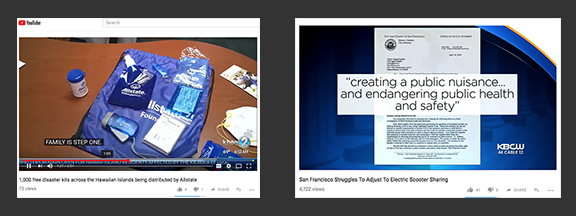
When choosing a problem and solution for the YCISL Project Studio, teams are guided to draw from their own “universe” and work on something that comes from their own experience or an issue they are very familiar with. With our emphasis on creativity and innovation, we also encourage students to work on the “crazy” end of the spectrum. But by rollout, we expect the product and pitch to have a compelling form and story.
SMART IDEA. I am following news stories on the volcanic fissure and lava flow activity on southeastern part of Hawaii, and found the story about emergency kits for evacuees as a great example for the YCISL students. While emergency kits are generally generic (plenty of choices on Amazon), creating one for a specific situation in real time involves EQ, fast-thinking, and problem-solving. This activity also has elements of philanthropy (I don’t think they’re planning on selling these kits) and sustainability (the victims need resources which can sustain them). This would make a great model on which a YCISL team can develop something – such as a formula and process to create custom-kits as disasters strike.
UN-SMART IDEA. I was in the Financial District of San Francisco last weekend and found that the lack of EQ in how electric scooter sharing has been executed is comedic. Further, this clouded-thinking innovation has created more problems than it has solved – and there is a charge for it. Given this product’s propensity for safety risk and “pollution” (physically littering the streets), this is so un-sustainable. They’ve avoided design thinking. Had they tried to improve on issues with bike sharing in China? It’s quite obvious that the companies developing these scooter businesses are chasing free publicity in the marketing battle to see who will survive in this industry. To this end, could it be that they employ people to ride these scooters to garner attention?
WSJ: District Drops Plan to Name School After Blackstone CEO
A page A3 article titled “District Drops Plan to Name School After Blackstone CEO” by Tawnell D. Hobbs appears in the April 13, 2018 of the WSJ. I am in the process of wrapping up composition of a YCISL white paper on adding Philanthropy to the YCISL program as a platform and cause.
The article reports on some gesticulation over a $25 million gift to a public school. This incident is interesting in that it highlights the distinctive features of conditional vs un-conditional philanthropic gifts of the monetary kind. For this conditional gift which involved naming and re-naming, a blanket of negative emotion was thrown on and it is certain that all named stakeholders (community members, the school board, the donor, and all other parties enabling the transaction) have had their positivity sucked out of them. Applying the lesson from Alison Ledgerwood’s TEDx Talk “Getting stuck in the negatives (and how to get unstuck)”: there was a framing problem for this particular gift and getting into the negative will have a lasting impact outweighing a series of positives. That’s too bad.
Could the gift have been framed in an un-conditional manner and the re-naming of the school be floated as a possible sign of gratitude? Should the re-naming of the school have been just one of the options that came up as a result of brainstorming ways to show gratitude? Could that brainstorming have been done in a way that all stakeholders respect the ideas expressed? What kind of prototyping of the most promising ideas could have been done? Do people prototype philanthropic ideas (I don’t know) or is this usually set up with pre-set extrinsic motivators to draw in donors? How do you decide what the best “skin” is to wrap around the engineering/design/architecture so that the beneficiaries and overseers will focus on the positives? How (timing, content and attributes) was the donation articulated? Did all stakeholders understand the PROMISE and the ASK?
I am wondering whether the lessons we incorporate into and attempt to impart through the YCISL program can help our students navigate through philanthropy projects and build LI (Leadership Intelligence). Maybe. I can’t wait to try it this summer.
WSJ: The Gatekeeper Tests
The lead article in the Review section of the Wall Street Journal published Saturday/Sunday, March 10-11, 2018 is titled “The Gatekeeper Tests” and written by Nathan Kuncel and Paul Sackett. This article essentially supports the use of SAT and ACT in college admissions. Personally, I believe it is time for a ground-up replacement of these tests and find it no surprise that the credits/disclosure section of this article indicates “In the past they have received research funding from the College Board.” The article is adapted from a publication Kuncel and Sackett authored.
This article is sectioned into myths and research-based arguments why they are misconceived. My read of this article gave me a feeling that the arguments have good intentions (justifying current practice) but lack full perspective. From the use of the words “research” and “facts”, it is clear their perspective is defensive.
Many of us know that GRADES DON’T MATTER. I would add that SAT/ACT/AP scores mean even less. This ties in well with another WSJ article that I have just commented on titled ” More Companies Teach Workers What Colleges Don’t.” In that comment, I posted a simple graphic that shows the balance of college graduates vs pre-college graduates going into the workforce. The main effect of pushing more students to college creates the greatest economic benefit for test providers (I would have named College Board specifically if I were just focused on US college admissions). Viewed as an exercise in mass action, more college applicants (and more applications thanks to technology) means more test fees. A higher level of competitiveness also results in more repeated testing -> higher fee revenue from each test taker. Just like an argument I saw for supporting the income tax preparation industry, I would believe that the college admission testing industry is on a roll (let’s also include test prep as well as college application counseling services). I am look forward to more colleges making the SAT and ACT optional.
OK, now to my views of the myths.
Myth: Tests Only Predict First-Year Grades. Successful SAT/ACT test takers are largely likely to be successful GRE/GMAT/LSAT/MCAT etc test takers. Test taking is a skill and scales from low to high. Test taking skills can also influence college course grades which rely wholly or heavily on proctored tests (as opposed to take-home finals, papers and presentations). The authors point to evidence that high test scores are predictors of several forms of outstanding achievement; there is no mention of how many high test score students end up with lower college measures and outcomes (remember the effect of students finding themselves average in college because of the selectivity in the admission process). Consider too how students with low Math and Analytical test scores may avoid STEM majors. How too to rationalize foreign students who are able to game the tests by conditioning?; I have read elsewhere about how the college drop-out rate for foreign students is increasing.
Myth: Tests Are Not Related to Success in the Real World. College admission tests measure convergent thinking. They are mostly made up of multiple choice questions – and even when there are other question formats, the key is simply to deduce the right answer (even in the essay). In YCISL, we emphasize the practice of preceding convergent thinking with divergent thinking, and repeating the cycle. Our program also positions real world success as being largely determined by fast thinking (improvisational) skills as well as emotional intelligence which are certainly not what these tests are testing.
Myth: Beyond A Certain Point, Higher Scores Don’t Matter. Higher scores really only matter to one group of people – college admissions staff. And the reason is to cut the workload down in the face of soaring numbers of applications due to the ease of applying thanks to technology and a larger proportion of many countries’ population aiming for college. When I interview students for on-campus jobs, I don’t ask for test scores (they don’t even put it on their resumes). Faculty seeking PhD students for their research groups couldn’t care less. An even when I worked in the tech industry, the interview never touched on test scores. You can’t even use GPAs any more either. So for all practical real world post-college purposes, test scores are buried history.
Myth: Common Alternatives to Tests Are More Useful. It is a pity that the authors discount letters of recommendations, personal statements and interviews in favor of test scores. They seem to miss the modern purpose of the college experience and the importance of self-fulfillment. They are stuck on older indicators of career success such as those mentioned in Ken Robinson’s TEDTalk about time of the Industrial Revolution. One is more likely to find a nugget among those with compelling personal stories (a topic in the YCISL program) than among test scores that measure a specific cohort on a specific date and less so between cohorts. Students would benefit more from self-presentation skills than test scores.
Myth: Tests Are Just Measures of Social Class. This is better phrased as a null hypothesis “Social Class has no influence on test scores” because if you look hard enough, you will likely see pockets of it. But the causation-correlation connection is weak because we also know that students from outside the US social structure have a propensity to ace the SAT tests. This could be due to grit (taken from the title of Angela Lee Duckworth’s TEDTalk) due to the higher barrier that foreign students perceive. Foreign applicants may also have an advantage due to the rigor of their education culture. Even within the US, I would hazard a guess that there are a measurable number of students who aced the SAT without any special prep.
Myth: Test Prep and Coaching Produce Large Score Gains. If we view tests like the SAT and ACT as IQ test derivatives then score gains are unlikely to come from test prep and coaching. But if you put all the factors discussed above together, they are not perfect IQ tests because there is an element of endurance and focus in taking these tests. And how do you build up endurance and help focus? You take practice tests and get someone to shift your viewpoint on test problems you can’t seem to get focus on. Again, these are test taking skills.
Myth: Tests Prevent Diversity in Admissions. Entering college cohorts are becoming diverse despite test scores and not because of them. There is a variety of options open to admissions staff to create the diversity. At my own college, we are quick to mention the presence of scholar athletes. And you may have heard about the legal actions being taken against Harvard. Test scores are a source of frustration.
I would disagree that such standardized test scores are “invaluable” and “effective” – we are just waiting for a revolution – one in which such tests are demoted to where they really belong. It is time to innovate and leverage intrinsic motivation in how we help willing students to pursue their passions for learning and self-development. Let’s get a system which helps you find the right college instead of keeping you in the dark.
WSJ: More Companies Teach Workers What Colleges Don’t
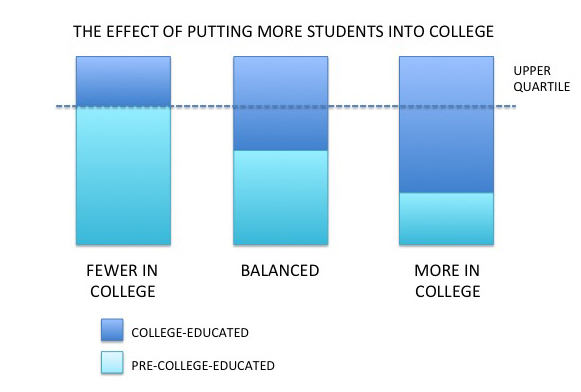 There was an online WSJ article today (March, 22, 2018) titled “More Companies Teach Workers What Colleges Don’t” by Douglas Belkin (https://www.wsj.com/articles/more-companies-teach-workers-what-colleges-dont-1521727200) which told about several companies which have training programs for new employees. These training programs don’t seem like anything new and the complaints by employers that colleges are not preparing graduates as perfect fits for their companies reflects usual me-me-me thinking.
What is different now though is how employers are having to take their pick from more college graduates (because government is pushing more students into college programs) who have gone through the 4-year memorization mill (that’s what undergraduate education is about). There are several problems with this development.
- ISSUE OF MASS BALANCE. More college graduates means fewer pre-college candidates. There just are fewer prospective employees that have not been conditioned by colleges to memorize (of course, high schools seem to be picking up that slack). The pool of pre-college candidates that do not go to college contains many who struggled with the “memorization” challenges of secondary education and possess the critical “out-of-box” thinking that employers today desire.
- ISSUE OF GROWING NUMBER OF COLLEGE GRADUATES WHO ARE AVERAGE OR BELOW AVERAGE AMONG PEERS. More students in college inflates the quality bell curve of college graduates. The main benefit of putting more students into tertiary education is increasing the number seeking advanced studies and doctoral research. Competitive employers are usually interested in the top decile of graduates from the top few percentile of colleges, so there is a slight benefit there. However, there will be a more noticeable increase in the lower quartiles of the distribution; that is, more average and below average students for whom further higher education is not an option. This is the candidate pool that has grown for most employers to select from, and where we find a magnified mis-match.
- ISSUE OF NEED FOR REMEDIAL COURSEWORK IN EARLY COLLEGE. Pushing more students into college prep and extending education for many to an additional 4 years has lowered the quality of students entering college. This is because secondary education can now rely more on colleges providing remedial courses, especially in writing, as part of an undergraduate degree program. Further, college prep has led to high schools struggling to cope with being a high school (reality) yet simulating a college education (virtuality). So the quality shift is across the whole applicant pool and not just the tail end.
It is therefore not a surprise that employers will place less weight on a college degree (hopefully, where the college degree is from also does not matter as much) and focus on skills uncovered in interviews, initial hiring periods and other opportunities to observe performance. Employers could probably use a new kind of assessment: one which evaluates problem-solving and collaboration aptitude before college. This could be used to identify and select candidates for in-house training programs (as an alternative to college) as well as a progress measure of whether workplace aptitude grew stronger in college (you really can’t tell from a college transcript). There are some employers who apply such a tool during their hiring process and I’ve seen effective results. But the idea is to make such an assessment as universal as existing college entrance exams.
In the YCISL program, we emphasize skills as tools to leverage knowledge. Our task is to bring awareness and attention to these skills so that students can educate themselves in this framework. We also believe that problem-solving and collaboration aptitude should be assessed at the beginning and end of each year in secondary education. This is to give the teacher a clearer view of individual skill levels as well as progress patterns. Without such information, we have the one-size-fits-all that ails our systems of education today.
Reflection: The Recommendation Letter
This is just a short reflection on the thoughts that jump up whenever someone asks me for a recommendation letter.
I usually have a limit of writing one recommendation letter per year. It’s hard to be original and genuine in composing the letter.
There is an exception to this rule, and that’s if a requestor has a long and memorable history of interaction (for example, my TA from 2010 who became a regular participant in my YCISL program). But most requestors have interacted with me on the order of days to weeks. It is from among these requestors that I am very selective in agreeing to a recommendation letter and my purpose needs to be strong and clear.
I am quite particular about the traits I need to have observed (and remembered). The three traits that I typically recall and draw upon are project accomplishment, personal and effectual energy, and sense of purpose. These contribute to the story that I would tell with the requestor and I as main characters.
If I feel an imbalance between these two characters of the story, I would be uneasy about being a recommender.
Thinking in terms of a bell curve (as I oft do), if the requestor is not at the very top end, then there is probably something negative on my mind. I would not want to be a recommender in this case either. There is a chance to turn this around though – by informing me of a plan to get to the top end.
I believe in the 3-parts of the Your Personal Story that we craft in our YCISL workshops. The Past element is what I am usually provided (resume, for example). The Who am I? Present element is typically the main driver in getting me motivated (this comes from our recent interactions). And the Future Self is where I take a guess at fit and determine how excited I get about the potential outcome.
So what does a prospective requestor need to do to get me to agree? The first is being confident that I would present only strengths and not in any significance about weaknesses. The second is to approach me with the request in a timely and informative manner – last minute or vague requests are a big turn-off. Third is to meet with me, and make sure I like Your Personal Story.
