
Category: Articles
TIME: Reinventing College
“Reinventing College” is the featured topic in the October 29, 2012 issue of TIME. It is made up of several articles (some short, some long) where viewpoints and ideas are shared. It pulls together multiple current and thought-provoking elements such as Massive Open Online Courses (MOOC), affordability and purpose (my variation on TIME managing editor Richard Stengel’s identification of “access, cost and quality” as being the “three interrelated problems” in the foreword.)
In my view, the problem is actually over-dilution of traditional college education – not access and quality. I think that cost/affordability is a side-effect of the problems in access and quality. While I was reading the article on MOOCs (titled “College is dead. Long Live College!” and authored by Amanda Ripley), I am reminded of the example of a college graduate who ends up working for a rental car company as a customer service representative, sometimes simply sitting for hours in the booth that checks cars out. This is obviously a position where soft skills are suited – and not the knowledge from a college education. This is a mismatch between the argument that employers are seeking college graduates, and the argument that employers are looking for soft skill talent (see “Hard Unemployment Truths About ‘Soft’ Skills'” by Nick Shulz in the September 19, 2012 issue of the WSJ). In his TED talk on creativity, Ken Robinson identifies this as a “process of academic inflation” where degrees have to become less of a credential over time.
Let’s frame some things about traditional college:
(1) a relatively small proportion of entering college freshmen know what they really want to do after college (let alone, in college),
(2) a relatively small proportion of entering college freshmen today are adequately prepared for rigorous scholarly thinking in college (eg, skill in expository writing),
(3) a relatively small proportion of entering college freshmen will find careers that exactly match the knowledge they gain in college,
(4) relatively few graduating college students can remember even half the knowledge they “learned” in college – at the time of graduation (less so later),
(5) relatively little knowledge gained or work done in college will be re-used in a career.
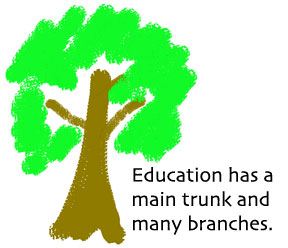 Undergraduate education has been and still is an opportunity to solidify a passion for lifelong learning. It is also a time to tier students into achievement and skill levels – based on their ability to integrate their existing knowledge with new knowledge from other disciplines (some distantly connected, others possibly close – hence, the depth and breadth requirements in the undergraduate degree requirements). University education is about going through phased development of thinking, interpretation and ideation skills; these phases are roughly segmented into undergraduate, masters graduate, doctoral graduate, and post-doctoral. The scope is largely limited to a research basis where a successful outcome would be a graduate who goes on to conduct high-impact research that stretches the domain of knowledge and information – a Professor (or as Ken Robinson figuratively describes as people who “look upon their body as a form of transport for their heads…”) Branching is possible but usually the trunk is research; the branches are the deviations from staying in a university for life.
Here, a short comment on the article by Amanda Ripley on MOOCs (the best article of this feature by far): I very much enjoyed reading this article because it persuasively raises numerous ponderous issues and hints at a solution to the over-dilution problem that I earlier mentioned. I position MOOCs in the evolution line of the continuing education branch where perhaps 40 years ago, people relied on compact self-help books (that’s when I read a book on Automaton Theory) and more recently, people are learning from YouTube (where I have been trying to teach myself to play a ukelele) – and not to forget textbooks becoming e-textbooks or supplemented online texts. The relationship I perceived from Ripley’s description of the Udacity Physics course video featuring Andy Brown was that between fundamental knowledge and an excellent PBS documentary (aren’t they all great?) such as NOVA. It’s accessible, understandable and caters to how the “brain learns” through casual attentiveness. As Ripley put it, it was “like Rick Steves’ Physics.” With this in mind, MOOCs do not replace traditional college education – they create another layer positioned for accessibility to those learners not able to enter traditional college. We know people have different learning methods – the bulk of whom are not suited to a rigorous college challenge. MOOCs thus provide hugely lateral branches for learning but offer little in vertical progression as required in academia. MOOCs should become globally popular for the breadth and accessibility, but users will likely remain in the “proof” level of the YCISL Leadership Objectives schema. If learners begin to select MOOCs as their alternative (note: not substitute) to entering college, then I would hope the over-dilution will ease and the sense of purpose will return.
Overall, this TIME feature has made me more aware of what some thought leaders are thinking, and I appreciate that. However, I firmly believe that the problem is primarily in secondary education where education reform is far more urgent – think about it… are the problems of “access, cost and quality” more dire in secondary or tertiary education?
Exercise Idea: Creativity Flowmeter
In Chapter 2 of Tina Seelig’s book “Ingenius,” the topic of ridiculous inventions is mentioned with particular reference to Japanese “un-useless” inventions. I picked up one such book about a year ago – “The Big Bento Box of Unuseless Japanese Inventions (101 Unuseless Japanese Inventions and 99 More Unuseless Japanese Inventions)” by Kenji Kawakami, Hugh Fearnley-Whittingstall and Dan Papia (Apr 17, 2005). When I first browsed it at a Kinokuniya in San Jose, I felt extremely “tickled” seeing the unabashed inventiveness of Japanese with high focus on their own culture.
Many of the inventions shown in this book and other similar ones could serve as prompts to measure reactions to the unusual creativity. I would compile a slide show of 20 or so of the inventions (perhaps just the image and not include the title/description) and have students fill in a “survey” of their reactions including perhaps: Useless, Ho-hum, Cool, I Could Have Thought of That! and I Wish I Had Thought of That! [<-to be refined.]
The idea is to gauge one’s creative flow as a result of viewing and judging the creativity of the un-useless inventions. This would not work so well with inventions that are familiar to our audience (eg, iPad) or are too complicated to understand the function. The lesson would also expose students to the idea that inventiveness can be derived from converging two or more apparently dissimilar objects, functions etc. This would be an exercise relevant to our discussion about divergence, convergence, crossover, spinoffs and parallelism in product design.
WSJ: Why Our Innovators Traffic in Trifles
In the Saturday/Sunday July7-8, 2012 issue of the WSJ, there is an article titled “Why Our Innovators Traffic in Trifles” by Nicholas Carr on page C2 (article can be found online at http://online.wsj.com/article/SB10001424052702304141204577508820786062502.html).
The article addresses the immense public awareness and awe surrounding incremental innovations such as Instagram. Carr writes “What we are seeing is not a slowdown in the pace of innovation but a shift in its focus.” He adds “We are getting precisely the kind of innovation that we desire – and deserve.” He points to Maslow’s “hierarchy of needs” and suggests we are experiencing a progression in human desires.
But really, I only heard about Instagram when Facebook offered to acquire them. Even then, I would estimate 98% or more of us look at Instagram’s user interface level to assign a level of innovation quality. How innovative is the whole product from design level to architecture level to structural coding etc? I can’t tell you. Could you? I did, however, work with the Blazer team when Bluelark was acquired by Handspring and the web browser app would become central to the Treo. I knew of its server-side features, its security issues, interface challenges and user experience aims. This level of detail allowed me to appreciate the innovative qualities of the product and process. So, can innovation be judged by the user interface and interaction alone? The answer, broadly speaking is “Yes, but not well.”
I’ve long held the definition that innovation is a term that should exclusively be associated with inventions that had a massively influential effect on life. Some of the best examples are flight, fire, the computer and the pencil. However, now that I think more about innovation as a process than an object, there is room for incremental innovation – for those who have gone through the same process as for true innovation – and yielded something that is unique and provides a valued alternative to existing solutions. By thinking of innovation as a process, we can make it accessible to youth and provide lessons in creative thinking.
And to Carr’s point about focus, innovation is really a matter of perspective and the level of fascination that is realized. While the truest innovations affect all, most of what is held as innovation today is held so by adult eyes and their focal control. At best, these are quasi-innovations – objects that have unique life-changing qualities but only upon a limited segment of people. Therefore, I am looking forward to helping define innovation for the youth segment and differentiating it from the “trifle” that has filled our lives.
WSJ: Children Learn a New Way to Play At Summer Camp That Teaches Tech
In the Thursday July 5, 2012 issue of the Bay Area edition of the WSJ on page A7B, there is an article titled “Children Learn a New Way to Play At Summer Camp That Teaches Tech” by Rachael King which describes the ID (“Internal Drive”) Tech Camps – some of which take place at Stanford. Many private non-Stanford companies run summer camps at Stanford as well as other university campuses.
One of my children attended a similar camp at Stanford in summer 2011 offered by Digital Media Academy – it was a compelling package including a Java curriculum based on Stanford’s popular CS106A course (including Karel the Robot) and overnight accommodations in a Stanford Row House. However, the only really authentic Stanford quality of these camps is the Row House living, dining in one of the Residence Dining Halls and being on-campus. Stanford classrooms are not used (our camp had a computer lab set up in the Row House’s kitchen), the people are migratory (just here for the summer), and the Stanford scholarly culture and atmosphere are missing.
I also say this to differentiate the YCISL program from these summer camps. The summer camps are a marvelous asset to extending learning opportunities when school is closed for the summer; this helps address the deep lull some students may get into when they are not tasked with school work (an interesting puzzle that there is way too much work during the school year, and relatively little during summer). So, I view the 3rd-party summer camps such as those at Stanford as competitors and I need to emphasize the YCISL features that works to our participants’ advantage. I also recognize that Stanford Summer College and EPGY are also competitors, and communicating the differences is warranted.
As for the WSJ article, I wish it had provided more evaluation on how camps such ID Tech helps supports education.
Messages: For Parents, Students and Educators
I composed a few brief statements to highlight the appeal of the YCISL program to the students, their parents and their educators. I was partially inspired by an article in IBD which recommends addressing the more important “customer needs” and matching them to the list of product attributes (Article is titled “Mull Customer Needs to Set Right Price”, online version http://news.investors.com/article/605408/201203231546/pricing-customer-needs-market-research-selling.htm).
MESSAGE FOR PARENTS: SHARE IN YOUR CHILD’S ASPIRATIONS
For parents, few things are more nervously uncertain than the time a child undertakes their preparation to leap to college. The intention of our workshop experience is to complement – using Stanford’s emphasis on critical and creative thinking – the college preparation that parents as well as schools and counselors provide, and ensure that the student reflects on their passions and strengths.
MESSAGE FOR STUDENTS: MAKING CLEAR CHOICES
Schools are excellent foundations for building knowledge and developing your logical and deductive reasoning skills. However, we also know that your growth and success also depends on you emerging as innovative thinkers and leaders. We believe that by harnessing your creative energy, and showing you how to get from ideas to realization, that we can impart clarity to your choices and confidence in your decisions.
MESSAGE FOR EDUCATORS: PRECIOUS RESPONSIBILITIES
With your experience in youth education, you have undoubtedly witnessed the amazing growth of youth as they progress upward through your school. We have come to appreciate that providing an education to youth is one of the most precious responsibilities we have in life, and you are probably always striving to improve their chances of success. Our program aims to task students with unleashing their creativity – we call this “Exploring Your Creative Universe” – where ideas appear and exist within the mind. By bringing all these aspects together, we hope to have empowered students with the insight and technique to innovate into the future.
WSJ Article: The Importance of Child’s Play

Lenore Skenazy wrote in the January 27, 2012 issue of The Wall Street Journal on “The Importance of Child’s Play.” In this article, Ms. Skenazy describes how pre-school has been influenced by “fears” – a fear of injury (by corollary, a fear of lawsuit), and a fear of “falling behind.” This has limited the types of activity that pre-school children get to engage in. In the end, children are limited. So, we see that the limitations that we see imposed on children starts even in pre-school. It just creates for a more conditioned attitude through one’s entire youth.
“…play time is sacrificed for academics.” Play time is opportune for several skills such as social skills, planning skills and communication skills. Think about how free time is replaced by tutoring or other taught-activities (e.g., piano lessons) – this reduces the opportunity for children to apply their social, planning and communication skills. Where, when and how are children going to learn these skills?
Our observation that children have less and less opportunity for free play time provides further evidence that adult compromises have encroached childhood – all the way to the earliest group learning settings, and are reducing youth readiness and wasting youth creativity.
This connects with the example we found in the Gamestorming book where a single child who has a football can practice alone and repeat with little need for change. When there are two children, creativity enters where they exchange ideas for how to play together with the football – and take into consideration a number factors to produce “fun.”
It would be an interesting discussion to have with the youth groups (a) whether they are being stifled by adults, and (b) if so, when they think it started. This is a good starting point to approach the topic of sustainable leadership – one that does not get formed by adults but are organic to youth.
Article: How to Improve Your Companywide Meeting By Jessie Scanlon (BusinessWeek)
Challenge-Based Learning (Apple)
http://www.apple.com/education/challenge-based-learning/
1. The Big Idea
Every challenge starts with the selection of a big idea — a broad topic that has importance to students and their community. Topics like democracy, the environment, or sustainability. Using Safari on a Mac, students can browse the web to quickly define and better understand their big idea. Let’s use food as an example.
2. Essential Questions
Students explore their big idea by asking questions that reflect their individual interests and community’s needs. How does food impact our health? How do our diets impact the environment? What are the benefits of organic farming? A simple way for students to keep their questions organized is with Pages. This streamlined word processor and page layout tool is included in iWork — a powerful suite of applications for creating amazing documents, spreadsheets, and presentations.
3. The Challenge
From the essential questions a challenge is developed to guide students toward a real-world solution. Like, let’s improve what we eat. Snow Leopard Server can help students collaborate and communicate throughout the challenge by ensuring safe and secure access to email, chat, calendars, wikis, blogs, and more. Documenting the process is also key. With iPod touch or iPhone 4, students can record audio and shoot HD video of themselves in action and on the go.
4. Guiding Questions and Activities
To meet their challenge, students need to ask guiding questions. What exactly do we eat? What nutrients do we need? What foods can we grow locally? To find answers, teachers work with students to identify guiding activities they can do at school and in their community. Students can interview people about their diets via FaceTime* and analyze nutritional data in Numbers — the easy-to-use application for creating spreadsheets included in iWork.
5. Guiding Resources
Students take advantage of websites, podcasts, apps, audiobooks, and other resources to help answer guiding questions and develop solutions. iTunes U provides instant access to some of the world’s best thinking for free — including lectures, videos, and articles from hundreds of distinguished universities, libraries, museums, and news organizations. And with iPad, they can find what they need anytime, anywhere.
6. Solutions and Presentations
With their research complete, students choose one solution to develop. In this example, creating a school garden. To showcase their thinking, they can build engaging slideshows in Keynote — the presentation application in iWork. Once the solution is approved, students implement it in the real world. The challenge is now complete and can be shared via a video made in iMovie or a website built in iWeb — apps included in iLife, the creativity suite that comes with every Mac. At the end of each challenge, students reflect on the entire process to help deepen their learning and enrich future projects.
WSJ: Humans: Why They Triumphed
Came across an interesting article in the WSJ Weekend Journal (May 22-23, 2010) titled “Humans: Why They Triumphed” by Matt Ridley. It mentions the idea of “collective intelligence” where innovation is part of evolution and its rate of change is affected by shifts of cultures and populations, often energized by trade and urbanization. A particularly stimulating remark was how “nobody” knows how a pencil is made – despite it being so widely used (so I went and looked – I recommend this Science Channel video). Anyway, back to youth creativity…with the belief that youth are an untapped creativity resource, it makes sense therefore to put them in groups formed from different unfamiliar sub-groups and encourage invention through their discovery and exchange of each others’ cultural backgrounds.
WSJ: The Case for Saturday School
Appearing in the Saturday/Sunday, March 20-21, 2010 issue of the Wall Street Journal (pages W1 and W2), this article, “The Case for Saturday School”, by Chester E. Finn, Jr. argues for additional time spent learning in school including more hours per day, more days per week and year. This essentially amounts to extended daycare. In particular, the comparison to education systems in other countries such as Singapore is weak. Students from Singapore fair better in the US standardized tests because they have a superior examination-based system that preps them over the course of two years, and includes timely “mock” examinations and a sabbatical to study for the exams. Further, students in Singapore typically have private tuition after-school and on weekends. The result has been students who have no opportunity to think creatively or critically, and who shy away from the challenges of leadership because of social and academic risks. In the US, an innovative model for educational reform is needed, and more time in school may be a great part of the plan, but it should be dedicated to creative and critical thinking, and not to out-compete students from other countries.
