
Category: Lessons
NYT: Nine Nonobvious Ways to Have Deeper Conversations
I came across this article through LinkedIn today. The article lists various ways to re-engage with each other especially during this time of un-shakeable stress. “Nine Nonobvious Ways to Have Deeper Conversations” is an Opinion article by David Brooks dated November 29, 2020 on nytimes.com.
The author’s suggestions make sense to me and I will undoubtedly be spending some time thinking how to turn these into YCISL workshop actions. But because I am currently engaged in a series of Popcorn with Colin discussions on creativity, in particular a tribute to Sir Ken Robinson’s epic TEDTalk “Do Schools Kill Creativity?” (originally titled “Schools Kill Creativity.”), I will dwell on the suggestion to “Ask Open-Ended Questions” and the timeliness of this for the online learning pivot.
This idea fits into the Divergent-Convergent Thinking and Asking Questions component of the YCISL Innovators Toolkit series. Open-ended questions (or problems which are inviting of innovative solutions) have the potential to stimulate and strengthen creativity. So the task is not to simply ask an open-ended question, but to frame a worldview that accommodates various perspectives and past experiences. We need to use design thinking in creating open-ended questions.
I haven’t had much practice at this, but let’s give it a few application attempts.
Here is a Physics homework problem I found on the web:
Gravitational Potential Energy GPE = mg∆h
12. A 5.0 kg mass is initially sitting on the floor when it is lifted onto a table 1.15 meters high at
a constant speed.
a. How much work will be done in lifting this mass onto the table?
b. What will be the gravitational potential energy of this mass, relative to the floor, once it is
placed on the table?
c. What was the initial gravitational potential energy, relative to the floor, of this mass while
sitting on the floor?
What if we changed this question to “Place a dumb bell (or other object) on the floor. Lift it onto a table at a constant speed. Use a scale and/or tape measure, if desired. It’s ok to estimate.”? Would this be too challenging? Could this be a more fun application-type question that helps the student use visualization as well as experimentation skills? Not all the questions would have to re-framed this way. But it does give a more first-person real world feel about how science applies to things we do on a daily basis.
—
And here is a Chemistry homework problem I found on the web:
Coffee cooling
A mug of coffee cools from 100 ℃ to room temperature, 20 ℃. The mass of the coffee is
m = 0.25 kg and its specific heat capacity may be assumed to be equal to that of water,
c = 4190 J. kg-1. K-1.
Calculate the change in entropy
(i) of the coffee
(ii) of the surroundings
What if we changed this question to “Your morning mug of coffee/tea/water cools to room temperature. Use a scale and/or thermometer, if available. Otherwise estimate.”? Hopefully, everyone has been aware at some point that a hot beverage gives off warmth and gradually cools. There is also the intrinsic motivation factor (that we are fond of in YCISL) where we involve mastery, autonomy and purpose (added through the use of another Innovator Toolkit skill: Filling & Crossing Gaps).
—
As another example, I require online seminar logs for a seminar course at Stanford. This is for proof of attendance. But instead of asking for a summary of the seminar presentation, the question is “Describe in 2-3 sentences how this talk connects with or relates to your interests, or your MS studies.” In general, most responses will be quite different reflecting perspectives and background. This makes it more interesting and informative for me. Note though that some students find this open-ended question challenging and defer to the seminar abstract as a basis for their thoughts – as opposed to internal stimulation and connections.
—
Re-reading the examples above, there is probably more fine-tuning possible to engage each other better. An example is to use the Positivity Innovator Toolkit skill and “garnish” the problems with emotionally positive words and uplifting expressions. “Your delicious morning mug of…”
A good topic for future discussion.
Alison Ledgerwood: A Simple Trick to Improve Positive Thinking (TEDxTalk)
The 2013 TEDxUCDavis talk by Alison Ledgerwood “A Simple Trick to Improve Positive Thinking” has had a significant influence on the presentation of positivity in the YCISL program. Her graphic illustrating how a positive event has a sharp peak effect, and a negative event has a blunt dragging effect is used in the workshop slide set to show how critical it is for leaders to work smart and diligently at maintaining stakeholder positivity. This further ties to the sustainability of intrinsic motivation which is also driven by constant positive thinking.
In her talk, she specifically describes the effect of informing people about a surgical procedure in terms of a success rate versus a failure rate. She further gives examples of (1) a governor’s likability based on which direction he initially messages, and (2) how long it takes people to convert between good news and bad news. This, I find, is an amazing coincidence. Do you?
Positive thinking and framing is an essential innovator and leadership skill. Innovators with the skill maintain their sense of purpose and intrinsic motivation. Leaders with the skill are more agile and appreciated. When a crisis unfolds, these skills go on display and accelerate a successful recovery.
If you are willing to invest in your positive thinking, the media is currently awash with negatively framed statements. See if you can re-phrase some of these statements in a way that stimulates “glass half full” feelings and a sense of hope. Learn to turn negative messaging into positive messaging before you seek meaning and knowledge. You will feel more productive and empowered.
Exercise: Divergent-Convergent Thinking Training Worksheet
We introduce the idea of divergent-convergent thinking cycles in our YCISL workshops. It is the structured pathway method to creative thinking, decision making and problem solving. School curricula generally emphasize convergent thinking only which limits creativity.
Three years after releasing the Turn the Donkey lesson, a Divergent-Convergent Thinking Trainer lesson is being released to our YCISL LinkedIn group.
This exercise is intended for practice and as a reminder to apply divergent-convergent thinking cycles in our creative behavior. The exercise comprises a series of worksheets each formatted slightly differently to inculcate agility in how we apply the method to different situations.
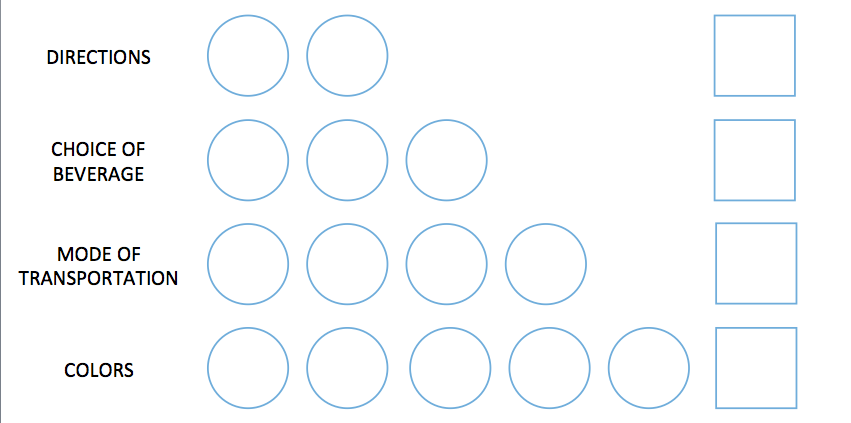
The first worksheet being released introduces divergent-convergent thinking in its simplest 2-choice form. Subsequent lines on the worksheet then stretch the divergent part of the exercise. Currently, the exercises converge on a single item, but in reality convergence could be on a group.
An example, run with the DIRECTIONS prompt with two circles and one square, might have Up (1st circle), Down (2nd circle) and Up (square) as an answer set.
The purpose is to train agility into the practice of divergent-convergent thinking, but also to familiarize us with the steps: interpreting the prompt, starting, completing the divergent part, and quickly finishing with the convergent part. Speed is key, but so is confidence in getting through the cycle.
And once the cycle is complete, a creative person should be able to start another cycle right away if needed.
The Paper Airplane Exercise and Comfort Zones

In the YCISL workshops, we play the Birthdate game where a group of students have to line up in the order of their birth date (date and month, no year) without talking (and now with hands in pockets). This is to explore how they behave when their normal go-to method to solve such a problem is removed. Do they have leadership tendencies or do they immediately look for an available solution from someone else? Do they follow or help enhance the solution?
In 2019, we added the Paper Airplane exercise to explore the same comfort zone borders. The objective was set to maximum distance – and accuracy was thrown in by opening a door through which they could fly farther. I couched this as a prototyping exercise where getting out of the comfort zone is necessary to be successful. They had 10 minutes to build their paper airplane.
Within each group (I expected), there was likely to be some who would know how to fold a paper airplane (upper mid-quartile). Then there would be others who either don’t know, can’t exactly remember, think they don’t do it well and perhaps know exactly what they need to do. I was interested in the various behaviors and responses to one’s comfort zone.
During the construction period, a few students happily built their paper airplane using basic techniques. Others who perhaps have never built a paper airplane before asked for help from a friend or looked up the web for instructions. I think no one simply tried watching someone else and copying.
We flew the paper airplanes. There were a few that got out the door. But more importantly we showed how a team collectively can find their way to step out of the comfort zone and learn immensely from one another in the prototyping stage of project development. It didn’t really matter how they chose to step out.
How did this even get past the first round?
 Once in a while, we wonder in astonishment how something is included in a released product. Despite internal checks, marketing management and advertising massaging, something that must have flown by a channel of yes (or distracted) people somehow got out. Granted, and thanks largely to Microsoft, we do now have a product development culture of releasing products with imperfections/bugs, but in those situations, the easy problems are usually taken care of quickly.
Recently, I have been getting views of an ad by Shipt when I am watching online drama videos. That brand name is so bad and wrong. The other odd thing is that the video ad itself has many bad ideas…like tossing a light bulb to someone..and then the guy screws the light bulb into an electrically live socket. Creating these negative emotions will affect the OOBE impression. And to add to the surprise, Shipt was acquired in 2018 by Target…Target! Some of the best marketing has come from Target. And they somehow let this one slip out. Traction…not a chance.
So, how does this fit with YCISL? The YCISL workshops are designed as bootcamps. The team project presentations are meant to be very early rehearsals to experiment with our core skills of fast-thinking, intrinsic motivation and emotional intelligence. Iteration is key. Closed-loop corrective action is another term I am fond of. We also spend Day 4 of the workshops working on the testing and closing phase of the projects. This is the opportunity in our innovation framework to scrub bugs, fix the important and easy problems, and have a plan to ameliorate outstanding issues (or cloak them…).
Lesson here: Create positive images and emotions. Work on the OOBE.
Paper Airplanes & A Reveal of Our Problem-Solving Mindset
I re-watched Tim Brown’s Tales of Creativity & Play this morning, and the part with the Finger Blaster had me wanting to incorporate something similar into the YCISL workshops. I also had just watched a TED video “How To Make Applying For Jobs Less Painful” by Priyanka Jain in which she showed a clapping test to reveal a thinking trait. This has me again wanting to demonstrate the spectrum of approaches any given group naturally takes to tackle a problem (and how education, let’s say a typical classroom, is herded to take just one approach). So here is an idea for a workshop exercise using paper to make paper airplanes.

I am assuming that for any given group that paper airplane-making skills are widely spread. Some may already know how to make a paper airplane. A few may know how to make sophisticated ones that fly far or can do acrobatics. Most will likely know how to make the simple paper airplane that fly a relatively short distance compared to the current record of 220′ 10″!
For this exercise, we provide one sheet of paper to each participant. They start by writing their name on the paper for post-flight identification. The participants are then simply instructed to build a paper airplane with their sheet of paper and we will see whose flies the farthest. No other instructions.
They will be given 10 minutes to do this. After that, it will be time to fly their creations.
I hope to observe a wide range of approaches to this task such as:
- folding using their existing knowledge about paper airplanes, if any
- doing some independent research such as checking the WWW
- asking someone for help or advice
- just watching someone else and copying
- forming a collaboration and working together
Then we fly and see whose flies the farthest. Just as we do with the Spaghetti Tower Marshmallow exercise, we could do multiple rounds of this and look for learning through iteration. Will they change folding technique or will they take a different approach?
Each of the approaches reveals how one’s mindset is currently geared to problem-solving. The three main lessons (phrased as questions) are:
- Does your leadership worldview include other people (collaborator, advisor, teacher, etc)?
- Do you have a trusted growth mindset that takes you out of your comfort zone? Or do you tend to play it safe?
- Are you comfortable learning more about yourself (self-awareness) and how you approach problem-solving (self-management)? Are there any issues that can be addressed?
Shark Tank’s Best Pitches Explained By the Cast | Vanity Fair
I came across a YouTube video this morning titled “Shark Tank’s Best Pitches Explained By the Cast | Vanity Fair” which made me think about the YCISL program. I have watched Shark Tank on television and YouTube before (just a few times), and attended a local Dolphin Tank event (similar concept but for youth). Mostly, I don’t connect Shark Tank to the YCISL program because of the weight given towards money (investments from the Sharks as well as the definition of the problem and success); it makes for compelling television viewing, I understand.
What I did get reminded of though is that the YCISL program is about porting adult frameworks and concepts to a youth context. YCISL is about attenuating “Play” to boost creative energy and the intrinsic motivation to sustain that energy. And from that video, it’s interesting to see the port connection.
- Know Your Numbers -> Elevator Pitch. “Know your numbers” is not so much a point about being a vessel for financial information, but more about being prepared (a state of readiness) with an elevator pitch that is emotionally intelligent. Know your target audience and be prepared to make a memorable impression. For an elevator pitch, having an idea of reaction buttons to press help too (not that you should press every button).
- Be Creative -> Creative Energy. In YCISL, we show our model where creative energy is at the base of innovation and leadership. For most though, one’s creative energy level is unknown (having been stifled by education) and untrained (not readily accessible or appropriately applied). On Shark Tank, the creativity in the pitches are in the person, product and pitch. In YCISL therefore, we emphasize exercises that expose creative energy levels and aiming that energy.
- Have “Chutzpah” -> Positivity. YCISL touches on positivity in several ways using examples from Shawn Achor (better productivity) and Alison Ledgerwood (framing). There is also a needed element of confidence that I draw from Mel Robbins. We ask our workshop project teams to ensure positivity when working together. We look for simple techniques that effect positive alignment.
- Problem Solver -> Project Studio. The YCISL innovation premise is based on solving problems. We search through personally-experienced problems as well as problems from one’s worldview and observations to select one to use for the workshop Project Studio. Our Project Studio exercise is done in a team to render normalization to the problem to remind us that a good solution has the potential for wide adoption and multiple applications beyond the original worldview. Picking a problem isn’t as easy as it sounds, and in YCISL we emphasize the basics of formulating a problem statement – for visionary inclusion and team alignment.
- Motivate Others -> Intrinsic Motivation (Self+Others). From Dan Pink, we understand that motivation has a sustainability issue. In YCISL, we recommend leveraging intrinsic motivation given limited resources (especially the case for youth). We also examine approaches to imparting intrinsic motivation in one’s self as well as to others (team and users). This is one of the critical leadership skills that we seek to develop through our program.
- Listen to Diverse Opinions -> Active Listening and Growth Mindset. To listen, we need to listen well and the skill of active listening is key to Shark Tank as well as innovator and leader roles. Unlike the make-it-or-break-it tone in Shark Tank, we moderate discussion in YCISL so that there is sequential exchange (like in Adora Svitak’s reciprocal learning), checkpoints and learning. From that, we can feed the growth mindset that we expect in a creative and decision-making setting. We also learn to train fast thinking and the cycle of divergent-convergent thinking. Subsequent to this process, we also learn about weighing competitive advantage and thriving through de minimis risk and initially huge uncertainty conditions.
This reflection years after YCISL started has been quite satisfying. I hope it will help further development of our concepts, ideas and products.
If I had nothing. Starting Over: A Reflection
Idea is to reflect on what you would be focused on if you were starting over and afresh. Many people in the developed and developing world lead cluttered lives and emotional luggage. Our attention is divided and we spend much of our mental energy sorting useful information from garbage.
Can we come up with an exercise to reflect on our priorities and imagine what it would be like to have nothing so that everything is a potential goal?
WSJ: Partners in Blood
Few organizations in Silicon Valley implode like Theranos has. [There also was Solyndra.] But Theranos is a good case example for the innovation process for the YCISL program. This entry is based on the article “Partners in Blood” by John Carreyrou published in the Saturday/Sunday May 19-20 issue of the WSJ (Review section).
The article describes ultimately poor leadership skills on the part of two main characters in the Theranos story: Elizabeth Holmes and Ramesh Balwani.
By YCISL measures, they actually did a great job at problem-setting, brainstorming, and elevator pitch. They should also be given credit for product development with regards to setting a very compelling feature list.
However, there are two parts of the innovation leadership process that seem to not have been done according to Silicon Valley standards. One is the testing and readiness step. Alpha and beta testing must have revealed serious problems with what they had developed. Once the product was put in the hands of a real user, QA, QC, LIMS and all other lab protocols should have alerted everyone to problems.
The other step that went awry is prototyping. In YCISL, we emphasize “fail early, fail fast” in the prototype stage but Theranos kept developing a product past prototyping with showstopper failings. Any skilled analytical chemist would not trust data from small sample size due to the amplified issues with the “scientific method” including sampling error, sample contamination, sample preservation, and the conditioning of analytical instrument detectors. What Theranos did is an error usually made (but eventually understood) by first-time science fair students. The real failing here however is the denial of the flaws, and the inability of investors to resist the obvious fib. Fuel to the fire.
The lesson for YCISL is to be disciplined during the prototyping stage and even the testing stage. Be honest with yourself. Be willing to embrace failure and learn from it. Be comfortable starting again – Silicon Valley style.
Follow-on: I decided to re-read Jeff Raskin’s “HOLES IN THE HISTORIES” to remind myself how it only takes one acceptable “authority” to build a consensus resulting in fact but not truth. Theranos’ lie may have started as a small seemingly-manageable one, but one can imagine it getting out of hand once one investor bought in. At some point, people chose not to check primary sources and relied on secondary sources. People bought into the “fact” but took the truth for granted. Raskin also writes on DELIBERATE MISREPRESENTATION and the “reality distortion field” that Steve Jobs is closely associated with. This is a leadership “disease” which has spread widely and we should address by instilling stronger EQ in youth leadership.
Paul Tasner: How I became an entrepreneur at 66 (TEDTalk)
What does age have to do with being an entrepreneur? The story in this TED Talk by Paul Tasner suggests that entrepreneurship is not reserved for the young, but can be a pursuit in late-career as well. The introductory paragraph for this talk on the TED.com web site reads “It’s never too late to reinvent yourself” and when I think about it (pause…), reinvention is one of those situations that provides an opportunity to gain life lessons in being a creative and persistent entrepreneur. The detail in the talk that I found the most interesting is “40 plus years of continuous employment for a variety of companies large and small…” which means Tasner had to reinvent himself several times over. This means he had past experience in changing/rebounding and even if he had or did not have confidence through each transition, he apparently made it – which shows resilience. Every change, even the latest one into entrepreneurship, is a testament to his mindset.
Youth is often seen as an advantage for entrepreneurs because they can afford to dedicate many hours to getting started, but there is a degree of sacrifice in this. Tasner actually has an advantage over young entrepreneurs in that there is little life sacrifice (it was working on this new endeavor or retirement) and he was driven by tremendous motivation (“most rewarding and meaningful work of my life right now”).
The YCISL program delves into one of the biggest transitions in our lives…from high school to college (which for many is about leaving the nest). If we can get through this particular transition well and learn some life lessons along the way, we can perhaps develop the resilience and mindset, like Tasner’s, to sustain ourselves through each future leap.
