
Category: Lessons
Activity: YCISL Photo Essays – Focus on Gratitude
 One of the YCISL agenda topics that has evolved over the past 6 years is emotional intelligence. Early on in this program, my colleague Stephen Murphy-Shigematsu shared with me and my students the idea of four emotional intelligence (EI or EQ) domains. Soon after, he chose to focus on Mindfulness as a practical discipline in exploring EI and I formulated the expression
KI + EI = LeaderI
to position how our workshop activity in EI helps achieve our sustainable leadership objective.
In one of the Mindfulness-focused workshops, Stephen played the video “A Good Day” With Brother David Steindl-Rast which called my attention to the topic of gratefulness. Steindl-Rast also has a great TED Talk titled “Want to be happy? Be grateful” that provides an actionable promise-ask. This resoundingly connected with the Happiness and Positive Mindset topics I had brought into the YCISL program via the ideas of Shawn Achor (see his 2011 TEDx Talk “The happy secret to better work”).
In 2016, I found the 2013 TEDx Talk “Getting stuck in the negatives (and how to get unstuck)” by Alison Ledgerwood in which she discusses the benefits of practicing gratefulness. This reminded me that Shawn Achor (in his TEDx Talk mentioned above) had also suggested a gratefulness training routine to increase optimism and focus on positives among the thatch of negatives. These ideas – and more – had led me to start an iOS app project called the GratitudeApp (that’s another story) in late 2016.
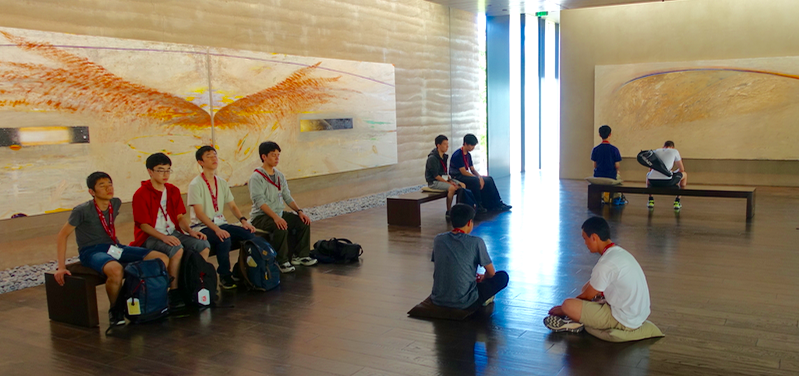
The final piece that has converged on this YCISL activity is the 2014 opening of the Windhover Contemplation Center at Stanford which demonstrated that the university considered mindful behavior of having merit and value in its academic setting. This has become the place we bring our YCISL workshop students so that they can focus on the Your Personal Story mid-series question of “Who am I?” and appreciate the present.
All this has led to the refinement of our Visit-Experience Photo Essay into a Visit-Experience-Gratitude Photo Essay where the emotional component is focused on the daily training of grateful reflection. Students in our most recent workshop were first introduced to the practice of being grateful in the present, then tasked with building a gratitude photo essay through daily reflection on that day’s events and experiences. We set up our Photo Essay Gallery on the last workshop day as usual. This was a great example of simple, but not easy. The idea of building this photo essay is a simple idea, but the emotionally positive portraits were powerful and lent great insight into the leadership confidence that gratitude enables.
We have a keeper.
Mel Robbins: How to stop screwing yourself over (TEDxSF Talk)
This is a two-part entry for two lessons I learned from the Mel Robbins TEDxSF talk “How to stop screwing yourself over” (you can find it on YouTube).
SIMPLE, BUT NOT EASY
In the Summer 2016 YCISL workshops, I added the message “Simple, but not easy” [SBNE, for short] which I derived from this talk. Robbins’ full message is that “Getting what you want… is SIMPLE (but not easy)” meaning the process to reach a goal usually consists of a few steps but there is a caveat that getting there takes energy, focus, persistence, etc.
In the YCISL workshop, I talk about my desire to lose weight and body fat – to do it, there are only two main steps: eat less and exercise more. But is it easy? Nooooooo!
The same thinking can be applied to the YCISL skills such as creativity, fast-thinking, emotional intelligence, intrinsic motivation, etc. Building up these skills is simple…practice, practice, practice…and you will become more creative, more innovative and a better leader. But I cannot promise that it’s easy.
And it can also be applied to our academic, work and social lives. For example: (i) to be a successful student, study hard and get good grades, (ii) to be successful at work, do good work and be rewarded, and (iii) to be socially active, get out more and make lots of friends.
This is a perfect example of how leadership usually works: here is point A and there is point B. Call me when you get there. [Think of Rory Sutherland’s strategic myth of management and tactical advantage in his TED Talk “Sweat the small stuff”]. However, if I place this in a positive frame, you can think of SBNE as the competitive advantage that we coach in the YCISL elevator pitch, PostIt Brainstorming and Rapid Prototyping exercises. Ideas, solutions and products that are simple may be worth pursuing because many others will find it too difficult to realize.
5-SECOND RULE
In the YCISL workshops, we coach fast-thinking as an essential self-trained skill. The YCISL Photo Essay assignment is an example of a “5-second rule” method…take a photo and capture the emotional thoughts as soon as possible. Most of our YCISL exercises that build fast-thinking involve decisions and actions that take on the order of seconds or even milliseconds.
Exercise: Turning the Donkey
Many of the activities in the YCISL program are derived from existing games – and we connect our topics to them. An example is the Spaghetti Tower-Marshmallow exercise where we demonstrate prototyping and “fail early, fail fast” as well as collaborative teamwork.
Today, I was searching the internet for a puzzle and came across a web site with a collection of matchstick puzzles (http://www.learning-tree.org.uk/stickpuzzles/stick_puzzles.htm). I was looking for something that would require divergent thinking. I didn’t have matchsticks, so I tried the puzzle with some pens. I confess I am bad at these types of puzzles and in the end, snuck a peek at the posted solution. But more importantly, I found that doing such a puzzle connects many of the topics we touch on in the YCISL workshops.
So I created a “Lessons” document which describes the puzzle and asks questions to reflect on. I have posted a link to this document in our LinkedIn Group Discussion and will likely incorporate it or something similar into the workshops.
LESSONS IN YOUTH CREATIVITY, INNOVATION & SUSTAINABLE LEADERSHIP
TURNING THE DONKEY
Found on http://www.learning-tree.org.uk/stickpuzzles/stick_puzzles.htm
 Move 1 pen to turn the donkey.
EQ CHECKLIST:
- Did you see the solution on your first pass? WOW! – if you did.
- Did you sense creative energy well up in you?
- Did you feel (instrinsic) motivation?
- Did you experience divergent fast thinking (iterating over many possible solutions)?
- Did you apply logical deductive reasoning (eliminating non-solutions)?
- Did you experience optimism?
- Did you notice frustration or self-doubt?
- Did you think about giving up?
- Did you second guess what the problem was asking?
- Do you think you accomplished something?
James Veitch: This is what happens when you reply to spam email (TEDTalk)
Watch the video for the humor. Commiserate in the vengeance exacted on an email spammer. But hear what was discovered when someone opted for the “crazy” option. It’s the extraordinary tale that connects yet another dot.
In the PostIt brainstorming exercise we have in YCISL workshops, we position our ideas along a normal to crazy axis. We view the crazy end as the area with the greatest opportunity for creative challenge and outcome.
In his December 2015 TED Talk, James Veitch spins his story about toying with email scammers. It’s a great story but I especially was struck by how this got started – with him almost by instinct tapping the delete button which is conditioned behavior for many of us, but instead deciding to see what would happen if he responded. What seemed to have ensued was highly creative thinking.
“I thought, I could just delete this. Or I could do what I think we’ve all always wanted to do.”
How often has this sort of choice come across our minds? How fast have we been to self-check ourselves and do the thing that we have short-circuited our thinking for the sake of convenience and saving time?
What about when we are shopping in a supermarket? With all the product choices on a shelf (at an instant) and the change in choices (over longer time periods) which we sometimes register – not to mention reshuffling (over medium time periods), have we conditioned ourselves to have “tunnel vision” when selecting products? And when we do notice a new competing product, we ask the “what if?” question to check whether we might be making a mistake.
For YCISL, we should consider our behavior when our our path gives us choices. Are we being “mindful” at these paths or do we become engrossed by the past or future?
What exercise can we conduct to illuminate our tendencies and train our behavior to be more mindful?
TED Radio Hour: The Source Of Creativity
It’s been a while since I have found something from TED provoking enough to comment on in this wiki. To some degree, the WSJ Personal Journal has been publishing articles on topics seemingly more relevant to the YCISL program, but I also feel the TED topics have become un-connectable; they are about personal experiences (yes, a good thing!) but not in a way that leads to connect-the-dots. So to my bemusement I now feel wont to comment here on “The Source of Creativity” which was the topic of the TED Radio Hour on October 3, 2014 (this was the original broadcast date, but it caught my attention now because it was re-broadcast in September 2015 and I happened to look for some podcasts to listen to on a long drive) and hosted by Guy Raz. I am particularly bemused because it refers to a collection of years past TED Talks (including one of my favorites by Ken Robinson) which goes to show how enduringly meaningful the older TED Talks are.
So if this is just a collection of older TED Talks, why not just listen to those TED Talks? It’s because the connections to past TED Talks is selective. These sound bites supported live interviews with those speakers and provided updates on their thoughts – further deepening the significance of the original TED Talks. I especially enjoyed listening to the part with Gillian Lynne which made Ken Robinson’s story about her become even better.
Besides being obviously in the Ken Robinson Fan Club, I would also mention that I found the part of the show with Sting also meaningful. In fact, in the week since listening to this show, I have referred to a point in this interview in two conversations with colleagues and it relates to the YCISL. There is reference to “a deeper place” and “comfort in being who I am” which comes from revisiting youth. This works with the YCISL exercise of “A Message to My Past Self” which is by natural perception deeper and vivid than the future outlook. This is motivating reason to work on reflections on the past – lessons learned and acceptance of paths chosen. For YCISL, KI, EI and LI all come from what Sting talks about in the interview. There is a struggle to maintain creativity, but strength from re-connecting with the past can help reinvigorate that creativity which can be smothered by C-R-A-P (reference to Richard St. John, btw).
Bottom line: yes, I recommend listening to this podcast. I plan to listen to it a few more times because I think I will learn more every time.
The Best in OOBE
My previous entry was about how prototyping can lead to productive failures. There is a lot of prototyping that can go into OOBE (“out of box experience”) design and those who do it well have excellent brand recognition.
Some companies spend a lot of effort on the OOBE where we know a positive impression in the first 15 seconds of sight of the package and the first 15 seconds of opening a package can set 80% of the overall impression of a product. Some products you might be able to relate to include an automobile or a hotel. Those who pride themselves in the customer experience will focus on that initial impression. So too did Apple back in the early Mac days. I spent some time working with product managers at Handspring looking into OOBE as determined by in-box collateral. Apple was the master of OOBE (and UI) until about the last 10 years. The product packaging of my latest iMac as well as the setup experience with my iPad show how off-track Apple has become.
In contrast, I want to share the best experience I have had recently with OOBE. And that’s with my Roku devices – a Roku 1 and a Roku 3 that were installed just this week. The box-opening experience was easy as was set-up. The on-screen directions for wi-fi and programming proceeded with ease. If I had to be critical of anything, I am not a fan of their color scheme.
So, when discussing OOBE in our workshop’s Project Studio, I will point to the Roku as one example of an OOBE to appreciate and use as a role model.
PS. We can also think of OOBE when we introduce ourselves to other people. I know you’re not supposed to “judge a book by its cover” but do you really want to finish a book that is off-putting at the start?

Feature List Exercise: Water Bottles
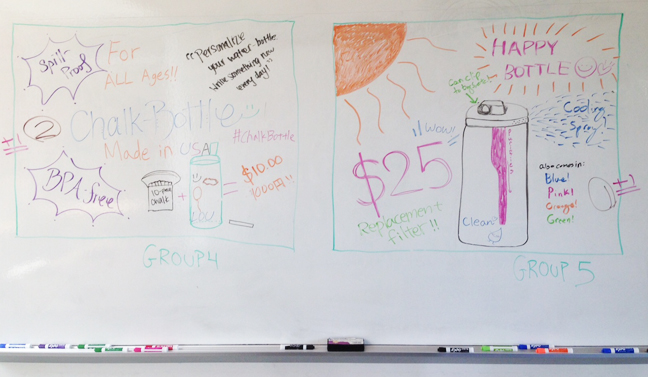
In the YCISL workshops, you worked on a project and made a rollout presentation. Sometimes, I have asked students to focus on just the top three most compelling features of the project and emphasize just those three features in the presentation. We have now designed an exercise just to demonstrate the process of brainstorming and selecting these primary features. We start with a group of water bottles, each with different features. Then teams get to examine each water bottle and create a list of all the features they notice. They then are asked to design their own water bottle. They start by selecting three features from the list they created (or they can choose features that they already know about but are not listed). Next, they have to come up with a special/crazy/extraordinary feature which would potentially differentiate their bottle (remember Competitive Advantage?) After that, they select a sustainability feature. The fun really begins as they create an advertisement on the whiteboard for their water bottle; and only three features can be listed (so two will get tossed in the end) – this requires a few prototyping iterations. An outsider gives feedback and modification can be made to the ad. Finally, everyone votes on the water bottle they would want. This is proving to be a good lesson in focusing on the feature list to promote a compelling creative idea. Try this yourself. You can do it as an exercise for yourself or with others. In the end, think about how your “personal” features stand out when you introduce yourself to others. It’s a very similar process.
[This entry was originally posted on the YCISL LinkedIn Group Discussion board]
Amazon Prime Day: Case Study in Overpromise, Underdeliver

Today, Wednesday July 15, 2015, is Amazon Prime Day. It was supposed to be a “Black Friday”-type special shopping day for those signed up for the Amazon Prime service.
Our household has been an Amazon Prime subscriber for a few years and so far it’s felt all right – mainly for the fast delivery. The excitement over Amazon Unlimited Prime Instant Video has long faded into irrelevance. My spouse and kids nibble on Netflix during the holidays and I have found all I care to consume at DramaFever. Then again, fast delivery was the Amazon standard before they introduced Amazon Prime, so service took a step back first before taking a step forward – and they basically are coming out $99 richer every year without doing anything extra. Well believe it or not, there are worse deals out there where people have figured out how to get your money by providing you the same or less service than before their fees.
Let me also say though that there are a number of things I do like about Amazon and it is #3 only to my shopping at Costco and factory outlets. I do really like their no-fuss return process as well as the customer reviews service. Pricing is also seriously competitive most of the time (wish it was all of the time).
Anyway, back to Amazon Prime Day. This was a seriously bad day for customer experience. Where the expectation was to find compelling shopping deals (like on Black Friday), there was more disappointment than satisfaction to be had. Up front, let me say that I think deals disappearing quickly is not entirely Amazon’s fault. There has to be some stock limit and it really depends on demand and the quick shall have it. The problem probably was that the quick were people looking to re-sell items later at regular prices and make a quick profit (and hence the positive PR about sales on this day) – it probably wasn’t as much to end users as to prospective profiteers.
I take issue more with the plethora of different third-party Sellers engaged in Amazon Prime Day and the inability to tell if there was any real discount because of Amazon Prime Day. We know from services such as CamelCamelCamel that Amazon prices fluctuate regularly, but we could not really tell how good the sale price was unless we checked something like CamelCamelCamel. This was just a jumbled presentation and the air quickly left the balloon. Our household did not buy anything on Amazon Prime Day.
With this in mind, I judge Amazon Prime Day to have been a case of overpromise and undeliver. A pretty nasty blunder in mismanaging expectations and presentation. They lost our attention within about 2 minutes.
In YCISL, we coach using a grab and monitoring “eye contact” to ensure that attention is not lost. Amazon.com, once the premier example of user persuasion, failed badly this day. Let’s move on. Accidents happen.
Related News Stories:
Amazon Prime Day Recap: Sold-Out Kindles, Wait Lists, Facebook ‘Fail’
Amazon Gets Defensive As Customers Criticize Prime Day
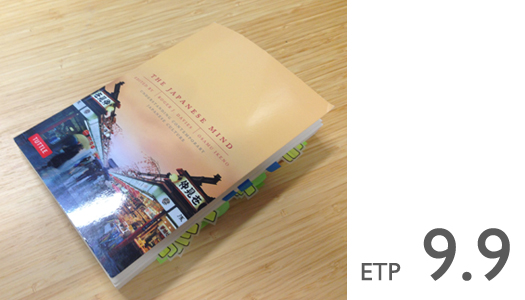
BOOK: The Japanese Mind by Roger J. Davies and Osamu Ikeno (Eds.)
I discovered this book while searching for tourist-type guides to Japan. It is a great find and became my primary read immediately. This is a collection of essays – each of which contain reflections on the Japanese culture, sometimes in comparison to Western culture. “The Japanese Mind” in fact contains a series of student essays (that feel were smoothed out by the editors, Davies and Ikeno) which each generally contain insights, meanings and socio-cultural influence. Reading this book was a marvelous learning experience and will add emphasis on cultural viewpoints to our YCISL workshop.
“Ambiguity is thus indispensable for maintaining harmony in Japanese life, where it has the quality of compromise.” I usually associate “ambiguity” with negative consequences (specifically in the context of Outliers by Malcolm Gladwell and Geerte Hofstede’s Cultural Dimensions), but now can appreciate the relation to positive influences such as harmony and compromise. It is fascinating to think of ambiguity as a skill where one has to be facile in both creating it and dealing with it.
“Silence can also be considered a kind of ambiguity.” In our YCISL workshops, silence usually feels awkward to me but it happens especially at the start of the workshop. In my next workshop, I will think more carefully about the meaning behind the silence and whether it provides any hints to the students’ mindsets.
“As a result, there is a constant emphasis on other people’s feelings in Japan, and parents try to teach their children from a very early age to be sensitive to this information.” While YCISL includes exercises to practice assertiveness, our desire to grow emotional intelligence fits well with any tendency to be highly (or even overly) considerate of the feelings of another person. We can look at this from the perspective of training skilled empathy which includes awareness as well as self-control and sensitivity.
“Until they graduate from elementary school, they are generally not completely conscious of these vertical relationships. However, as soon as they enter junior high school, they are expected to confirm to this rigid system.” This suggests that the timing of YCISL intervention at early high school is perfect. Parents and teachers need to believe that when creative behavior, motivation and productivity are desired, the vertical relationships need to be relaxed.
“Simplicity and elegance are often considered two of the essential aesthetic qualities of Japanese culture, and they have been important features of Japanese life since ancient times.” I would like to try to emphasize simplicity and elegance in all YCISL activities – from our concepts and exercises to the projects and lessons. With these two attributes, we can expect greater teamwork and leadership as well as clearer purpose and deeper passion.
“However, this also inspired a positive attitude toward such desolation in treasuring the beauty that was out of sight.” Being able to value things not in plain sight is a key to innovative thinking. In the case of prototyping where we understand the practical advantages of “fail early, fail fast” and moving on despite obstacles and failures, deriving a positive attitude in these situations is a valuable skill in creating unique solutions in problem-solving.
“Although millions of people continue to learn calligraphy, tea ceremony, and flower arrangement, most do so not to develop their own distinct inner sense of beauty but simply as an imitation of models.” In YCISL, we should seek to develop this inner sense of beauty as part of our exploration for creative energy; this is possible in YCISL because we do not have a rigid model.
Activity: The Thomas Interview
While YCISL emphasizes “Your Personal Story” as a theme, it may be worthwhile to develop an exercise where one develops a personal story of another person through an interview. The interview would involve questions based on a variety of YCISL topics such as “Purpose” and “Motivation.” Through such an exercise, students would learn to frame their personal story using the YCISL elements and appreciate the directions that can be taken.
