
Category: Planning
Coursera: How to get a job with no experience

A moment ago, I received an email from Coursera with the Subject line “How to get a job with no experience.” There are 8 steps listed in the email. Let’s see if we can create a similar (and better, more EQ-enabled) list using YCISL ideas.
HOW TO PREPARE TO GET YOUR FIRST JOB – THE YCISL WAY
- Active Listening. Showing that you can hear, listen and understand may be the most important factor in an interview as well as mentoring for a new hire. Your sense of timing, word choice and expression (facial, hands & body language) reflects on your emotional intelligence and is your chance to earn initial trust.
- Shared Problem. Sharing a problem closes the distance between you and the person you are talking to in an elevator pitch. Ask about the problem related to the job and discuss how the new hire is expected to solve the problem. How do your interests and skills connect to the problem and solution?
- Business Card, Mind & Heart. Show an understanding for the job functions (perhaps written in a job description), intelligence requirements, and the intangibles that may make the work fulfilling and meaningful.
- Opportunity. From personal experience, timing is everything. Demonstrate flexibility and adaptability. Be aware of the timeliness as well as “currents” and “cross-currents.”
- Team. You must show that you can work with others and contribute as an individual. Do you have group, social and empathy skills? Demonstrate composure and leadership potential.
- Growth Story. In YCISL, we like to think about Your Personal Story. How would you grow in the job? How does it connect to your past and future? Make sure you are the main character in your story. Do describe the chapter scene at the prospective workplace. Make it interesting for the “reader” using success and happiness, two fundamental positivity features.
- Intrinsic Motivation. Highlight the many ways you are motivated and self-motivated. What aspects of the job has the potential to make you feel rewarded emotionally and perform well sustainably? Helping people? Learning from others? A balanced work-social life? Flexible work hours? Practice divergent-convergent thinking here.
- Promise. Show that you can make and keep promises. Be clear on what you are sincerely promising if you are granted the job role. You can echo and resonate the promise in your follow-up (thank you) note as well as when you start your first job.
This is why the YCISL tagline is “Life Lessons in EQ.”
Good luck!
Reflection: NIFTI Roundtable 2021 “Sustainability in Education”
“Envision an education where sustainability is a core academic subject. Imagine students empowered by global sustainability actions. The NIFTI Roundtable 2021 will bring together education stakeholders to brainstorm and shape a platform of curricula, courses and experiential learning programs to re-define how we learn about sustainability.”
The first NIFTI program (August 14 – October 2, 2020) was a seminar series coupled with a group discussion. In an idea for a followup activity, a NIFTI Roundtable was developed where there would be an organizing committee comprising a small select group of invited NIFTI students. The seed idea was to reverse the students’ roles as audience to organizers, and provide a leadership opportunity. The initial scope called for the students to invite an audience comprising students and educators from their school. The purpose of the roundtable would be to share viewpoints and experiences on a sustainability topic.
We had our organizing committee kick-off meeting on December 18, 2021. There were initially 4 students on the committee. We floated topics that would interest us as well as our prospective audience. At the second meeting on January 15, 2022, the topic of Sustainability in Education eventually stuck. We then discussed organizing timelines, roles and the agenda. We decided to have a Zoom meeting instead of a webinar mainly to allow for stronger engagement.
Progress on organization was slow with students managing with the disruptions to their schooling caused by Covid-19-related responses. After more than 8 months of intermittent progress and passed deadlines, the NIFTI Roundtable was scheduled as part of the Fall 2021 NIFTI program. The audience became the students in that NIFTI program and the panelists comprised educators and students. That firmed up the event date and audience. We then focused on the agenda to make it attractive and fresh.
We had the NIFTI Roundtable on December 3, 2021. We learned a lot about what the educators and students at Sekolah Bogor Raya were doing in the area of sustainability in their school environment. Several students shared their experiences in organizations addressing sustainability. Committee members served as hosts and engaged the panelists and audience in dialog. We had a Mentimeter poll. We had Zoom breakout groups for social networking. We had a brainstorming session. We created an Instagram hashtag so students could post ideas for educational activities on sustainability.
While the organization and delivery of this event was not easy, it was a worthwhile effort to bring us awareness about opportunities to get sustainability to a top tier level in education. The journey has just begun. And we hope others will join this effort to elevate sustainability in our lives.
Epilogue: We are planning on publishing an e-book on this experience. The organizing committee has been invited to contribute chapters covering the organizational effort and event notes. I also plan to author a YCISL White Paper on my reflections about what I learned about Sustainability in Education from this activity.
YCISL Skills Survey: Which skill group do you want to improve the most?
In 2019, we presented the idea of EQ-fying Schools, Classrooms & Learning in order to optimize the level of engagement. We postulated that current teaching paradigms exclude evaluation and optimization of emotional intelligence of students and the instructor, and that leads to fuzzy learning. We envisioned a smart dashboard for instructors that would help in course preparation. Data would include student academic records (mainly to identify gaps), learning strengths and weaknesses, and conditional preferences. For example, does the student typically need to be taught a math concept one or five times before it is mastered?
A creativity skills survey was designed and prototyped for a Stanford Sustainability Design Thinking course in 2020. A similar survey was then applied to various ITW workshops in 2020 and 2021. One of the questions (multiple choice) in the survey is “Which skill group do you want to improve the most?” In the YCISL context, this question is aimed at informing the instructor on student motivation and self-awareness. The survey is still in the prototype phase because we have had short programs and long programs, small groups and larger groups, and so on. So we are learning how the survey works in various settings.
However, I came across a YouTube video today on a cool way of displaying data in infographics so I thought I would try it out. The following infographic show the response to the above-mentioned question by a group of students from a university in Japan attending a YCISL Focus Group.
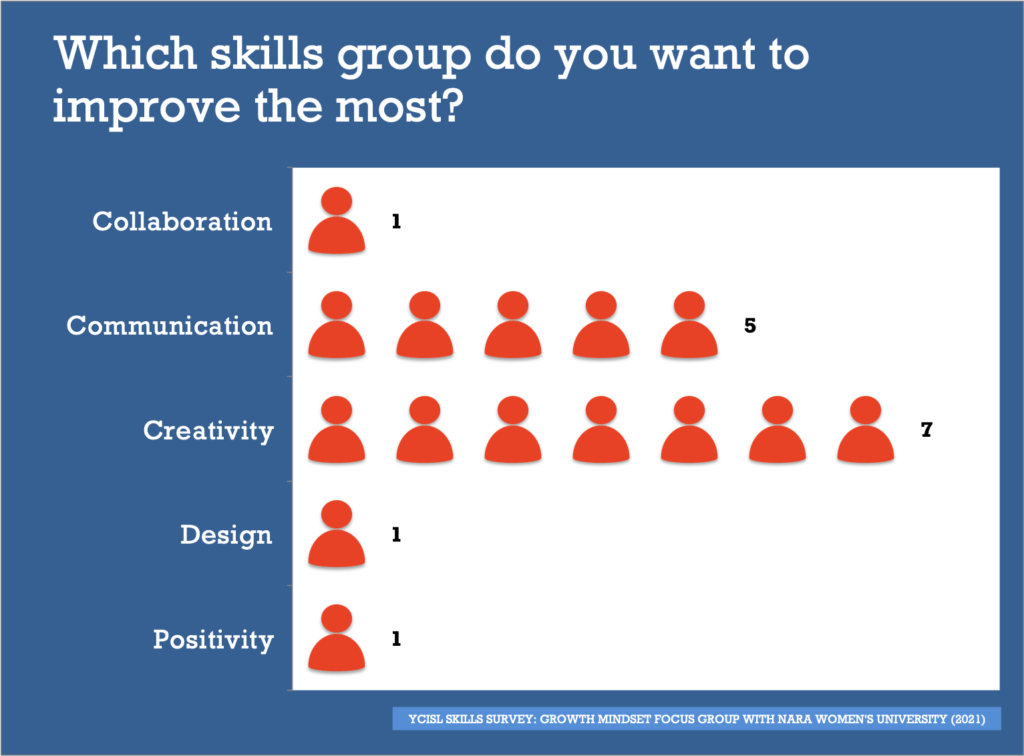
Almost half the students were interested in improving their creativity skills which is great because the YCISL program focuses on creativity (or more specifically creative energy). Many students were interested in improving their communication skills which is helpful to know since we have our elevator pitch exercise. Having this kind of information could help us balance our workshop agenda with accurate eq awareness & management.
Plan: Divergent-Convergent Thinking (Popcorn Series)
The Popcorn with Colin (PwC) series started in mid-2020 as a means of connecting with students in the virtual space to chat about creativity and developments in the YCISL program. Each PwC meeting, a short 60 to 90 minutes with a small group of 5 to 12 students, is designed to create engagement and the sharing of viewpoints (where you are) and perspectives (what you see). I’ll write up more about it in another article; it’s been going well and should have good future pick-up.
This wiki entry focuses on an upcoming PwC meeting where I would like to discuss Divergent-Convergent Thinking (DCT). I will probably follow-up that PwC with a YCISL White Paper to share action items that “pop” up. DCT has been a part of the YCISL workshops for about 5 years and more recently it was included in the Innovators Toolkit publications on the YCISL web site and the Innovators Toolkit Workshops (ITW). And I just made a short presentation last week on DCT in the NIFTI-SEWSS program; the response from students has been fantastic.
The tentative agenda for that PwC is:
DIVERGENT-CONVERGENT THINKING
– What is it and why is it a useful creativity skill?
– Checking our divergent thinking (brainstorming) skill…an exercise.
– Applying divergent-convergent thinking to a research project. A group discussion.
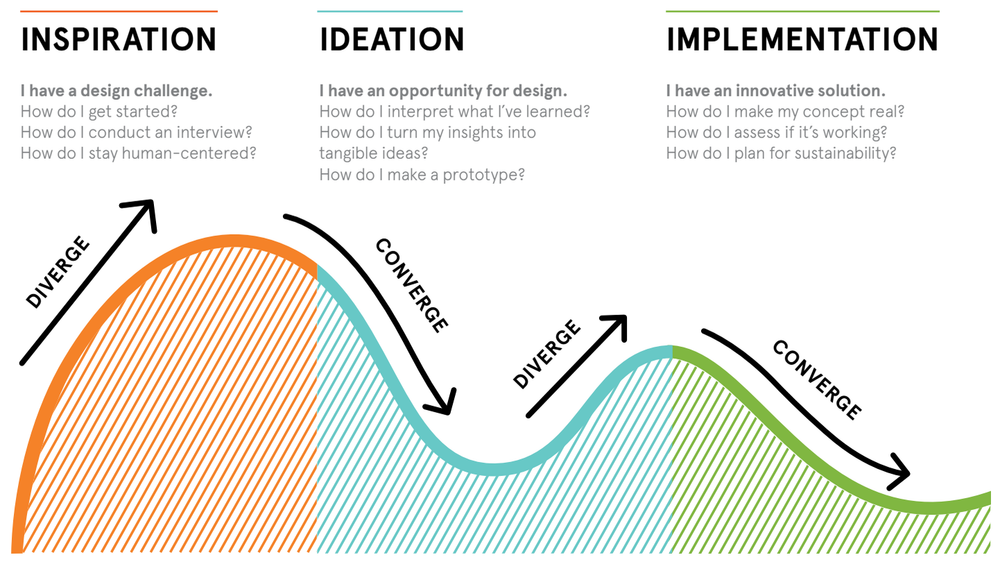
The new part that needs development is the connection of DCT to research methods and skills. I’ve heard from many YCISL students that they would like to improve their research skills and find research opportunities. I found the figure below which I think could lend structure to a presentation on research applications of DCT. Inspiration, ideation and implementation are practical stages to step through in all aspects of research (I will focus on proposal writing, experimental design, and reporting). I will need to remember to embed this in a design thinking teamwork and collaboration context because research needs to be people-connected.
That’s all I wanted to share for now about the PwC DCT plan.
The Straits Times: 6 in 10 S’porean households recycle weekly, though misconceptions about the process remain: Surveys
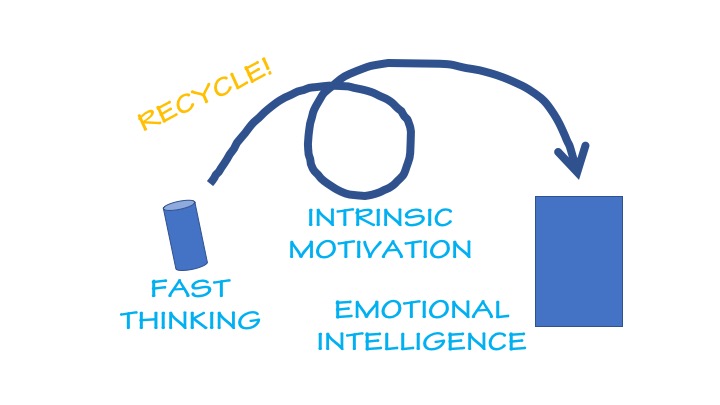 Household recycling is still an immature process – meaning plenty of confusion, indifference and emotional un-intelligence. This The Straits Times article by Ng Huiwen published on April 29, 2019 titled “6 in 10 S’porean households recycle weekly, though misconceptions about the process remain: Surveys” reminds me of my own household’s behavior with respect to recycling as well as how government policies keep getting in the way of creating sustainable recycling behavior (eg, the plastic bag ban). Thus with the condition of wanting so much more out of a good cause, we can possibly take on this problem scope for the YCISL workshop team projects.
TUNING THE RECYCLING MINDSET
Purpose: To design solutions utilizing YCISL strengths that enable optimizable recycling behavior in homes.
How: For this pilot-level project, team projects will be required to include fast-thinking conditioning, instrinsic motivation leveraging, and emotional intelligence smart-ness.
Methodology: Team products could be service-oriented, educational (various media or channels), interfacial (eg, using HCI), interactive (eg, with feedback), gadget (something to install or carry) or programmatic (crowd-sourced or information campaign). To optimize, make it simple AND easy.
Rules (who needs rules?): No financial aspect will be considered.
Shark Tank’s Best Pitches Explained By the Cast | Vanity Fair
I came across a YouTube video this morning titled “Shark Tank’s Best Pitches Explained By the Cast | Vanity Fair” which made me think about the YCISL program. I have watched Shark Tank on television and YouTube before (just a few times), and attended a local Dolphin Tank event (similar concept but for youth). Mostly, I don’t connect Shark Tank to the YCISL program because of the weight given towards money (investments from the Sharks as well as the definition of the problem and success); it makes for compelling television viewing, I understand.
What I did get reminded of though is that the YCISL program is about porting adult frameworks and concepts to a youth context. YCISL is about attenuating “Play” to boost creative energy and the intrinsic motivation to sustain that energy. And from that video, it’s interesting to see the port connection.
- Know Your Numbers -> Elevator Pitch. “Know your numbers” is not so much a point about being a vessel for financial information, but more about being prepared (a state of readiness) with an elevator pitch that is emotionally intelligent. Know your target audience and be prepared to make a memorable impression. For an elevator pitch, having an idea of reaction buttons to press help too (not that you should press every button).
- Be Creative -> Creative Energy. In YCISL, we show our model where creative energy is at the base of innovation and leadership. For most though, one’s creative energy level is unknown (having been stifled by education) and untrained (not readily accessible or appropriately applied). On Shark Tank, the creativity in the pitches are in the person, product and pitch. In YCISL therefore, we emphasize exercises that expose creative energy levels and aiming that energy.
- Have “Chutzpah” -> Positivity. YCISL touches on positivity in several ways using examples from Shawn Achor (better productivity) and Alison Ledgerwood (framing). There is also a needed element of confidence that I draw from Mel Robbins. We ask our workshop project teams to ensure positivity when working together. We look for simple techniques that effect positive alignment.
- Problem Solver -> Project Studio. The YCISL innovation premise is based on solving problems. We search through personally-experienced problems as well as problems from one’s worldview and observations to select one to use for the workshop Project Studio. Our Project Studio exercise is done in a team to render normalization to the problem to remind us that a good solution has the potential for wide adoption and multiple applications beyond the original worldview. Picking a problem isn’t as easy as it sounds, and in YCISL we emphasize the basics of formulating a problem statement – for visionary inclusion and team alignment.
- Motivate Others -> Intrinsic Motivation (Self+Others). From Dan Pink, we understand that motivation has a sustainability issue. In YCISL, we recommend leveraging intrinsic motivation given limited resources (especially the case for youth). We also examine approaches to imparting intrinsic motivation in one’s self as well as to others (team and users). This is one of the critical leadership skills that we seek to develop through our program.
- Listen to Diverse Opinions -> Active Listening and Growth Mindset. To listen, we need to listen well and the skill of active listening is key to Shark Tank as well as innovator and leader roles. Unlike the make-it-or-break-it tone in Shark Tank, we moderate discussion in YCISL so that there is sequential exchange (like in Adora Svitak’s reciprocal learning), checkpoints and learning. From that, we can feed the growth mindset that we expect in a creative and decision-making setting. We also learn to train fast thinking and the cycle of divergent-convergent thinking. Subsequent to this process, we also learn about weighing competitive advantage and thriving through de minimis risk and initially huge uncertainty conditions.
This reflection years after YCISL started has been quite satisfying. I hope it will help further development of our concepts, ideas and products.
YCISL Team Project: Disrupting Human Behavior
One of the challenges that we have discussed in the YCISL workshops is changing human behavior. From ideas of the growth mindset (Dweck) to Simple, But Not Easy (Robbins), we know that changing human behavior like a disruptor requires a high level of mindful and persuasive creativity. We would need to leverage the sense of “new” (linked to the Try Something New workshop idea) and a worldview-framed story.
I am therefore considering the design of a YCISL team project with the theme “Disrupting Human Behavior” whereby teams have to realize a product that opens a new and competitively compelling path towards a sustainable objective.
The project would require a clear path and powerful messaging. Competitive advantage (just like in our Elevator Pitch exercise) would need to be awesome – as would ask and promise.
To be ultimately challenging, the teams would have to make (influence) other participants in the workshop willing to try the new path and consider sticking with it. It would have to be something workshop participants are actually doing at the start of the workshop – and would change their behavior by the end of the workshop.
How hard would that be?
What’s the plan for YCISL 2019?
The December break was a good time to come up with ideas for the 2019 YCISL workshops.
- A Symposium on Inspiring Cases of Youth Creativity, Innovation and Leadership. The schedule would involve research & development of a TED-style talk on a selected person, place or event. The selected case would have to exemplify the YCISL principles of EQ, intrinsic motivation and creative energy. Presentations could also make commentary on other YCISL topics including positivity, fast thinking, problem-solving, gratitude, teamwork/teambuilding, brand identity, and your personal story.
- Team Project on EQ-fying Schools, Classrooms & Learning. Exploring a range of solutions to quality of engagement in Education. Particular focus in the first year will be on classroom OOBE (first impressions for the students and teacher). The aim will be to create an EQ-based familiarization between students and teachers in order to enable the reciprocal learning posited by Adora Svitak. We could touch on expectations, methodology and assessment.
What Makes You Happy? Keeping Your Personal List.
On of the KDramas I am watching presently is Hotelier (호텔리어). Towards the end of episode 4, Frank asks Leo “What does happiness mean to you?” Leo’s ‘serious’ reply includes “Good pay, good food, good social status.” Frank is reflective about his pursuit of happiness. [I am noticing “happy” and “happiness” spoken many times in this series]
This question may be of value in the YCISL journal. So we’ll have students title a page with this question, and initially have them create a list of things they think make them happy. They should also keep another list of things which do make them happy (as they experience it). This may be a useful reference in positive thinking as well as thinking of the future and the pursuit of happiness in the personal story.
I searched on the phrase “What makes people happy” in Google and the top-most results generally refer to studies pointing to research conducted in the US and findings that social connectedness is most vital to happiness. More interesting to me was the result pointing to the article “How our view of what makes us happy has changed in 80 years” published by the British Psychological Society in which a happiness index is updated. Given our age of informatics, it may be more valuable to have a multidimensional index that crosses age as well as cultural or even social status lines. For YCISL, we could compile data based on our group profiles, but more impactful maybe to design a method to design, fill and update our own personal happiness index. Above, I mention a simple entry list into the journal, but what if we could create an app to maintain ones personal happiness list and provide valuations so that the list is indexed? How cool would that be?
Idea: Build-a-Store Brainstorming Project
The following could be done as a rapid-fire 1-hour brainstorming assignment.
A group of students would be asked to design a store (and this is the only requirement) for KIDS.
Originally, I was thinking about a Toy store but have each group discuss about stretching and staying within this scope. For example, a Toy store might sell what mainstream consumers might consider toys, or they could have collector’s toys, or just a subset of the Toy realm (eg, BoardGames, or Video Games) – or they could have magazines/comics on top of toys – if they think that is what would “drive” kids to their store.
The subsequent idea is to design any store so long as the appeal is to KIDS. Preferably, the store would be something that could be set up at their school – either as something that would open regularly (eg, daily, weekly or monthly) or just once a year (eg, something for the holidays or a school event).
Some of the things that they would brainstorm and pull together are:
(1) Scope of the store – customers (eg, age and male/female/both) and type of goods/wares/services
(2) Sample of actual items they would want to sell
(3) Purpose of having the store
(4) Positioning of the store (how it fits into the proprietors or school’s goals); uniqueness and appeal
(5) Look of the store – design a storefront (real or virtual)
(6) Name of the store, design a logo and create a slogan
(7) Plans for growth and sustaining interest
Since this is just a brainstorming (dreaming) exercise, we would not discuss logistics. The intention of this exercise is for students to express their dreams without substantial practical consideration.
