Category: Activity
Idea: Build-a-Store Brainstorming Project
The following could be done as a rapid-fire 1-hour brainstorming assignment.
A group of students would be asked to design a store (and this is the only requirement) for KIDS.
Originally, I was thinking about a Toy store but have each group discuss about stretching and staying within this scope. For example, a Toy store might sell what mainstream consumers might consider toys, or they could have collector’s toys, or just a subset of the Toy realm (eg, BoardGames, or Video Games) – or they could have magazines/comics on top of toys – if they think that is what would “drive” kids to their store.
The subsequent idea is to design any store so long as the appeal is to KIDS. Preferably, the store would be something that could be set up at their school – either as something that would open regularly (eg, daily, weekly or monthly) or just once a year (eg, something for the holidays or a school event).
Some of the things that they would brainstorm and pull together are:
(1) Scope of the store – customers (eg, age and male/female/both) and type of goods/wares/services
(2) Sample of actual items they would want to sell
(3) Purpose of having the store
(4) Positioning of the store (how it fits into the proprietors or school’s goals); uniqueness and appeal
(5) Look of the store – design a storefront (real or virtual)
(6) Name of the store, design a logo and create a slogan
(7) Plans for growth and sustaining interest
Since this is just a brainstorming (dreaming) exercise, we would not discuss logistics. The intention of this exercise is for students to express their dreams without substantial practical consideration.
Exercise: Prototyping with Lego
I am thinking it may be possible (and fun) to reproduce the iPod prototype unveiling experience described in Chapter 30 of “Steve Jobs” by Walter Isaacson. Fadell had designed 3 prototype models whose purpose was for Steve Jobs to inspect (for look and feel, as well as features). Fadell put what he considered the top candidate under a bowl (hidden from view). The presentation started with a layout of the components and then assembling them to show the various ways they could or would go together.
At this point, the book does mention Lego blocks which is something that has previously been used in the YCISL workshop.
The story continues with the unveiling of the #2 and #3 prototype models. Since the actual models were carved from styrofoam, there wasn’t any operational functionality (ie, no “click and feel”) but the creative concept could be considered. In fact, it was probably critical to the iPod’s success that engineering was not considered at this stage. There was a little bit of brainstorming with what-if? thinking as they considered modifications to the models. When the #1 prototype model was un-hidden [important so that it would not attract too much early attention], it seemed that it addressed the creative energy that they had experienced just moments before, and there was instantaneous agreement about the direction to take.
We could do this as a YCISL exercise. Students could build a series of optional base models [selected from the sandboxing phase] and build models using Lego pieces. The exercise would then involve prototyping for look and feel, and the packaged feature set. We would then need one group of students to present their prototypes and another group to be the audience. We would do the what-if? so presenters and presentees have their views in the open. Then the members of the audience would select the best candidate. We could then have a discussion about the presentation, the chosen prototype and whether they felt they could move forward or had to trace back.


Exercise: Your Personal Vocabulary List
This is a straightforward exercise to initiate a short and accessible list of words that one can use in writing. In writing proposals, essays, college essays, etc., one needs to show depth in wording to produce a positive impression (so this most important when making a first impression). The basic idea is that some words more accurately define an action or emotion, and that the reader needs this clarity to empathize with the meaning.
At one end, when “bland” words are chosen, the reader may become disinterested…
Instead of “said”, one could use (where appropriate) “argued”, “pleaded” , “denied” or “explained.” Attaching an adjective would also greatly expand the impact of carefully chosen words. For example, “pleaded vehemently” which creates a scene/action readily imagined.
The words that we hope to include are those that engage/stimulate interest and emotion (eg, hope, sympathy, happiness, beneficial), even empathy. They can also affect the feeling of time and place. We would aim to influence, persuade and take control.
Unfortunately, at the other extreme is the frequent use of words not in the average person’s vocabulary (this harms momentum and perhaps interest).
Now for the exercise – some starting prompts:
1. Imagine your favorite pastime – how would you describe it?
2. What word best describes your hero?
3. What word best describes the most exciting/engaging part of your favorite movie?
4. How does your favorite television commercial make you feel?
5. What kind of books do you like to read?
6. Imagine that you are dancing. How would you describe it?
7. What word would you use to describe a pile of work in front you?
8. What word would you use to describe something very important?
Some of my favorite words:
Positivity
1. efficacious – can be used to describe people, ideas, work and many other things.
2. dichotomy – can be used to describe relationship of ideas; especially useful when debating two sides of an issue.
3. convergence – denotes movement of both tangible (technologies) and intangible (ideas) objects.
4. motivate – can be used to demonstrate an effort to change or a change agent which lends to revealing something new (always exciting to discover something new!)
5. inspiration – can be used to introduce a high-level factor and build a connection to/association with something already highly regarded or promising.
Other candidates: versatile, commendable, amicable, compelling
Negativity
1. ferocious – example of word that conjures thankful feeling of not being in the same situation; describes a personal state (eg, fever) or a stressor (hurricane).
2. fallacy – expresses a strong opinion and position; sets expectation of forthcoming proof/evidence/support.
3. unrelenting – denotes length of time of a stressor in which a subject can go through one or more significant phases/changes such as in mood.
4. tension – if used properly, the reader will start to feel tense in a physical reaction/manner; builds empathy.
5. perfunctory – can be used to influence the reader that something is not worth thinking of in detail; comes across as robotic/programmed or void of emotion.
Other candidates: inconsequential, dimunitive, impediment
Exercise: Ball Conduit (executed)
I managed to insert the ball conduit exercise into the SP YCISL program. And I am very pleased that I did. I decided to do it because I noticed how well they responded to the Lego-PostIt exercise. I placed it over the slots for youth leadership and teamwork/team building.
I did the almost all the shopping at Target: golf balls (real and plastic practice), aluminum foil, elastic bands, paper clips, …
This will need to be refined for the future, but in the meantime, it did provide valuable experience in teamwork, execution and communication.

Programming: Summation Using Video
For the SP YCISL program, we went to a finale dinner. Before we sat down to dinner, I had the students take my video camera and record each other [important feature is that I did not do the video recording so that they weren’t directly talking to me – hopefully, their statements were spontaneous] make a short statement about (a) what they liked most about the workshop, and (b) what they liked most about the whole trip. They also had to state their name and which school they were from – for future reference. I plan to make this available to them in the near future. This is firstly, good feedback for me; it also pushes them to recall and set a memory before the moment has passed and become fuzzy; lastly and perhaps foremost in usefulness, it can be used as a discussion point when we meet in the future to see if they have acted on the lesson – and I have a way to recall name with face.
Project Idea: What is the pH of…?
It occurred to me that I don’t have a good idea what the pH of certain things are. I know Coca Cola is highly acidic, and that vinegar is quite acidic. I know the pH range of rainwater, common laboratory chemicals, soils, my aquarium (and so on). But there are also a lot I do not know. So perhaps it would be a good idea to start a collection of pH values based on contributions from the students. I could equip them with pH paper (standardize the method) and have them spend a half day going around measuring the pH of anything that catches their curiosity.
Activity: Fast Prototyping with Lego
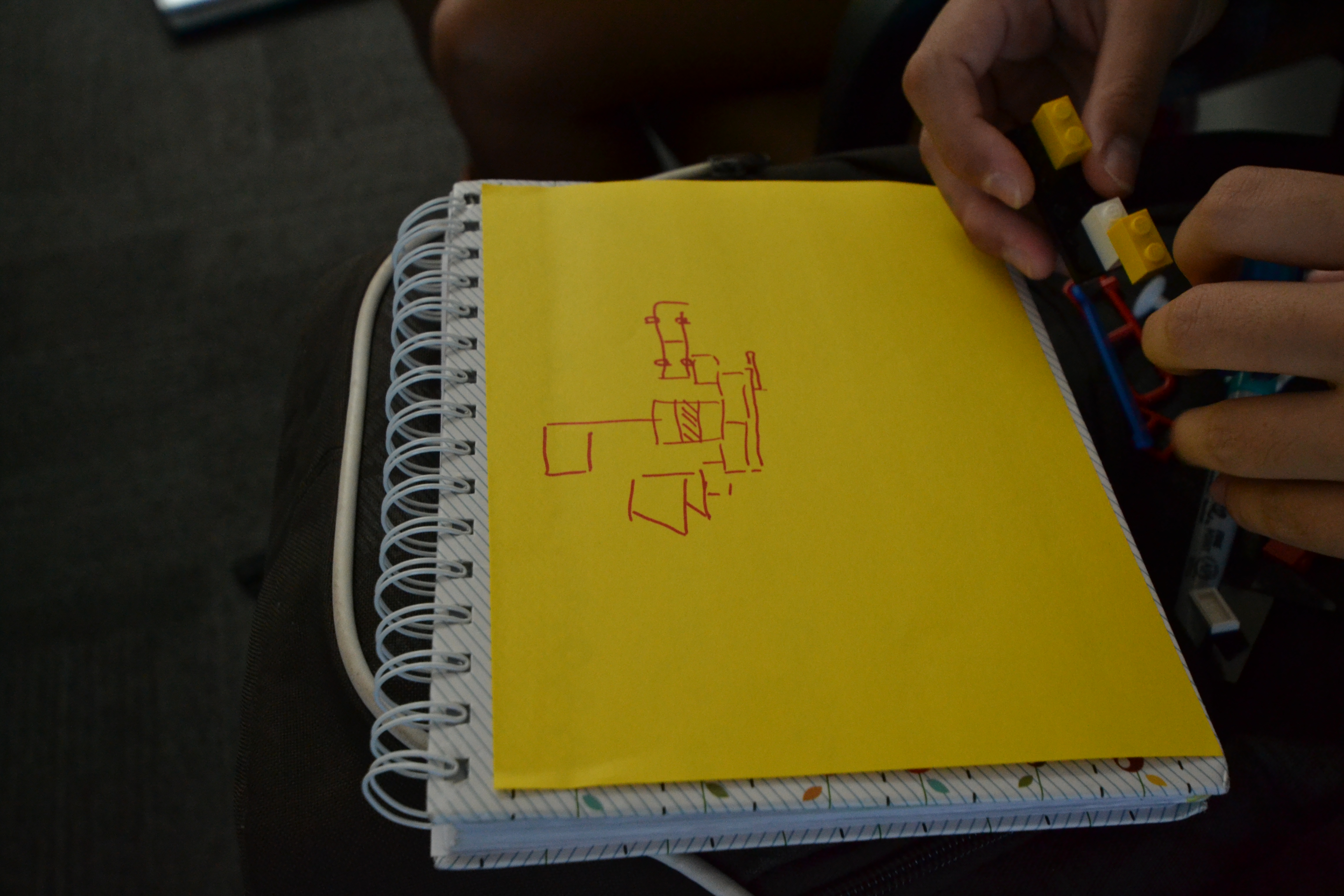
On the spur of the moment of the current Singapore Polytechnic YCISL workshop, I created an activity to demonstrate (a) visualization of a product from raw material, (b) drawing a sketch of a product that someone else can interpret and understand, and (c) setting expectations when the designer and builder are not the same person.
So, each person was asked to grab a handful of assorted LEGO® pieces and lay it out in front of them. Without manipulating any of the pieces, they had to sketch on a large Post-it® something that could be built with the pieces. They had 3 minutes. Without telling them earlier, I then had them pass the pieces and sketch to the person to their right. Each person then had 4 minutes to build the model from the sketch. Next, the model was passed back to the person on the left and we observed reactions.
On the youth level, this was a demonstration about expectations and being part of a multi-step process. Sometimes, not everything will be under your control.