
Category: People
LinkedIn: Post by Anthony J James of “Fluidity” by designlibero
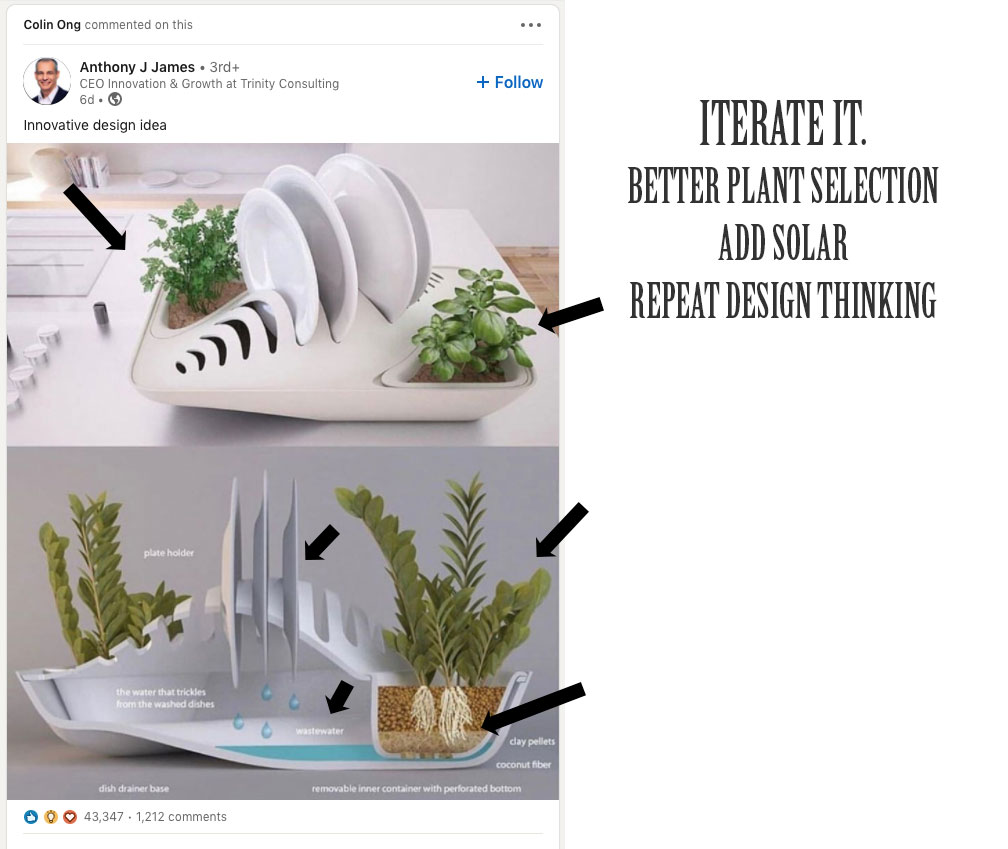
In my LinkedIn feed today, I noticed a post by Anthony J James commenting “Innovative design idea” about a dish drying rack with sections for small plants that would be watered by water that drips from the drying dishes. My reaction was “cool” idea and a wonderful idea using the convergence technique we use in the current YCISL ITW program.
But wait! There was more… There were negative comments aplenty. Many comments were based on lack of understanding and a resistance to the product idea being able to replace the traditional dish drying rack (fixed mindset, I would diagnose). Here are a few examples:
“What about the soap? Would that not be toxic to plants?” Careful how you use the word “toxic” because there are several beneficial plant applications for soap. You can also discard lightly soapy water into your garden (ever washed your deck or patio stone?) without harming the plants.
“Nice try, quite ingenious except lots of plants grow spores, mold, fungi, and insects larvae form their ecosystem and not ours.” Ummm…are you suggesting not having houseplants at all? Or would you like to have a 6 ft social distancing requirement from any plant?
“The person who designed it doesn’t wash dishes.” One of those responses that is most likely incorrect. Perhaps not the way you wash dishes.
“No herbs raised on detergent water will ever taste good or be good for your health.” Reminds me of the Mister Boffo phrase “Unclear on the concept.”
“It is likely that there will be trace of chemicals present in water, that might affect the plant?” Tip: The water you use has chemicals in it. Be it from water treatment, natural atmospheric dissolved gases, dissolved minerals from aquifers, etc.
There were many encouraging comments too. Mostly on the external form design which I agree is cool.
But what struck me is the lack of productive commentary. I don’t usually comment on LinkedIn, but since this product touches on so many personal and YCISL interests, I wrote:
“Iterate this idea. Forget hydroponics. Many houseplants (ie, indoor plants such as the ZZ shown) need humidity rather than constantly wet roots. The LECA balls would provide support and a porous way for humidity to rise to plant. Would suggest removeable bottom tray for periodic cleaning. Other applications would be micro greens or seed starting using seed starter mix where constant moist but not wet needs to be maintained, but would recommend pre-filter such as activated carbon.”
The idea is to collaborate, not object or discourage. Use your expertise, if you have it to share. Wonder out loud, if you like – but imagine the possibilities rather than close your mind. The surprising thing is the LinkedIn titles the negative commenters had; eg, Concept Designer, Team Builder, Entrepreneur, Consultant, and so on. Evident absence of growth mindset.
I would also further share that this product is called “Fluidity” and a full description can be found on the designlibero web site. First, note that the design is dated 2012. Then now also note this article dated November 23, 2020 “Scotts Miracle-Gro completes acquisition of company that makes home-grow kits” which reports how AeroGrow, the maker of the well-known AeroGarden, was acquired. The hydroponic countertop product was already finding a place in kitchens and other places around the home (let’s also remember the countertop composting worm bins!) where nature is succeeding over germaphobia. So I do feel there is a design genius within Fluidity. It just needs iteration based on constructive feedback and focus group testing.
If this was a YCISL DEZIGNBLÄST design project, we would be fully supportive and encourage iteration through further design thinking and divergent-convergent thinking. In the feature list exercise that we do, we would build Smart-app support, sustainability factors such as use of solar cells, and positivity in form and function. Then our students would craft a story to go along with this must-have product.
Just think…if this was made for college students living in a dorm. They would have just a few dishes, want late night snacks, and stress-relieving plants to look at and take care of. Find that early adopter to help you tell your story in a positive worldview.
PS. The other lesson is not to take criticism too harshly unless you have found reason to trust your critic. Do they have growth mindset and positive mindset skills (remember, it takes work)? Do they have emotional intelligence and an ability to brainstorm self-edit-free? Test their ability for active listening and mindful push/pull/centering.
Activity: LwL The Principal Dialogues

I’ve been partnering with Learn with Leaders (LwL) on YCISL programs for about 8 months. It has inspired and enabled me to reach out to new horizons and focus on Zoom-enabled coaching. It’s been a fun challenge.
A couple of weeks ago, I participated in an event called “The Principal Dialogues” where LwL invited a group of school heads/principals for a Popcorn with Colin-like online Zoom discussion group. The event came about as a result of discussions about how to partner with schools with our new series of online programs. As reflected by my organizing partner in Japan, it may be that (1) schools are still putting their focus and energy into re-grouping from the virus-induced disruption and concentrating on curriculum continuity, or (2) the on again-off again switches creates too much uncertainty to make commitments. To find out more, we thought we would ask the school leaders.
We came up with an agenda where everyone took a turn to warm-up the discussion by sharing their reflections as an educator in 2020. For my part, I mentioned the ITW program and the five skills being coached, the NIFTI-SEWSS Scholars Program seminar series, and the in-progress NIFTI Roundtable planning activity. The uncertainty about whether we would resonate quickly dissipated as we found several in-common areas of thought. And we did this despite varying levels of disruption – or even non-disruption as described by Guy (Presbyterian Ladies’ College, Perth WA). Here are a few “bites” from the discussion (what I managed to jot down):
- Awareness. We heard from Caroline (Liger Leadership Academy) about the importance of self-awareness. Mark (The British School, New Delhi) connected this to metacognition and the “snowflake” condition. To me, this fits well with my YCISL interest in emotional intelligence and the application of design thinking to developing a personal brand identity through our “Your Personal Story” exercises. I think the issue is that there is a common belief that one’s awareness and brand identity is already naturally present and needs no additional investment or work. The problem is in the form and function being absent of EQ.
- Playfulness Quotient. Many of the participants identified social isolation as a front-line issue during the current educational rollercoaster ride. This isolation has inhibited in-person social interaction as well as creating new connections. Like a neural network, there is a decay going on. Monica (Shiv Nadar School, Gurgaon) raised the term “Playfulness Quotient” which piqued my interest as it resonated with the YCISL activities (eg, ping pong game) emphasizing play as a means for sparking creativity. This “PQ” idea extends well from Tim Brown’s “Tales of Creativity & Play” from which we learn that interventional action is needed during the school years to ensure happiness and well-being for life.
- Thinking Skills and a Culture of Creativity. I am 100% sure that everyone present has “thinking skills” as a top priority. I specifically recall Meenakshi (Modern School, Delhi) bringing up the topic. This is one of those “simple, but not easy” areas because teachers are broadly accountable for the answers students give, but not the “thinking” route that led to the answer. At this point, I believe everyone jumped in to wonder whether teachers need to join this discussion. For my YCISL contribution, I offered the recommendation to visit Jef Raskin’s article “Holes in the Histories” to find a list of ways people mis-lead themselves as well as others with information that is mis-understood or mis-interpreted.
I would also like to acknowledge Kai (British School Muscat), Dominic (Liger Leadership Academy), and Gerald (North Jakarta Intercultural School) for their shared insights as well; my note-taking just wasn’t quick enough. Regardless, the international scope of the present challenge is clear.
Alison Ledgerwood: A Simple Trick to Improve Positive Thinking (TEDxTalk)
The 2013 TEDxUCDavis talk by Alison Ledgerwood “A Simple Trick to Improve Positive Thinking” has had a significant influence on the presentation of positivity in the YCISL program. Her graphic illustrating how a positive event has a sharp peak effect, and a negative event has a blunt dragging effect is used in the workshop slide set to show how critical it is for leaders to work smart and diligently at maintaining stakeholder positivity. This further ties to the sustainability of intrinsic motivation which is also driven by constant positive thinking.
In her talk, she specifically describes the effect of informing people about a surgical procedure in terms of a success rate versus a failure rate. She further gives examples of (1) a governor’s likability based on which direction he initially messages, and (2) how long it takes people to convert between good news and bad news. This, I find, is an amazing coincidence. Do you?
Positive thinking and framing is an essential innovator and leadership skill. Innovators with the skill maintain their sense of purpose and intrinsic motivation. Leaders with the skill are more agile and appreciated. When a crisis unfolds, these skills go on display and accelerate a successful recovery.
If you are willing to invest in your positive thinking, the media is currently awash with negatively framed statements. See if you can re-phrase some of these statements in a way that stimulates “glass half full” feelings and a sense of hope. Learn to turn negative messaging into positive messaging before you seek meaning and knowledge. You will feel more productive and empowered.
Decluttering…Inspired by Marie Kondo
It took a while (years, I think), but yesterday I finally took notice of the idea of decluttering (mainly thanks to a couple of articles on AsiaOne) as it is inspired by Marie Kondo. I decided to watch the first episode of “Tidying Up with Marie Kondo” on NetFlix, and found engaged by the cultural bridging displayed on the show. The formula was fairly simple: putting the Japanese sense of less is more with the US sense of automatic-consumerism yielded a challenge worth viewing – kind of like rubbernecking a road accident.
Then the connection struck me. Several years ago, one of the YCISL workshop project teams had worked on a decluttering idea (of toys and clothes of children who outgrow the items) and it became one that I use as an example over and over again. Thinking broadly, decluttering (or at least envisioning, planning and empowering for) is a prime leadership skill. Defocused and un-collaborative teams or products are prime candidates for decluttering leadership. Getting teams to bring everything to the fore and sorting them into piles is needed. Showing appreciation for purpose is also emotionally soothing for saving or detaching issues.
Decluttering is about sharing the vision of Point A and Point B, and how to get from Point A to Point B (this has always been what I view as the primary task of leadership). Sharing in the journey is the touch that contributes to fulfillment and success.
So I am hoping to design “Decluttering” into the YCISL projects. The steps from Brainstorming to Prototyping to Feature List to Product Realization are each decluttering exercises. Even Testing & Readiness requires disciplined decluttering. I have a feeling this will be a very useful idea for the YCISL model of creativity, innovation and leadership.
Thanks Marie Kondo for reminding me of this.
Thoughts: Meltdown Uncertainty
“They live up there, and slightly to one side.”
Sir Ken Robinson in his TED 2006 Talk “Do schools kill creativity?”
A lack of emotional intelligence can lead to a meltdown – which includes irrationality, insecurity and isolation. At the social awareness level, people will notice defensiveness (“I” language) punctuated by jabs of aggression, and impatience. Truth in negotiation and compromise are impossible as trust has shrunk. This is typically found in adult behavior and signals an absence of self-awareness and self-management. It is likely rooted in an imaginary fear and lack of true confidence where the senses are numb and non-functional.
When you run into such a person, it can be horrifyingly puzzling. You wonder whether it is a reflection of their true unguarded personality or a circumstance of recent events leading up to the melting point (then you don’t know if it will get worse or better).
This is the kind of situation our YCISL program endeavors to train young people to gird themselves against in their own behavior, and to be able to recognize this problematic “pothole” behavior in others. When encountering such behavior in adults, our YCISL position is to step aside or put yourself into reverse. There’s no value in trying to save the other person or offering help; they are in adulthood where behaviors are unlikely to change and biased mindsets are entrenched. Adults who learn leadership later in life mostly learn to put on a facade – a modified interface layer on top of a complex and messy structure.
In YCISL, we train teams to ensure group positivity before launching into creativity. We encourage teams to have quick techniques to lift up the positivity, but what should you do when each has been used?
WSJ: Why LeBron Trusts His Teammates
Not a big NBA fan. Been to just one pre-season GSW game when I first went to college and a WNBA game 15 years later. I do like basketball though. “Played” it (benchwarmer), coached it (youth leagues) and I include shooting baskets at the park court as an option in my exercise routine. As a spectator, I prefer NCAA.
Anyway, this article “Why LeBron Trusts His Teammates) by Ben Cohen and published in the Sports section of the June 6, 2018 edition of the WSJ caught my interest because I did watch much of Game 2 of the current NBA Finals. There was commentary about the “incident” in Game 1 and an analysis of LeBron’s body language. It’s worth noting because LeBron is clearly in a leadership position.
The article is also notable because it’s much about a story of LeBron’s past when he first played youth league basketball. I feel a connection because of my coaching youth basketball for nine years; and I learned a lot from this experience – some of it is used to build the YCISL program.
“But what happened that night is something that James has never forgotten” Perfect fit for the Message to My Past Self exercise in the YCISL Your Personal Story activity. Leaders are driven by life lessons that affect the growth mindset.
“Right then I knew that this was a team game” Teamwork and team-building are two leadership activities which we include in the YCISL program. The main challenge is to make good teamwork automatic and instinctively positive.
“At 9 years old…he knew how to pass to 7-year-olds without knocking them down.” Sign of emotional intelligence. Self-awareness, self-management, social awareness and social management.
“We both was good at what we did.” There has to be respect as well as trust in order to maintain a team’s positive mindset. How many leaders today can sit out and spectate one half of a “game” without getting in the way?
“It’s what he’s been trained to do since the moment he started playing this sport” The YCISL is a training program. It is structurally modeled like a basketball practice with a scrimmage thrown in. The life lessons that we provide to our YCISL youth will hopefully lead to future quality leaders who can readily apply EQ.
———
*This article is online at https://www.wsj.com/articles/why-lebron-james-still-trusts-his-teammates-1528211656. However, it’s title includes “(Still)” which is not in the print edition.
CNBC: The world’s richest self-made woman shares her No. 1 key to success
I read an article on AsiaOne titled “The world’s richest self-made woman shares her No. 1 key to success” (by Serena Lin, dated May 8, 2018 on CNBC.com) which tells a story of Zhou Qunfei. For context, this was on CNBC.com in their Leadership section.
This story seems like a good one to touch on several YCISL ideas.
- For YCISL, we view success as having many forms (just as we do for leadership and sustainability) and perhaps the least encouraged way is on the level of attained wealth. As I scan the story, I see success in (a) how she pursued her dream of starting a business, and (b) how she teamed with relatives. Her personal commitment to perseverance is also a success.
- As we learn from Shawn Achor, we should place happiness before success. In the story, neither “happy” or “happiness” or anything similar are mentioned. Did she sacrifice happiness or has she not yet found any?
- The use of “self-made” in the article’s story seems incorrect. The article touches on several instances in which her support network kicked in. The fact that she started a family watch lens workshop shows that there was a support network. So too are her daughter and Motorola. Given this, I would have liked to have read about how she has shown gratitude to her supporters.
- In YCISL, we train in “fail early, fail fast” and discuss how one of Silicon Valley’s key strengths is the embrace of failure (or failing well) and one’s ability to rebound with learned lessons from failure. The part of the story where she is contemplating jumping from a train platform illustrates the opposite.
- There are two photos of Zhou with wide smiles. Applying Guy Kawasaki’s lessons on real smiles (ie, associated with positive mindset), I wonder whether she has a positive and growth mindset – which I consider critical elements on leadership.
Overall, I feel it’s a good Your Personal Story. It starts with a strong reflection of the past (especially a series of good decisions that seems like she would make again if she had to), an identity in the present (such as Brother Fei), and…ok, the story is missing a message to her future self. Almost there.
WSJ: District Drops Plan to Name School After Blackstone CEO
A page A3 article titled “District Drops Plan to Name School After Blackstone CEO” by Tawnell D. Hobbs appears in the April 13, 2018 of the WSJ. I am in the process of wrapping up composition of a YCISL white paper on adding Philanthropy to the YCISL program as a platform and cause.
The article reports on some gesticulation over a $25 million gift to a public school. This incident is interesting in that it highlights the distinctive features of conditional vs un-conditional philanthropic gifts of the monetary kind. For this conditional gift which involved naming and re-naming, a blanket of negative emotion was thrown on and it is certain that all named stakeholders (community members, the school board, the donor, and all other parties enabling the transaction) have had their positivity sucked out of them. Applying the lesson from Alison Ledgerwood’s TEDx Talk “Getting stuck in the negatives (and how to get unstuck)”: there was a framing problem for this particular gift and getting into the negative will have a lasting impact outweighing a series of positives. That’s too bad.
Could the gift have been framed in an un-conditional manner and the re-naming of the school be floated as a possible sign of gratitude? Should the re-naming of the school have been just one of the options that came up as a result of brainstorming ways to show gratitude? Could that brainstorming have been done in a way that all stakeholders respect the ideas expressed? What kind of prototyping of the most promising ideas could have been done? Do people prototype philanthropic ideas (I don’t know) or is this usually set up with pre-set extrinsic motivators to draw in donors? How do you decide what the best “skin” is to wrap around the engineering/design/architecture so that the beneficiaries and overseers will focus on the positives? How (timing, content and attributes) was the donation articulated? Did all stakeholders understand the PROMISE and the ASK?
I am wondering whether the lessons we incorporate into and attempt to impart through the YCISL program can help our students navigate through philanthropy projects and build LI (Leadership Intelligence). Maybe. I can’t wait to try it this summer.
Paul Tasner: How I became an entrepreneur at 66 (TEDTalk)
What does age have to do with being an entrepreneur? The story in this TED Talk by Paul Tasner suggests that entrepreneurship is not reserved for the young, but can be a pursuit in late-career as well. The introductory paragraph for this talk on the TED.com web site reads “It’s never too late to reinvent yourself” and when I think about it (pause…), reinvention is one of those situations that provides an opportunity to gain life lessons in being a creative and persistent entrepreneur. The detail in the talk that I found the most interesting is “40 plus years of continuous employment for a variety of companies large and small…” which means Tasner had to reinvent himself several times over. This means he had past experience in changing/rebounding and even if he had or did not have confidence through each transition, he apparently made it – which shows resilience. Every change, even the latest one into entrepreneurship, is a testament to his mindset.
Youth is often seen as an advantage for entrepreneurs because they can afford to dedicate many hours to getting started, but there is a degree of sacrifice in this. Tasner actually has an advantage over young entrepreneurs in that there is little life sacrifice (it was working on this new endeavor or retirement) and he was driven by tremendous motivation (“most rewarding and meaningful work of my life right now”).
The YCISL program delves into one of the biggest transitions in our lives…from high school to college (which for many is about leaving the nest). If we can get through this particular transition well and learn some life lessons along the way, we can perhaps develop the resilience and mindset, like Tasner’s, to sustain ourselves through each future leap.
Salman Khan: Let’s teach for mastery — not test scores (TEDTalk)
Back in 2011 at an Education Roundtable at Stanford, Salman Khan (as a roundtable participant) left me with one enlightening understanding and it was about the pursuit of a “productive and happy life” in order to feel a satisfying sense of fulfillment. Education in the US (generalized), demonstrating low EQ, apparently does not understand this and continues to structure itself based on imminent failure and impossible fulfillment. This is what I found to be the premise of Salman Khan’s latest TEDTalk “Let’s Teach for Mastery – Not Test Scores” from November 2015.
Let’s also connect the mastery mentioned here with the mastery mentioned by Daniel Pink in his 2009 Ted Talk “The Puzzle of Motivation” and his book “Drive.” Mastery is one of the keys to intrinsic motivation which in turn is an essential element to building a love of lifelong learning – this ultimately is the purposeful beauty (albeit forgotten) of education.
“…then I start to disengage.” Under the lecture-homework-lecture-homework-quiz-test model (traditional US secondary education model), there is no opportunity to engage. So the problem is that there probably wasn’t any engagement to begin with (student-subject and student-teacher both) and that this lack of engagement is only apparent after an assessment. Even more pitiful is that the knowledge of a lack of engagement does not create any action item. There is ample opportunity to have a more professional approach to engagement, but it’s not done. For example, teachers should allocate time to checking engagement levels of individual students (akin to checking your blood pressure periodically to track health) so that action items can be prescribed and followed. Should we treat teachers as “educational physicians” – the ones on whom we rely on for our educational health?
“…it would reinforce the right mindset muscles.” Yes, ideally positive and growth mindsets along with creative and critical thinking would be nurtured, but the Target (tar-jay) model of US secondary education provides no aisle space to it (the IB model on the other hand does the mindset training well). One usually only starts to see this in graduate school where professors are somewhat focused on their research teams and identifying future prospects from their crop of lecture students. Below graduate school, the existing opportunities are in sports and other extracurricular activities. This is why the YCISL program treats leadership development as a self-driven choice.
“If you were allowed to be operating in a mastery framework…” I would have liked to have seen more visualization about the “mastery framework” being proposed. What is the “process” in mind and what are the specific changes (action item deltas) from the current process? Is the mastery for students as well as educators? What is the “ask” and what is the “promise”? I believe the greater ideal is to build intrinsic motivation, not only mastery, through education.
Following the YCISL leadership model, the mastery objective in high school (“Proof”) is different than in undergraduate college (“Integration”) which is different as you move higher. If you think of a Gamestorming framework, we need rules for “mastery” in education then be allowed to play and ultimately have a conclusion. What’s most absent now is the “play” sector where students can explore, experiment and change. But just as critical is to re-write the opening rules and re-define how the game ends. And we certainly should not be expected to close all the gaps.
