
Category: Ideas
Activity: YCISL Design Thinking Incubator
In June 2021, the first YCISL ITW-DTI (Design Thinking Incubator) was launched. The second was just concluded yesterday. The ITW-DTI focuses on design thinking iteration in order for students to get the feel for revisiting design ideas in a fast succession prototyping manner. This gets the “raw-ness” out of the ideas which we thought would be a useful lesson for design thinking newbies. Previous to the ITW-DTI, we had the ITW (Innovators Toolkit Workshop) which was more broadly skills-based and ended with just one presentation. In the ITW-DTI, students have had to give their presentations three times where each time there was a blast of experiential learning.
| Innovators Toolkit Workshop (ITW) | Design Thinking Incubator (ITW-DTI) |
| 4 days (2 weekends) Skills: Asking Questions, Fast Creative Thinking, Divergent-Convergent Thinking, Filling & Crossing Gaps, Positivity Project: Smart-ified Space or Object Presentation: 1 Group Pitch Exercises: Design-a-Tent, Invent-an-Ice Cream Flavor Core: Out-of-Box Design Thinking |
4 days (consecutive) Skills: Asking Questions, Brainstorming, Divergent-Convergent Thinking Project: Design-a-Club, Design-a-(Smart) School Space, & more… Presentations: Team Practice, Group Practice, Faire Exercises: Problem Statement, Solution Concept, Feature List Core: Asking Questions Approach to Design Thinking |
The ITW-DTI is a much faster program, but also attends to the “5-second Rule” phenomenon that was dragging the ITW program. By this rule and the more highly packed ITW-DTI schedule, the design thinking brainwork stays in the fast lane. Quick acceleration is key, but only needs to be pushed once. Making incremental improvements is a lot simpler too.
Compared to the earlier YCISL workshop programs that were on-campus and totaled many more contact hours, the ITW-DTI is an effective means of experimenting with design thinking with the potential to connect presence with action (EQ-talk). So long as the ITW-DTI experience along with all other YCISL programs spring the Aha! moments for students, I think we have something worth pursuing.
LinkedIn: Post by Anthony J James of “Fluidity” by designlibero
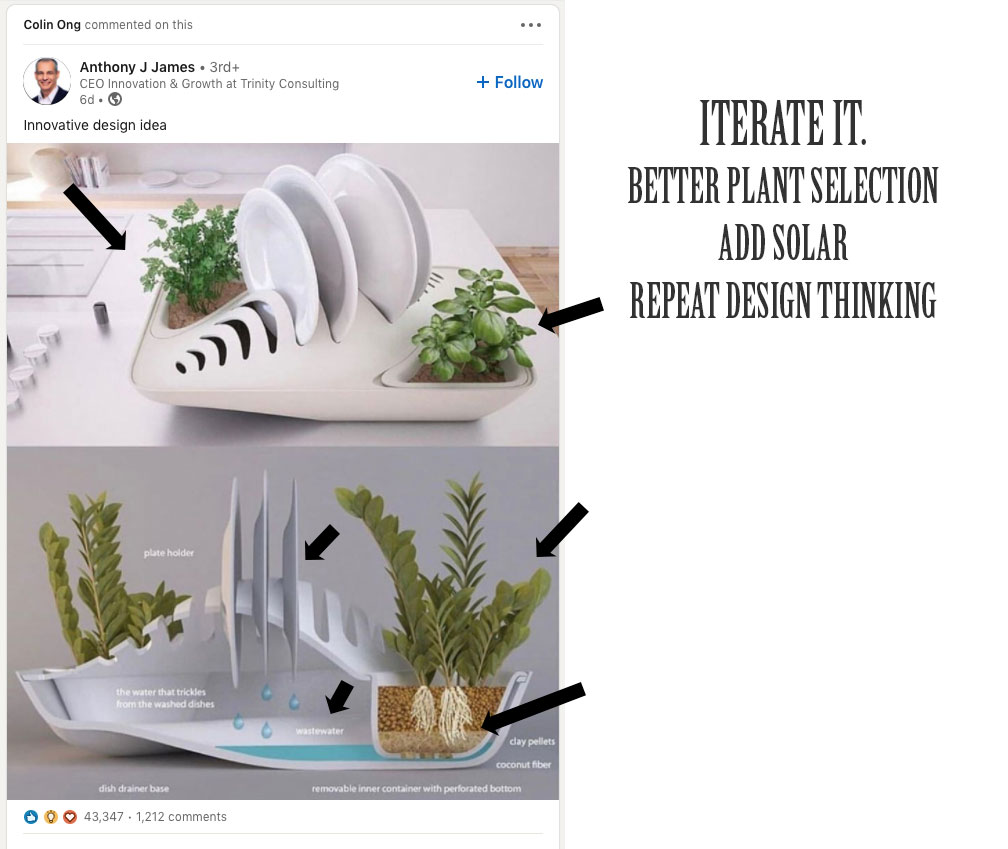
In my LinkedIn feed today, I noticed a post by Anthony J James commenting “Innovative design idea” about a dish drying rack with sections for small plants that would be watered by water that drips from the drying dishes. My reaction was “cool” idea and a wonderful idea using the convergence technique we use in the current YCISL ITW program.
But wait! There was more… There were negative comments aplenty. Many comments were based on lack of understanding and a resistance to the product idea being able to replace the traditional dish drying rack (fixed mindset, I would diagnose). Here are a few examples:
“What about the soap? Would that not be toxic to plants?” Careful how you use the word “toxic” because there are several beneficial plant applications for soap. You can also discard lightly soapy water into your garden (ever washed your deck or patio stone?) without harming the plants.
“Nice try, quite ingenious except lots of plants grow spores, mold, fungi, and insects larvae form their ecosystem and not ours.” Ummm…are you suggesting not having houseplants at all? Or would you like to have a 6 ft social distancing requirement from any plant?
“The person who designed it doesn’t wash dishes.” One of those responses that is most likely incorrect. Perhaps not the way you wash dishes.
“No herbs raised on detergent water will ever taste good or be good for your health.” Reminds me of the Mister Boffo phrase “Unclear on the concept.”
“It is likely that there will be trace of chemicals present in water, that might affect the plant?” Tip: The water you use has chemicals in it. Be it from water treatment, natural atmospheric dissolved gases, dissolved minerals from aquifers, etc.
There were many encouraging comments too. Mostly on the external form design which I agree is cool.
But what struck me is the lack of productive commentary. I don’t usually comment on LinkedIn, but since this product touches on so many personal and YCISL interests, I wrote:
“Iterate this idea. Forget hydroponics. Many houseplants (ie, indoor plants such as the ZZ shown) need humidity rather than constantly wet roots. The LECA balls would provide support and a porous way for humidity to rise to plant. Would suggest removeable bottom tray for periodic cleaning. Other applications would be micro greens or seed starting using seed starter mix where constant moist but not wet needs to be maintained, but would recommend pre-filter such as activated carbon.”
The idea is to collaborate, not object or discourage. Use your expertise, if you have it to share. Wonder out loud, if you like – but imagine the possibilities rather than close your mind. The surprising thing is the LinkedIn titles the negative commenters had; eg, Concept Designer, Team Builder, Entrepreneur, Consultant, and so on. Evident absence of growth mindset.
I would also further share that this product is called “Fluidity” and a full description can be found on the designlibero web site. First, note that the design is dated 2012. Then now also note this article dated November 23, 2020 “Scotts Miracle-Gro completes acquisition of company that makes home-grow kits” which reports how AeroGrow, the maker of the well-known AeroGarden, was acquired. The hydroponic countertop product was already finding a place in kitchens and other places around the home (let’s also remember the countertop composting worm bins!) where nature is succeeding over germaphobia. So I do feel there is a design genius within Fluidity. It just needs iteration based on constructive feedback and focus group testing.
If this was a YCISL DEZIGNBLÄST design project, we would be fully supportive and encourage iteration through further design thinking and divergent-convergent thinking. In the feature list exercise that we do, we would build Smart-app support, sustainability factors such as use of solar cells, and positivity in form and function. Then our students would craft a story to go along with this must-have product.
Just think…if this was made for college students living in a dorm. They would have just a few dishes, want late night snacks, and stress-relieving plants to look at and take care of. Find that early adopter to help you tell your story in a positive worldview.
PS. The other lesson is not to take criticism too harshly unless you have found reason to trust your critic. Do they have growth mindset and positive mindset skills (remember, it takes work)? Do they have emotional intelligence and an ability to brainstorm self-edit-free? Test their ability for active listening and mindful push/pull/centering.
WSJ: Standardized Tests, Ancient and Modern.
Back in 2018, I wrote a comment about a WSJ article titled “The Gatekeeper Tests.” Today, I read an article in my March 13, 2021 print copy WSJ titled “Standardized Tests, Ancient and Modern” (it is titled “The Ordeal of Standardized Testing” in the WSJ online edition; strange as this is reverse of the positivity in titling lesson that TED has followed) by Amanda Foreman.
The article tickles me a little because it tries to show a history of standardized testing systems – set in wholly negative circumstance. And it’s more of what is not mentioned as parallels in testing historically that bemuses me. Even today, the SAT (and ACT etc) are obviously more Big Business than Education in a present when superior alternatives are readily available. If the motivation (or better put, raison d’être) for standardized testing is actual academic ability and accomplishment, then the purpose works, and the autonomy and mastery elements join in too. This is consistent with the various historical settings described in the article.
It’s a tool. And if used correctly and applied correctly, can be quite valuable. And like most tools, they need periodic improvements and refinements. And if I use the YCISL idea of precision vs accuracy-based education, standardized testing could use the same paradigm shift.
Think about all the forms of testing that exist today. Would anyone think their test would improve if they followed the SAT model? From tech QA to chemical analysis to sports performance to transportation to whatever else…, the SAT model is the one you need to face away from.
Thought: How many chucks can a woodchuck chuck?
Actually the question that came across my mind is “How many students in a class can a teacher teach?” This follows on my earlier idea of precision education versus accuracy education. This also connects the idea of preparing for classroom teaching with emotional intelligence and design thinking.
Let’s make this an estimation exercise.
If we define “students being taught” as those who get a C grade or better, then perhaps we could estimate that 3/5 of a class is taught successfully (Salman Khan might twitch at this point since this would mean there are a whole lot of gaps).
When I teach a Stanford class, I have a cut-off where a B or A grade means the student should be allowed to exercise that knowledge professionally. So that might be 2/5 of a class (no, not really as you have to try really hard to get a C, D or F from me).
How about we consider only the students who have negligible demonstrated gaps? Let’s say those scoring 98% or above on tests? In my experience (and depending on several circumstantial factors), that’s around 10/100 of a class. Or how about those who get an A+ for the class? That’s anywhere between zero and 5/100 depending on the instructor’s mood.
And if we want to look beyond the tests? How many students who complete a course could actually engage in an intellectual conversation involving the subject just after the end of the course? How about the same conversation a week, a month or a year later? Of course, the answer is “depends” but if we were to keep this to estimation, the range would be none to a few.
The idea I would like to share is about judging students for their expandability as much as expansion. A teacher’s mission should be to cultivate a wholesome love for learning and propensity for connecting one thought to another. And they should be praised for being able to accomplish these. This is a low-cost/big impact idea that falls in the “Chief Detail Officer” and “Perspectives” action items imparted to us by Rory Sutherland in his TEDTalks. As Sir Ken Robinson told us in his epic “Do Schools Kill Creativity?” – “…it’s put us in a place where we have no idea what’s going to happen in terms of the future. No idea how this may play out.”
Maybe it’s time to give teachers quizzes, homework and exams so that they can review what they have learned from their class each day…and identify the gaps.
Ideas: YCISL & the IB Extended Essay
I received my IB Diploma in 1981. The Extended Essay was one of the highlights of the program, and it still remains a fixture for IB students around the world. My Extended Essay on crystal growth is connected with my geochemistry interest as well as research into evaporite minerals. The folder containing a crystal sample from experiments attached is still with me today.
And so I would like to connect my YCISL program to the IB program, especially the Extended Essay – and even ToK and CAS. Here, I am going to lay out 5 process tips for the IB Extended Essay so that it embraces creativity, curiosity and impact.
Planning. Make a plan. Start with a napkin plan. Then expand it to a 1-page summary of what you want to do and accomplish. Capture your inspiration and vision here. Include goals and tasks if space allows. Remember, just one page for your initial plan. Subsequent plans can get longer (just a little).
Design Thinking. Another human being (or two) is going to read your Extended Essay. So use the human-centered mindset of design thinking to connect yourself with your reader via your extended essay. Focus positive attention on shared perspectives, engagement and benefit. Show and apply intrinsic motivation to promise empowerment.
Connect-the-Dots. “Again, you can’t connect the dots looking forward; you can only connect them looking backward. So you have to trust that the dots will somehow connect in your future. You have to trust in something — your gut, destiny, life, karma, whatever. This approach has never let me down, and it has made all the difference in my life.” – Steve Jobs, Stanford Commencement Speech 2005. Show how all the work you did for your Extended Essay is connected. Also connect it to your other experiences and web of knowledge.
Storytelling. There are many ways to tell a story. You just have to choose one. You are the author of your Extended Essay, plus you are the producer and director of this story that the reader will want to visualize. Focus interest on the main character, but also provide details in terms of other characters, objects, thoughts and actions that reveal the full story.
Feature Set. Your Extended Essay will have many features, You will also consider many features that your Extended Essay could have, and trim away excess (at least you SHOULD trim away excess). Think of features that at least half the other extended essays would not have. Then select just three of the features for you to distinctively highlight in your Extended Essay. Put them in the foreground in front of everything else. Put a spotlight on them. Make them shine. And the analogies go on and on. Your goal is to have the reader remember and be impressed by one or more of these distinctive features. This would help your work stand out in a crowd of Extended Essays on the same or a similar topic.
Idea: The Résumé and the Art of Storytelling Your Personal Story
Over the years, the Emotional Intelligence topic in YCISL workshops has developed into a 3-part exercise feature called Your Personal Story. Inspired by Satoru Iwata’s 2005 GDC Keynote speech opening, we have also had add-ons involving creative business cards and LinkedIn profiles. In 2021, we plan to roll out a résumé-focused activity where the student builds a résumé entry that reflects their YCISL workshop gains.
The résumé is a weak part of most people’s personal story. Areas of weakness may be in the substance, style or flow. While many résumés are scanned by computing systems looking for keywords, the best opportunities are usually from person-to-person contact. And at the interview stage, that narrative in the résumé is going to come back into play. This is where feedback loops are an essential part of résumé preparation – and these feedback loops vary widely in quality. I heard recently that some school counselors do not recommend their students to get feedback from anyone but them. Job security. I understand. Students who hire private counselors may feel that their résumé could not get any better since their résumé was written by a professional. Do you see what’s wrong with this picture? Parents: encourage your child to maintain a résumé. Help them make a start and keep it updated. If your child is already in high school and has not yet started a résumé, do it now.
Our prototype for workshop résumé entry crafting will involve having the students submit a résumé before the workshop start, and use an entry-building template at the workshop end to attain the entry. The template would be in a quick-start style and students would tailor the intermediate to fit-to-suit the original résumé.
Our purpose of adding this activity to YCISL workshops is to remind students of the real value they are gaining from their workshop experience. It will be an outcome to remember.
Thought: Are Jigsaw Puzzles Good for Training Divergent-Convergent Thinking and Creativity?

One of my newest obsessive hobbies is now jigsaw puzzles. After completing about 10 puzzles in the past 3 months, I have begun to wonder whether jigsaw puzzles build creativity and are a good example of an activity that uses divergent-convergent thinking. Could a jigsaw puzzle exercise be designed for YCISL workshops just like how we have a Lego activity to demonstrate rapid team prototyping?
Putting together jigsaw puzzles involves creative energy because there are many solution paths and solution strategies. Also, there are multiple and switchable directions: finding a piece that fits a hole or edge(s), or finding a hole or edge that fits the piece you have picked up. There are trial-and-error methods as well as visualization methods that involve rapid eye movement. There is not only shape matching. One could involve color matching as hints. So even though the end result should be the same assembled puzzle (assuming you finish the puzzle), there is a creative element because of the variations that are essentially guaranteed; even if I were to solve the puzzle twice, it is improbable that the exact same solution path would be repeated – and think of the probability that the same time-based profile would be repeated.
Let us also consider how jigsaw puzzles would make a good model for training divergent-convergent thinking. Usually, the jigsaw puzzle pieces have some sort of distinguishable pattern based on the number and directionality of the tabs and slots. These are sortable features and are part of my strategy. So given a particular hole or edge waiting to be connected with a piece, there are certain piece patterns that could be fit and other patterns that could be deductively reasoned not to be a fit candidate. So we can select several candidates to fit a position – this would be the divergent thinking step. We could choose two or more candidates for a hole using the criteria of the moment. We would start our convergent step by selecting a candidate piece and trying to attach it. If there is a perfect fit, great! (but sometimes it is a fake fit), and if that piece was not the right fit, then we would go back to the pool of candidates or create a new pool of candidates (if we learned something from that non-fit attempt where we figured the pool was not going to work). The big bonus of using jigsaw puzzles to model divergent-convergent thinking is the fast thinking cycle aspect because the divergent-convergent thinking steps are usually repeated in clusters. These clusters could be sized by varying the time periods spent on finding matches.
With the creativity and divergent-convergent aspects confirmed, what fun ways might there be to make this worthy of a workshop workout? The first round might involve individual efforts establishing the time periods of sustainable puzzle solving (ie, how long before you need to take a break and rest the mind and eyes?) The next level might be a team effort to reflect interpersonal communication and group dynamics skills. A trick version might be to include a piece that doesn’t actually belong.
The jigsaw puzzle lessons would be compared to real world problems where the pieces may or may not be at our disposal, and we have to practice divergent-convergent thinking with an understanding that the final product may be quite different from what we expected at the start.
Fun. Can’t wait to try it. Now if only I can figure out a version of this that would work over Zoom.
NYT: Nine Nonobvious Ways to Have Deeper Conversations
I came across this article through LinkedIn today. The article lists various ways to re-engage with each other especially during this time of un-shakeable stress. “Nine Nonobvious Ways to Have Deeper Conversations” is an Opinion article by David Brooks dated November 29, 2020 on nytimes.com.
The author’s suggestions make sense to me and I will undoubtedly be spending some time thinking how to turn these into YCISL workshop actions. But because I am currently engaged in a series of Popcorn with Colin discussions on creativity, in particular a tribute to Sir Ken Robinson’s epic TEDTalk “Do Schools Kill Creativity?” (originally titled “Schools Kill Creativity.”), I will dwell on the suggestion to “Ask Open-Ended Questions” and the timeliness of this for the online learning pivot.
This idea fits into the Divergent-Convergent Thinking and Asking Questions component of the YCISL Innovators Toolkit series. Open-ended questions (or problems which are inviting of innovative solutions) have the potential to stimulate and strengthen creativity. So the task is not to simply ask an open-ended question, but to frame a worldview that accommodates various perspectives and past experiences. We need to use design thinking in creating open-ended questions.
I haven’t had much practice at this, but let’s give it a few application attempts.
Here is a Physics homework problem I found on the web:
Gravitational Potential Energy GPE = mg∆h
12. A 5.0 kg mass is initially sitting on the floor when it is lifted onto a table 1.15 meters high at
a constant speed.
a. How much work will be done in lifting this mass onto the table?
b. What will be the gravitational potential energy of this mass, relative to the floor, once it is
placed on the table?
c. What was the initial gravitational potential energy, relative to the floor, of this mass while
sitting on the floor?
What if we changed this question to “Place a dumb bell (or other object) on the floor. Lift it onto a table at a constant speed. Use a scale and/or tape measure, if desired. It’s ok to estimate.”? Would this be too challenging? Could this be a more fun application-type question that helps the student use visualization as well as experimentation skills? Not all the questions would have to re-framed this way. But it does give a more first-person real world feel about how science applies to things we do on a daily basis.
—
And here is a Chemistry homework problem I found on the web:
Coffee cooling
A mug of coffee cools from 100 ℃ to room temperature, 20 ℃. The mass of the coffee is
m = 0.25 kg and its specific heat capacity may be assumed to be equal to that of water,
c = 4190 J. kg-1. K-1.
Calculate the change in entropy
(i) of the coffee
(ii) of the surroundings
What if we changed this question to “Your morning mug of coffee/tea/water cools to room temperature. Use a scale and/or thermometer, if available. Otherwise estimate.”? Hopefully, everyone has been aware at some point that a hot beverage gives off warmth and gradually cools. There is also the intrinsic motivation factor (that we are fond of in YCISL) where we involve mastery, autonomy and purpose (added through the use of another Innovator Toolkit skill: Filling & Crossing Gaps).
—
As another example, I require online seminar logs for a seminar course at Stanford. This is for proof of attendance. But instead of asking for a summary of the seminar presentation, the question is “Describe in 2-3 sentences how this talk connects with or relates to your interests, or your MS studies.” In general, most responses will be quite different reflecting perspectives and background. This makes it more interesting and informative for me. Note though that some students find this open-ended question challenging and defer to the seminar abstract as a basis for their thoughts – as opposed to internal stimulation and connections.
—
Re-reading the examples above, there is probably more fine-tuning possible to engage each other better. An example is to use the Positivity Innovator Toolkit skill and “garnish” the problems with emotionally positive words and uplifting expressions. “Your delicious morning mug of…”
A good topic for future discussion.
WSJ: Universities Abandon Reason for a False Idea of ‘Empowerment’
This is a commentary on “Universities Abandon Reason for a False Idea of ‘Empowerment’” by Aaron Alexander Zubla which appears as an opinion article in the Saturday/Sunday, August 15-16, 2020 print edition of the WSJ.
I empathize with the thought that the new requirement is inappropriate…albeit perhaps with a different worldview.
Looking at the CSU Press Release CSU Press Release “CSU Trustees Approve Ethnic Studies and Social Justice General Education Requirement” and California Assembly Bill No. 1460 which addresses this ethnic studies GE requirement at CSU, this appears to be a case of lipstick on a pig. The stated case for academic (scholarly) and social benefit is overly optimistic…it could have the opposite effect too. Why isn’t there instead a special task force that addresses the issue at all levels of society (and globally in-between)?
Let’s return to the WSJ article…
To answer my own question about why place this un-promising requirement in a university setting, it seems to be motivated by image-based appeasement. The WSJ article describes this as “another sign of the politicization of universities” and laments that “For decades the humanities have tilted progressive.” While this matches the motions in my worldview, my perceptions of the direction are slightly different and tend towards a comedy of errors as opposed to an evil plot.
CSU could have simply offered courses in the history or political science departments to add courses which relate to sociological race issues. GE already includes these courses. The idea that a dedicated 3-unit course will benefit student scholarship is like a car salesman’s sell (they try to go over every single feature hoping that one will click – instead of listening and responding in a precise manner). And even if 10% of any class cohort retains, how have they been empowered? Knowledge without EQ is not empowerment.
How else is my worldview different? I think the scope is not sufficiently global. What if the requirement included international relations and global studies courses? What if it went beyond social justice and the direction of political winds? The challenge is not so much to become aware of the strife, but more so one of looking for positive lessons. I predict that these courses will be negatively-toned which is the switch-flipper to off for most people…especially those already with many distractions. Which makes me think…should this also include courses from the psychology department.
One last comment on the idea in the article that non-humanities subject areas (eg, medicine, accountancy and engineering) are set in supported applicable fact alone (the author uses the word “truth”). Not so. Social justice has entered these programs as well. However, they may be better models than what is being instituted by CSU where students can apply critical thinking as to whether these social issues are important. There may be no choice but to align in a GE course. Even so, how many will have learned anything?
Concept: Education Accuracy vs Education Precision
Modern education intentionally tries to distribute learning achievement by limiting the attempts at understanding. This is based on the classical requirement of memorization in the early age of scholarly thought and written recordings. As you know, thinking and speaking outpaces writing (and typing even) so memorization and recall among scribes was a priority. This bias towards memorization talent in education creates knowledge gaps upon which academic differentiation is made.
The limited form of education targets and seeks to identify a very particular type of student, especially one good at memorization. Educators are equipped with skills and materials solely towards this bias and incentivized to stay within the bounds of this program. With this perspective, we could think of today’s education as having a precision design that provides a positive outcome for a minor fraction of the student population.
An equitable educational system re-design would provide positive outcomes for practically the entire student population and embrace education accuracy as the vision. This would require identification of learning strengths and preferences of each student, and guidance to a curriculum and educator that would allow academic success. Here are several ways that education accuracy could be implemented:
- Allow for multiple chances to memorize without penalty, and encourage accretive learning. This would provide a path to subject mastery as opposed to having knowledge gaps set in.
- Design assessments based on how a student is best able to reflect their subject mastery. Provide coaching on learning strategies for the various assessment types.
- Learning schedules, pace of learning, and size of learning segments (eg, attention spans) should be tuned to the student. Presently, education is scheduled for the parents’ convenience, and segmented without consideration for the student.
- Group students for symbiotic learning such that they would elevate each other’s progress. A teacher should be able to teach at a level that suits all the students in a class.
- Get performance feedback from students and promote their learning autonomy through involvement in academic decisions and problem-solving. Provide activities that elevate awareness and intrinsic motivation.
I imagine teachers would welcome a shift to education accuracy. Their personal motivation as well as relationships with students would be healthier and stronger. And I am also certain that teachers have many of their own ideas how they could re-design their lessons and teaching styles for accuracy.
The YCISL is seeking to kickstart this hyperleap to education accuracy by developing a series of EQ-assessments for application to each teacher-students grouping. It would involve three stages: pre-instruction, mid-instruction, and post-instruction. The pre-instruction assessment would prepare teachers and students for the partnership they are about to experience. The mid-instruction assessment (or two) would check for progress and allow for corrective action, if necessary. And the post-instruction assessment would evaluate the effectiveness of the EQ-based approach to learning, and perhaps be reported as part of student performance profile as they advance in their education.
