Category: Ideas
If I had nothing. Starting Over: A Reflection
Idea is to reflect on what you would be focused on if you were starting over and afresh. Many people in the developed and developing world lead cluttered lives and emotional luggage. Our attention is divided and we spend much of our mental energy sorting useful information from garbage.
Can we come up with an exercise to reflect on our priorities and imagine what it would be like to have nothing so that everything is a potential goal?
Salman Khan: Let’s teach for mastery — not test scores (TEDTalk)
Back in 2011 at an Education Roundtable at Stanford, Salman Khan (as a roundtable participant) left me with one enlightening understanding and it was about the pursuit of a “productive and happy life” in order to feel a satisfying sense of fulfillment. Education in the US (generalized), demonstrating low EQ, apparently does not understand this and continues to structure itself based on imminent failure and impossible fulfillment. This is what I found to be the premise of Salman Khan’s latest TEDTalk “Let’s Teach for Mastery – Not Test Scores” from November 2015.
Let’s also connect the mastery mentioned here with the mastery mentioned by Daniel Pink in his 2009 Ted Talk “The Puzzle of Motivation” and his book “Drive.” Mastery is one of the keys to intrinsic motivation which in turn is an essential element to building a love of lifelong learning – this ultimately is the purposeful beauty (albeit forgotten) of education.
“…then I start to disengage.” Under the lecture-homework-lecture-homework-quiz-test model (traditional US secondary education model), there is no opportunity to engage. So the problem is that there probably wasn’t any engagement to begin with (student-subject and student-teacher both) and that this lack of engagement is only apparent after an assessment. Even more pitiful is that the knowledge of a lack of engagement does not create any action item. There is ample opportunity to have a more professional approach to engagement, but it’s not done. For example, teachers should allocate time to checking engagement levels of individual students (akin to checking your blood pressure periodically to track health) so that action items can be prescribed and followed. Should we treat teachers as “educational physicians” – the ones on whom we rely on for our educational health?
“…it would reinforce the right mindset muscles.” Yes, ideally positive and growth mindsets along with creative and critical thinking would be nurtured, but the Target (tar-jay) model of US secondary education provides no aisle space to it (the IB model on the other hand does the mindset training well). One usually only starts to see this in graduate school where professors are somewhat focused on their research teams and identifying future prospects from their crop of lecture students. Below graduate school, the existing opportunities are in sports and other extracurricular activities. This is why the YCISL program treats leadership development as a self-driven choice.
“If you were allowed to be operating in a mastery framework…” I would have liked to have seen more visualization about the “mastery framework” being proposed. What is the “process” in mind and what are the specific changes (action item deltas) from the current process? Is the mastery for students as well as educators? What is the “ask” and what is the “promise”? I believe the greater ideal is to build intrinsic motivation, not only mastery, through education.
Following the YCISL leadership model, the mastery objective in high school (“Proof”) is different than in undergraduate college (“Integration”) which is different as you move higher. If you think of a Gamestorming framework, we need rules for “mastery” in education then be allowed to play and ultimately have a conclusion. What’s most absent now is the “play” sector where students can explore, experiment and change. But just as critical is to re-write the opening rules and re-define how the game ends. And we certainly should not be expected to close all the gaps.
Mel Robbins: How to stop screwing yourself over (TEDxSF Talk)
This is a two-part entry for two lessons I learned from the Mel Robbins TEDxSF talk “How to stop screwing yourself over” (you can find it on YouTube).
SIMPLE, BUT NOT EASY
In the Summer 2016 YCISL workshops, I added the message “Simple, but not easy” [SBNE, for short] which I derived from this talk. Robbins’ full message is that “Getting what you want… is SIMPLE (but not easy)” meaning the process to reach a goal usually consists of a few steps but there is a caveat that getting there takes energy, focus, persistence, etc.
In the YCISL workshop, I talk about my desire to lose weight and body fat – to do it, there are only two main steps: eat less and exercise more. But is it easy? Nooooooo!
The same thinking can be applied to the YCISL skills such as creativity, fast-thinking, emotional intelligence, intrinsic motivation, etc. Building up these skills is simple…practice, practice, practice…and you will become more creative, more innovative and a better leader. But I cannot promise that it’s easy.
And it can also be applied to our academic, work and social lives. For example: (i) to be a successful student, study hard and get good grades, (ii) to be successful at work, do good work and be rewarded, and (iii) to be socially active, get out more and make lots of friends.
This is a perfect example of how leadership usually works: here is point A and there is point B. Call me when you get there. [Think of Rory Sutherland’s strategic myth of management and tactical advantage in his TED Talk “Sweat the small stuff”]. However, if I place this in a positive frame, you can think of SBNE as the competitive advantage that we coach in the YCISL elevator pitch, PostIt Brainstorming and Rapid Prototyping exercises. Ideas, solutions and products that are simple may be worth pursuing because many others will find it too difficult to realize.
5-SECOND RULE
In the YCISL workshops, we coach fast-thinking as an essential self-trained skill. The YCISL Photo Essay assignment is an example of a “5-second rule” method…take a photo and capture the emotional thoughts as soon as possible. Most of our YCISL exercises that build fast-thinking involve decisions and actions that take on the order of seconds or even milliseconds.
Universal Design for Learning (UDL)
In a discussion about a prospective workshop for middle school students, I learned about UDL (Universal Design for Learning) and the implementation at a school in New Hampshire. In a web search, I found the National Center on Universal Design for Learning web site. This approach asks some interesting questions with regards to providing education for a broad range of learners.
In the framework, UDL is represented by:
Recognition Networks: The “what” of learning
Strategic Networks: The “how” of learning
Affective Networks: The “why” of learning
Each one relates to a broad approach including:
Representation – related to delivery
Action & Expression – related to organization and timing
Engagement – related to motivation and mindset
Overall, there is a lot to like about these educational concepts and they do allow an appreciation of how poor US education generally is presently. This relates to the problems highlighted in “Race to Nowhere” and the decay particularly in pre-university education.
Exercise: Turning the Donkey
Many of the activities in the YCISL program are derived from existing games – and we connect our topics to them. An example is the Spaghetti Tower-Marshmallow exercise where we demonstrate prototyping and “fail early, fail fast” as well as collaborative teamwork.
Today, I was searching the internet for a puzzle and came across a web site with a collection of matchstick puzzles (http://www.learning-tree.org.uk/stickpuzzles/stick_puzzles.htm). I was looking for something that would require divergent thinking. I didn’t have matchsticks, so I tried the puzzle with some pens. I confess I am bad at these types of puzzles and in the end, snuck a peek at the posted solution. But more importantly, I found that doing such a puzzle connects many of the topics we touch on in the YCISL workshops.
So I created a “Lessons” document which describes the puzzle and asks questions to reflect on. I have posted a link to this document in our LinkedIn Group Discussion and will likely incorporate it or something similar into the workshops.
LESSONS IN YOUTH CREATIVITY, INNOVATION & SUSTAINABLE LEADERSHIP
TURNING THE DONKEY
Found on http://www.learning-tree.org.uk/stickpuzzles/stick_puzzles.htm
 Move 1 pen to turn the donkey.
EQ CHECKLIST:
- Did you see the solution on your first pass? WOW! – if you did.
- Did you sense creative energy well up in you?
- Did you feel (instrinsic) motivation?
- Did you experience divergent fast thinking (iterating over many possible solutions)?
- Did you apply logical deductive reasoning (eliminating non-solutions)?
- Did you experience optimism?
- Did you notice frustration or self-doubt?
- Did you think about giving up?
- Did you second guess what the problem was asking?
- Do you think you accomplished something?
WSJ: Feeling Stuck? Write Yourself a New Job Description
In the Personal Journal section of the Wednesday August 12, 2015 issue of the WSJ, Sue Shellenbarger wrote the article “Feeling Stuck? Write Yourself a New Job Description” which touches on a “sense of meaning and purpose” – thus connecting to this year’s YCISL workshop theme of Purpose. The article also mentions “intrinsic motivation” as a “hiring draw” for employers. This fits in well with what I have learned from Daniel Pink’s description about intrinsic motivation. The article also contains other YCISL keywords such as “coaching” and “fulfilling.”
The takeaway lesson from this article for YCISL is about the process of redesigning what we do – and to put this in the youth context. In the workplace, adults can discuss changes with supervisors – but the opportunities to do this are likely quite spread apart (e.g. at annual performance reviews) and need a good elevator pitch behind it (and a supervisor with the requisite understanding and influence). Focusing on youth though, we can develop YCISL exercises to practice the work redesign process – as training as well as in school or at home. What if our students could discuss a personal redesign with their parents, bringing up things that they really want to do and managing tasks that are less fulfilling? What if school counsellors actually took personal interest in students and discussed changes needed to heighten sense of meaning and purpose in school? What if schools tapped on intrinsic motivation to make education more intrinsically motivating?
For the YCISL workshops, we could add this as a topic (or a feature) to the elevator pitch exercise and have our students show emotional leadership to the idea they pitch.
Feature List Exercise: Water Bottles
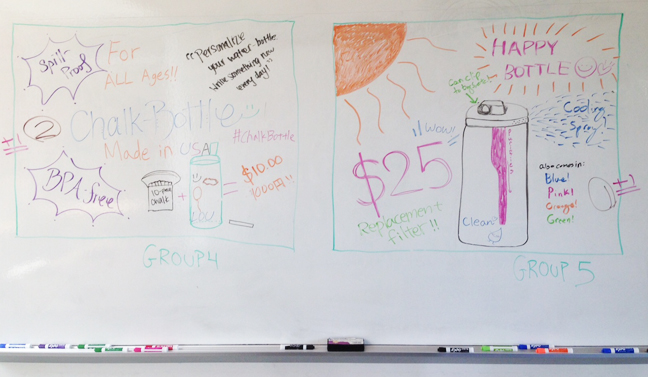
In the YCISL workshops, you worked on a project and made a rollout presentation. Sometimes, I have asked students to focus on just the top three most compelling features of the project and emphasize just those three features in the presentation. We have now designed an exercise just to demonstrate the process of brainstorming and selecting these primary features. We start with a group of water bottles, each with different features. Then teams get to examine each water bottle and create a list of all the features they notice. They then are asked to design their own water bottle. They start by selecting three features from the list they created (or they can choose features that they already know about but are not listed). Next, they have to come up with a special/crazy/extraordinary feature which would potentially differentiate their bottle (remember Competitive Advantage?) After that, they select a sustainability feature. The fun really begins as they create an advertisement on the whiteboard for their water bottle; and only three features can be listed (so two will get tossed in the end) – this requires a few prototyping iterations. An outsider gives feedback and modification can be made to the ad. Finally, everyone votes on the water bottle they would want. This is proving to be a good lesson in focusing on the feature list to promote a compelling creative idea. Try this yourself. You can do it as an exercise for yourself or with others. In the end, think about how your “personal” features stand out when you introduce yourself to others. It’s a very similar process.
[This entry was originally posted on the YCISL LinkedIn Group Discussion board]
What Makes You Happy? Keeping Your Personal List.
On of the KDramas I am watching presently is Hotelier (호텔리어). Towards the end of episode 4, Frank asks Leo “What does happiness mean to you?” Leo’s ‘serious’ reply includes “Good pay, good food, good social status.” Frank is reflective about his pursuit of happiness. [I am noticing “happy” and “happiness” spoken many times in this series]
This question may be of value in the YCISL journal. So we’ll have students title a page with this question, and initially have them create a list of things they think make them happy. They should also keep another list of things which do make them happy (as they experience it). This may be a useful reference in positive thinking as well as thinking of the future and the pursuit of happiness in the personal story.
I searched on the phrase “What makes people happy” in Google and the top-most results generally refer to studies pointing to research conducted in the US and findings that social connectedness is most vital to happiness. More interesting to me was the result pointing to the article “How our view of what makes us happy has changed in 80 years” published by the British Psychological Society in which a happiness index is updated. Given our age of informatics, it may be more valuable to have a multidimensional index that crosses age as well as cultural or even social status lines. For YCISL, we could compile data based on our group profiles, but more impactful maybe to design a method to design, fill and update our own personal happiness index. Above, I mention a simple entry list into the journal, but what if we could create an app to maintain ones personal happiness list and provide valuations so that the list is indexed? How cool would that be?
A Model for a Well-Being YCISL Workshop
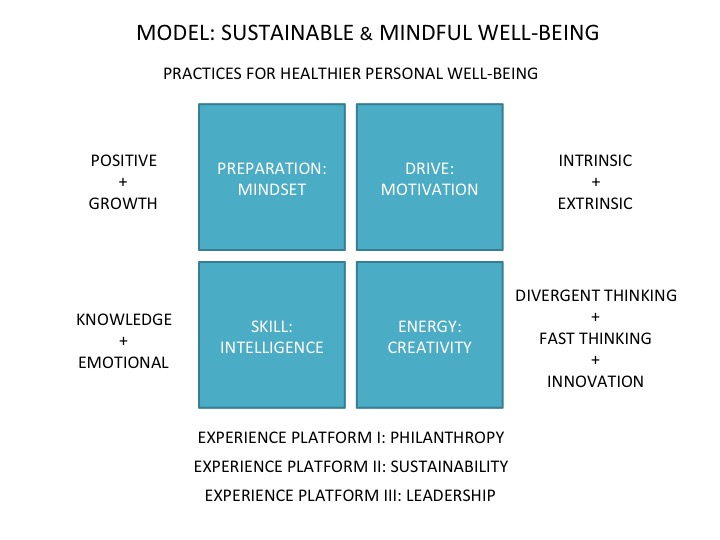
I recently had discussions with two parties interested in the YCISL program. One was with a group of high school administrators/teachers concerned with student wellness and well-being; this ties in with the mindful aspect presented in YCISL workshops by Stephen Murphy-Shigematsu. The other discussion was with the President of a Teen Volunteer organization who offers philanthropic activities for youth; I have had previous communications on philanthropic lessons through YCISL. As an exercise, I have “prototyped” a model for a prospective well-being workshop and it adds philanthropy as an additional layer to the underlying platform of the workshops. This model selects four main emphasis areas, each of which uses a pair or triplet of sub-topics to demonstrate the emphasis area. Each sub-topic is a skill element and demonstrable by a workshop activity, exercise or discussion. The emphasis areas are intended for reflection and performance evaluation. Put together, this model should promote development of “Your Personal Story.”
Mentor Exercise: Map Our Workshop
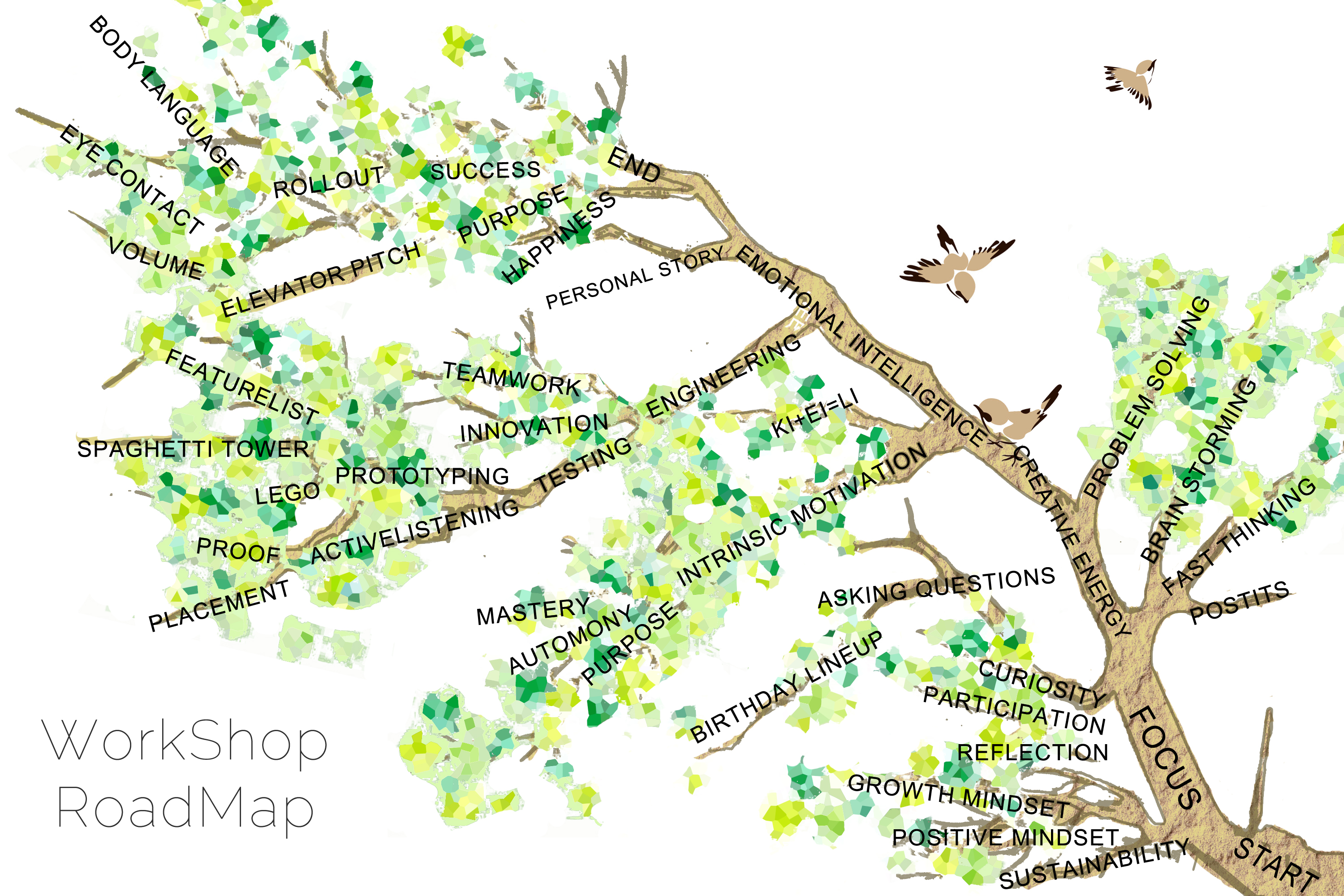
The main idea is to graphically list all the topics (life lessons, messages, activities, etc) into a map and perhaps show connections to our themes. Mentor Sophie designed the following based on the Wasedajuku March 2015 YCISL Workshop.