
Category: Thoughts
WSJ: For Top Students, Rejections Pile Up
Each year, a few students ask me for a letter of recommendation for their college applications. This commentary is for their benefit.
The article “For Top Students. Rejections Pile Up” by Douglas Belkin in the April 22, 2022 WSJ (Print edition) really misunderstands the purpose of the college admissions process. Note that the Digital edition of this article is “To Get Into the Ivy League, ‘Extraordinary’ Isn’t Always Enough These Days” which really demonstrates how the misunderstanding probably won’t get corrected. While I am not involved in undergraduate admissions at Stanford University, I have been Freshman Advisor to several students, had a few undergraduate assistants, and had some undergraduates enroll in my courses.
First, note the second paragraph in the article which attempts to establish a reference point for the rest of the article…
“She took her first advanced-placement course as a freshman, scored 1550 on her SATs as a junior at McKinney High School near Dallas and will graduate this spring with an unweighted 3.95 grade-point average and as the founder of the school’s accounting club. Along the way she performed in and directed about 30 plays, sang in the school choir, scored top marks on the tests she has so far taken for 11 advanced-placement classes, helped run a summer camp and held down a part-time job.”
For what is said in this paragraph, the profile is not extraordinary. But especially absent is mention of academic achievement of valedictorian or salutatorian honors. At best, her extracurricular activities put her in a 1-in-1000 group, but for Stanford a 1-in-25 is more appropriate.
Later in the article: “Harvard has said it believes enrolling a diverse student body is important”…Stanford has the same diversity aim as well…but diversity can be widely interpreted among an admitted cohort and any same-ness with other applicants will at least give an applicant a chance. None-ness though such as generic qualities or lack of features can be a dealbreaker. And it’s a trap many applicants get caught in.
In the YCISL ITW skillset, there is Positivity. And in the WSJ article: “Ms. Younger wrote in the applications about her history of depression and anxiety to explain the two B’s she earned during her sophomore year.” Unless this is connected to a success story of overcoming the challenges or motivational change, this is actually a red flag in any application. In the Stanford application where there is the Letter to Your Roommate part, is revealing depression and anxiety a good idea? Also, be sure admission staff are looking carefully for those who would succumb to the “Stanford Duck Syndrome” which relates to the probability of academic success.
When I am in group discussions about college admissions – applications & outcomes – I say that most admission offers are based on an experienced belief that there is a good match and reasonable chance for academic success. Near the end of the article: “She plans on attending Arizona State University to study business on an academic scholarship. The acceptance rate there last year was 88%.” Chances are ASU is the best match and a happy result. Assuming she had made her best effort in the application (and the recommenders have checked the box that this applicant is in the top 1% of students they have ever known), she had simply applied to too many reach schools.
Here are three recommendations for any YCISL student in the process of college admissions:
- Apply Creativity. Make it a pleasure for someone to review your application & read your essays. Would they learn something new & useful? Give your application a chance to be remembered.
- Apply Design Thinking. Make an emotional connection by framing a story & practice EQ: show self-awareness & self-management, and use social awareness & social management to include the reader in the story. There may be a close connection in interests, but even a distant interest connection would be better than no connection at all. Use the Who? What? Where? When? Why? & How? Asking Questions method of YCISL Design Thinking to provide vivid details.
- Apply Design Build. How can a particular college help you grow, adjust & change? How will the college phase of life influence & support you? College may seem like a black box, but it really isn’t. Quality input, quality output. It’s that simple. Recall the elements of our Elevator Pitch & Water Bottle Feature List exercises.
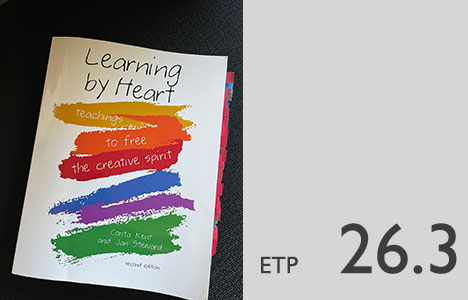
BOOK: “Learning by Heart” by Corita Kent and Jan Steward, Second Edition
I was sparked to learn more about Corita Kent from a section of Austin Kleon’s book “Keep Going.” I watched a bunch of YouTube videos (eg, Art + Life Rules from a Nun) and wandered through the Corita Art Center website. Already fascinated by the art, mindset & story, I ordered the book “Learning by Heart” from Amazon.com. I learned a lot from this book & have some notes to share here especially in the YCISL context.
- “Looking is the beginning of seeing.” p.33. This is meaningful to me because I often go from one place to another without being aware or appreciative. I often think back a minute or two, and wonder where I had just been. More of a blank than a blur. I think this is a good reason to have photo essay & video assignments in the YCISL program: taking a blur and trying to sharpen the important parts. Even in a more focused design thinking state of mind, this expression helps remind us to practice divergent thinking (look) & convergent thinking (see): we can look through Corita Kent’s Finder to quickly find a variety of framed content, stories & perspectives, then choose one to evaluate for a closer look (our prototyping phase).
- “The concepts of limitation, structure, and boundary are sometimes looked on as inhibitors of our creative energy.” p. 82. I am particular excited to see the phrase “creative energy” because that is one of the concepts that YCISL started with. This also connects with our use of Gamestorming where we have the Open phase which is made up things like “limitation, structure, and boundary.” Creative energy really comes into play mainly in the Explore phase. Still, remember that creative energy can be applied in the Open and Close phases if we choose: we can be creative about setting the rules (eg, our YCISL ping pong exercise) & reaching closure (eg, our YCISL launch presentations).
- “Every child is creative – until the time when teachers, parents and other adults in her world begin to patiently explain the way things should be, what connections can or can’t be made.” p. 104. This reminds me of Sir Ken Robinson’s TEDTalk “Schools Kill Creativity” and the idea that creativity is suppressed starting early in life. I like the graphical image of creativity conjured by the word “connections” where our creativity process really is about making connections – demonstrated by our YCISL Fast Thinking exercises especially the Associative Architecture “What do cows drink?” question.
- “PLORK…we need a third word – one which combines the two concepts and allows us to recognize them together as one responsible act necessary for human advancement.” p. 159. In the YCISL program, the words “fun” and “party” are introduced in at the start of the workshops with the intention of setting the senses & mindsets to a dynamic mode. The combination of play & work also reminds me of Tim Brown’s “Tales of Creativity & Play” where he says “And if you’re starting a design firm, let’s say, then you probably also want to create a place where people have the same kind of security. Where they have the same kind of security to take risks. Maybe have the same kind of security to play.”
- Immaculate Heart College Art Department Rules. p. 176. Also known as the 10 Rules Poster. I am surprised by the absence of an explanation of these rules in the book. I imagine these reflected the mindset expectations in that college setting. Still, we can gain wisdom by connecting these rules to our own settings. In particular, note the rule “The only rule is work” in large type, serif type and bold type for obvious emphasis. This attaches to many ideas quoted in YCISL that it takes work, often “hard” work, to be creatively productive.

Reflection: NIFTI Roundtable 2021 “Sustainability in Education”
“Envision an education where sustainability is a core academic subject. Imagine students empowered by global sustainability actions. The NIFTI Roundtable 2021 will bring together education stakeholders to brainstorm and shape a platform of curricula, courses and experiential learning programs to re-define how we learn about sustainability.”
The first NIFTI program (August 14 – October 2, 2020) was a seminar series coupled with a group discussion. In an idea for a followup activity, a NIFTI Roundtable was developed where there would be an organizing committee comprising a small select group of invited NIFTI students. The seed idea was to reverse the students’ roles as audience to organizers, and provide a leadership opportunity. The initial scope called for the students to invite an audience comprising students and educators from their school. The purpose of the roundtable would be to share viewpoints and experiences on a sustainability topic.
We had our organizing committee kick-off meeting on December 18, 2021. There were initially 4 students on the committee. We floated topics that would interest us as well as our prospective audience. At the second meeting on January 15, 2022, the topic of Sustainability in Education eventually stuck. We then discussed organizing timelines, roles and the agenda. We decided to have a Zoom meeting instead of a webinar mainly to allow for stronger engagement.
Progress on organization was slow with students managing with the disruptions to their schooling caused by Covid-19-related responses. After more than 8 months of intermittent progress and passed deadlines, the NIFTI Roundtable was scheduled as part of the Fall 2021 NIFTI program. The audience became the students in that NIFTI program and the panelists comprised educators and students. That firmed up the event date and audience. We then focused on the agenda to make it attractive and fresh.
We had the NIFTI Roundtable on December 3, 2021. We learned a lot about what the educators and students at Sekolah Bogor Raya were doing in the area of sustainability in their school environment. Several students shared their experiences in organizations addressing sustainability. Committee members served as hosts and engaged the panelists and audience in dialog. We had a Mentimeter poll. We had Zoom breakout groups for social networking. We had a brainstorming session. We created an Instagram hashtag so students could post ideas for educational activities on sustainability.
While the organization and delivery of this event was not easy, it was a worthwhile effort to bring us awareness about opportunities to get sustainability to a top tier level in education. The journey has just begun. And we hope others will join this effort to elevate sustainability in our lives.
Epilogue: We are planning on publishing an e-book on this experience. The organizing committee has been invited to contribute chapters covering the organizational effort and event notes. I also plan to author a YCISL White Paper on my reflections about what I learned about Sustainability in Education from this activity.
A Look Back About 10 Years on the YCISL Program
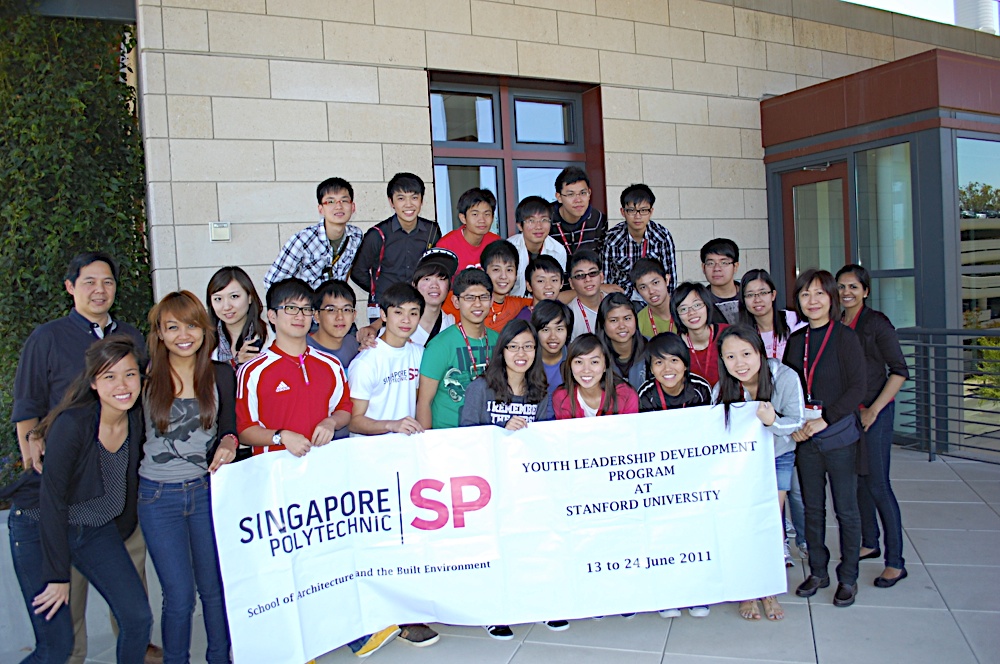 Today, I came across the group photo from the first YCISL workshop in 2011. It reminded me to reflect on the past 10 or so years of YCISL programming.
I checked the original posts in my YCISL wiki and noticed that I started this wiki in 2010, a year before that first workshop. Spurred by Sir Ken Robinson’s TEDTalk, I had started collecting thoughts on creativity. I had drawn the graphic on Approximation of Leadership Objectives by Age Stage in March 2010 and added it to this wiki as my second entry. That graphic is still central to my program’s thesis.
Good fortune (which I have often been lucky to have) came my way when Singapore Polytechnic wanted to send students on a visit to Stanford University for a leadership program. Off-shooting from earlier good fortunes of having Jim Leckie as my “boss”, the Singapore-Stanford Partnership experience, and the formation of the Center for Sustainable Development & Global Competitiveness, I couldn’t have wished for a better school and group of students to start the YCISL with. Really.
The relationship with SP ended after three annual workshops. A prospective new path, this time with students from China, turned out to be a very bumpy ride. The China part of the YCISL program started small with a workshop organized by a Stanford MBA/MEd alum (2013) then continued with Raising Culture organized by another Stanford alum (2014) and finally a sustained series of workshops sponsored by Goldmine for university-level students (2017-2019).
There were two very good workshops with City University of Hong Kong (2016 & 2018). In contrast, there was the workshop for students from SNU (2017) which revealed how playful creativity is not accepted in some academic cultures.
Gathering momentum was tough for any particular school or group of students, especially from China. Even more difficult though was getting new programs launched. I received a lot of interest from prospective organizers and had a lot of planning meetings. The first plan was to create a program for children of executives attending a CSDGC executive workshop co-organized with an educational exchange company (2011). That didn’t get far. A program for South Korean students through a Silicon Valley incubator fell flat after intensive discussions (2012). A program planned with an investment company based in Hong Kong and an educational consultancy couldn’t get pulled together either (2013). Two other educational exchange companies (2012 and 2017) found that finding students in China would need special authorization that eventually shredded our plans. The failure rate was frustratingly high, yet still energizing to know there were prospects. Persistence.
This leads me to two of the best and most successful collaborations in the history of YCISL. The first was the relationship with GPI US which launched connections with several schools and one juku in Japan. The Wasedajuku workshops (2014 & 2015) were great…until there was a sale of the business. Ritsumeikan (2013-2015) impressed me because I met the head of school during the first workshop and showed awareness of design thinking. Hiroo Gakuen (2013-2019) was a broader-than-most program with its after-session research presentation evening. Asano Gakuen (2014-2019) added learning with its all boys groups; I had an interest in group dynamics and this group always gave a useful comparison.
The second important relationship for the YCISL program was with E-Squared Learn with Leaders. This came about because of the Covid panic and lockdown. This allowed for YCISL to pivot to an online platform and meet a distant student audience through a virtual setting that had not been so appealing a few years before. The pivot enabled shorter programs (for concern over Zoom fatigue) that required a new sense of creativity for program design. From this circumstance, we invented Popcorn with Colin, the Innovators Toolkit Workshop (ITW), and NIFTI (New Ideas from the Inside). Why this is so amazing is that the same pivot was offered to GPI US and they couldn’t get it to grow. Not an easy ask because a couple of other prospective partners in Indonesia and China also could not get traction.
Looking ahead, I am going to focus on YCISL e-books and perhaps other media to document the lessons and learnings of the YCISL program. The collaboration with E-Squared Learn with Leaders is now in the rear window and I am looking for something new and newly exciting with a fresh and refreshing partner. As I have showing on my presentation introductions, I am in the “What’s next?” stage – actually, I am always at that stage.
“Each day a chance to do something memorable for someone.” – Richard M. Nixon
BOOK: Keep Going by Austin Kleon
It’s been a while since I finished reading a book all the way to the end – without skipping anything. “Keep Going” by Austin Kleon (2019) follows “Steal Like An Artist” and “Show Your Work” which I have reviewed previously in this wiki. His idea of separate analog and digital workspaces has been a concept that I bring up in YCISL workshops frequently to help students understand that there are two (or more) modes to make creative thinking work – such as in our divergent-convergent thinking exercise. The analog connects to the divergent thinking creative side whereas the digital connects to the convergent thinking focus side. This incidentally connected well when I read (actually I listened to the audiobook) of “Thinking, Fast & Slow” by Daniel Kahneman where he describes two systems that operate together to enable our thinking.
“Keep Going” continues the series in his concise and practical, personal and reflective style. The overall theme relates to a sort of biorhythm where his creativity vibrance rises and ebbs, and the resonance he has found in the personal stories of other creative artists to help him “keep going.”
“Lots of people want to be the noun without doing the verb.” Sad, but true. In the various frameworks we display in the YCISL, we have nodes with labels (the nouns) connected by actions (the verbs). This is especially embodied in the emotional intelligence framework where our awareness is connected by management. We also present design thinking as an exercise focused on both form (noun) and function (verb) in order to be compelling and complete. In terms of practice, think of the noun and verb as a pair and be creatively quick in coupling them. This would make an interesting YCISL exercise. For example, I could show a noun then have students come up with three verbs for that noun. The reverse of giving a verb or two, and asking students for a noun to match may also be good for thinking agility.
“One of my art heroes was a nun.” To me, this may be my most fascinating discovery in this book. After reading about her in the book, I Googled Corita Kent and found a treasure trove of things I could use in the YCISL program: (1) Immaculate Heart College Art Department Rules, (2) “You are who we love.” A collaborative poem for Corita Day posted online at corita.org website, (3) the Corita Kent Art Collection, (4) the Finder, a simple tool used in “experimentation” to frame views, and (5) the term “Plork” combining the words “work” and “play” and describing the resulting emotional uplift [reminds me of Richard St John’s TEDTalk where he says “It’s all hard work. Nothing comes easily. But I have a lot of fun.”]
“In an age obsessed with speed, slowing down requires special training.” In the basketball training paradigm that we use in YCISL, this means being able to switch modes – between ball handler and supporter, or between offense and defense. Speed (and focus) can be critical in some situations, whereas slowing down (assessment) is needed in others. In a reverse way, the YCISL also emphasizes a need to be able to engage in fast creative thinking in problem solving because education generally teaches us to store and recall.
“To slow down and pay attention to your world, pick up a pencil and a piece of paper and start drawing what you see.” The YCISL ITW workshops have been using drawing as a means to express the design thinking form and function. Perhaps more in line with Kleon’s “what you see” motive, we can use the drawing method in a problem statement finding exercise which would promote the attention to the world (or worldview) that we need. Does this have the same meaning as “Stop and smell the roses”?
“What you choose to pay attention to is the stuff your life and work will be made of.” The idea of listening filters and fidelity is something learned from “Understanding Other People” by Beverly D. Flaxington, and is the premise behind our workshop exercise in learning to turn off listening filters and fully listen to the information being transmitted. Paying attention to certain things and not paying attention to others is our way of filtering and prioritizing. How the rules of those filters are written and ordered affect our perception and consequently influences our mindsets and behavior. More importantly, our mannerisms and behaviors reflect these filters and shape our identity.
“Of course, to change your mind is to do some real thinking.” How do I know if I am doing some real thinking? I’m not sure, but I hope that I am able to do it at least some of the time. Personally, I am open to changing my mind as well as others changing their minds – so long as it isn’t in a vacillating manner or with ill intent. So long as the change is based appropriately in intelligent and intellectual navigation, it should be expected and welcomed. This connects with our YCISL interest in the growth mindset where we are open to new ideas and experiences that may turn out to be good or may turn out to be bad or non-events. But recognizing that real thinking is “hard work”, it might not be available all the time – although we should train ourselves to build stamina for it. In YCISL, I think our prototyping exercises and the concept of iteration strengthen us in mindset, skills and abilities so that changing our mind is practically normal and necessary with no dings on our self-confidence and sense of direction.
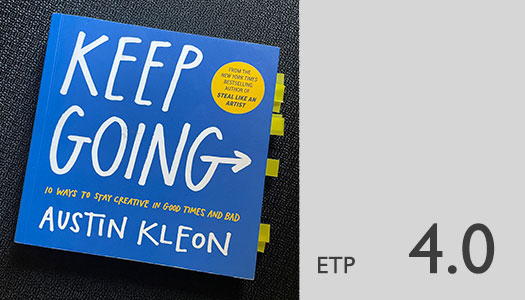
Why is the ETP relatively low? I didn’t mark as many parts of the book as compared to Kleon’s other two books. And what I did mark was isolated between pages 65 and 136, a total of 71 pages out of a 201 page book. Then again, the mark for Corita Kent would get a 10x impact factor (if I had such a factor) which makes me super grateful for this book. I recall my thinking being sidetracked in the latter part of the book a couple of times in a way that I started feeling disagreeable. The language used in the treatment of Marie Kondo’s tidying method pinged of singularity (eg, the use of the negativity words “propaganda”, “mania” and “fetishize” in a single sentence) and blocked my search for practical extensibility. It was good and interesting storytelling in the latter part of the book…the fresh air and the walks etc…but I was no longer on the same journey. I became a spectator. Oh well.
WSJ: The Elizabeth Holmes Trial: Founder Recounts ‘Big Idea’ That Led to Creation of Theranos
 Jury duty can sometimes be interesting. Out-the-corner-of-an-eye, I have been watching some news reports about the Elizabeth Holmes/Theranos trial. I have previously commented on the leadership and innovation characteristics of Theranos leaders. Today, I watched a news report about how a hedge fund investor claimed to have been deceived by the Theranos story. I also found a WSJ article published today titled “The Elizabeth Holmes Trial: Founder Recounts ‘Big Idea’ That Led to Creation of Theranos” which has the very interesting by-line “Holmes says early feedback from scientists fueled her optimism about startup’s blood-testing technology.” At least, it’s interesting to me.
So I am thinking and wondering:
1. Miniaturization can be a very compelling direction in technology innovation. We generally love personal products that are compact and sometimes even almost invisible. Thinking “nano” as a favored buzz word. The result isn’t always a success and can be the cause of new problems. But anyone who has studied analytical chemistry should be able to tell you that miniaturizing sampling lowers accuracy. The margin of error in the blood draw, contamination issues, preservation requirements and eventual sample handling all detrimentally affect sample integrity and analyte detectability. This is understood of even simple samples and as being even more difficult in a blood media matrix. The basic knowledge one needs is that scaling down pushes uncertainty up…and in chemical analysis, unbridled uncertainty leads to useless data. It’s reality, not skepticism. Lesson for YCISL: Manage uncertainty with divergent-convergent thinking with a fail early, fail fast attitude.
2. So where were the scientists? The WSJ news report mentions scientists inside and outside Theranos, and uses the words “dismissed” and “unimpressed” which reflects negative views, but that still does not reflect a clear and thorough scientific understanding of analytical detection limits. Was there any robust & rigorous scholarly communication and discussion? Where are the science publications, reviews and commentaries? And where were the hedge fund manager’s scientists and science advisors? How did the science of this get so distorted and mis-aligned? Lesson for YCISL: Make sure your team communicates really well.
3. Most of the news reports mention what was said and what people thought was said. What were the questions asked and what was the path of enquiry that these questions developed? For leadership, the questions are as important as the answers. Did anyone perform a check-for-understanding? What were the body language and other hints that accompanied the Q&A? Lesson for YCISL: Practice active listening and make sure you support your critical thinking with questions.
Thoughts: Sustainability has a PR Problem
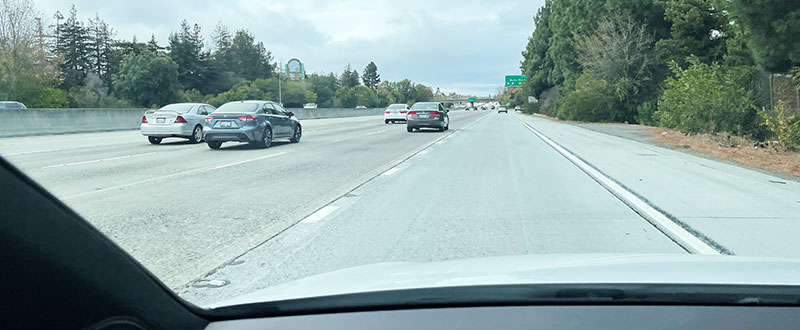
One of the messages shown to students at the start of the current YCISL NIFTI program is that “Sustainability has a PR Problem.” The idea behind this statement is that sustainability messaging has probably peaked. I believe there are two main reasons. Firstly, most people are tired of negative news from the media and news about sustainability gets filtered or drowned out quickly. Secondly, sustainability is usually presented in a significant loss-frame which fractionates attention. People are not motivated to live sustainably under these conditions.
The sustainability issue I have been thinking about to analyze this lack of motivation and poor messaging is the push to EV transportation. Do we need EVs? The answer isn’t clear and obvious. In a mass market, EVs could be a huge sustainability problem with uncertain resilience and reliability leading to un-even benefit. EVs can be inefficient and that has already been demonstrated by poor distance performance when driven at highway speeds – below EPA estimates. And if you have personally had poor experiences with electronics and battery-operated devices, your trust in EVs could be very low. It’s understandable. Cash incentives don’t help because that shows EVs are not a strong compelling choice.
For tens of years, I have watched vehicles on the 280 freeway going at 70 to 85 mph. I learned from college thermodynamics class that the car engine combusts most efficiently in the 45 to 55 mph range. That is why the EPA expresses its mileage estimates at that speed. What people do not seem to realize is that the drop in fuel efficiency is precipitous above 55 mph. It’s figuratively like walking off a cliff. And what about fuel efficiency in stop-and-go traffic or slow traffic or just idling waiting for something or someone? One last behavior that is really inefficient is accelerating the car really quickly which injects fuel into the engine that does not combust and just gets dispersed. All this puts more wear and tear on the vehicle which in itself is non-sustainability.
Is the problem fossil fuel? Only partly. Human behavior is mostly the issue. Some of it is determined by economics where people live quite a distance from work. Or the shift to online shopping is pushing up the number of delivery trucks. Growing consumerism requires more transportation of goods (notice all the Amazon rigs on Highway 5?) and globalized access to goods means longer distances for shipping. In California, public transportation is poorly maintained and relatively inconvenient. Focus on profitability in government and private corporations ensures that human actions are dictated by monetary tides.
California’s messaging on water conservation is also failing. Water resources sustainability is in a loss-frame with new levies and higher cost structures. Affordable innovations for water use reduction are absent. Instead, the conservation message is ignoring reality and the residential needs elevated by shelter-in-place are miscalculated. The reduction baseline is from 2019 which is pre-Covid and at a point in time when many people had already converted to drought-tolerant landscaping, drip irrigation and reduced watering schedules. Instead, we have electronic water meters whose cost is passed to homeowners…so that fees can be collected more quickly.
Sustainability really has a PR problem. We need sustainability design thinking and creativity to improve on this.
Thoughts: Building NIFTI 2.0
NIFTI 2.0
Last weekend, we kicked off the second year of the NIFTI program. I am calling it NIFTI 2.0 – The Sustainable Futures Initiative. Our primary focus will be on sustainability design thinking. There are many situations where sustainability design thinking is absent. The California water crisis is one.
The YCISL program sees sustainability design thinking as comprising smart programming, debugging and release to early adopters as prototypes. We will coach students to get divergent-convergent thinking to be instinctual and an essential ingredient of their emotional intelligence practice.
The new NIFTI will be less about career guidance, and more about upgraded and upgradable thinking skills. We will pollinate NIFTI with exercises from the ITW program so that students can envision what the next-generation of leadership needs to do – and how to do it.
If we were to give the current NIFTI group of students the challenge of solving the California water crisis, how would the divergent-convergent thinking process go? I think first we will have a long list of people who would be accountable. We will then have a comprehensive list of reasons for the water crisis perception. On the convergent side, we would design innovative solutions – perhaps a trio that get all stakeholders to realize we have a glass half full and the challenge is to get it more full, and not prevent it from getting emptier.
One of the premises I presented in the introduction to NIFTI 2.0 is “Sustainability has a PR problem” and that this explains why sustainability is stuck (stuck in the negatives as Alison Ledgerwood puts it) – and why it is so hard to move ahead. I am hoping that the NIFTI students will learn design thinking strategies to make sustainability behavior popular (like phenomenally popular) and practically naturally. And this leads to our NIFTI Roundtable 2021 topic of “Sustainability in Education.”
Google Data Studio: YCISL Skills Survey
I have been wondering how to create web dashboards and came across Google Data Studio. While learning how to use Google Data Studio, I played with visualizing the results from the YCISL Skills Survey. I aggregated the results from several YCISL workshops including two NIFTI programs, one ITW workshop and one YCISL Focus Group; there were responses from 107 students.
I will be starting the another NIFTI program next week and will update this dashboard when the survey results are in.
First, a few things I learned about using Google Data Studio:
- Collect GEO information. Google Data Studio includes a Google Maps chart which looks cool and would show the worldwide reach of the YCISL program.
- Try to eliminate chances for duplicate entries. I use Google Forms to do the survey and that is collected into Google Sheets. I manually moved data from each event’s survey to an aggregate Google Sheet from which Google Data Studio accesses data. I did this because I needed to clean out duplicates manually in Google Sheets.
- Include time stamp information. This allows Google Data Studio to display data from different time frames.
And now some observations about what I found through Google Data Studio:
- Students rated their Positivity skills very high at 4 or 5. This is a great indication of growth mindset.
- Students rated their Design Skills as average with most choosing 3. This suggests that we could discuss the meaning of “design” in the same way we discuss the broadness of “creativity” and “leadership” so every one feels that it is accessible. It was also interesting to see that design was the skill most students wanted to improve. Fits well with our programming on design thinking and design-build.
- There are also several students who rate various skills at 1 or 2. This could be an indication of no prior exposure or poor past experiences. Pushes our YCISL program to try to turn this around by creating memorable great experiences.
Looking forward to collecting more survey feedback and updating this dashboard.
CNA: The PSLE Math problem that got everyone calculating – and asking
In my CNA app today (Sunday October 3, 2021), I read an article about a math test problem that reportedly caused immense distress among test-takers and their parents…plus caused a wave of reactions on social media. The story “The PSLE Math problem that got everyone calculating – and asking Why do Helen and Ivan have so much change when everyone’s gone cashless?” was written by Khoo Bee Khim.
The test question as reported in the article was…
Helen and Ivan had the same number of coins. Helen had a number of 50-cent coins, and 64 20-cent coins. These coins had a mass of 1.134kg. Ivan had a number of 50-cent coins and 104 20-cent coins.
1) Who has more money in coins and by how much?
2) Given that each 50-cent coin is 2.7g more heavier than a 20-cent coin, what is the mass of Ivan’s coins in kilograms?
I gave a go at solving the problem. I initially started on a spreadsheet then moved to a pen and paper (and calculator). I scribbled an equality expression and after 10 minutes reached an answer for part 1 when I realized it wasn’t an equality problem. Then I contemplated an approach to part 2 and set up an equality expression for that and reached an answer. My answer for part 1 was correct, but I had done an addition when a subtraction was called for in part 2 and had the wrong answer initially. Switching the addition to a subtraction got the correct answer. I am an average C-student after all.
After this experience, I feel this was a fair question and showed which students had high organizational thinking skills. There are other factors in play as well though. These include:
(1) the ability to interpret story-based questions. We know that girls tend to do better in this area.
(2) the comfort with unknowns. Most students are conditioned to be able to manage two unknowns in a problem: x and y. This two-part question had three unknowns in part 2, but one of them was already expressed in part 1. There was sequential dependency. So the issue here was the perceived high uncertainty because the problem had two parts. In coding, we might call this nested logic.
(3) tracking units. Some students may have got the wrong answer in part 2 because weight information was given in kg and g. This is a classic “trick” in STEM problem solving.
(4) test context. If this question was considered part of the “hardest” part of the test, then perhaps we could assume most of the rest was…less hard? There is also strategy in where this and other “hardest” questions were placed in the test…beginning…middle…or end. This would be the stamina and change of pace factors. In the real world, if this problem was the only one that needed to be solved in day, how many people would be successful?
(5) test balance. Was this question building on a previous problem that tested a similar math skill but in a simpler context? Ever had a test where every single question was “hardest” and filled with booby-traps? I have…once.
In relation to what we discuss in YCISL, I wonder whether students will ever need this particular math solving skill? And after answering that, will the educational system ever help students to become masters at solving this type of problem?
Furthermore, this question is outright positioned on the reasoning side of thinking skills. The storyline set-up is a distraction and perhaps a creativity decoy. There are many ways to make this a creativity-testing question or even a real world type question. Maybe one day, our tests will advance to that more emotionally intelligent level.
Love the Instagrams really though…!
