
Category: Lessons
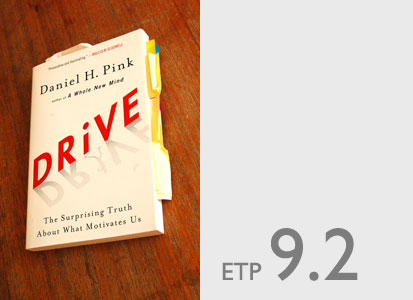
Book: Drive by Daniel Pink
This is the entry to review my thoughts on the book “Drive” by Daniel H. Pink. I found the writing style highly persuasive and engaging. For the YCISL workshop, there is quite a lot to relay [in fact, I did use several topics from this book in the June 2011 workshop].
The main idea that comes through is that intrinsic motivation is very powerful and enduring. While extrinsic motivators such as cash incentives can result in increased yield, its effects are temporary and decline in peak performance with every use – like with rechargeable batteries. Extrinsic motivators also include punitive actions which are equally unsustainable and ineffective.
For our YCISL context, particularly notable is the section “Type I for Parents and Educators: Ten Ideas for Helping Our Kids.” The idea of a DIY Report Card is interesting in the sense it might have a positive motivational effect (traditional report cards would have, I would hazard to guess, about a 50-50 chance of being motivational – because of the limitations to standardization) with little downside. Pink states that “Good grades become a reward for compliance – but don’t have much to do with learning.” I’m not sure I would agree with exactly with how Pink proposes it should be done – his description sounds like an adult workplace performance review – another thing not to expose to youth. What if the report card, for say an elementary student, was done within the framework of a SkillScan card sort? Analyze how the cards get sorted at the start and the end of a term, and see if there is a correlation to the teaching effectiveness and student behavior.
Other notables:
(1) In the section “Words”, page 138: “And a powerful way to provide that context is to spend a little less time telling how and a little more time showing why.” I should constantly remind myself of this point. I am very focused on the typical failure to show “how” because of the attention paid to “Here’s point A, and there’s Point B”; to keep my message engaging, I need to periodically remind ourselves of “why.”
(2) In the section”Purpose”, page 130: If so, when am I going to do something that matters? When am I going to live my best life? When am I going to make a difference in the world?” The author’s point is that motivation is suppressed in adults to the point that delay after delay is the norm in leveraging that motivation. This suppression of course is that which we experience as children in our learning environments, and carries on in adult life in various other forms.
(3) In the section “Oxygen of the Soul”, page 127: “The days that people make progress are the days they feel most motivated and engaged.” Also, “You start to get ashamed that you’re doing is childish” <- this second quote is attributed to Mihaly Csikszentmihalyi.
(4) In the section “Type I and Type X”, page 75: “Type X behavior is fueled more by extrinsic desires than intrinsic ones.” And “For Type I’s, the main motivator is the freedom, challenge, and purpose of the undertaking itself; any other gains are welcome, but mainly as a bonus.”
(5) The Three Elements are “AUTONOMY”, “MASTERY” and “PURPOSE.” I would call these the ideals for motivation.
(6) The Four Essentials of Autonomy are “TASK”, “TIME”, “TECHNIQUE” and “TEAM.” I would call these the ingredients that need to be assembled into an engagement in order to attain the Three Elements.
(7) Motivation 1.0 to 2.0 to 3.0: overall, I am not certain that version 3.0 is going to supplant version 2.0, and even whether version 3.0 is real or better or even an actual stepping stone (maybe it’s actually an alpha or beta version currently?). There is mention on page 19 about version 2.1. Perhaps for the time being, we would be better off using version 2.1 and waiting for version 3.1 instead of jumping into 3.0? Version numbers aside, it would seem that we want to focus on the features of 2.0 we should retain, and add a digestible set of new features – in order to design a new way of doing things. Granted this isn’t “disruptive” which is how some people think things should be done (aka the grass is always greener on the other side).
Creative Choices: How Many Ways Are There to Cut a Strawberry?
Just put together some fruit and cereal for breakfast. Made some choices (creativity at work): got my usual bowl, added the usual Honey Bunches of Oats, some ground flaxseed, and frozen blueberries. Right before drowning everything in 1% milk, I spotted fresh strawberries in the fridge (an occasional treat in our house). I decided to add strawberries to my otherwise typical breakfast (actually a snack at any time for me). Pulled out the chopping board and a paring knife. Took a couple of strawberries out of their container and rinsed them. I knew I had to remove the strawberry leaves and core so I did that. Then I paused a few seconds to decide how I wanted to slice the strawberry. There were at least two possible ways I was contemplating – from top to bottom, or side to side. I decided I wanted to make o-rings today so chose to slice them top to bottom. I didn’t really think about slice thickness. So, for a few seconds, I employed creative (although not innovative) energy. Like regular physical exercise, it must be good and healthy to regularly work out with creative exercise. Fortunately, I was able to make a fairly quick decision as indecisiveness in a creative situation would be a bad thing.
In the SP YCISL workshop, I used dressing in the morning as an example of a creative exercise (more so perhaps than other dressing occasions because there really is usually a blank slate, new attitude and refreshed inspiration after waking up in the morning – at least normally, I would guess). Even where a uniform is involved and choices are limited, there may be at least one creative decision involved even if the decision is the same as the one chosen the day before.

Book: Enchantment by Guy Kawasaki
I just finished reading “Enchantment: The Art of Changing Hearts, Minds, and Actions” by Guy Kawasaki. It joins my collection of Could-Not-Put-It-Down books. It was overall a fluid and well-structured treatise filled with practical suggestions and insightful observations on behaviors that trigger responses of inner attraction and appeal. (Underlines are my way of “sucking up.” Read the book and you’ll get the idea!)
[I will digress for a moment to put enchantment in terms of the ion attraction models that I am familiar with. If two bodies are at infinite distance apart, there is theoretically zero attraction. At any real distance however there is some level of attraction (think exponential decay, approaching but never reaching zero). As the bodies get closer, there is an increase in attraction. At some point, the bodies are close enough to be involved in some weak holding pattern (the outer layer of influence -> speaking in 2d but we could just as readily say outer sphere for a 3d model). Closer still, the bodies interact and actually form a strong bond (high energy) and deviation becomes limited (an inner layer that is somewhat structured and ordered). If the resulting proximity of the bodies can result in a reaction, then the two bodies might transform into a new entity (hopefully stable) OR if there is a propensity for it, a smaller body might bind in the inner channels of the larger body.]
So how did that relate to the book at hand? Enchantment discusses a phenomenon like the inner layer bonding. Enchantment happens at a point at which reactions are likely to occur and there is a level of fixation. But the bodies need to get close enough, through the outer layer – and in a realistic scenario there will be many competing bodies that will serve to thwart bodies reaching the inner layer level (unless sheer Brownian motion or physical momentum causes an actual or near collision).
Time to list my favorite parts of the book:
(1) I found Chapter 2 How to Achieve Likability – Make Crow’s-Feet a great way to show that Enchantment is a genuine and honest pursuit. You can think about your own likability as shown by your muscle behavior, or detecting other’s likability. Likability may be difficult for some to pervade or one may have a phobia about putting forth a likable personality. However, understanding that Likability is an early step to achieving a connection will help our students find an opportunity to even “step into the ring” to start their journey of innovation and leadership.
(2) Chapter 5’s discussion about the “First Follower” is worth presenting to our students.Working in teams in a school (where social structures generally guarantee the availability of first followers), it would be useful to begin the presentation of a new product or idea by having a first follower become engaged in plain sight of potential additional followers. [Quick digression: I guess this has started to get me to think about Flash Mob Dancing – what an exhilarating phenomenon!]
(3) In Chapter 8 How to Use Push Technology, I like the section on Email. Perhaps I will try it by composing an email to Guy Kawasaki, and see if this works for me (I realize mileage may vary). In particular, I like the advice to “Keep it to six sentences.” This is highly consistent with how I have created assignments in my teaching career. When I design an assignment or question, I am looking for an initial response showing that the student is revealing thoughts in an appropriate direction. I would prefer to leave it to the student to determine the depth to which they would go to be satisfied, and develop their answer in a short form just to convince me that that is where they are headed.
I would close by noting that there are many useful tips in this book that could potentially fit into the YCISL content and benefit the participants. These tips could help inspire us to create some great modules. However, the book does seem to weigh closer to adults so some refining or contextual adjustment may be necessary but when it comes to life lessons, there is great value that Guy Kawasaki has shared.
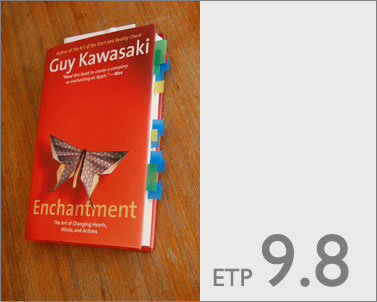
I am also quite excited to start a new analysis based on the fact that for the books I am reading in printed format, I am attaching PostIt tags when I find something that I may want to go back to because it might contribute to the YCISL program. Enchantment received 18 tags. For an 184 page book, that becomes an Earned Tag Percentage (ETP) of 9.8 (divide tags by number of pages then multiply by 100). I am also attaching a photo of the book with its tags showing, and will retroactively update earlier wiki entries with photos and their ETPs. What fun!
Module: Our Guest Answers Your Questions
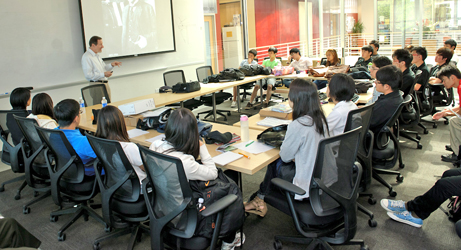
Imagine you’re in a school lecture: how likely are you to ask a question? Imagine you’re competing in a science fair: how likely are you to have prepared your presentation with the help of questions? Just what opportunities are there for youth to learn to ask questions and ask them well? Not many really. Youth are taught mainly to provide answers. But the skill of asking questions, especially creative ones, is critical for discovery, innovation and leadership.
In a university setting, creative questioning sadly does not become a significant opportunity until graduate school. So, one of the skills our youth program would like to impart to youth is thinking of and asking good questions. First, it would help to know what kind of questions are at one’s disposal:
(a) clarification – perhaps the easiest because it safely stays within current scope and can cycle on itself until full clarity is reached.
(b) extension or tangent – the question could suggest a further conclusion or further work. Ask if it is useful to the discussion.
(c) speculation or propositional – the question could suggest an alternate interpretation or conclusion that has yet to be supported. Some element of risk but potentially impressive. Demonstrates vertical thinking.
(d) connecting – the question could ask whether the topic at hand is connected to another topic that was not presented. Demonstrates lateral thinking.
(e) gap-filling – the question could ask about the existence of missing information or if/when a gap might be filled.
(f) philosophical – especially useful in data-driven communications is to look for the intangible forces behind a work. For example, ask who would benefit from a product or new knowledge, or how a paradigm might shift as a result of the new findings or strategies.
(g) critical – a difficult question to frame because of potential misunderstanding and conflict. Requires experienced questioning skill.
Now down to the practical application of this to a YCISL workshop. We could have a guest speaker prepare just a few minutes introduction or none at all. It would be entirely up to the audience of students to ask questions to drive the conversation. This is consistent with the desires to: (a) facilitate bi-directional flow of ideas and thoughts, (b) encourage students to discover by asking questions, (c) ease the pressure on speakers to formally prepare material or topics for their session, and (d) encourage spontaneity.
For this to work, we would need a good moderator. We might videotape such a session so the students can (a) review how they asked the question, (b) gauge the speaker’s reaction, (c) listen to the response elicited by the question, and (d) gauge the audience’s reaction to the resulting question-answer exchange.
And I should mention why I even considered such a module. It’s because I have observed how some students might not get connected with a speaker because (a) they are the silent type, (b) they are worried about how they will be perceived by their interaction, and (c) they are worried that their knowledge about the subject matter is novice and potentially annoying to the speaker. By putting the responsibility to drive the conversation on the students (and having a speaker who is open to questions), we can demonstrate to the students the importance of asking good questions.
Modules: Transitions
One idea for the next modules is to demonstrate the link between (1) creativity and innovation, and (2) innovation and leadership. This will reinforce the link and provide practice in connecting the pairs. As with a basketball drill, we could start with beginner/easy drills, and include optional steps to make it more challenging, if desired.
Modules: Prototyping

One of the products from this program will be lesson modules that can be applied in workshops as well as at alumni events (as follow-on sharing). I am not considering selling modules to 3rd parties since quality control and experience may be off-base.
The first module that I am working on is one which is based on the pocket guides developed by the SeafoodWatch program of the Monterey Bay Aquarium. I remember how this seemingly simple printed material had such an influential piece of sustainability knowledge contained within. It certainly promotes the desired human behavior and makes it easier to sustain the behavior.
I intend to introduce this module initially during my alumni visit to SP, and apply it to one or more of the Summer 2012 workshops. I think this module contains all the elements we desire to apply: knowledge, communication, persuasion, utility, access, competitive, scalable, directional, and not least of all, affordable to produce.
In a way, I have prototyped the experience by working on my own portable pocket guide and I have been carrying it around in my wallet for several months now, and even occasionally pulled it out to show people. As a prototype, such a card is a great conversation piece and a simple way to start introducing an idea.
For this module at the start, we will need materials and a way to design the layout (hand drawn/sketched or computer-generated?). One should probably then engage in a brief brainstorming/sandbox exercise to divergently think of possible topics. Then would come the prototype designs (including how to fold; the final product should be professionally printed). One should then carry around the prototype and perform focus group use to get feedback.
One could even practice how to get the topic that is on the card into a conversation to give oneself the guerrilla marketing edge and create the opportunity to pull out the card.
This has made me think about the Chinese language iPad app that Prof Leckie just showed me this week. What would be the competitive advantage/weakness of this wallet-fitting card? People still carry business cards, so card carrying doesn’t seem to be disappearing.
UPDATE: I recently went for a visit to Singapore Polytechnic – mainly to followup with students who attended the June 2011 workshop – and had the opportunity to test the exercise in quick-designing pocket guides such as those mentioned above. The group consisted of about 13 students of the forthcoming June 2012 group, and 9 students of the June 2011 group. I started by handing out the SeafoodWatch pocket guides as a reference point. Then I explained that the objective of the exercise was to design your own pocket guide. Each person in the group had 15 minutes to design a pocket guide, thinking up a topic, figuring out the folded layout and drawing on a piece of paper. 15 minutes is hardly enough to complete the pocket guide, and so after 15 minutes the work-in-progress was passed to another student – whose job was to finish off the card – which included figuring out the idea of the card and filling the rest of the content. After another 15 minutes, the pocket guide was passed to another student who was given 15 minutes to analyze the card and come up with a 15 second pitch (i.e., something to say about the card and interest a passer-by). SP staff took turns being the casual passer-by and each student took turns making their 15 second pitch. We made remarks about eye-contact, grabbing interest and covering the most relevant feature – within the 15 seconds which is about the time limit a stranger might allow – if all goes well. We made observations how our passer-by actors reacted to the pitch – with positive interaction (i.e., taking hold of the card) or disinterest (e.g., lost eye contact). This exercise demonstrated:
(a) how a small object (i.e., the pocket guide) can be used to advance an idea,
(b) seat-of-the-pants design keeps the overall theme simple enough to be able to collaborate with others (i.e., the second designer and the pitcher),
(c) that focus is critical when pitching an idea to a stranger,
(d) the process of extending an idea (second designer) also requires creativity,
(e) always have an idea (or a few) at the ready in case an opportunity arises suddenly.
Based on this experience, we could use this exercise for open house events as a way of showing how creativity, ideation, design, readiness and delivery have to come together. And when the delivery is “pitch-perfect” and shows personal commitment to the idea, leadership comes through.
Take-Home Lessons: Questions & Answers
Key to the success of a YCISL workshop is to sustain conversation and thought exchange so that there is dynamic learning. Our workshops are designed to be interactive with the goal of participants deriving useful take-home lessons. Fundamentally, we can set rhythm using questions and provide tonal variety with answers. We also know that students are already quite good at providing answers (after all that is what schools teach), so our main task will be to get them as skilled at providing questions. We can thus teach by setting good examples, and prompting questions. We can also examine how one interprets questions and synthesize an answer – through both convergent and divergent thinking.
The title to this take-home lesson may be: Lead with Questions. Give your best answer.
So why develop questioning skills? The obvious answer is that the most efficient ways to fill in knowledge gaps is to ask questions, collect the answers, and apply to the gaps as needed. One would also use questions to set scopes and frameworks when brainstorming and problem-solving. Questions are critical for problems for which are not fully defined – where data is needed or can never be properly known. Questions are needed for due diligence as well as definition and clarity.
Extra dimensions we can summon – that students would be not well acquainted with – include (a) encouraging a series of questions (perhaps well-sequenced) that coherently pursue a point [maybe 20 questions?], and (b) questioning the ideas of others (especially authority).
Perhaps we can create a Question game?
Book: Out of Our Minds by Ken Robinson
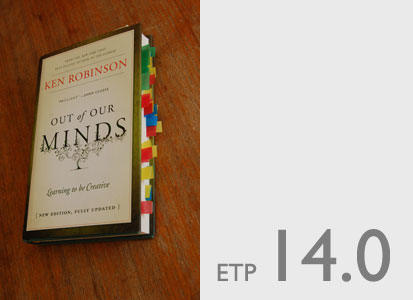
It was slower going through this book (Out of Our Minds, 2011 edition, by Ken Robinson) compared to the time I read The Element. It might have been that there was less for me to “grab on to” or “reach out for” in terms of relatable situations, or perhaps there wasn’t much I was making notes of that would pertain to the youth program. In this entry (at least in the initial draft), I note some notable parts:
– “Creative schools are creative with the schedule”, p. 260. This reminds me of the curriculum at Bowman International School in Palo Alto where there is no strict subject schedule – except for a regular language class where it is essential for students to be feeling immersed in the language and speaking to each other and the teacher in that language. But even so, there is a thought-provoking argument as to whether having schools’ daily schedules suit the traffic schedule, the parents’ work schedule or the teachers’ workload schedule (as opposed to an optimum schedule for student learning) – are detrimental to the desired outcome of learning in depth and to a command level. What do the students in the YCISL workshops think?
– “Digital natives and digital immigrants”, p. 75 and 253. These terms are attributed to Mark Presnky, and are used to denote a phenomenon that moves in the opposite direction of [traditional] cultural transmission. With new technologies and platforms flying out of the idea factories, youth are far quicker to adopt, adapt and embrace these new ways of life, and often end up teaching the older generation (the digital immigrants – those moving out from the non-digital world). In normal cultural transmission, the older generation is typically engaged in trying to pass down traditions and processes that they grew up with in order to preserve them. So, for those youth who feel that they have something to teach adults, how would they do it?
– “The task of a creative leader is to facilitate a resilient relationship between the internal and external cultures”, p. 224. We could think of this in terms of a cell which has several internal components that are somewhat protected as a group by a semipermeable (selective) membrane but nonetheless must interact with the external environment to survive as well as thrive. This makes me think about the layers of a web site where there is an external interface but several layers of hidden internal function, form, design and architecture. The creative leader has to deal with all these layers.
– ” A culture of innovation depends on cultivating three processes”, p. 219. These processes are imagination, creativity and innovation. I don’t exactly agree with how this concept has been structured (including the exact definitions of the three processes in the book). If we are to follow the argument in The Element, imagination and creativity, don’t necessarily need to be “cultivated”, they need to be uncovered – by social or organizational pressures. On the other hand, I think it is fair to say that “innovation” is cultivated. However, I would further the book’s definition of “innovation” to say that this process is a selective one. With regards to the definition of “creativity”, I would not exclude ideas because they are not “original” – the same creative idea could come about by different routes – and it all requires energy and expression. I guess you could think of this as a multi-path chemical reaction with similar reactants but the exact same product (albeit perhaps with different yields, energy of reaction and activation energies).
– “The intellect cannot work at its best without emotional intelligence”, p. 186. Perhaps something Stephen Murphy-Shigemtasu can address? More on Emotional Intelligence on p. 175.
– “Academic ability is based on the two capacities for logico-deductive reasoning and for propositional knowledge”, p. 83.
WSJ Article: The Importance of Child’s Play

Lenore Skenazy wrote in the January 27, 2012 issue of The Wall Street Journal on “The Importance of Child’s Play.” In this article, Ms. Skenazy describes how pre-school has been influenced by “fears” – a fear of injury (by corollary, a fear of lawsuit), and a fear of “falling behind.” This has limited the types of activity that pre-school children get to engage in. In the end, children are limited. So, we see that the limitations that we see imposed on children starts even in pre-school. It just creates for a more conditioned attitude through one’s entire youth.
“…play time is sacrificed for academics.” Play time is opportune for several skills such as social skills, planning skills and communication skills. Think about how free time is replaced by tutoring or other taught-activities (e.g., piano lessons) – this reduces the opportunity for children to apply their social, planning and communication skills. Where, when and how are children going to learn these skills?
Our observation that children have less and less opportunity for free play time provides further evidence that adult compromises have encroached childhood – all the way to the earliest group learning settings, and are reducing youth readiness and wasting youth creativity.
This connects with the example we found in the Gamestorming book where a single child who has a football can practice alone and repeat with little need for change. When there are two children, creativity enters where they exchange ideas for how to play together with the football – and take into consideration a number factors to produce “fun.”
It would be an interesting discussion to have with the youth groups (a) whether they are being stifled by adults, and (b) if so, when they think it started. This is a good starting point to approach the topic of sustainable leadership – one that does not get formed by adults but are organic to youth.
Life Lessons from Going Through a Car Purchase Decision-making Experience
I am thinking about a car purchase again – it’s one of those life phases that one goes in and out at fairly regular intervals. There’s a life lesson in there – about making decisions, compromising, prioritizing, and moving ahead. For cars, I rate Safety as #1. Comfort and reliability are the next most important criteria for me. There’s utility, convenience and road visibility as well that I would call priorities. Then, cost-to-own, fuel efficiency, looks and power are towards the tail end – something has to be at the bottom of the list!
It’s tough enough to prioritize these factors, but there are complications/tough challenges still:
(1) How do you match these priorities with the car? Just about every auto manufacturer does not make Safety their #1 priority [they have a list too]. It’s probably somewhere around #5 or so. How do you make a decision when priorities are not in-synch?
(2) If the purchase involves two decision-makers, how do you proceed with a purchase where the priority list does not EXACTLY match?
For the YCISL, we could focus on computers or digital cameras – or anything the participants would care to suggest. There are decision-making lessons in this exercise, but there are various other skills and attitudes to be assessed.
