
Category: Activity
Idea: Desktop Wallpaper Design Divergent-Convergent Thinking Exercise
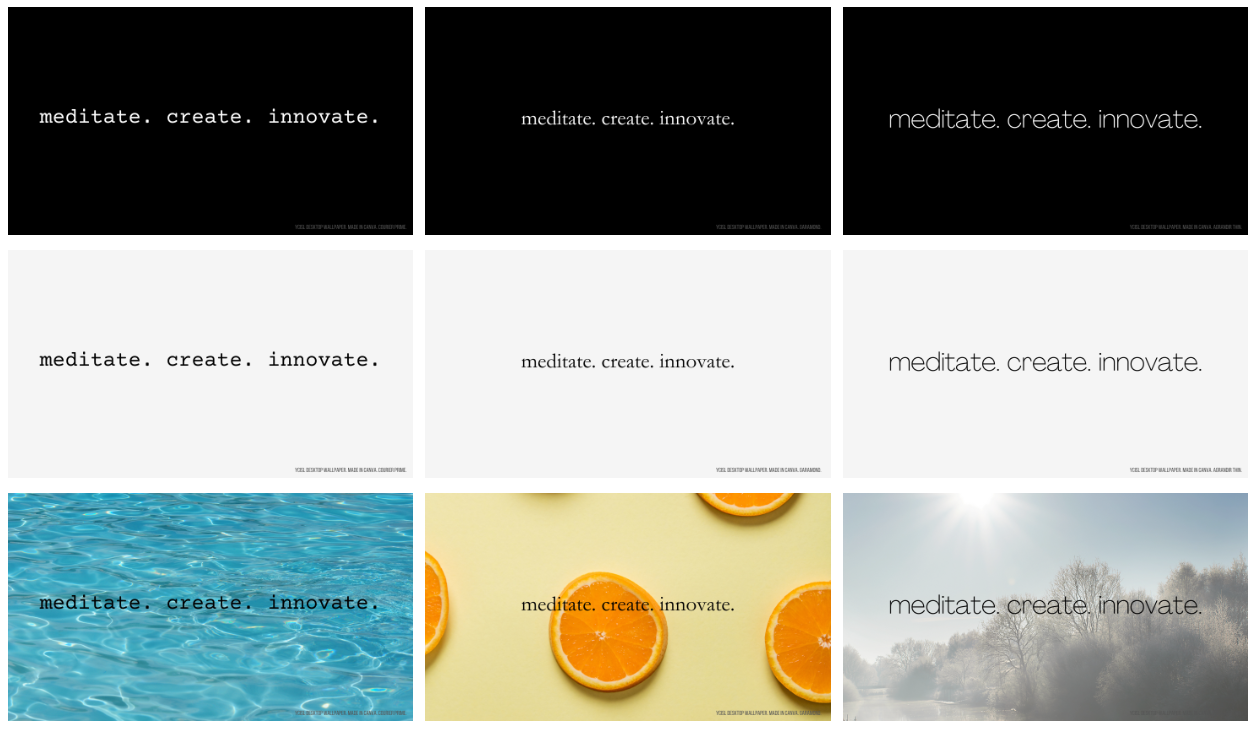 I have an idea for a YCISL Divergent-Convergent Thinking Exercise. Along with DCT, this exercise also involves brainstorming, rapid prototyping, fast thinking, design thinking, creativity and eq. We could also add an elevator pitch component with storytelling and your personal story elements.
Overview: In Canva, create a desktop wallpaper. We could assign various scenarios based on purpose and context.
Instructions: Divergent Phase: In Canva, set up a blank desktop wallpaper template. Add your text. Play with the font styles coming up with various prototypes. With the font prototypes, play with various color schemes for the text and monochrome background. As a last step, create versions with background images. Convergent Phase: Identify up to three prototypes that you think resonate the most. The criteria are up to you. Pitch Phase (optional): Design a 90-second elevator pitch around these selected prototypes providing a feature list, a story and an explanation of how it connects to your personal story. Assess the level of creativity, growth and mindfulness involved in this exercise.
I may have a chance to try this exercise out this summer in Sustainability Design Thinking. In the meantime, I will describe my experience reflected by the 9 designs in the gallery above in this wiki entry.
- I started off with a black background to have lower computer screen glare. I also think a black background has a sophisticated vibe.
- I chose three words related to the YCISL and intentionally selected words that rhymed so that they bounce around in the head together. I also feel the expression has a connected 3-step progression so there is an element of active listening (hearing, listening & understanding) involved.
- I actually created 16 prototypes based on font type. The three font types shown in the gallery at the top are Courier Prime, Garamond and Agrandir Thin representing the more common type styles.
- I then made a copy of the set of 16 prototypes and changed the background to white. As I started working on this WordPress entry, I found that I preferred having some contrast between the wiki image and the wiki background, and made another set with an off-white background (#f5f5f5). I feel both the white and off-white background sets work well. Putting a little red, blue or green tint would have been an interesting expansion, but I didn’t do it. That’s because I like to design exercises with sets of 3, and the 3rd step in this exercise is to…
- Use images for the background. Again, I did actually create 16 prototypes with various backgrounds, and the three shown in the gallery above are just by chance the ones for the three basic font typefaces. Still, I like the variability represented here where the water has a cool and dynamic feel, the orange slices image touches most of our senses, and the scenery background denotes place and time.
Another important note is that even with 16 font typefaces and three variations on the background, there is learning happening in this exercise. Preferences, new ideas and intrinsic motivation are being exposed. So if there is enough time in this exercise to conduct a second DCT cycle, that would be consistent with the way we do the Spaghetti Tower Marshmallow exercise (“Fail Early, Fail Fast”) as part of rapid prototyping.
A Note to Self: About Hard Work
On my way to play some tennis this morning, I came up with an idea for the next YCISL e-book. It’s about Hard Work. The idea springs from Alison Ledgerwood’s 2013 TEDxUCDavis Talk “Getting stuck in the negatives (and how to get unstuck)” which was somewhere along the way re-titled to “A simple trick to improve positive thinking.” In that talk, she says “We literally have to work harder to see the upside of things.” That statement links to another which I do find more resonating which is “It’s all hard work. Nothing comes easily” – spoken by Richard St. John in his 2005 TED Talk “8 Secrets of Success,” but credited to Rupert Murdoch through an interview.
So I think I will work on an e-book with maybe eight examples of creativity and hard work.
- “We literally have to work harder to see the upside of things.” Alison Ledgerwood. TEDxUCDavis. 2013.
- “It’s all hard work. Nothing comes easily.” Richard St. John. TED. 2005.
- “It’s very, very simple to get what you want. But it’s not easy.” Mel Robbins. TEDxSF. 2011.
- Work = Force x Distance. An equation to describe the Growth Mindset. The YCISL Personal Story & Roadmap.
- Push. Pull. Center. Mindfulness. Sweat Equity. Stress & Strain. About YCISL EQ.
- Active Listening. Filters. A YCISL conversational topic.
- “Must try harder.” Sir Ken Robinson. TED. 2006.
- Creativity. Fast Thinking. Divergent-Convergent Thinking. Self-Edit. Self-Doubt. The YCISL Creativity Model.
That’s probably enough for the kind of short e-book I have been publishing. Hopefully, I can make it interesting for readers. The structure goes from ideas to concepts to a model.
Looking forward to getting started.
Lessons: Synopsys Science & Technology Championship 2023
Last week was the 2023 Synopsys Science & Technology Championship in San Jose, CA. I was invited to volunteer for Grand Prize (High School) judging, Category (Middle School) Judging, and Check-in. It was my first time doing check-in and it was fun being a trainee. I’ve done the judging before. But this time, I was tasked with selecting a project for a Special Award in the Environmental area, and I learned a few things. The following are impressions I got from the project and student I selected for the Special Award, and reflections on what influenced the decision with respect to YCISL ideas.
- “I thought the idea had creative and personally connected origins.” Part of creativity depends on what on what others are doing at this instance in time. I had reviewed many Machine Learning projects and none had problem-solving depth. I also had reviewed numerous environmental sustainability projects that made over-reaching claims and promises. The winning project had a simple creative idea and involved a rigorous scientific approach and process. During the judging interview, I checked that there was a personal interest in the subject which in conversation expanded to similar applications. In YCISL, we have the elevator pitch exercise where students design a creatively persuasive one-on-one discussion.
- “I felt a sense of authentic curiosity and a research question with good scope (not too small, not too big).” Beyond the curiosity that is expected at such an event, an authenticity in the inspiration and motivation helps distinguish the project idea. Then it also helps to frame the idea with a scope that is Goldilocks-“just right” so I don’t wonder why there is such poor alignment between the promise, problem and solution. The winning project had vivid vision that fit the scope and performed actions that made the vision interesting.
- “The project poster was clear and displayed an end to end research study. There was scientific methodology involved that required independent scholarly learning, skill and mastery. The narrative was focused and compelling (I really wanted to know the outcome and where it could lead to).” Poster presentations need to be balanced from end to end for effective storytelling. For me, that includes starting with an idea that has grab, and concludes with a bibliography that gains my trust in the project quality.
- “I did have a 1-on-1 meeting with him at the poster where he presented project highlights…I found his oral presentation presence and delivery to be perhaps the best I saw today (it helped that we were both interested in sports).” For me, there were three opportunities for this project to impress me including the proposal review, the pre-interview poster read, and the interview-based discussion. The most critical one in this case was the poster read. I may not have been as keenly attentive during the interview if the poster hadn’t been so impressive. Still, a successful interview was still required for me to conclude that this project and student researcher was distinctly outstanding and deserving of the Special Award. The student did not rush and, as I recall, practiced active listening.
To wrap up this entry, I am going to list the top three basic dealbreakers that I generally observed at the event:
- Bibliography. A weak or absent bibliography erases credibility.
- Over-promise, Under-deliver. Un-managed expectations reduces believability. Some project titles were not refined enough.
- Science. A scholarly mastery of science at the grade-level or higher needs to be apparent. This is reflected in preparatory, methodology and analysis components.
Thoughts: YCISL-Style Interview Questions
[I “retired” from Stanford in 2022, but I continue to develop the YCISL program. I haven’t posted to this Wiki in months because of the retirement, but I continue to be involved in activities related to YCISL.]
I volunteered as a mock interviewer for a career fair organized by the Sequoia Union High School District. The event will take place in a couple of days. From the information I have received about the event, mock interviewers will (1) need to find an agreeable job scenario to discuss, (b) review the resume together with the student, and (3) engage in Q&A to help the student develop interview skills.
In preparation, I came up with a list of interview questions based on the Life Lessons in EQ-mindset of the YCISL.
1. Can you name one or two work places you would like to get your first job? What role or position would you like to have?
Hopefully, this is a good lead-in question. In a way, it’s a quick divergent-convergent thinking question based on waggle-dance reasoning fast thinking. I might ask what other work places came to mind, but were edited out.
2. Could you recall one or two experiences that have prepared you for such a work scenario?
This question relates to the “A Message to My Past Self” exercise where we reflect on our history including positive influences, decisions & circumstances. This forms our “bibliography” of support & evidence, & initiates our positivity starting point that we learned from Alison Ledgerwood.
3. What would you enjoy contributing to that work place? Can you give an example of where/when you have been a contributor?
Productivity & proactivity are basic expectations of any work situation, and remind me of our Lego exercise, the Spaghetti Tower Marshmallow exercise, the Egg Parachute Drop exercise, Human Knot exercise, and so many more. In YCISL, we look for teamwork, team-building and leadership as the EQ-action elements in developing our growth mindset.
4. What would you do to grow in that work position? Is that consistent with your educational mindset?
A discussion about education is certain to arise in a first job interview. But as Sir Ken Robinson story-told in his epic TEDTalk: “…but if you ask people about their education, they pin you to the wall.” This question would explore the propensity for growth with a growth mindset, but also a balanced understanding that a fixed mindset is sometimes appropriate (and expedient).
5. What traits or habits do you have that make you an outstanding candidate for the role?
This question is a request for the student interviewee’s feature list. We look for 3 soft skills features that will match the preferences & satisfy the needs & requirements. This is about using competitive advantage in the elevator pitch. Compatibility & work quality are also involved.
6. What are your strongest skills? Which weak skill would you most like to improve?
In the early YCISL years, we collaborated with Chris Pohalski on using SkillScan. This exercise lays out the skillset and identifies strengths as well as weaknesses that the person would like to improve upon. This touches on feature list & growth mindset.
7. Do you thrive most working independently or in a team? Explain.
This question relates to our Spaghetti Tower Marshmallow exercise with respect to group interpersonal dynamics. We can also think about the analog-digital model described by Austin Kleon where independent and team work are necessarily interconnected and balanced.
8. Have you worked on a project at school? Were there any challenges? How did they get resolved?
With this question, we can explore the structural approach to problem solving. With the initial response to this question, we can journey through the project experience using (a) the phases of the YCISL Simple Innovation Framework of Brainstorming-Prototyping-Building-Test & Readiness-Rollout, or (b) the Gamestorming framework of Open-Explore-Close.
9. Have you ever experienced a setback? If yes, could you share what you learned from it?
Failures or setbacks are explored in YCISL through our Spaghetti Tower Marshmallow exercise, and the lesson “Fail Early, Fail Fast.” This question would reveal EQ with regards to responding to a setback. Is there ownership? Was there value gained from the setback experience? Was there interest in learning what caused the setback or failure? Was appropriate closed loop-corrective action taken?
10. Imagine yourself in the future at the workplace. Describe the scene.
Of course we need to look at the third stage of our Your Personal Story series: “A Message to My Future Self.” Through this scene setting question, we look at the design thinking details of the potential result of hiring the interviewee. The imagined scene is as much a useful picture for the interviewee as the interviewer.
11. What makes you happy? What motivates you?
Most work places would prefer having a positive environment. We know that a single negative point can trigger a contagion and cause a diversion or distraction. It would be wonderful to learn how intrinsic motivation boosts the interviewee’s state of mind.
12. How do you make decisions? If I ask you to find and choose a location for a meeting at your school, how would you go about making that decision?
We’re making decisions all the time. Sometimes, it’s using fast (creative) thinking and sometimes it’s slow (reasoned) thinking. And sometimes, it might be that “5-second rule” from Mel Robbin’s about not making decisions. Or worse purposely avoiding having to make decisions. For work place decision making, ethics, honesty & trust may become involved.
Well, I hope these question ideas based on my YCISL experience will serve the purpose to educate these high school students in interviewing skills.
Reflection: NIFTI Roundtable 2021 “Sustainability in Education”
“Envision an education where sustainability is a core academic subject. Imagine students empowered by global sustainability actions. The NIFTI Roundtable 2021 will bring together education stakeholders to brainstorm and shape a platform of curricula, courses and experiential learning programs to re-define how we learn about sustainability.”
The first NIFTI program (August 14 – October 2, 2020) was a seminar series coupled with a group discussion. In an idea for a followup activity, a NIFTI Roundtable was developed where there would be an organizing committee comprising a small select group of invited NIFTI students. The seed idea was to reverse the students’ roles as audience to organizers, and provide a leadership opportunity. The initial scope called for the students to invite an audience comprising students and educators from their school. The purpose of the roundtable would be to share viewpoints and experiences on a sustainability topic.
We had our organizing committee kick-off meeting on December 18, 2021. There were initially 4 students on the committee. We floated topics that would interest us as well as our prospective audience. At the second meeting on January 15, 2022, the topic of Sustainability in Education eventually stuck. We then discussed organizing timelines, roles and the agenda. We decided to have a Zoom meeting instead of a webinar mainly to allow for stronger engagement.
Progress on organization was slow with students managing with the disruptions to their schooling caused by Covid-19-related responses. After more than 8 months of intermittent progress and passed deadlines, the NIFTI Roundtable was scheduled as part of the Fall 2021 NIFTI program. The audience became the students in that NIFTI program and the panelists comprised educators and students. That firmed up the event date and audience. We then focused on the agenda to make it attractive and fresh.
We had the NIFTI Roundtable on December 3, 2021. We learned a lot about what the educators and students at Sekolah Bogor Raya were doing in the area of sustainability in their school environment. Several students shared their experiences in organizations addressing sustainability. Committee members served as hosts and engaged the panelists and audience in dialog. We had a Mentimeter poll. We had Zoom breakout groups for social networking. We had a brainstorming session. We created an Instagram hashtag so students could post ideas for educational activities on sustainability.
While the organization and delivery of this event was not easy, it was a worthwhile effort to bring us awareness about opportunities to get sustainability to a top tier level in education. The journey has just begun. And we hope others will join this effort to elevate sustainability in our lives.
Epilogue: We are planning on publishing an e-book on this experience. The organizing committee has been invited to contribute chapters covering the organizational effort and event notes. I also plan to author a YCISL White Paper on my reflections about what I learned about Sustainability in Education from this activity.
Thoughts: Building NIFTI 2.0
NIFTI 2.0
Last weekend, we kicked off the second year of the NIFTI program. I am calling it NIFTI 2.0 – The Sustainable Futures Initiative. Our primary focus will be on sustainability design thinking. There are many situations where sustainability design thinking is absent. The California water crisis is one.
The YCISL program sees sustainability design thinking as comprising smart programming, debugging and release to early adopters as prototypes. We will coach students to get divergent-convergent thinking to be instinctual and an essential ingredient of their emotional intelligence practice.
The new NIFTI will be less about career guidance, and more about upgraded and upgradable thinking skills. We will pollinate NIFTI with exercises from the ITW program so that students can envision what the next-generation of leadership needs to do – and how to do it.
If we were to give the current NIFTI group of students the challenge of solving the California water crisis, how would the divergent-convergent thinking process go? I think first we will have a long list of people who would be accountable. We will then have a comprehensive list of reasons for the water crisis perception. On the convergent side, we would design innovative solutions – perhaps a trio that get all stakeholders to realize we have a glass half full and the challenge is to get it more full, and not prevent it from getting emptier.
One of the premises I presented in the introduction to NIFTI 2.0 is “Sustainability has a PR problem” and that this explains why sustainability is stuck (stuck in the negatives as Alison Ledgerwood puts it) – and why it is so hard to move ahead. I am hoping that the NIFTI students will learn design thinking strategies to make sustainability behavior popular (like phenomenally popular) and practically naturally. And this leads to our NIFTI Roundtable 2021 topic of “Sustainability in Education.”
Google Data Studio: YCISL Skills Survey
I have been wondering how to create web dashboards and came across Google Data Studio. While learning how to use Google Data Studio, I played with visualizing the results from the YCISL Skills Survey. I aggregated the results from several YCISL workshops including two NIFTI programs, one ITW workshop and one YCISL Focus Group; there were responses from 107 students.
I will be starting the another NIFTI program next week and will update this dashboard when the survey results are in.
First, a few things I learned about using Google Data Studio:
- Collect GEO information. Google Data Studio includes a Google Maps chart which looks cool and would show the worldwide reach of the YCISL program.
- Try to eliminate chances for duplicate entries. I use Google Forms to do the survey and that is collected into Google Sheets. I manually moved data from each event’s survey to an aggregate Google Sheet from which Google Data Studio accesses data. I did this because I needed to clean out duplicates manually in Google Sheets.
- Include time stamp information. This allows Google Data Studio to display data from different time frames.
And now some observations about what I found through Google Data Studio:
- Students rated their Positivity skills very high at 4 or 5. This is a great indication of growth mindset.
- Students rated their Design Skills as average with most choosing 3. This suggests that we could discuss the meaning of “design” in the same way we discuss the broadness of “creativity” and “leadership” so every one feels that it is accessible. It was also interesting to see that design was the skill most students wanted to improve. Fits well with our programming on design thinking and design-build.
- There are also several students who rate various skills at 1 or 2. This could be an indication of no prior exposure or poor past experiences. Pushes our YCISL program to try to turn this around by creating memorable great experiences.
Looking forward to collecting more survey feedback and updating this dashboard.
YCISL Skills Survey: Which skill group do you want to improve the most?
In 2019, we presented the idea of EQ-fying Schools, Classrooms & Learning in order to optimize the level of engagement. We postulated that current teaching paradigms exclude evaluation and optimization of emotional intelligence of students and the instructor, and that leads to fuzzy learning. We envisioned a smart dashboard for instructors that would help in course preparation. Data would include student academic records (mainly to identify gaps), learning strengths and weaknesses, and conditional preferences. For example, does the student typically need to be taught a math concept one or five times before it is mastered?
A creativity skills survey was designed and prototyped for a Stanford Sustainability Design Thinking course in 2020. A similar survey was then applied to various ITW workshops in 2020 and 2021. One of the questions (multiple choice) in the survey is “Which skill group do you want to improve the most?” In the YCISL context, this question is aimed at informing the instructor on student motivation and self-awareness. The survey is still in the prototype phase because we have had short programs and long programs, small groups and larger groups, and so on. So we are learning how the survey works in various settings.
However, I came across a YouTube video today on a cool way of displaying data in infographics so I thought I would try it out. The following infographic show the response to the above-mentioned question by a group of students from a university in Japan attending a YCISL Focus Group.
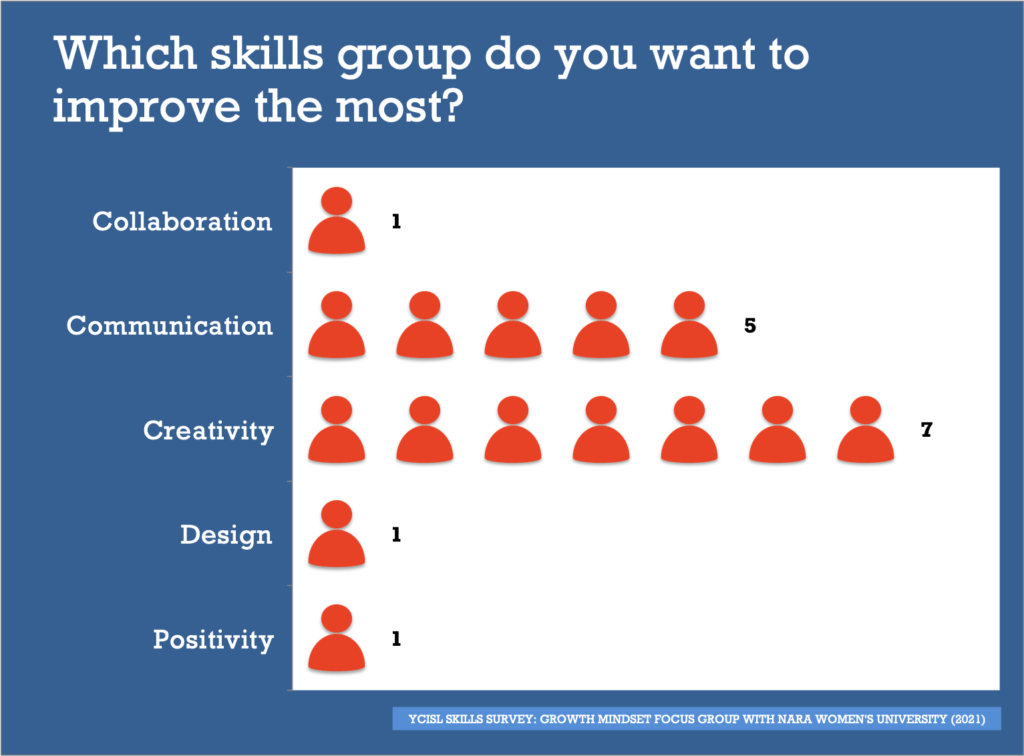
Almost half the students were interested in improving their creativity skills which is great because the YCISL program focuses on creativity (or more specifically creative energy). Many students were interested in improving their communication skills which is helpful to know since we have our elevator pitch exercise. Having this kind of information could help us balance our workshop agenda with accurate eq awareness & management.
WSJ: Making Senses
There was a special insert in the Friday July 8, 2021 issue of the WSJ titled the “Future of Everything.” In the center spread was an article titled “Making Senses” by Angus Loten & Kevin Hand. The article widened my mind scope on the “smart” and “eco-smart” project themes that are a part of the YCISL ITW-DTI workshops being offered this summer. Advances in sensory devices and dataset building with the alignment to human preferences should find amazing applications in sustainability design thinking.
Transparency. We are very familiar with computer vision and image recognition, but most of this is with regards to shapes and little else in terms of physical characteristics. The advancement described in the article about transparency will lead to better depth perception and recognition of vessel contents.
Taste. The need for sensory systems in food storage (eg, refrigerators that can detect bad food) is taking a long time. Let’s hope the advancements in “electronic tongue” technology means we are near the point where we can greatly reduce wasted food. A premium market for this may be in wine since wine can improve or decay depending on various factors.
Touch. I have seen many fascinating videos of product assembly lines and food production lines to know that there is a lot of mechanical tools involved. Upgrades to these and other applications could help healthcare as well as more common needs.
Smell. The AI sensory application to robotic noses and identifying vapors can be used in enhancing or neutralizing odors. There are so many places where pleasing odors could enhance productivity and removal of objectionable odors could reduce distractions.
Hearing. Noise cancellation hearing devices are quite popular presently. Ever tried using one during air travel? Isolating voices using AI could process sounds so that no idea is lost among the “chatter” and everyone is heard. Ever been to a call center?
The common thread in these advancing areas is the collection of reference data. Even so, there is so much variability that it is challenging to consider anything as a reference. Things change very quickly and conditions can tweak channels. For example, in the food waste application I mentioned above: how much reference data would be needed to tell whether it’s time to discard your jar of sauerkraut?
Activity: Mentoring Short Essays
I have asked the mentors who have participated so far in the current season’s ITW-DTI workshops to compose short essays reflecting on their experience interacting with students and the life skills involved. The opportunity to mentor in a creativity setting is as significant to the YCISL program is as the opportunity to participate. The concepts of design thinking are as relevant to mentoring as they are to ideation and product realization.
This short essay collection assignment for the mentors is an additional chance for me to inspire these few students to be leaders lifted by emotional intelligence and deep thought on their journey. I have a few ideas in mind on how to fulfill this request:
(1) Storytelling. Through our YCISL technique in storytelling, we paint world views which detail the setting and circumstance, and enliven it with actions.
(2) Elevator Pitch. Using our YCISL “The Art of the Executive Summary” technique, we edit scenes and storyboard them in different orders to check for flow and meaning.
(3) Your Personal Story. Using our 3-part YCISL Your Personal Story technique, we build a resume-like chronicle of our past experiences, our present mindsets and behaviors, and ideas on our aspirational pursuit of meaning and fulfillment.
This could turn into one of those procrastination-type endeavors, so I am setting a 30-day goal of completing this assignment. Better this way anyway as the ITW-DTI workshops are still quite fresh in memory.
