
Category: Ideas
Bloomberg: “The New Magic Word for Branding is Collaborations”
Earlier today, a Bloomberg Quicktake: Explained video popped up on my YouTube screen. The title “The New Magic Word for Branding is Collaborations” mentions two words sometimes seen in the YCISL program – branding and collaborations (I also realize I don’t use the word “magic” much).
“…the magic that happens when brands co-mingle fans.”
In this video, Ben Schott talks about how well-known brands team together to create a blend that succeeds in explosive curiosity among existing consumers. He gives several commercial examples. Not that this strategy works every time, but it is a worthwhile simple strategy to apply our creative energy.
How this connects with YCISL:
- Divergent-Convergent Thinking – it would be useful to first use divergent thinking to list all the candidates for the collaboration. Next, a brainstorming technique like the one we use with sticky notes could list combinations and then convergent-ly sort these combinations from normal to crazy (reminder: recall that the point of this exercise is to find unique competitive ideas).
- Feature List – with the “crazy” candidates, primary feature lists would help set up a brand identity that satisfactorily provides RoI to the combining brands. Satisfaction would be based on (a) no negative effect on the original brand, and (b) a sensible fit between the brands that is supportive and associated.
- Fail Early, Fail Fast – Our rapid prototyping approach values weakness detection with low-cost investment of time, money and resources. This is a necessary refining step in the innovation process that challenges our fixed mindset and biases. We need to don our “Chief Detail Officer” cap (credit to Rory Sutherland) and appreciate the subtleties that result in powerful shifts.
Schott presents several good examples of collaborations that I would admit tickle our senses & move our sensibilities. One example that applies to me is his Beachhead category case of “introducing new shampoos to unsuspecting hotel guests.” My exposure to Le Labo Rose 31 Shampoo at some Fairmont Hotels set my high quality level impressions of both brands. I actually also prefer the small bottles associated with hotel amenities so the collaboration itself is a win.
What are the lessons for youth? Perhaps it is being aware of our collaboration mindset (a willingness based on a growth mindset) and the ability to act in a productive collaboration (ref. Mel Robbins’ 5-second rule). Put effort into teamwork and team-building.
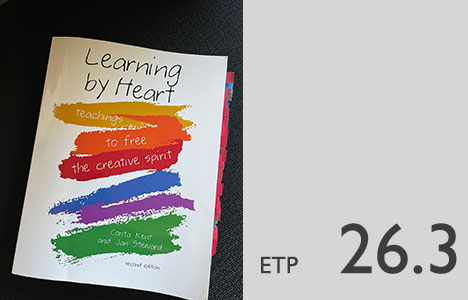
BOOK: “Learning by Heart” by Corita Kent and Jan Steward, Second Edition
I was sparked to learn more about Corita Kent from a section of Austin Kleon’s book “Keep Going.” I watched a bunch of YouTube videos (eg, Art + Life Rules from a Nun) and wandered through the Corita Art Center website. Already fascinated by the art, mindset & story, I ordered the book “Learning by Heart” from Amazon.com. I learned a lot from this book & have some notes to share here especially in the YCISL context.
- “Looking is the beginning of seeing.” p.33. This is meaningful to me because I often go from one place to another without being aware or appreciative. I often think back a minute or two, and wonder where I had just been. More of a blank than a blur. I think this is a good reason to have photo essay & video assignments in the YCISL program: taking a blur and trying to sharpen the important parts. Even in a more focused design thinking state of mind, this expression helps remind us to practice divergent thinking (look) & convergent thinking (see): we can look through Corita Kent’s Finder to quickly find a variety of framed content, stories & perspectives, then choose one to evaluate for a closer look (our prototyping phase).
- “The concepts of limitation, structure, and boundary are sometimes looked on as inhibitors of our creative energy.” p. 82. I am particular excited to see the phrase “creative energy” because that is one of the concepts that YCISL started with. This also connects with our use of Gamestorming where we have the Open phase which is made up things like “limitation, structure, and boundary.” Creative energy really comes into play mainly in the Explore phase. Still, remember that creative energy can be applied in the Open and Close phases if we choose: we can be creative about setting the rules (eg, our YCISL ping pong exercise) & reaching closure (eg, our YCISL launch presentations).
- “Every child is creative – until the time when teachers, parents and other adults in her world begin to patiently explain the way things should be, what connections can or can’t be made.” p. 104. This reminds me of Sir Ken Robinson’s TEDTalk “Schools Kill Creativity” and the idea that creativity is suppressed starting early in life. I like the graphical image of creativity conjured by the word “connections” where our creativity process really is about making connections – demonstrated by our YCISL Fast Thinking exercises especially the Associative Architecture “What do cows drink?” question.
- “PLORK…we need a third word – one which combines the two concepts and allows us to recognize them together as one responsible act necessary for human advancement.” p. 159. In the YCISL program, the words “fun” and “party” are introduced in at the start of the workshops with the intention of setting the senses & mindsets to a dynamic mode. The combination of play & work also reminds me of Tim Brown’s “Tales of Creativity & Play” where he says “And if you’re starting a design firm, let’s say, then you probably also want to create a place where people have the same kind of security. Where they have the same kind of security to take risks. Maybe have the same kind of security to play.”
- Immaculate Heart College Art Department Rules. p. 176. Also known as the 10 Rules Poster. I am surprised by the absence of an explanation of these rules in the book. I imagine these reflected the mindset expectations in that college setting. Still, we can gain wisdom by connecting these rules to our own settings. In particular, note the rule “The only rule is work” in large type, serif type and bold type for obvious emphasis. This attaches to many ideas quoted in YCISL that it takes work, often “hard” work, to be creatively productive.

Reflection: NIFTI Roundtable 2021 “Sustainability in Education”
“Envision an education where sustainability is a core academic subject. Imagine students empowered by global sustainability actions. The NIFTI Roundtable 2021 will bring together education stakeholders to brainstorm and shape a platform of curricula, courses and experiential learning programs to re-define how we learn about sustainability.”
The first NIFTI program (August 14 – October 2, 2020) was a seminar series coupled with a group discussion. In an idea for a followup activity, a NIFTI Roundtable was developed where there would be an organizing committee comprising a small select group of invited NIFTI students. The seed idea was to reverse the students’ roles as audience to organizers, and provide a leadership opportunity. The initial scope called for the students to invite an audience comprising students and educators from their school. The purpose of the roundtable would be to share viewpoints and experiences on a sustainability topic.
We had our organizing committee kick-off meeting on December 18, 2021. There were initially 4 students on the committee. We floated topics that would interest us as well as our prospective audience. At the second meeting on January 15, 2022, the topic of Sustainability in Education eventually stuck. We then discussed organizing timelines, roles and the agenda. We decided to have a Zoom meeting instead of a webinar mainly to allow for stronger engagement.
Progress on organization was slow with students managing with the disruptions to their schooling caused by Covid-19-related responses. After more than 8 months of intermittent progress and passed deadlines, the NIFTI Roundtable was scheduled as part of the Fall 2021 NIFTI program. The audience became the students in that NIFTI program and the panelists comprised educators and students. That firmed up the event date and audience. We then focused on the agenda to make it attractive and fresh.
We had the NIFTI Roundtable on December 3, 2021. We learned a lot about what the educators and students at Sekolah Bogor Raya were doing in the area of sustainability in their school environment. Several students shared their experiences in organizations addressing sustainability. Committee members served as hosts and engaged the panelists and audience in dialog. We had a Mentimeter poll. We had Zoom breakout groups for social networking. We had a brainstorming session. We created an Instagram hashtag so students could post ideas for educational activities on sustainability.
While the organization and delivery of this event was not easy, it was a worthwhile effort to bring us awareness about opportunities to get sustainability to a top tier level in education. The journey has just begun. And we hope others will join this effort to elevate sustainability in our lives.
Epilogue: We are planning on publishing an e-book on this experience. The organizing committee has been invited to contribute chapters covering the organizational effort and event notes. I also plan to author a YCISL White Paper on my reflections about what I learned about Sustainability in Education from this activity.
BOOK: Keep Going by Austin Kleon
It’s been a while since I finished reading a book all the way to the end – without skipping anything. “Keep Going” by Austin Kleon (2019) follows “Steal Like An Artist” and “Show Your Work” which I have reviewed previously in this wiki. His idea of separate analog and digital workspaces has been a concept that I bring up in YCISL workshops frequently to help students understand that there are two (or more) modes to make creative thinking work – such as in our divergent-convergent thinking exercise. The analog connects to the divergent thinking creative side whereas the digital connects to the convergent thinking focus side. This incidentally connected well when I read (actually I listened to the audiobook) of “Thinking, Fast & Slow” by Daniel Kahneman where he describes two systems that operate together to enable our thinking.
“Keep Going” continues the series in his concise and practical, personal and reflective style. The overall theme relates to a sort of biorhythm where his creativity vibrance rises and ebbs, and the resonance he has found in the personal stories of other creative artists to help him “keep going.”
“Lots of people want to be the noun without doing the verb.” Sad, but true. In the various frameworks we display in the YCISL, we have nodes with labels (the nouns) connected by actions (the verbs). This is especially embodied in the emotional intelligence framework where our awareness is connected by management. We also present design thinking as an exercise focused on both form (noun) and function (verb) in order to be compelling and complete. In terms of practice, think of the noun and verb as a pair and be creatively quick in coupling them. This would make an interesting YCISL exercise. For example, I could show a noun then have students come up with three verbs for that noun. The reverse of giving a verb or two, and asking students for a noun to match may also be good for thinking agility.
“One of my art heroes was a nun.” To me, this may be my most fascinating discovery in this book. After reading about her in the book, I Googled Corita Kent and found a treasure trove of things I could use in the YCISL program: (1) Immaculate Heart College Art Department Rules, (2) “You are who we love.” A collaborative poem for Corita Day posted online at corita.org website, (3) the Corita Kent Art Collection, (4) the Finder, a simple tool used in “experimentation” to frame views, and (5) the term “Plork” combining the words “work” and “play” and describing the resulting emotional uplift [reminds me of Richard St John’s TEDTalk where he says “It’s all hard work. Nothing comes easily. But I have a lot of fun.”]
“In an age obsessed with speed, slowing down requires special training.” In the basketball training paradigm that we use in YCISL, this means being able to switch modes – between ball handler and supporter, or between offense and defense. Speed (and focus) can be critical in some situations, whereas slowing down (assessment) is needed in others. In a reverse way, the YCISL also emphasizes a need to be able to engage in fast creative thinking in problem solving because education generally teaches us to store and recall.
“To slow down and pay attention to your world, pick up a pencil and a piece of paper and start drawing what you see.” The YCISL ITW workshops have been using drawing as a means to express the design thinking form and function. Perhaps more in line with Kleon’s “what you see” motive, we can use the drawing method in a problem statement finding exercise which would promote the attention to the world (or worldview) that we need. Does this have the same meaning as “Stop and smell the roses”?
“What you choose to pay attention to is the stuff your life and work will be made of.” The idea of listening filters and fidelity is something learned from “Understanding Other People” by Beverly D. Flaxington, and is the premise behind our workshop exercise in learning to turn off listening filters and fully listen to the information being transmitted. Paying attention to certain things and not paying attention to others is our way of filtering and prioritizing. How the rules of those filters are written and ordered affect our perception and consequently influences our mindsets and behavior. More importantly, our mannerisms and behaviors reflect these filters and shape our identity.
“Of course, to change your mind is to do some real thinking.” How do I know if I am doing some real thinking? I’m not sure, but I hope that I am able to do it at least some of the time. Personally, I am open to changing my mind as well as others changing their minds – so long as it isn’t in a vacillating manner or with ill intent. So long as the change is based appropriately in intelligent and intellectual navigation, it should be expected and welcomed. This connects with our YCISL interest in the growth mindset where we are open to new ideas and experiences that may turn out to be good or may turn out to be bad or non-events. But recognizing that real thinking is “hard work”, it might not be available all the time – although we should train ourselves to build stamina for it. In YCISL, I think our prototyping exercises and the concept of iteration strengthen us in mindset, skills and abilities so that changing our mind is practically normal and necessary with no dings on our self-confidence and sense of direction.
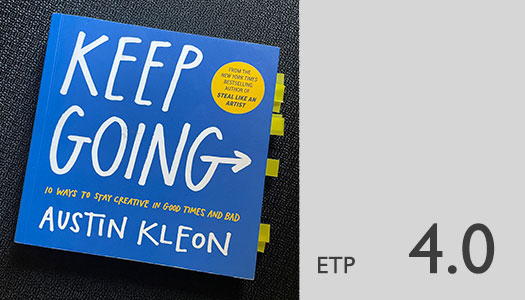
Why is the ETP relatively low? I didn’t mark as many parts of the book as compared to Kleon’s other two books. And what I did mark was isolated between pages 65 and 136, a total of 71 pages out of a 201 page book. Then again, the mark for Corita Kent would get a 10x impact factor (if I had such a factor) which makes me super grateful for this book. I recall my thinking being sidetracked in the latter part of the book a couple of times in a way that I started feeling disagreeable. The language used in the treatment of Marie Kondo’s tidying method pinged of singularity (eg, the use of the negativity words “propaganda”, “mania” and “fetishize” in a single sentence) and blocked my search for practical extensibility. It was good and interesting storytelling in the latter part of the book…the fresh air and the walks etc…but I was no longer on the same journey. I became a spectator. Oh well.
Thoughts: Building NIFTI 2.0
NIFTI 2.0
Last weekend, we kicked off the second year of the NIFTI program. I am calling it NIFTI 2.0 – The Sustainable Futures Initiative. Our primary focus will be on sustainability design thinking. There are many situations where sustainability design thinking is absent. The California water crisis is one.
The YCISL program sees sustainability design thinking as comprising smart programming, debugging and release to early adopters as prototypes. We will coach students to get divergent-convergent thinking to be instinctual and an essential ingredient of their emotional intelligence practice.
The new NIFTI will be less about career guidance, and more about upgraded and upgradable thinking skills. We will pollinate NIFTI with exercises from the ITW program so that students can envision what the next-generation of leadership needs to do – and how to do it.
If we were to give the current NIFTI group of students the challenge of solving the California water crisis, how would the divergent-convergent thinking process go? I think first we will have a long list of people who would be accountable. We will then have a comprehensive list of reasons for the water crisis perception. On the convergent side, we would design innovative solutions – perhaps a trio that get all stakeholders to realize we have a glass half full and the challenge is to get it more full, and not prevent it from getting emptier.
One of the premises I presented in the introduction to NIFTI 2.0 is “Sustainability has a PR problem” and that this explains why sustainability is stuck (stuck in the negatives as Alison Ledgerwood puts it) – and why it is so hard to move ahead. I am hoping that the NIFTI students will learn design thinking strategies to make sustainability behavior popular (like phenomenally popular) and practically naturally. And this leads to our NIFTI Roundtable 2021 topic of “Sustainability in Education.”
Google Data Studio: YCISL Skills Survey
I have been wondering how to create web dashboards and came across Google Data Studio. While learning how to use Google Data Studio, I played with visualizing the results from the YCISL Skills Survey. I aggregated the results from several YCISL workshops including two NIFTI programs, one ITW workshop and one YCISL Focus Group; there were responses from 107 students.
I will be starting the another NIFTI program next week and will update this dashboard when the survey results are in.
First, a few things I learned about using Google Data Studio:
- Collect GEO information. Google Data Studio includes a Google Maps chart which looks cool and would show the worldwide reach of the YCISL program.
- Try to eliminate chances for duplicate entries. I use Google Forms to do the survey and that is collected into Google Sheets. I manually moved data from each event’s survey to an aggregate Google Sheet from which Google Data Studio accesses data. I did this because I needed to clean out duplicates manually in Google Sheets.
- Include time stamp information. This allows Google Data Studio to display data from different time frames.
And now some observations about what I found through Google Data Studio:
- Students rated their Positivity skills very high at 4 or 5. This is a great indication of growth mindset.
- Students rated their Design Skills as average with most choosing 3. This suggests that we could discuss the meaning of “design” in the same way we discuss the broadness of “creativity” and “leadership” so every one feels that it is accessible. It was also interesting to see that design was the skill most students wanted to improve. Fits well with our programming on design thinking and design-build.
- There are also several students who rate various skills at 1 or 2. This could be an indication of no prior exposure or poor past experiences. Pushes our YCISL program to try to turn this around by creating memorable great experiences.
Looking forward to collecting more survey feedback and updating this dashboard.
Thoughts: Framing Your Design Thinking Story
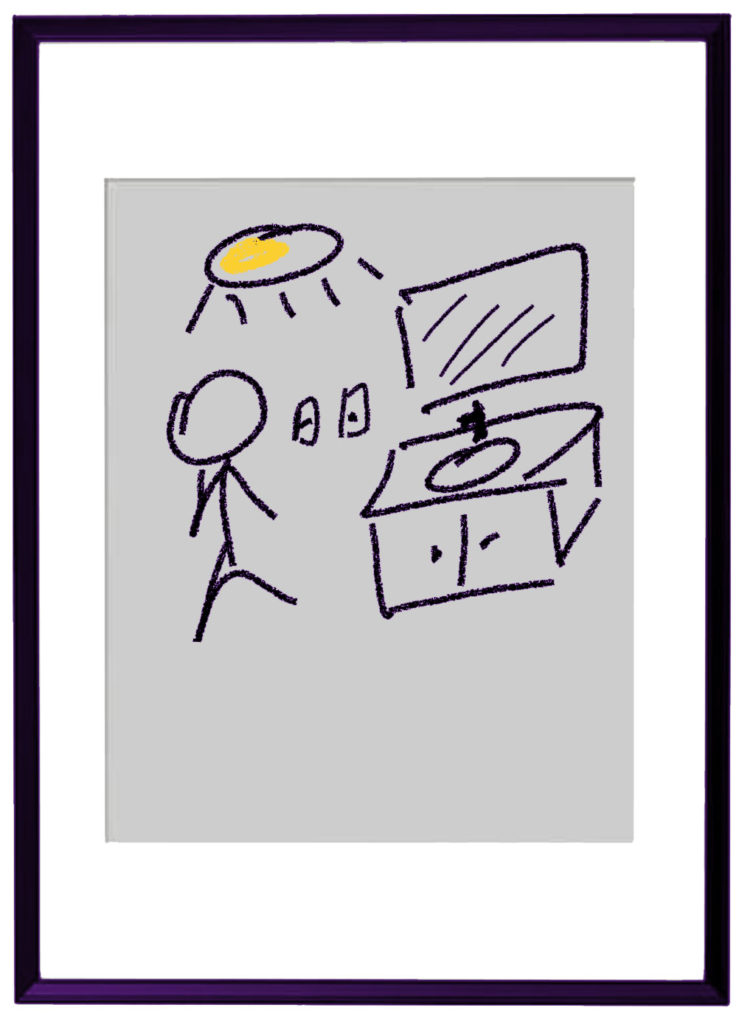
In the YCISL program, particularly with the project work, we have been taking our asking questions design thinking method and placing it in a storytelling frame. When ideating concepts, teams have to ask Who? What? Where? When? Why? & How? questions regarding the story frame they wish to open presentation of their concept. The aim is to engage the viewer to share or empathize with the problem or need. In a Thinking Out Loud session I recently presented in, I had students “doodle” a scene where their product and user were together. I asked them to try to answer as many of the design thinking questions as they could through their doodle sketch. Working on such a sketch helps teams learn their concept’s positioning and application circumstance as well as opportunities for adding details and filling gaps.
The doodle sketch above reflects an exercise I have used where we look at sustainability in bathroom lighting.
Want to try this method? Here is a 3-step method to try:
- Form and answer the design thinking questions.
- Make a preliminary sketch using the answers.
- Add details to the sketch to focus on one concept message (eg, your problem statement or your concept statement).
Bonus: give your sketch a title (could be your concept title).
LinkedIn: The Lego Data Story
You know, YCISL and “Lego” (the pieces) have been together since the start. We’ve had our Lego Exercise since our first workshop in 2011. We’ve used it to demonstrate creativity, visualization and team collaboration.
In my LinkedIn newsfeed this week, I saw a graphic that uses Lego pieces. I managed to trace it back to a company called Hot Butter Studio and a photographer named Brandon Rossen. The LinkedIn version is an extended modification of the original and I found yet an even more extended version on Reddit in an article titled “The Lego Data Story, adapted from original image by Monica Rosales Ascenio.”
I find the LinkedIn version thought provoking when it comes to design thinking. In our YCISL ITW-DTI design thinking workshops, we are using an asking questions method to acquire pieces of information that subsequently get architectured into a story worldview. This model also fits well with our Divergent-Convergent Thinking Feature List exercise where we gather as many options as possible, categorize them into priority levels, and use select attributes to differentiate for innovation.
I feel the “Explained with a Story” step enters the emotional intelligence realm by applying resources with purpose and meaning. The prior four steps (data, sorted, arranged & presented visually) are essentially analysis steps and would be considered part of the knowledge intelligence …and as per the YCISL KI + EI -> LI formula, we need to flex our EQ to achieve leadership and success.
If we also remind ourselves of Sir Ken Robinson’s thought that “In fact, creativity — which I define as the process of having original ideas that have value — more often than not comes about through the interaction of different disciplinary ways of seeing things.”…we also can appreciate the Actionable (Useful) extension of this graphic because the energy we put into our own creativity is intrinsically motivating when we receive feedback that we are serving something of value (further credit to Richard St John’s thought “…you’ve got to serve others something of value.”)
WSJ: Making Senses
There was a special insert in the Friday July 8, 2021 issue of the WSJ titled the “Future of Everything.” In the center spread was an article titled “Making Senses” by Angus Loten & Kevin Hand. The article widened my mind scope on the “smart” and “eco-smart” project themes that are a part of the YCISL ITW-DTI workshops being offered this summer. Advances in sensory devices and dataset building with the alignment to human preferences should find amazing applications in sustainability design thinking.
Transparency. We are very familiar with computer vision and image recognition, but most of this is with regards to shapes and little else in terms of physical characteristics. The advancement described in the article about transparency will lead to better depth perception and recognition of vessel contents.
Taste. The need for sensory systems in food storage (eg, refrigerators that can detect bad food) is taking a long time. Let’s hope the advancements in “electronic tongue” technology means we are near the point where we can greatly reduce wasted food. A premium market for this may be in wine since wine can improve or decay depending on various factors.
Touch. I have seen many fascinating videos of product assembly lines and food production lines to know that there is a lot of mechanical tools involved. Upgrades to these and other applications could help healthcare as well as more common needs.
Smell. The AI sensory application to robotic noses and identifying vapors can be used in enhancing or neutralizing odors. There are so many places where pleasing odors could enhance productivity and removal of objectionable odors could reduce distractions.
Hearing. Noise cancellation hearing devices are quite popular presently. Ever tried using one during air travel? Isolating voices using AI could process sounds so that no idea is lost among the “chatter” and everyone is heard. Ever been to a call center?
The common thread in these advancing areas is the collection of reference data. Even so, there is so much variability that it is challenging to consider anything as a reference. Things change very quickly and conditions can tweak channels. For example, in the food waste application I mentioned above: how much reference data would be needed to tell whether it’s time to discard your jar of sauerkraut?
Activity: Mentoring Short Essays
I have asked the mentors who have participated so far in the current season’s ITW-DTI workshops to compose short essays reflecting on their experience interacting with students and the life skills involved. The opportunity to mentor in a creativity setting is as significant to the YCISL program is as the opportunity to participate. The concepts of design thinking are as relevant to mentoring as they are to ideation and product realization.
This short essay collection assignment for the mentors is an additional chance for me to inspire these few students to be leaders lifted by emotional intelligence and deep thought on their journey. I have a few ideas in mind on how to fulfill this request:
(1) Storytelling. Through our YCISL technique in storytelling, we paint world views which detail the setting and circumstance, and enliven it with actions.
(2) Elevator Pitch. Using our YCISL “The Art of the Executive Summary” technique, we edit scenes and storyboard them in different orders to check for flow and meaning.
(3) Your Personal Story. Using our 3-part YCISL Your Personal Story technique, we build a resume-like chronicle of our past experiences, our present mindsets and behaviors, and ideas on our aspirational pursuit of meaning and fulfillment.
This could turn into one of those procrastination-type endeavors, so I am setting a 30-day goal of completing this assignment. Better this way anyway as the ITW-DTI workshops are still quite fresh in memory.
