
Category: Ideas
WSJ: Interior Gardens Hit the Wall but Don’t Forget to Water Them

This article (WSJ May 30, 2012, Personal section) reminded me of Rik Juan Yikai’s design of a green office divider. I am going to order a few of the Wally Ones by the Woolly Pocket Garden Company: one to try out in my office, and the others to inspire similar thinking in a YCISL exercise, perhaps rapid visualization and prototyping. We can look at the feature set as well as the challenges that must have been faced in the design. Will we be able to detect any issues that were not addressed? The blend of garden greenery, home decor, architectural feature (uses wall space which is often ample in a home) and recycled material serves as a good case study for the YCISL.
Exercise: Uses for a Pail (Multitasking Revisited)
In extension to the entry titled “Unitaskers Bad, Multitaskers Good,” I am thinking that a bucket/pail might be a great object to ponder multitasking. I have several around the house and in the garden.
One approach would be to actually bring one or more pails in. We could do the brainstorming exercise (a) with no visual identification of the object (i.e., just tell them it’s a pail), (b) with an image on a screen or piece of paper (i.e., no 3-d impression), (c) with a pail sitting at the front of the room (i.e., observe from a distance, or (d) actually have participants play with one first or during.
I am also thinking to make this an experiment where we also develop a methodology and collect data for analysis.
We would give the same exercise to individuals not in the workshop to create a reference set of ideas for usage. The reference set would be longitudinal in age, and these references would be used to compare with the results from workshop participants.

Exercise: School Rules
Briefly, the idea is a PostIt type exercise where participants brainstorm changes to the rules at school. Simple targets may be the timetable (including start and end times, lunch breaks, etc) and dress code. How about rearranging the seating style in a classroom (oftentimes in rows)? I am sure we could also examine one or two sets of school guidelines to come up with more. This exercise hopefully mixes feasibility with fantasy, and reality with possibility.

Exercise: Team Design Challenge var.1 – Chute Races
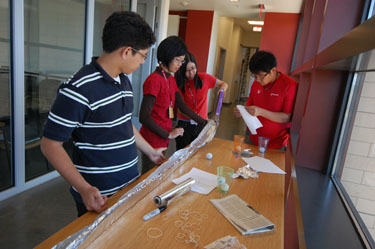
TEAM DESIGN CHALLENGE: ALUMINUM FOIL CHUTE RACES
This is partly a recount of the team design challenge from June 2011. It is also an opportunity to think why we do this exercise, and variations that are consistent with the objectives.
WHY?
To provide engaged team atmosphere.
To test team dynamics under time-constrained conditions.
To experience rapid team idea exchange, design and decision-making.
For the teambuilding lessons.
To create an impromptu structure of leadership and functional responsibilities.
To focus on blend of instant creativity and teamwork.
To work with basic (on-hand) materials.
Sometimes, when you’re given a small window of opportunity to prove or demonstrate something, you have to build that thing with just the materials at hand and with only your instinct about whether it will work. Think MacGyver. Think Top Chef Quickfire Challenge.
HOW?
Students will not be given the details of this exercise until the start of the time slot.
Time slot will be 3 hours: 15 minutes explanation, 30 minutes brainstorming and design, 1 hour construction, 1 hour set-up and execution, 15 minutes discussion.
The aim will be to design a chute using some basic materials.
Last year’s materials: aluminum foil (1 roll), elastic bands (1 box), paper clips (1 box), tape (1 roll), cup (1 ea), golf balls (4 ea), string (1 ball).
Materials are open to variation.
Examples: water instead of golf balls; chute must have Y- junction; baseball instead of golf ball; curvature (spiral, bend or mole-hill); ramp-jump; jump and land in receptacle (eg, a bucket).
Exercise: 90-Second “Elevator” Pitch

I mentioned the 90-second elevator pitch idea in an earlier entry based on my reading of “The Most Awkward Meeting: New Elevators Sort Employees, Foiling Manners And Face Time” that was published in the WSJ (http://online.wsj.com/article/SB10001424052748703509104576331044032063796.html).
Here is an attempt to formalize an exercise that could fit into one of the pre-speaker “mental wake-up/warm-up” workshop slot that have been under consideration.
PURPOSE: to get students to focus on the most important points, to think on their feet, and have a sense of time when they are trying to persuade someone. They need to appreciate that they need to grab attention and that once they have it, they only have it for a short time. [Aside: this makes me think of another WSJ article (April 24, 2012 issue) I just read “What Cocktail Parties Teach Us” by Melinda Beck (http://online.wsj.com/article/SB10001424052702303459004577361850069498164.html) where the term “cocktail-party effect” is used to describe how the “auditory complex boosts some sounds to help the brain prioritize what’s important.” I’ll reflect on the significance of this in another entry but suffice it say that one needs to gain the FULL attention of the listener to have an effective pitch experience.]
1. We will do this in teams. Whether we use the Project Studio teams, or some other team formation (for variety) is up for consideration. For example, if the number of members in each Project Studio team is quite different, it might be prudent to re-sort the teams so the number of people of team is the same – mainly to make sure we have the best chance of getting through the exercise.
2. Put an assortment of products into a box – one for each participant. Each participant will draw out an item and that becomes their product (or idea) to pitch. Perhaps include an option to employ something of their own.
3. What kind of products? Junk? The hottest gadgets? Weird things? I’ll get back to you on this.
4. After selecting the item, the “pitcher” will have 15 minutes to map out their pitch. I would suggest that the pitch includes a grab, a short set of feature highlights and differentiators, why people are going to be enchanted by it, and how there is competitive advantage. Of course, the pitcher should also use visual clues to steer their pitch as needed. For example, if eye contact is not attained or is lost (looks at watch, smiles at someone else), then it might be time to jump to Plan B or the next grabber.
5. The pitch. Will need some sort of timer, probably in view of the audience but not the pitcher (or maybe both actors).
6. Feedback. The pitchee should give a quick , spontaneous and genuine response when the time is up. It could be something like “I’ll take 100!” or “Send me your business plan” or “Come to my office later and tell me more” or …
7. Maybe we should video these interactions on an iPad for later review?
Book: Drive by Daniel Pink
This is the entry to review my thoughts on the book “Drive” by Daniel H. Pink. I found the writing style highly persuasive and engaging. For the YCISL workshop, there is quite a lot to relay [in fact, I did use several topics from this book in the June 2011 workshop].
The main idea that comes through is that intrinsic motivation is very powerful and enduring. While extrinsic motivators such as cash incentives can result in increased yield, its effects are temporary and decline in peak performance with every use – like with rechargeable batteries. Extrinsic motivators also include punitive actions which are equally unsustainable and ineffective.
For our YCISL context, particularly notable is the section “Type I for Parents and Educators: Ten Ideas for Helping Our Kids.” The idea of a DIY Report Card is interesting in the sense it might have a positive motivational effect (traditional report cards would have, I would hazard to guess, about a 50-50 chance of being motivational – because of the limitations to standardization) with little downside. Pink states that “Good grades become a reward for compliance – but don’t have much to do with learning.” I’m not sure I would agree with exactly with how Pink proposes it should be done – his description sounds like an adult workplace performance review – another thing not to expose to youth. What if the report card, for say an elementary student, was done within the framework of a SkillScan card sort? Analyze how the cards get sorted at the start and the end of a term, and see if there is a correlation to the teaching effectiveness and student behavior.
Other notables:
(1) In the section “Words”, page 138: “And a powerful way to provide that context is to spend a little less time telling how and a little more time showing why.” I should constantly remind myself of this point. I am very focused on the typical failure to show “how” because of the attention paid to “Here’s point A, and there’s Point B”; to keep my message engaging, I need to periodically remind ourselves of “why.”
(2) In the section”Purpose”, page 130: If so, when am I going to do something that matters? When am I going to live my best life? When am I going to make a difference in the world?” The author’s point is that motivation is suppressed in adults to the point that delay after delay is the norm in leveraging that motivation. This suppression of course is that which we experience as children in our learning environments, and carries on in adult life in various other forms.
(3) In the section “Oxygen of the Soul”, page 127: “The days that people make progress are the days they feel most motivated and engaged.” Also, “You start to get ashamed that you’re doing is childish” <- this second quote is attributed to Mihaly Csikszentmihalyi.
(4) In the section “Type I and Type X”, page 75: “Type X behavior is fueled more by extrinsic desires than intrinsic ones.” And “For Type I’s, the main motivator is the freedom, challenge, and purpose of the undertaking itself; any other gains are welcome, but mainly as a bonus.”
(5) The Three Elements are “AUTONOMY”, “MASTERY” and “PURPOSE.” I would call these the ideals for motivation.
(6) The Four Essentials of Autonomy are “TASK”, “TIME”, “TECHNIQUE” and “TEAM.” I would call these the ingredients that need to be assembled into an engagement in order to attain the Three Elements.
(7) Motivation 1.0 to 2.0 to 3.0: overall, I am not certain that version 3.0 is going to supplant version 2.0, and even whether version 3.0 is real or better or even an actual stepping stone (maybe it’s actually an alpha or beta version currently?). There is mention on page 19 about version 2.1. Perhaps for the time being, we would be better off using version 2.1 and waiting for version 3.1 instead of jumping into 3.0? Version numbers aside, it would seem that we want to focus on the features of 2.0 we should retain, and add a digestible set of new features – in order to design a new way of doing things. Granted this isn’t “disruptive” which is how some people think things should be done (aka the grass is always greener on the other side).

Book: Enchantment by Guy Kawasaki
I just finished reading “Enchantment: The Art of Changing Hearts, Minds, and Actions” by Guy Kawasaki. It joins my collection of Could-Not-Put-It-Down books. It was overall a fluid and well-structured treatise filled with practical suggestions and insightful observations on behaviors that trigger responses of inner attraction and appeal. (Underlines are my way of “sucking up.” Read the book and you’ll get the idea!)
[I will digress for a moment to put enchantment in terms of the ion attraction models that I am familiar with. If two bodies are at infinite distance apart, there is theoretically zero attraction. At any real distance however there is some level of attraction (think exponential decay, approaching but never reaching zero). As the bodies get closer, there is an increase in attraction. At some point, the bodies are close enough to be involved in some weak holding pattern (the outer layer of influence -> speaking in 2d but we could just as readily say outer sphere for a 3d model). Closer still, the bodies interact and actually form a strong bond (high energy) and deviation becomes limited (an inner layer that is somewhat structured and ordered). If the resulting proximity of the bodies can result in a reaction, then the two bodies might transform into a new entity (hopefully stable) OR if there is a propensity for it, a smaller body might bind in the inner channels of the larger body.]
So how did that relate to the book at hand? Enchantment discusses a phenomenon like the inner layer bonding. Enchantment happens at a point at which reactions are likely to occur and there is a level of fixation. But the bodies need to get close enough, through the outer layer – and in a realistic scenario there will be many competing bodies that will serve to thwart bodies reaching the inner layer level (unless sheer Brownian motion or physical momentum causes an actual or near collision).
Time to list my favorite parts of the book:
(1) I found Chapter 2 How to Achieve Likability – Make Crow’s-Feet a great way to show that Enchantment is a genuine and honest pursuit. You can think about your own likability as shown by your muscle behavior, or detecting other’s likability. Likability may be difficult for some to pervade or one may have a phobia about putting forth a likable personality. However, understanding that Likability is an early step to achieving a connection will help our students find an opportunity to even “step into the ring” to start their journey of innovation and leadership.
(2) Chapter 5’s discussion about the “First Follower” is worth presenting to our students.Working in teams in a school (where social structures generally guarantee the availability of first followers), it would be useful to begin the presentation of a new product or idea by having a first follower become engaged in plain sight of potential additional followers. [Quick digression: I guess this has started to get me to think about Flash Mob Dancing – what an exhilarating phenomenon!]
(3) In Chapter 8 How to Use Push Technology, I like the section on Email. Perhaps I will try it by composing an email to Guy Kawasaki, and see if this works for me (I realize mileage may vary). In particular, I like the advice to “Keep it to six sentences.” This is highly consistent with how I have created assignments in my teaching career. When I design an assignment or question, I am looking for an initial response showing that the student is revealing thoughts in an appropriate direction. I would prefer to leave it to the student to determine the depth to which they would go to be satisfied, and develop their answer in a short form just to convince me that that is where they are headed.
I would close by noting that there are many useful tips in this book that could potentially fit into the YCISL content and benefit the participants. These tips could help inspire us to create some great modules. However, the book does seem to weigh closer to adults so some refining or contextual adjustment may be necessary but when it comes to life lessons, there is great value that Guy Kawasaki has shared.
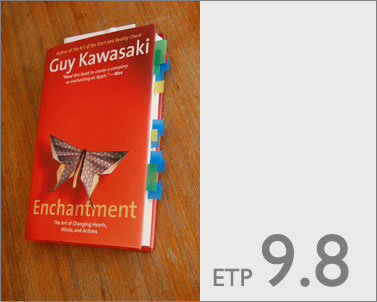
I am also quite excited to start a new analysis based on the fact that for the books I am reading in printed format, I am attaching PostIt tags when I find something that I may want to go back to because it might contribute to the YCISL program. Enchantment received 18 tags. For an 184 page book, that becomes an Earned Tag Percentage (ETP) of 9.8 (divide tags by number of pages then multiply by 100). I am also attaching a photo of the book with its tags showing, and will retroactively update earlier wiki entries with photos and their ETPs. What fun!
Module: Our Guest Answers Your Questions
Imagine you’re in a school lecture: how likely are you to ask a question? Imagine you’re competing in a science fair: how likely are you to have prepared your presentation with the help of questions? Just what opportunities are there for youth to learn to ask questions and ask them well? Not many really. Youth are taught mainly to provide answers. But the skill of asking questions, especially creative ones, is critical for discovery, innovation and leadership.
In a university setting, creative questioning sadly does not become a significant opportunity until graduate school. So, one of the skills our youth program would like to impart to youth is thinking of and asking good questions. First, it would help to know what kind of questions are at one’s disposal:
(a) clarification – perhaps the easiest because it safely stays within current scope and can cycle on itself until full clarity is reached.
(b) extension or tangent – the question could suggest a further conclusion or further work. Ask if it is useful to the discussion.
(c) speculation or propositional – the question could suggest an alternate interpretation or conclusion that has yet to be supported. Some element of risk but potentially impressive. Demonstrates vertical thinking.
(d) connecting – the question could ask whether the topic at hand is connected to another topic that was not presented. Demonstrates lateral thinking.
(e) gap-filling – the question could ask about the existence of missing information or if/when a gap might be filled.
(f) philosophical – especially useful in data-driven communications is to look for the intangible forces behind a work. For example, ask who would benefit from a product or new knowledge, or how a paradigm might shift as a result of the new findings or strategies.
(g) critical – a difficult question to frame because of potential misunderstanding and conflict. Requires experienced questioning skill.
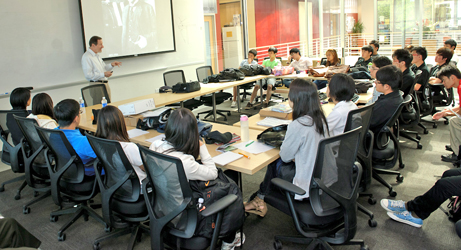
Now down to the practical application of this to a YCISL workshop. We could have a guest speaker prepare just a few minutes introduction or none at all. It would be entirely up to the audience of students to ask questions to drive the conversation. This is consistent with the desires to: (a) facilitate bi-directional flow of ideas and thoughts, (b) encourage students to discover by asking questions, (c) ease the pressure on speakers to formally prepare material or topics for their session, and (d) encourage spontaneity.
For this to work, we would need a good moderator. We might videotape such a session so the students can (a) review how they asked the question, (b) gauge the speaker’s reaction, (c) listen to the response elicited by the question, and (d) gauge the audience’s reaction to the resulting question-answer exchange.
And I should mention why I even considered such a module. It’s because I have observed how some students might not get connected with a speaker because (a) they are the silent type, (b) they are worried about how they will be perceived by their interaction, and (c) they are worried that their knowledge about the subject matter is novice and potentially annoying to the speaker. By putting the responsibility to drive the conversation on the students (and having a speaker who is open to questions), we can demonstrate to the students the importance of asking good questions.
Modules: Transitions
One idea for the next modules is to demonstrate the link between (1) creativity and innovation, and (2) innovation and leadership. This will reinforce the link and provide practice in connecting the pairs. As with a basketball drill, we could start with beginner/easy drills, and include optional steps to make it more challenging, if desired.
