
If I had nothing. Starting Over: A Reflection
Idea is to reflect on what you would be focused on if you were starting over and afresh. Many people in the developed and developing world lead cluttered lives and emotional luggage. Our attention is divided and we spend much of our mental energy sorting useful information from garbage.
Can we come up with an exercise to reflect on our priorities and imagine what it would be like to have nothing so that everything is a potential goal?
Thoughts: Meltdown Uncertainty
“They live up there, and slightly to one side.”
Sir Ken Robinson in his TED 2006 Talk “Do schools kill creativity?”
A lack of emotional intelligence can lead to a meltdown – which includes irrationality, insecurity and isolation. At the social awareness level, people will notice defensiveness (“I” language) punctuated by jabs of aggression, and impatience. Truth in negotiation and compromise are impossible as trust has shrunk. This is typically found in adult behavior and signals an absence of self-awareness and self-management. It is likely rooted in an imaginary fear and lack of true confidence where the senses are numb and non-functional.
When you run into such a person, it can be horrifyingly puzzling. You wonder whether it is a reflection of their true unguarded personality or a circumstance of recent events leading up to the melting point (then you don’t know if it will get worse or better).
This is the kind of situation our YCISL program endeavors to train young people to gird themselves against in their own behavior, and to be able to recognize this problematic “pothole” behavior in others. When encountering such behavior in adults, our YCISL position is to step aside or put yourself into reverse. There’s no value in trying to save the other person or offering help; they are in adulthood where behaviors are unlikely to change and biased mindsets are entrenched. Adults who learn leadership later in life mostly learn to put on a facade – a modified interface layer on top of a complex and messy structure.
In YCISL, we train teams to ensure group positivity before launching into creativity. We encourage teams to have quick techniques to lift up the positivity, but what should you do when each has been used?
WSJ: Why LeBron Trusts His Teammates
Not a big NBA fan. Been to just one pre-season GSW game when I first went to college and a WNBA game 15 years later. I do like basketball though. “Played” it (benchwarmer), coached it (youth leagues) and I include shooting baskets at the park court as an option in my exercise routine. As a spectator, I prefer NCAA.
Anyway, this article “Why LeBron Trusts His Teammates) by Ben Cohen and published in the Sports section of the June 6, 2018 edition of the WSJ caught my interest because I did watch much of Game 2 of the current NBA Finals. There was commentary about the “incident” in Game 1 and an analysis of LeBron’s body language. It’s worth noting because LeBron is clearly in a leadership position.
The article is also notable because it’s much about a story of LeBron’s past when he first played youth league basketball. I feel a connection because of my coaching youth basketball for nine years; and I learned a lot from this experience – some of it is used to build the YCISL program.
“But what happened that night is something that James has never forgotten” Perfect fit for the Message to My Past Self exercise in the YCISL Your Personal Story activity. Leaders are driven by life lessons that affect the growth mindset.
“Right then I knew that this was a team game” Teamwork and team-building are two leadership activities which we include in the YCISL program. The main challenge is to make good teamwork automatic and instinctively positive.
“At 9 years old…he knew how to pass to 7-year-olds without knocking them down.” Sign of emotional intelligence. Self-awareness, self-management, social awareness and social management.
“We both was good at what we did.” There has to be respect as well as trust in order to maintain a team’s positive mindset. How many leaders today can sit out and spectate one half of a “game” without getting in the way?
“It’s what he’s been trained to do since the moment he started playing this sport” The YCISL is a training program. It is structurally modeled like a basketball practice with a scrimmage thrown in. The life lessons that we provide to our YCISL youth will hopefully lead to future quality leaders who can readily apply EQ.
———
*This article is online at https://www.wsj.com/articles/why-lebron-james-still-trusts-his-teammates-1528211656. However, it’s title includes “(Still)” which is not in the print edition.
WSJ: Employers Find ‘Soft Skills’ Like Critical Thinking in Short Supply
In actuality, I am writing this entry in reaction to an article titled “The CEO of LinkedIn shares the No. 1 job skill American employees are lacking” that is posted on CNBC.com written by Ruth Umoh dated April 26, 2018. However, I feel that particular article is too limited in scope because it refers to “research” reported by LinkedIn which is limited in context. So I looked up a WSJ article (by Kate Davidson, August 30, 2016) with a similar idea – it does also refer to LinkedIn, but on a slightly broader scale.
From my YCISL perspective, EQ is lacking in a general way and that is being picked upon as a failing when trying to hire new employees. The ironic part though is that EQ is just as likely to be missing within a company as it is among those looking to join.
One could feel that there is ample critical thinking available, but it is easy to miss because of (1) a fear of sharing that critical thinking in a one-to-one or small group setting, (2) a lack of active listening where critical thoughts go un-heard because of cognitive filters, and (3) a socio-cultural norm where critical thinking should be kept to one self. After all, I see plenty of criticism (a representation of critical thinking) on Yelp! and YouTube. And in education, critical thinking still means that you have to converge to the same conclusion as the examiner.
With these constraints, one could also consider whether leaders are asking the right questions to generate the critical thinking they desire. Asking questions is a general weakness too in leadership and closely tied to teambuilding. We have thus come back full circle in the cause-effect analysis and suggest that the solution starts with LEADERS becoming more skilled at starting the cycle with (a) good questions, (b) keener active listening, and (c) creating a trusted environment where critical thinking is expected and valued.
WSJ: Partners in Blood
Few organizations in Silicon Valley implode like Theranos has. [There also was Solyndra.] But Theranos is a good case example for the innovation process for the YCISL program. This entry is based on the article “Partners in Blood” by John Carreyrou published in the Saturday/Sunday May 19-20 issue of the WSJ (Review section).
The article describes ultimately poor leadership skills on the part of two main characters in the Theranos story: Elizabeth Holmes and Ramesh Balwani.
By YCISL measures, they actually did a great job at problem-setting, brainstorming, and elevator pitch. They should also be given credit for product development with regards to setting a very compelling feature list.
However, there are two parts of the innovation leadership process that seem to not have been done according to Silicon Valley standards. One is the testing and readiness step. Alpha and beta testing must have revealed serious problems with what they had developed. Once the product was put in the hands of a real user, QA, QC, LIMS and all other lab protocols should have alerted everyone to problems.
The other step that went awry is prototyping. In YCISL, we emphasize “fail early, fail fast” in the prototype stage but Theranos kept developing a product past prototyping with showstopper failings. Any skilled analytical chemist would not trust data from small sample size due to the amplified issues with the “scientific method” including sampling error, sample contamination, sample preservation, and the conditioning of analytical instrument detectors. What Theranos did is an error usually made (but eventually understood) by first-time science fair students. The real failing here however is the denial of the flaws, and the inability of investors to resist the obvious fib. Fuel to the fire.
The lesson for YCISL is to be disciplined during the prototyping stage and even the testing stage. Be honest with yourself. Be willing to embrace failure and learn from it. Be comfortable starting again – Silicon Valley style.
Follow-on: I decided to re-read Jeff Raskin’s “HOLES IN THE HISTORIES” to remind myself how it only takes one acceptable “authority” to build a consensus resulting in fact but not truth. Theranos’ lie may have started as a small seemingly-manageable one, but one can imagine it getting out of hand once one investor bought in. At some point, people chose not to check primary sources and relied on secondary sources. People bought into the “fact” but took the truth for granted. Raskin also writes on DELIBERATE MISREPRESENTATION and the “reality distortion field” that Steve Jobs is closely associated with. This is a leadership “disease” which has spread widely and we should address by instilling stronger EQ in youth leadership.
WSJ: Advice to New Grads: Scale or Bail
As I make final preparations for my YCISL workshop this weekend with undergraduate students from the City University of Hong Kong, I read “Advice to New Grads: Scale or Bail” by Andy Kessler in today’s WSJ (Opinion Section in Monday May 21 21, 2018 issue; Inside View column) looking for spreadable wisdom from the author’s perspective.
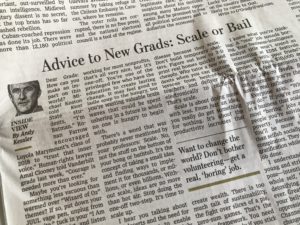
I thought it started off well, pulling in the advice that commencement speakers are giving at this year’s college graduations. Kessler’s main idea appears to be one of “scale” where the number of users are in the “thousands, or millions, or even billions.” His point about “Scale is about doing more with less” is quite inspiring – although I feel he needed the word “proportionally” in there.
To me, this resonates with Rory Sutherland’s point about “Stuff that has a big effect” and “Stuff that costs a lot of money” where there is opportunity to do “stuff” with big effect but costs little or no money. I think the key word here though is “opportunity” and it seems Kessler discounts opportunities and pathways (eg, “Stop doing one-off volunteering” and use of the word “Bail” in the title). It’s not that his advice is incorrect; it’s just that this advice itself doesn’t scale. It’s binary and not integrative. Innovation is about taking on uncertainty and risk. There is no guarantee.
Bottom line is that problems are everywhere and occurring all the time. Problem-solving – with huge (emotional) impact and rewards – spans all scales and requires action-takers willing to accept the possible outcomes. I think this article needs some framing correction for the social awareness component of EQ so that today’s graduates would be more willing to challenge their abilities and dynamically work with expectations on all scales.
CNBC: The world’s richest self-made woman shares her No. 1 key to success
I read an article on AsiaOne titled “The world’s richest self-made woman shares her No. 1 key to success” (by Serena Lin, dated May 8, 2018 on CNBC.com) which tells a story of Zhou Qunfei. For context, this was on CNBC.com in their Leadership section.
This story seems like a good one to touch on several YCISL ideas.
- For YCISL, we view success as having many forms (just as we do for leadership and sustainability) and perhaps the least encouraged way is on the level of attained wealth. As I scan the story, I see success in (a) how she pursued her dream of starting a business, and (b) how she teamed with relatives. Her personal commitment to perseverance is also a success.
- As we learn from Shawn Achor, we should place happiness before success. In the story, neither “happy” or “happiness” or anything similar are mentioned. Did she sacrifice happiness or has she not yet found any?
- The use of “self-made” in the article’s story seems incorrect. The article touches on several instances in which her support network kicked in. The fact that she started a family watch lens workshop shows that there was a support network. So too are her daughter and Motorola. Given this, I would have liked to have read about how she has shown gratitude to her supporters.
- In YCISL, we train in “fail early, fail fast” and discuss how one of Silicon Valley’s key strengths is the embrace of failure (or failing well) and one’s ability to rebound with learned lessons from failure. The part of the story where she is contemplating jumping from a train platform illustrates the opposite.
- There are two photos of Zhou with wide smiles. Applying Guy Kawasaki’s lessons on real smiles (ie, associated with positive mindset), I wonder whether she has a positive and growth mindset – which I consider critical elements on leadership.
Overall, I feel it’s a good Your Personal Story. It starts with a strong reflection of the past (especially a series of good decisions that seems like she would make again if she had to), an identity in the present (such as Brother Fei), and…ok, the story is missing a message to her future self. Almost there.
A Study in Contrast: Smart Ideas vs Un-Smart Ideas
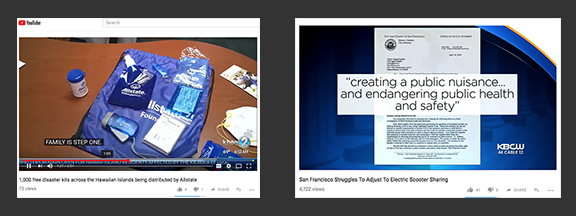
When choosing a problem and solution for the YCISL Project Studio, teams are guided to draw from their own “universe” and work on something that comes from their own experience or an issue they are very familiar with. With our emphasis on creativity and innovation, we also encourage students to work on the “crazy” end of the spectrum. But by rollout, we expect the product and pitch to have a compelling form and story.
SMART IDEA. I am following news stories on the volcanic fissure and lava flow activity on southeastern part of Hawaii, and found the story about emergency kits for evacuees as a great example for the YCISL students. While emergency kits are generally generic (plenty of choices on Amazon), creating one for a specific situation in real time involves EQ, fast-thinking, and problem-solving. This activity also has elements of philanthropy (I don’t think they’re planning on selling these kits) and sustainability (the victims need resources which can sustain them). This would make a great model on which a YCISL team can develop something – such as a formula and process to create custom-kits as disasters strike.
UN-SMART IDEA. I was in the Financial District of San Francisco last weekend and found that the lack of EQ in how electric scooter sharing has been executed is comedic. Further, this clouded-thinking innovation has created more problems than it has solved – and there is a charge for it. Given this product’s propensity for safety risk and “pollution” (physically littering the streets), this is so un-sustainable. They’ve avoided design thinking. Had they tried to improve on issues with bike sharing in China? It’s quite obvious that the companies developing these scooter businesses are chasing free publicity in the marketing battle to see who will survive in this industry. To this end, could it be that they employ people to ride these scooters to garner attention?
YouTube Video: this $90 water bottle has a Hi Def Video Camera
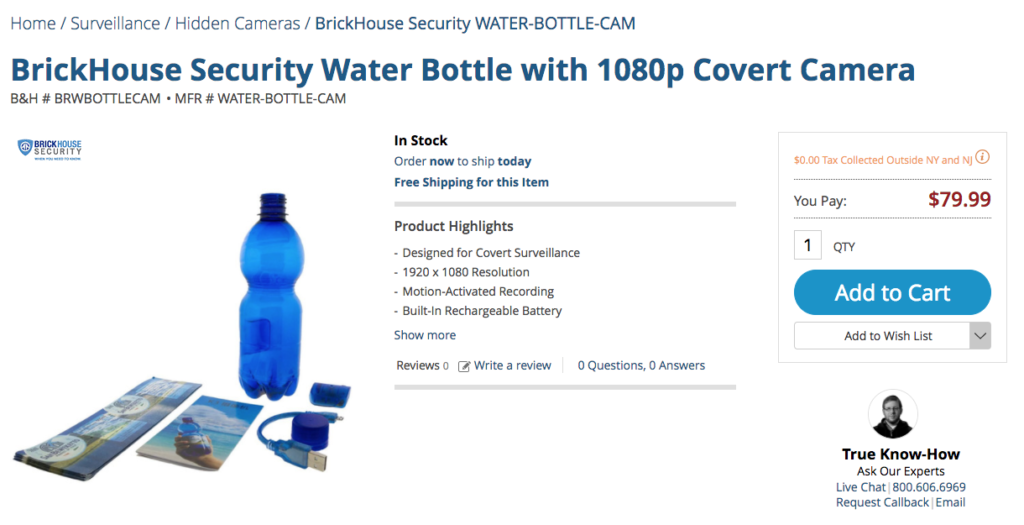 This morning (Tuesday May 1, 2018), Casey Neistat (actually I am finding several of his videos quite relevant to YCISL) posted a YouTube video review of a water bottle with a mini video camera built-in. The three main features (there are more, but you have to click on “Show more”) of this product as posted on the B&H web site are:
- 1920 x 1080 Resolution
- Motion-Activated Recording
- Built-in Rechargeable Battery
The product name, although wordy, adds to the draw: BrickHouse Security Water Bottle with 1080p Covert Camera. For interesting contrast, the BrickHouse Security web site calls the product “HD 1080P Water Bottle Hidden Camera” and the three main features are:
- Motion Detection Recording
- Supports Up to 64GB Memory
- Food Grade PET Plastic
We’ve visited the idea of a video camera in a water bottle in our workshop with teams that are assigned a GoPro Hero Session as their convergence inspiration for their water bottle design. While the GoPro is an action camera and less so (although capable) a surveillance/spy camera, it’s cool to see a company realizing such a product.
Beyond the convergence part of our exercise, positioning and framing could be factors considered for the presentation (an exercise in storytelling, perhaps). Framing would be the attempt to have prospective users imagine a scene in which the product is present, and positioning is messaging where exactly that product may appear within that frame. Framing and positioning are generally singular in messaging (lest you risk contradiction, confusion and dilution), but combining with the other elements of our elevator pitch exercise (eg, opportunity, ask and promise) should give rise to a compelling story. I feel the compelling story is missing which is why Neistat had both positive and negative recommendations in his review conclusion.
How Much Homework Is Enough? Depends Who You Ask

I probably should read “You, Your Child, and School: Navigate Your Way to the Best Education” by Sir Ken Robinson [published March 2018]. In a short cut way, I scanned through an “adapted excerpt” on the Education Week web site titled “How Much Homework Is Enough? Depends Who You Ask” which was linked from Sir Ken Robinson’s FaceBook feed – and to which I posted a comment (my first time ever, btw).
My comment read “The title and article suggests that the problem is quantity. I would posit that the bigger problem is actually quality. Repetition and application is part of learning for most students…and using the learned knowledge outside of a classroom setting is useful practice towards a lifelong love of learning. However, there is clearly an attempt at substituting quality with quantity. So basically we have a lot of homework with low value and little motivational factoring.”
I kept it quite brief, and had a few drafts before clicking to post. School homework is a touchy subject for many people, and I have commented on this topic from the start of this wiki, particularly stirred by Alfie Kohn’s “The Homework Myth” which I had read in 2011. Since that time, I have taken a critical eye of the homework that my kids have had to do. In my assessment, most of it was junk quality (the meaning of junk here is similar to how it might be used for junk food and junk bonds, or one man’s junk is another man’s treasure). It’s consumable by the masses, but the benefits and circumstances are iffy.
What is the meaning of homework (I am asking this in the same philosophical mood as the question about the meaning of life)? In my view, homework today is a tool of convenience for the education system. Their primary purpose is to differentiate students and justify the education system. But it can be so much more…more fulfilling, more motivating, more purposeful, more about growth and more embraceable.
The typical mode of homework operations reminds me of the criticisms raised by Adora Svitak in her 2010 TED Talk “What adults can learn from kids” in which she touches on reciprocal learning. Is there reciprocity in homework? Nope. From what I’ve observed, teachers are on a mission to get through the curriculum and show grades along the way. Checking homework is a chore (often caffeine-fed) to teachers and for many subjects, it boils down to comparing a homework to an answer guide. That is one of the consequences of the volume of homework that is addressed in the Education Week article.
I think it’s fairly obvious that the problem is the quality of homework. There is a massive QUANTITY of homework because the QUALITY is absent. The quantity is there to compensate for the inability to design homework to optimize for active recall, short and long-term retention, and individual needs. Further, homework perpetuates the problem of the focus on memorization by requiring only convergent thinking (aka logical deductive reasoning). To become a more sophisticated element of learning, homework needs to include divergent thinking in the process. Get that Growth Mindset (tip of the hat to Carol Dweck) into the mix. Train the students to make assumptions and give it a go. Explore the impossible and possible together.
What if teachers were required to design or re-design homework assignments on a regular basis? That is, they would be limited on how much they could rely on textbooks, the internet and other teachers. They would also not be allowed to re-use a portion of their homework from the past. Make it acceptable for the homework assignment to be imperfect. In fact, make sure the students understand that the homework is imperfect and have them deal with it. How enlightening would that be?
I think re-inventing homework needs to be a project that a team needs to work on in future YCISL workshops.
