
Exercise: Divergent-Convergent Thinking Training Worksheet
We introduce the idea of divergent-convergent thinking cycles in our YCISL workshops. It is the structured pathway method to creative thinking, decision making and problem solving. School curricula generally emphasize convergent thinking only which limits creativity.
Three years after releasing the Turn the Donkey lesson, a Divergent-Convergent Thinking Trainer lesson is being released to our YCISL LinkedIn group.
This exercise is intended for practice and as a reminder to apply divergent-convergent thinking cycles in our creative behavior. The exercise comprises a series of worksheets each formatted slightly differently to inculcate agility in how we apply the method to different situations.
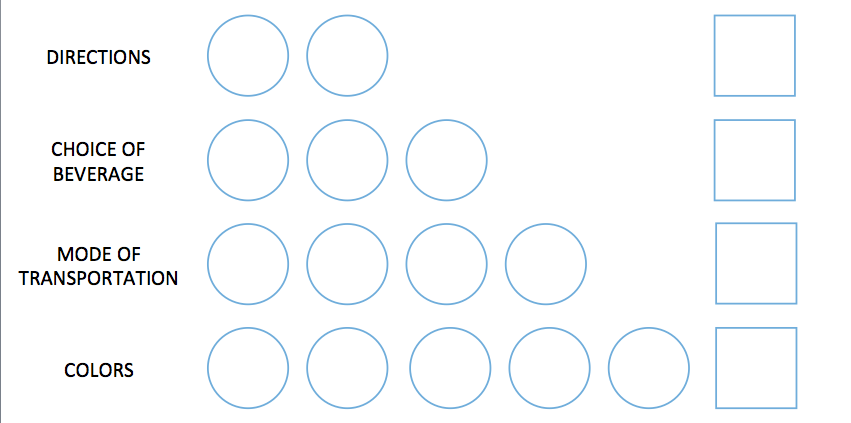
The first worksheet being released introduces divergent-convergent thinking in its simplest 2-choice form. Subsequent lines on the worksheet then stretch the divergent part of the exercise. Currently, the exercises converge on a single item, but in reality convergence could be on a group.
An example, run with the DIRECTIONS prompt with two circles and one square, might have Up (1st circle), Down (2nd circle) and Up (square) as an answer set.
The purpose is to train agility into the practice of divergent-convergent thinking, but also to familiarize us with the steps: interpreting the prompt, starting, completing the divergent part, and quickly finishing with the convergent part. Speed is key, but so is confidence in getting through the cycle.
And once the cycle is complete, a creative person should be able to start another cycle right away if needed.
Duncan Wardle: The Theory of Creativity (TEDxAUK)
I’m working on a YCISL White Paper currently on the question “Where is your creativity?” so that we can feel more secure by finding our own creativity and having it at the ready for when we need it. Speaking of which…Duncan Wardle asks in his 2018 TEDxAUK talk the question “When does your creativity flourish?” and describes a variety of “brain states” which explain our creativity behaviors.
One common theme in response to this “When?” question is when we are calm and relaxed. This is consistent with our YCISL approach through positivity and intrinsic motivation. The “door” to creativity is typically shut tight when we are stressed or feeling negative. And just being in a particular place that virtually reminds us of stress or negativity can have that stifling effect making the “when” seem like never.
In the YCISL, we have a variety of training methods to access our creative energy:
- seek creative flow and avoid pre-mature self-editing
- learn to frame the problem in different ways
- set a cyclic rhythm between divergent and convergent thinking
With these skills, we should have more control on the question of “when do find creative ideas?”
WSJ: Schools’ Tech Push Meets Backlash
What will it take for Education Strategists to focus on the Low Cost-High Impact area (reference to Rory Sutherland)? When will the enlightenment take place? A WSJ front page article titled “Schools’ Tech Push Meets Backlash” from the Wednesday September 4, 2019 issue storytells a significant instance of overpromise, underdeliver. A case of negative disruption and vague intentions.
Parents should question the value of pouring tech into education. Taxpayers in general should question it too. Another recent WSJ article (“Phones Buzz in Class—With Texts From Mom and Dad,” September 6, 2019) discussed how cell phones are disruptive in the wrong way. The act of equipping each student with an iPad or similar device is a step in the wrong direction. Such devices exacerbate pre-existing problem conditions in education.
Even in my university setting, I have a rule in my course syllabus where students have to stow their electronic devices during seminars because the devices are distractions to themselves, others in the audience and the speaker (accessible education students excepted). Using such devices during class time defeats the active listening and reciprocal learning channels that need to function.
I know as a parent that the required iPads in my children’s high school were a waste of money and impediment to learning. And think about the heavy burden of spam, junk email, fake this-and-that, gaming/social network addiction, and theft that this brought along as luggage. Why expose students to these diseases while at school?
Yes, there are some particular benefits to tech in education. Certainly have to admit that. And there is much potential if strategized in a specialized way. What if we took the current thinking of customized healthcare to education(care)? Perhaps students should only have access to and use a tech device for precision purposes? We need to be more mindful about what tech is doing to our young students.
Marvel, Prototyping & The Fast Thinking App
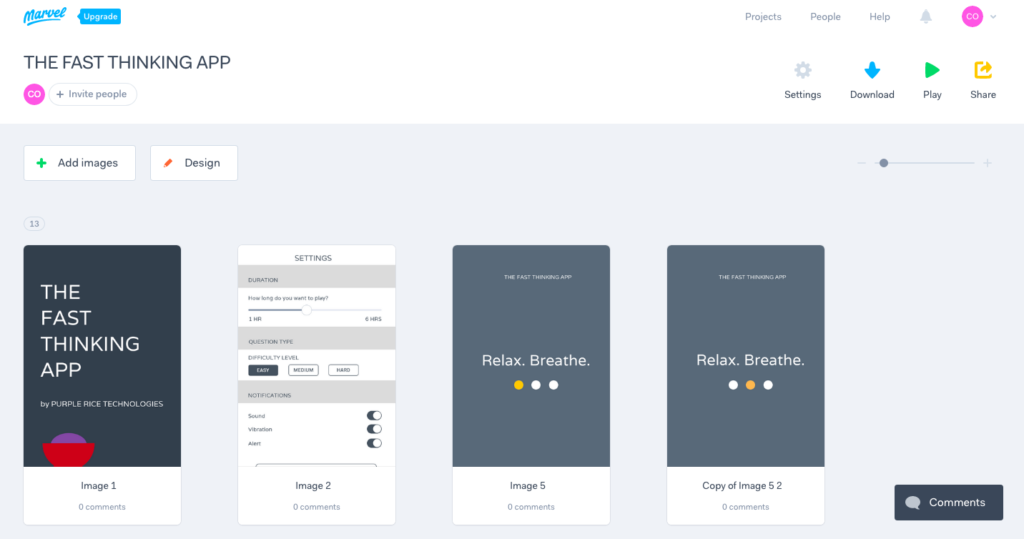 I recently learned about Marvel as a software prototyping tool from Tammi Feng. It has re-ignited my interest in software design (my last flame with software design was with Swift, but that faded within 3 months because it kept changing).
Marvel may have a place in the YCISL workshops. It seems easy to learn – especially what it can do and what might have to be compromised. But it fuels the design and process imagination and would be a great tool for project studio teams that want to produce an app. For our prototyping phase, it would support our “Fail Early, Fail Fast” mindtool (a component of our innovator mindset).
The Paper Airplane Exercise and Comfort Zones

In the YCISL workshops, we play the Birthdate game where a group of students have to line up in the order of their birth date (date and month, no year) without talking (and now with hands in pockets). This is to explore how they behave when their normal go-to method to solve such a problem is removed. Do they have leadership tendencies or do they immediately look for an available solution from someone else? Do they follow or help enhance the solution?
In 2019, we added the Paper Airplane exercise to explore the same comfort zone borders. The objective was set to maximum distance – and accuracy was thrown in by opening a door through which they could fly farther. I couched this as a prototyping exercise where getting out of the comfort zone is necessary to be successful. They had 10 minutes to build their paper airplane.
Within each group (I expected), there was likely to be some who would know how to fold a paper airplane (upper mid-quartile). Then there would be others who either don’t know, can’t exactly remember, think they don’t do it well and perhaps know exactly what they need to do. I was interested in the various behaviors and responses to one’s comfort zone.
During the construction period, a few students happily built their paper airplane using basic techniques. Others who perhaps have never built a paper airplane before asked for help from a friend or looked up the web for instructions. I think no one simply tried watching someone else and copying.
We flew the paper airplanes. There were a few that got out the door. But more importantly we showed how a team collectively can find their way to step out of the comfort zone and learn immensely from one another in the prototyping stage of project development. It didn’t really matter how they chose to step out.
How did this even get past the first round?
 Once in a while, we wonder in astonishment how something is included in a released product. Despite internal checks, marketing management and advertising massaging, something that must have flown by a channel of yes (or distracted) people somehow got out. Granted, and thanks largely to Microsoft, we do now have a product development culture of releasing products with imperfections/bugs, but in those situations, the easy problems are usually taken care of quickly.
Recently, I have been getting views of an ad by Shipt when I am watching online drama videos. That brand name is so bad and wrong. The other odd thing is that the video ad itself has many bad ideas…like tossing a light bulb to someone..and then the guy screws the light bulb into an electrically live socket. Creating these negative emotions will affect the OOBE impression. And to add to the surprise, Shipt was acquired in 2018 by Target…Target! Some of the best marketing has come from Target. And they somehow let this one slip out. Traction…not a chance.
So, how does this fit with YCISL? The YCISL workshops are designed as bootcamps. The team project presentations are meant to be very early rehearsals to experiment with our core skills of fast-thinking, intrinsic motivation and emotional intelligence. Iteration is key. Closed-loop corrective action is another term I am fond of. We also spend Day 4 of the workshops working on the testing and closing phase of the projects. This is the opportunity in our innovation framework to scrub bugs, fix the important and easy problems, and have a plan to ameliorate outstanding issues (or cloak them…).
Lesson here: Create positive images and emotions. Work on the OOBE.
The Straits Times: 6 in 10 S’porean households recycle weekly, though misconceptions about the process remain: Surveys
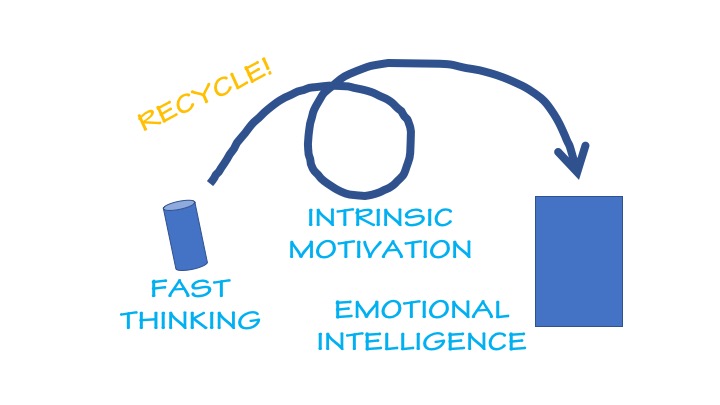 Household recycling is still an immature process – meaning plenty of confusion, indifference and emotional un-intelligence. This The Straits Times article by Ng Huiwen published on April 29, 2019 titled “6 in 10 S’porean households recycle weekly, though misconceptions about the process remain: Surveys” reminds me of my own household’s behavior with respect to recycling as well as how government policies keep getting in the way of creating sustainable recycling behavior (eg, the plastic bag ban). Thus with the condition of wanting so much more out of a good cause, we can possibly take on this problem scope for the YCISL workshop team projects.
TUNING THE RECYCLING MINDSET
Purpose: To design solutions utilizing YCISL strengths that enable optimizable recycling behavior in homes.
How: For this pilot-level project, team projects will be required to include fast-thinking conditioning, instrinsic motivation leveraging, and emotional intelligence smart-ness.
Methodology: Team products could be service-oriented, educational (various media or channels), interfacial (eg, using HCI), interactive (eg, with feedback), gadget (something to install or carry) or programmatic (crowd-sourced or information campaign). To optimize, make it simple AND easy.
Rules (who needs rules?): No financial aspect will be considered.
Teams and the Universal Issue of Sustainability
In the YCISL framework, I position Sustainability as a universal issue meaning that it affects everyone, should be on everyone’s mind, and requires everyone’s active input and feedback. In modern times, environmental sustainability fits this “universal” theme but we could think of sustainable human health, agricultural sustainability and sustainable education as universal causes that should engage everyone. The “SL” in our acronym stands for sustainable leadership – based on the idea that everyone is in a leadership position and there is a general need to train and strengthen EQ to garner higher quality leadership.
I am writing this entry in thought to my reading of Stanford’s latest Vision Initiatives in Research. My worldview on this includes the Sustainable Urban Systems program that I helped put together in a proposal several years ago as well as the YCISL idea of sustainability as a universal issue. From this, I have few thoughts on how to put together teams and what to list as the principal tasks. For our YCISL project teams to be successful in product realization with sustainability as a feature, these team strategies may be useful.
- Form multidisciplinary teams with cross-functional competencies. I learned this at Handspring. The team should represent the various functions that move the product forward. Participation by representatives may vary at each development stage or even within a stage – which is where cross-functionality comes in. Representation from each function is also critical to ask questions from diverse perspectives (eg, from the testing part of our YCISL workshop) as well as to share insight and ideas (eg, from our PostIt brainstorming part of our YCISL workshop). And in most situations, an experienced project manager is needed to keep everything upright and progressing.
- Strive for team emotional intelligence (an extension of individual EQ). Our EQ framework comprises self and social components. In the YCISL, we start with the self by defining our Personal Story in order to build our identity, and understanding EQ life lessons that we can apply to continuously training ourselves. Teams should communicate a collective Personal Story and develop a singular image of their identity (eg, purpose, energy, direction, shape and function). We also work on the social by energetically activating ourselves to connect new experiences, skills and ideas using a growth mindset (teams need to maintain positivity and productivity).
- Using the Gamestorming format, teams should engage in the OPEN then move on to the EXPLORE with the known parameters of when and how to CLOSE. Iteration is key to the team process as is fail early, fail fast (the virtual reset button), and the divergent-convergent thinking loop.
Workshop Group Introductions
In the early YCISL workshops, we used to have the usual self-introductions at the start with a random question thrown in such as “What is your favorite [something]?” Then we also played the action-name game for many years where each student pairs their name with a word and act out an action related to that word.
I am also now thinking of adding an exercise where we look at our same-ness and differences. At a simple level (depending on available time), I would have pairs of students confer with each other and come up with three things they have in common, and three things which are different. This could extended into a speed dating format where pairs switch partners and create a same/different list for each person they meet. In the end, we would tally the number of similarities and differences, and maybe even categorize them. This would give a good snapshot (with a quantitative element) of the group.
As is the usual YCISL style, the instructions will be kept simple: identify three similarities and three differences. The categories will be up to each pair to choose – by asking divergent thinking questions, exchanging through active listening, and converging on their list. The quantitative part would establish connectedness as well as individual and group identities.
It would be interesting to get some of this information up on the screen using Mentimeter.
Paper Airplanes & A Reveal of Our Problem-Solving Mindset
I re-watched Tim Brown’s Tales of Creativity & Play this morning, and the part with the Finger Blaster had me wanting to incorporate something similar into the YCISL workshops. I also had just watched a TED video “How To Make Applying For Jobs Less Painful” by Priyanka Jain in which she showed a clapping test to reveal a thinking trait. This has me again wanting to demonstrate the spectrum of approaches any given group naturally takes to tackle a problem (and how education, let’s say a typical classroom, is herded to take just one approach). So here is an idea for a workshop exercise using paper to make paper airplanes.

I am assuming that for any given group that paper airplane-making skills are widely spread. Some may already know how to make a paper airplane. A few may know how to make sophisticated ones that fly far or can do acrobatics. Most will likely know how to make the simple paper airplane that fly a relatively short distance compared to the current record of 220′ 10″!
For this exercise, we provide one sheet of paper to each participant. They start by writing their name on the paper for post-flight identification. The participants are then simply instructed to build a paper airplane with their sheet of paper and we will see whose flies the farthest. No other instructions.
They will be given 10 minutes to do this. After that, it will be time to fly their creations.
I hope to observe a wide range of approaches to this task such as:
- folding using their existing knowledge about paper airplanes, if any
- doing some independent research such as checking the WWW
- asking someone for help or advice
- just watching someone else and copying
- forming a collaboration and working together
Then we fly and see whose flies the farthest. Just as we do with the Spaghetti Tower Marshmallow exercise, we could do multiple rounds of this and look for learning through iteration. Will they change folding technique or will they take a different approach?
Each of the approaches reveals how one’s mindset is currently geared to problem-solving. The three main lessons (phrased as questions) are:
- Does your leadership worldview include other people (collaborator, advisor, teacher, etc)?
- Do you have a trusted growth mindset that takes you out of your comfort zone? Or do you tend to play it safe?
- Are you comfortable learning more about yourself (self-awareness) and how you approach problem-solving (self-management)? Are there any issues that can be addressed?
