
Influencers
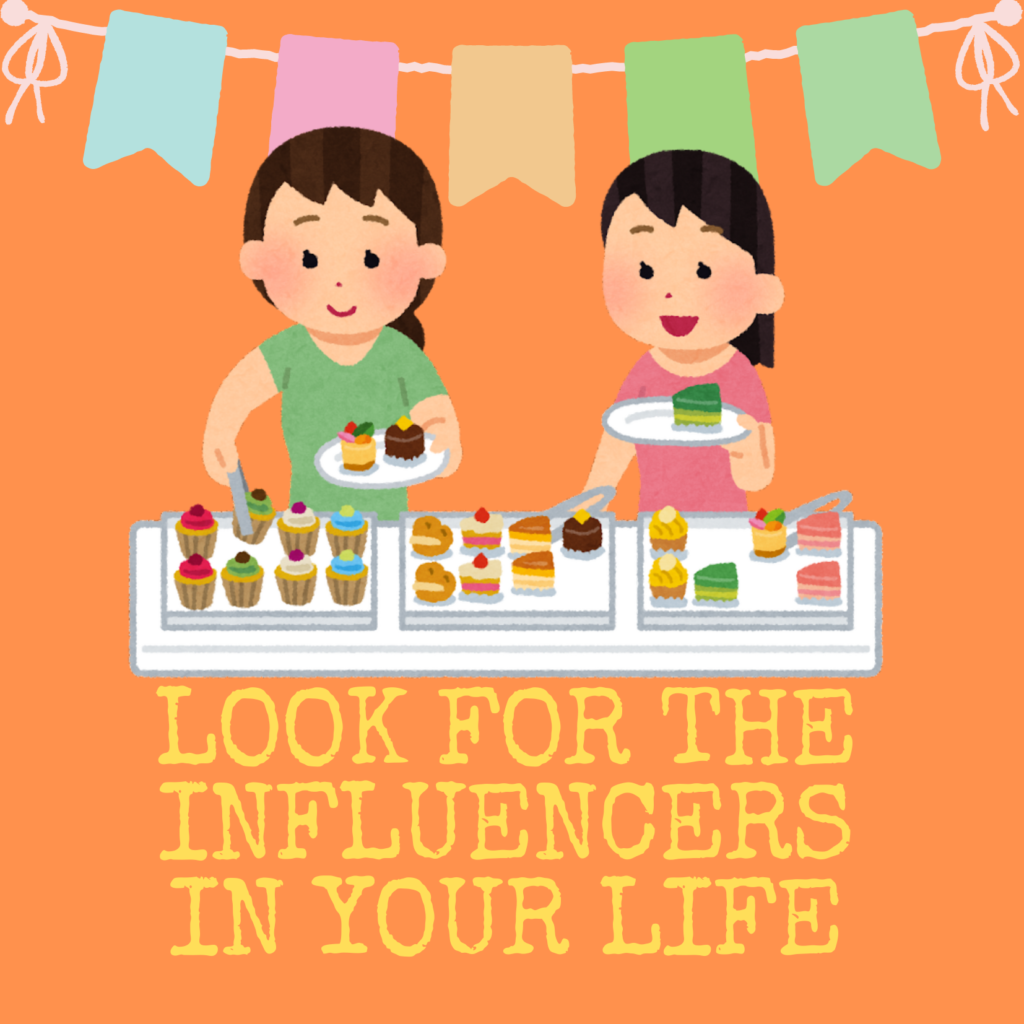
Today, meeting up & catching up with one of my high school friends from decades ago, I recounted how my storied interests in tennis, and photography are traceable back to the times we were together in high school…boarding school to be more precise because that condition was critical – in my mind. We had tennis courts at the school. We had a dark room as well. He was a great influencer and I was definitely a follower.
And following up on my recent note on your first resume, I want to suggest that such influencers might find a way to…well…influence your resume…in content as well as theme. Close friends who have had a influence on how you think, what you choose & your life experiences are worth considering for your resume.
I remember one example from the SUHSD CTE volunteering earlier this year, where I saw a resume which mentioned experience helping with a family catering business. In my discussion with the student, I asked for vivid detail about what they did, what responsibilities they had, and who they interacted with. And to lighten the Q&A load, I asked what food was being served & about the success of the event. Along the way, I formed a story in my mind and asked for details where I thought there were gaps. The storyline, the detail & the human-element are all important in conveying – in your resume – how you could be trusted with the responsibilities.
So if you are working on your first resume, try to recall one or more such events & shape your resume entry to show your situational awareness & how the people & experience has influenced your mindset & outlook…and who is the influencer that made it possible.
PS. In case the thought crosses your mind: social media influencers do not count. At least, the value of such influencers is minimal since there isn’t a direct or bilateral interaction. You may be influenced by social media and feel it is ok & harmless…even had positive results. It’s just not likely to make your resume look good.
Advice for a Youth Preparing Their First Resume
I am slowly working through another YCISL mini e-book. It is based on my volunteering with the Sequoia Union High School District Career Technical Education (CTE) program where I participate in mock job interviews. In these activities, I get to see students’ resumes…usually their first. I use these resumes to come up with talking points related to the interview, but also give feedback on the resume quality.
So the e-book I am working on now is about the basics of putting together a resume. A first resume. The SUHSD students are fortunate to have gained some work experience through their CTE program. Still, they (like many others who work on their resumes) need guidance for fundamental readability in their resume as well as communicating positive fitting attributes.
I have a plan to ask some of my contacts to contribute their reflection on their first resume, and to share their wisdom & experience. I’ve already asked some of my Singapore Stanford Partnership students, but will also include YCISL and Stanford connections.
Can you recall your first resume? What do you wish you knew then?
For me – and in light of my present design thinking enlightenment – I think white space is under-appreciated in a first resume. A first resume might have little content to include. However, little content has a tendency to end up being superfluous in order to impersonate extensive experience & abilities. The result is little to no white space. And this can be a problem because (1) it makes it harder for the reader to match the applicant to the job, & (2) the applicant appears unable to exercise restraint & be organized. One example of poor white space management is when paragraph formatting including indentation is inconsistent.
Creative Energy of a 16-Year Old

In the YCISL program, we present the idea of creative energy as a “natural” resource to drive the innovation journey from ideas to realized products. As the YCISL host for over 10 years, I have been reading levels of creative energy in the students I have met. Most students at the YCISL workshops show little sign of creative energy when I first meet them. The task is then simple…to search for and tap their creative energy. And then there are the few students who are already fueled by their creative energy & I get to go on a whitewater rapids-like adventure (not that I have actually gone whitewater rafting before).
I was reminded of that exhilarating YCISL-idealistic creative energy level yesterday. She’s 16 years old & possesses an uncommon innovator acuity for the past, present & future. Instead of going into the details of our conversation, I am going to wonder here about perspective-dependent perceptions of creative energy. I think it’s worth pondering.
For one, can the YCISL program elevate the creative energy of a 16-year old youth…especially with my conservative senior citizen-mindset? What should I do to not diminish their creative energy?
What about how another 16-year old may perceive another whose creative energy is relatively greater? Is osmosis of creative energy possible? Or is there a catalytic effect we can leverage?
Youth whose creative energy is born from parents can be expected although not guaranteed. However, what of families where the parents have buried their creative energy, but the child is finding theirs? Should we encourage parents to-rediscover their creative energy, or do we need to protect the child’s creative energy?
I have also heard numerous stories where teachers (esp. art teachers) squish creative energy. How do we correct the teacher behavior & mindset?
In the YCISL framework, I like to think of parents as partners in helping youth explore & use their creative energy. The solution may lie in the meadow of creative youth using some of their creative energy to help their parents periodically do some divergent-convergent thinking, & remind themselves that their happiness & success as parents lies in their partnership with their child. Another SIMPLE, but not EASY. That’s YCISL.
Thoughts: What makes me smile?
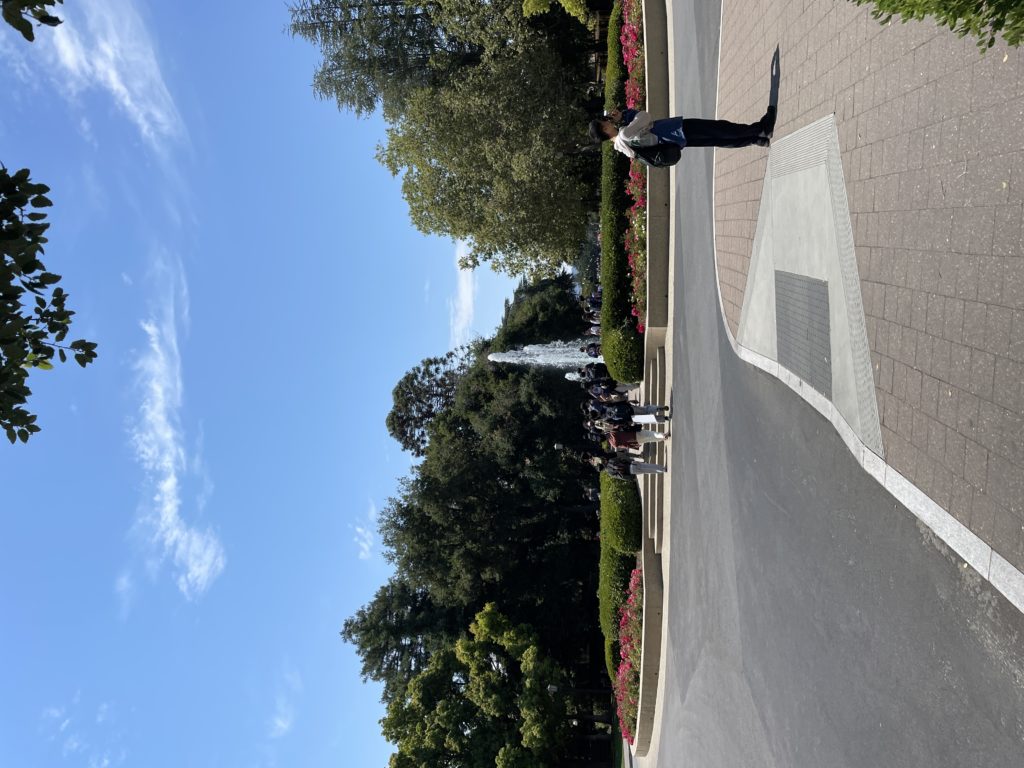
Last week, I was on a walking tour with a group of visiting high school students when one of them asked me “Why are you always smiling?” At that moment, many thoughts quickly crossed my mind, but the immediate and strategic answer was to say I was gaining a lot from the interactions with the group. I was still in the mode of emphasizing positivity as a competitive advantage when it came to design thinking.
Ah, positivity. That factor that has been embedded in the YCISL for a long time with wisdom-ful quotes from Shawn Achor and Alison Ledgerwood. The element that I say drives our ideation to success. The persuasive embrace that we can put in place for little cost, but likely with a lot of effort.
But today, I am feeling a little sad. The title of this wiki entry was going to be “I am sad” at first, but with a little pushing and pulling mindfully, I came up with “What makes me smile?” Fortunately, the present state of sadness is not unfamiliar, and so I know I have managed through it before…several times. I guess that resonates with my YCISL by-line of “Life Lessons in EQ.”
For YCISL maybe 7 years ago, I added a slide to my slide deck about “No-Cost Sources of Positivity.” Everything on that slide usually does make me smile. But I think if I added a slide that had the heading “What makes me smile?”…what would be on that slide?
- My Family. The most organic aspect of life & living. Recalling good memories. Being together. Doing things together.
- Flowering. Signs of new, growth, & hope.
- A Good Beverage. Especially a beverage that meets or exceeds my expectations and needs.
- Ice Cream. Often anything sweet. Perhaps indulgent too. And the sensory aspects of color, cooling, taste, etc.
- Inventing. Experiencing the intrinsic motivation of mastery, control & purpose. Solving problems through reasoning, creativity & resourcefulness.
Well, that’s the first draft. We’ll see what I get into my slide deck. What makes you smile?
YouTube: “The importance of play – for creatives and anyone” by Mae Ceramics
Just over a year ago, I started taking pottery classes with my kids. I am now a pottery-making addict with more than 100 ceramic items amassed & covering a couple of tabletops at home. I have been enjoying this hobby because (a) I share this new interest with my kids, and (b) it reminds me of life lessons in learning, sense of purpose & sense of passion – all things that I have used in the YCISL program. Just today, I came across a YouTube video by Mae Ceramics titled “The importance of play – for creatives and anyone” which touches on many of the same points I have talked about in the YCISL workshops including:
- Creative Play
- Growing out of creativity as adults
- Being ok with being a new beginner at something
This video resonates so much with my feeling that my pottery experiences are so in sync with my mindset and thoughts on creativity, innovation and leadership. Where design thinking starts with empathy, I have also found that EQ plays a profound role in taking up pottery and sticking with it through the good and the bad. Bottom line is that I am suggesting watching this video (especially if you are similarly into pottery) to ignite your creative life outlook & hope for productive design in your life & work.
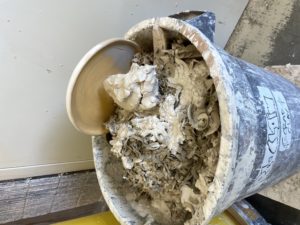
PS. The plate in the clay reclaim bin at the top is mine. It cracked really bad when air drying, and was beyond help.
Teaching: Sustainability Design Thinking (IntroSem)
“BE INSPIRED BY WHAT EXISTS”
Stanford has a program called IntroSems. “IntroSems are an excellent opportunity to interact in small, discussion-based seminars with some of the Stanford’s most esteemed and talented professors and instructors.” A version of our Sustainability Design Thinking course was given in Spring 2024. We will have the last class meeting of the term later today, & it seems that a reflection may be a useful exercise.
From a high level, the IntroSems version of the course (CEE 11Q) has involved more visualization which resulted in more discussion. The Winter 2019 version (CEE 176G/276G) had a similarly small class size (~7 or 8 students), but the group dynamics was different. CEE 11Q distinctly dug deeper into shared issues, whereas the other course spanned a more diverse range of issues. Having a DCI student in the Winter course added to that stretch. The question though is whether Sustainability Design Thinking is academically effective as an IntroSems course.
From two instances of assignments so far this term in CEE 11Q, the design thinking personal reflections (a mini-essay) have been more encouraging relative to the Winter course reflections. A few excerpts from CEE 11Q:
“…be inspired by what exists…” Inspiration is key to launching in the course project work. Students should recognize & be comfortable with inspiration – to exercise the GROWTH MINDSET.
“Thinking about the amount of things this process can be applied to excites me a lot.” While we can be academically critical & analytical about existing sustainable behaviors, the life lesson from this course involves feeling ready to apply the design thinking process to future projects & challenges – as part of YOUR PERSONAL STORY.
“…the most important part of the design thinking process for this project was empathizing.” Empathy threads our entire design thinking process so that we have awareness structure & confidence for action – to strengthen our EMOTIONAL INTELLIGENCE.
The focal proposition of an IntroSems course to be formative & feed on curiosity makes for a good introductory course. It’s like a “lite” version of our other course. So now I am curious whether we need an advanced version of the course?
The DezignBläst Projects
A couple of days ago, I uploaded the syllabus for Summer Quarter 2024 CEE 176G/276G Sustainability Design Thinking onto syllabus.stanford.edu. For that syllabus, I included a section on the design projects in the course. This was based on the design of and experiences with the project assignments in Summer 2023 and Winter 2024. The descriptions are intentionally brief and written in an academic bulletin style.
Design Project 1: Independent Project. Emphasis on learning the systematic design thinking process, & changing human behavior. Ideation and design of a single product to influence an individual’s sustainability behavior & mindset. Delivery of a presentation & spec sheet.
Design Project 2: Team Project. Emphasis on supporting programs & initiatives that promote sustainable behaviors within a community. Ideation & prototyping of a space, service, activity or program. Involves interacting with others using interviews & surveys to identify opportunities & resources. Delivery of a presentation & spec sheet.
Design Project 3: Independent or Team Project. Emphasis on sustainability in the future. Design using anticipation of needs & innovative technologies in the future. Involves rapid prototyping & human-centered storytelling. Delivery of a presentation & spec sheet.
I like to think there is YCISL-style design thinking in these concept statements about the assignments. The Who? element is answered by the words “Independent” or “Team.” The Emphasis Areas summarily describe the What? of the course content. The When? is subtle in that we specify “future” in Design Project 3 leaving the other projects more in the now. And the deliverables of the presentation and spec sheet give us the How? the design thinking journey will be communicated for evaluation. Hopefully, the When? & Why? are apparent from the teaching part of the class.
This is just further evidence that design thinking (as well as emotional intelligence) is essential to teaching design. I feel it helps me in building courses that are consistent with Stanford’s reputation for entrepreneurship and innovation. Should design thinking perhaps be a component of teacher education? I’ve always wanted to try a teacher workshop for the YCISL creativity program.
YCISL Returns to On-campus with a “Popcorn with Colin”
 Last week, I hosted a group of high school students from Kanagawa Prefecture for the first on-campus YCISL program since 2019. And it was the first “Popcorn with Colin” session at Stanford; previously, PwC had only been online through Zoom in response to the pivot to remote education.
In this PwC, the focus was on Creativity, Uncertainty, & Real-World Problem-Solving. When I was ideating in preparation, I thought about two aspects of creativity application that sets Stanford-style education apart. The first is the concept of uncertainty – which I learned most when teaching environmental toxicology (ETox is full of uncertainty…and risk). Uncertainty was also a talking point early in YCISL taking Geert Hofstede cultural dimension examples from the book “Outliers” by Malcolm Gladwell (it was one of the books in the Stanford freshman orientation Three Books program in 2009). So, this PwC started on the topic of uncertainty – in everyday as well as academic terms.
The second concept introduced in the PwC was Real-World Problem-Solving. I recalled examples from various Stanford environmental courses where problem assignments are designed with intentional incompleteness – just like in the real-world where there are numerous gaps or questionable information. The idea was for students to learn to make guesses or estimates to come up with justified and plausible solutions. This approach to academic coursework aligns with high-level research where knowledge extensions and connections are made and tested.
With the above concepts set in a Stanford context, the students were then pulled into the YCISL-style of playful creativity. We started with the fast thinking exercises (“What do cows drink?”) then moved into the 30 circles exercise to demonstrate imaginative agility as well as transfer from mind to paper. We ended our creativity fun-fest with the Human Knot exercise to immersively showcase group problem-solving.
To complete the circle, I introduced a variation of the Design Sprint exercise just completed in the Sustainability Design Thinking course; partly to share what happened in an actual Stanford course, and partly to get the students to apply creativity, uncertainty, & real-world problem solving to a forward-thinking problem that may affect even their own future. In my view, this turned out to be very resonating as it brought in some of my latest thinking & experiences, & tasked the students with brainstorming along a timeline. The temporal flow was sweet.
This was a great way to get back to on-campus YCISL activity.
Getting Started: The IB Extended Essay
I am preparing for an upcoming Popcorn with Colin where students at an IB school have been invited to discuss their ideas for an extended essay. The IB Extended Essay “…is an independent, self-directed piece of research, finishing with a 4,000-word paper” and a mandatory part of the IB Diploma program. I have an interest in this activity because I was an IB Diploma student when I was in high school, and still have vivid memories of my extended essay project work.
The plan for the Popcorn session is to open with a discussion about “what is research?” for the purpose of shared viewpoints and expectations.
Then we would move into a reveal-type segment where we explore the ideas that the students have for their extended essays. We would tease these ideas for creativity, connectedness & design thinking. Our discussion about creativity could look into personal curiosity, originality & innovation where concepts such as comfort zone, out-of-the-box thinking, and uncertainty. Connectedness would deal with awareness of published scholarly literature as well as personal experience, and how to support/justify a research project. And design thinking would be about sketching a human-centered problem statement and vision using the YCISL Innovators Toolkit method.
The third component of our session would be on the suggestion of the need for a research plan & the design elements; this is intended to encourage good documentation habits as well as methodical forward-thinking skills.
That’s probably plenty for our 90-minute session where I hope to have plenty of reciprocal learning.
Teaching: Sustainability Design Thinking (Part 4)
It’s been a couple of days since I initially wrote up some notes about preparing to co-teach Sustainability Design Thinking this summer. Another thought just popped up. It relates to the YCISL equation:
KI + EI -> LI
For this equation, we posit that the limiting factor is EI (emotional intelligence) which explains why there is so little LI (leadership intelligence) around. KI (knowledge intelligence) is relatively abundant, but variable in quantity and quality (thinking for a moment about Salman Khan’s idea about teaching for mastery as well as Jef Raskin’s thoughts about issues with knowledge).
That said, if we are to push EQ with regards to the course, we need to utilize the students’ existing KI as a base resource. There are two channels we could use: (1) academic learning, especially recent learning, and (2) personal experience. We should have students list their academic topics in the past year (active recall) and significant personal experiences in the past few months (waggle dance reasoning). Students could then research any of the items on the list to deepen their understanding. This may quickly lead to a useful KI so that we can move on to focus on EI.
