
Category: Ideas
Teaching: Sustainability Design Thinking (Part 3)
In Part 2 of this teaching reflection, I had mentioned individual and team as groupings for assignments. There is also the possibility of pairings – in terms of fixed pairs, or speed dating-type pairs where changes in the pairing are made quickly. Pairings could be even more interesting if there was not just equity and parity in the pairings, but we could have intentional mentor-mentee setups.
But the grouping I wanted to really add for consideration in this course is a “committee” comprising students and instructors would serve as mentors. We could form committees of students where they would be responsible for organization and execution. This experience would involved design thinking at a very different level and allow for leadership as well as interpersonal group dynamics lessons.
In YCISL, we formed a committee for the Sustainability in Education Roundtable (oooh, could we have a student-organized roundtable please? Pretty please?). We have also included in our YCISL program proposals, the idea of an editorial committee to publish mini-conference proceedings. This would help us as well to deliver a reference from which we could design accurate and precise resume statements about a student’s experience in this course (use asking-questions design thinking).
Teaching: Sustainability Design Thinking (Part 2)
I have written before how EQ should be used in preparing for and opening a course. Here are more thoughts as I design think what I would like to contribute to the Sustainability Design Thinking course this summer.
We could start with a pre-arrival survey like we have used in past YCISL workshops. This is mainly to raise potential talking points, but can also be used to set expectations using Adora Svitak’s reciprocal learning model.
Along with a topical overview, the instructors should communicate to students the work characteristics (form and load) and performance expectations. We could use the DezignBläst RFP from past YCISL workshops. For most students, this scenario should put them in an unfamiliar position and will reflect their EQ.
The students should be able to communicate to instructors early their learning preferences as well as strengths and weaknesses (academic knowledge as well as skillsets).
The type of work we require for the course should be different from their past experience to provide the opportunity to grow and learn. As in the Richard Nixon quote I have used of late in YCISL workshops, “Each day a chance to do something memorable for someone.” This short idea is full of EQ with timing, awareness and action. Students should be coached for success on their sense of timing and timeliness, a divergent-convergent thinking ability to assess awareness, and a 5-second rule propensity for EQ-rich action.
I imagine there will be a variety of assignments:
- in-class quick challenges such as the 30 circles test or water bottle feature list exercise.
- overnight individual or team observational and inspirational efforts to exercise Corita Kent’s “Look & See” and practice converging or merging ideas for innovative solutions.
- 1 week or longer development efforts that involve iteration and feedback loops.
- One or more term-long deliverables such as a video or portfolio package to give a memorialized close to the gamestorming framework of the course.
- In a way, we could also ask the students to reflect on their personal story or brand identity. We could perform mindfulness exercises to train the mind to navigate and explore their imagination. Very non-academic. Potently life-changing.
I hope these ideas will make it daylight. Right now, I am just imagining what we could do to make the course very forward looking.
Teaching: Sustainability Design Thinking (Part 1)
I have been invited to be co-instructor for the course CEE 176G/276G Sustainability Design Thinking in Summer Term 2023 at Stanford. This is not a new connection, but I will have greater-than-before involvement with instruction this time. I thought I would write three ideas for my part of this course.
- Engagement of the EQ (awareness and action) senses in design thinking projects with sustainability in mind.
- The concept of nudging into sustainability at an angle to be persuasive and human behavior changing will be explored.
- The Art of Environmental Sustainability Communication. Using the idea of “Sustainability has a PR Problem,” we can get students to practice communicating ideas over various modes. Perhaps we could use the YCISL DezignBläst framework for students to practice writing proposals for sustainability products, spaces & services.
These components will involve creativity where we will hope and expect that students can advance through rapid prototyping and brainstorming, and develop their design thinking skillset.
Quickstart: Activities for the High School Resume
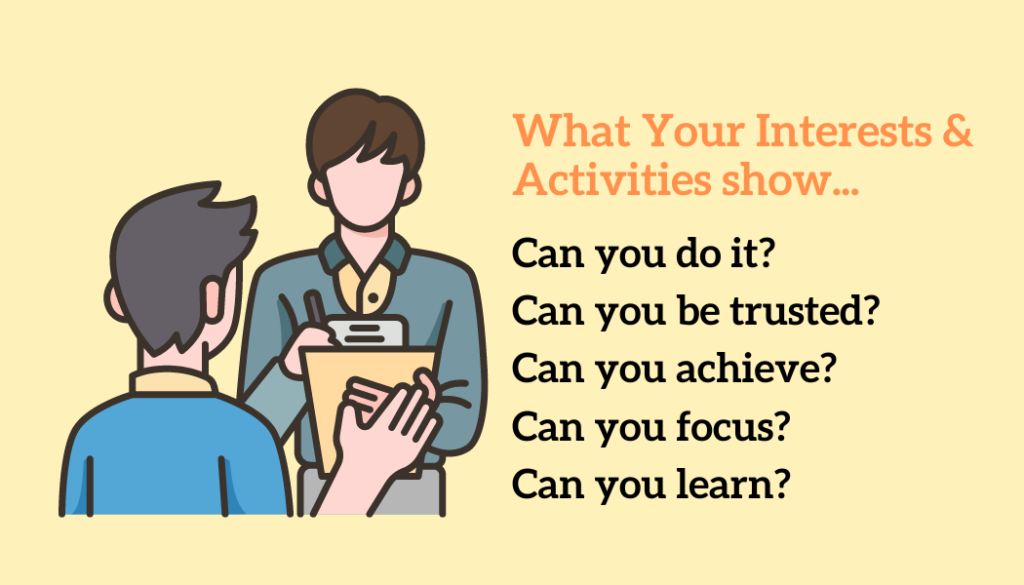 This week, I participated as a volunteer mock interviewer for high school students in Career Technical Education programs offered through the Sequoia Union High School District. I met with 7 students in total that day. We practiced engaging in a discussion about skills and experience as well as reviewing a resume.
As I reflect on that experience, one of the main talking points was the listing of interests and activities. This really gets to the core of the YCISL program with the Proof stage representing the high school level of the YCISL leadership objectives. First, let’s list 20 ideas for interests and activities that could be on a high school student’s resume as Proof.
1. Sports (Recreational)
2. Sports (Competitive)
3. Community Service/Volunteer Work
4. Tutoring
5. Clubs
6. Science, Math & Engineering Competition
7. Fundraising
8. Work/Internship/Shadow
9. Music (Individual/Group)
10. Art/Graphics/Photography
11. Drama/Acting
12. Social Media/Blogging/Vlogging
13. Video Production
14. Writing (Technical)
15. Writing (Non-Technical)
16. Journalism/Newspaper/Yearbook
17. Travel
18. Computer Programming
19. Website Design
20. Small Business Entrepreneur
Next, so that any of these interests or activities become a part of your personal story, practice EQ and asking-questions design thinking so that you can include it in your storytelling resume. As an example, one of the students I met at the SUHSD interviews had included an experience where he helped an aunt with a catering business at an event. His resume had only functional points describing his role. We discussed the scene and activity to color the story. We started with Who? What? Where? When? Why? and How? Then I asked about anything particularly memorable or an opportune learning or growth opportunity. Finally, we talked about the emotional senses before, during and after the event to gauge motivation and mindfulness. If we had more time, we probably could have gone deeper to find the hook words, keywords and action words that best represent this experience on the resume.
By this method of developing a mind view, I hope high school students can find more value in their early experiences and discover memorable moments of success and happiness for their personal story.
Idea: Desktop Wallpaper Design Divergent-Convergent Thinking Exercise
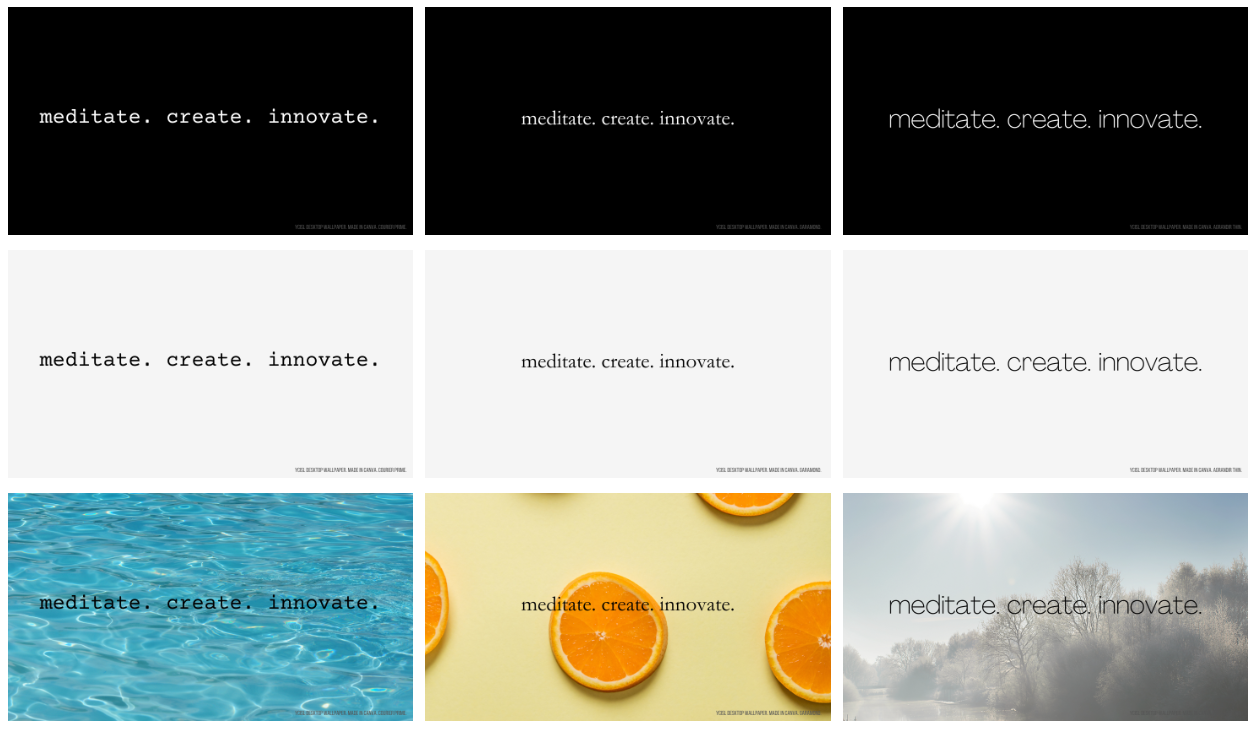 I have an idea for a YCISL Divergent-Convergent Thinking Exercise. Along with DCT, this exercise also involves brainstorming, rapid prototyping, fast thinking, design thinking, creativity and eq. We could also add an elevator pitch component with storytelling and your personal story elements.
Overview: In Canva, create a desktop wallpaper. We could assign various scenarios based on purpose and context.
Instructions: Divergent Phase: In Canva, set up a blank desktop wallpaper template. Add your text. Play with the font styles coming up with various prototypes. With the font prototypes, play with various color schemes for the text and monochrome background. As a last step, create versions with background images. Convergent Phase: Identify up to three prototypes that you think resonate the most. The criteria are up to you. Pitch Phase (optional): Design a 90-second elevator pitch around these selected prototypes providing a feature list, a story and an explanation of how it connects to your personal story. Assess the level of creativity, growth and mindfulness involved in this exercise.
I may have a chance to try this exercise out this summer in Sustainability Design Thinking. In the meantime, I will describe my experience reflected by the 9 designs in the gallery above in this wiki entry.
- I started off with a black background to have lower computer screen glare. I also think a black background has a sophisticated vibe.
- I chose three words related to the YCISL and intentionally selected words that rhymed so that they bounce around in the head together. I also feel the expression has a connected 3-step progression so there is an element of active listening (hearing, listening & understanding) involved.
- I actually created 16 prototypes based on font type. The three font types shown in the gallery at the top are Courier Prime, Garamond and Agrandir Thin representing the more common type styles.
- I then made a copy of the set of 16 prototypes and changed the background to white. As I started working on this WordPress entry, I found that I preferred having some contrast between the wiki image and the wiki background, and made another set with an off-white background (#f5f5f5). I feel both the white and off-white background sets work well. Putting a little red, blue or green tint would have been an interesting expansion, but I didn’t do it. That’s because I like to design exercises with sets of 3, and the 3rd step in this exercise is to…
- Use images for the background. Again, I did actually create 16 prototypes with various backgrounds, and the three shown in the gallery above are just by chance the ones for the three basic font typefaces. Still, I like the variability represented here where the water has a cool and dynamic feel, the orange slices image touches most of our senses, and the scenery background denotes place and time.
Another important note is that even with 16 font typefaces and three variations on the background, there is learning happening in this exercise. Preferences, new ideas and intrinsic motivation are being exposed. So if there is enough time in this exercise to conduct a second DCT cycle, that would be consistent with the way we do the Spaghetti Tower Marshmallow exercise (“Fail Early, Fail Fast”) as part of rapid prototyping.
A Note to Self: About Hard Work
On my way to play some tennis this morning, I came up with an idea for the next YCISL e-book. It’s about Hard Work. The idea springs from Alison Ledgerwood’s 2013 TEDxUCDavis Talk “Getting stuck in the negatives (and how to get unstuck)” which was somewhere along the way re-titled to “A simple trick to improve positive thinking.” In that talk, she says “We literally have to work harder to see the upside of things.” That statement links to another which I do find more resonating which is “It’s all hard work. Nothing comes easily” – spoken by Richard St. John in his 2005 TED Talk “8 Secrets of Success,” but credited to Rupert Murdoch through an interview.
So I think I will work on an e-book with maybe eight examples of creativity and hard work.
- “We literally have to work harder to see the upside of things.” Alison Ledgerwood. TEDxUCDavis. 2013.
- “It’s all hard work. Nothing comes easily.” Richard St. John. TED. 2005.
- “It’s very, very simple to get what you want. But it’s not easy.” Mel Robbins. TEDxSF. 2011.
- Work = Force x Distance. An equation to describe the Growth Mindset. The YCISL Personal Story & Roadmap.
- Push. Pull. Center. Mindfulness. Sweat Equity. Stress & Strain. About YCISL EQ.
- Active Listening. Filters. A YCISL conversational topic.
- “Must try harder.” Sir Ken Robinson. TED. 2006.
- Creativity. Fast Thinking. Divergent-Convergent Thinking. Self-Edit. Self-Doubt. The YCISL Creativity Model.
That’s probably enough for the kind of short e-book I have been publishing. Hopefully, I can make it interesting for readers. The structure goes from ideas to concepts to a model.
Looking forward to getting started.
Coursera: How to get a job with no experience

A moment ago, I received an email from Coursera with the Subject line “How to get a job with no experience.” There are 8 steps listed in the email. Let’s see if we can create a similar (and better, more EQ-enabled) list using YCISL ideas.
HOW TO PREPARE TO GET YOUR FIRST JOB – THE YCISL WAY
- Active Listening. Showing that you can hear, listen and understand may be the most important factor in an interview as well as mentoring for a new hire. Your sense of timing, word choice and expression (facial, hands & body language) reflects on your emotional intelligence and is your chance to earn initial trust.
- Shared Problem. Sharing a problem closes the distance between you and the person you are talking to in an elevator pitch. Ask about the problem related to the job and discuss how the new hire is expected to solve the problem. How do your interests and skills connect to the problem and solution?
- Business Card, Mind & Heart. Show an understanding for the job functions (perhaps written in a job description), intelligence requirements, and the intangibles that may make the work fulfilling and meaningful.
- Opportunity. From personal experience, timing is everything. Demonstrate flexibility and adaptability. Be aware of the timeliness as well as “currents” and “cross-currents.”
- Team. You must show that you can work with others and contribute as an individual. Do you have group, social and empathy skills? Demonstrate composure and leadership potential.
- Growth Story. In YCISL, we like to think about Your Personal Story. How would you grow in the job? How does it connect to your past and future? Make sure you are the main character in your story. Do describe the chapter scene at the prospective workplace. Make it interesting for the “reader” using success and happiness, two fundamental positivity features.
- Intrinsic Motivation. Highlight the many ways you are motivated and self-motivated. What aspects of the job has the potential to make you feel rewarded emotionally and perform well sustainably? Helping people? Learning from others? A balanced work-social life? Flexible work hours? Practice divergent-convergent thinking here.
- Promise. Show that you can make and keep promises. Be clear on what you are sincerely promising if you are granted the job role. You can echo and resonate the promise in your follow-up (thank you) note as well as when you start your first job.
This is why the YCISL tagline is “Life Lessons in EQ.”
Good luck!
Scientific American: Does Vitamin D Improve Brain Function?

I just watched a YouTube video titled “New US Vit D research” by Dr. John Campbell, and wondered about a possible connection between Vitamin D and the thinking skills in the YCISL program. Could creativity, EQ, growth mindset, mindfulness, positivity & fast thinking be enhanced by Vitamin D (also called “sunshine vitamin” by some)? A Google search led me to the Scientific American article “Does Vitamin D Improve Brain Function?” written by Diane Welland and published November 1, 2009?
The article mentions information-processing speed, cognitive impairment, and cognitive losses – all of which affect our creativity. It does mention one study of “3,100 men aged 40 to 79 in eight different countries across Europe” which sets up a huge knowledge gap open to a YCISL Innovators Toolbox Filling & Crossing Gaps analysis.
This is one of those “Hmmmmmm?” moments. A pause to reason (or imagine) this out. An opportunity to ask “What if…?”
Should we discuss a possible YCISL-Vitamin D link in a Popcorn with Colin? We could explore a youth perspective about Vitamin D as well as a need to improve brain function. Do students notice any brain function performance difference between seasons, between night and day, between indoors vs outdoors, or anything else related to light exposure?
Should we create YCISL projects around Vitamin D healthcare? Besides a physician telling a patient to take Vitamin D supplements, is there anything else that can be done to improve Vitamin D healthcare? Could a person’s Vitamin D be measured without a blood test making it more convenient? Is there any program that could be designed so that people would take Vitamin D supplements consistently? Is there a software app that could change human behavior to improve Vitamin D levels? I imagine there are many possible innovations.
Should we ask YCISL participants about their Vitamin D levels? As part of an EQ-framework, should we assess self-awareness about Vitamin D levels as well as boosting and supplementation? Should we also complete the EQ-framework with a design thinking discussion about resources and how to connect with those resources?
While writing this, I took a Vitamin D3+Vitamin K2 supplement. Let’s see if it worked.
Lessons: The YCISL Business Card Exercise
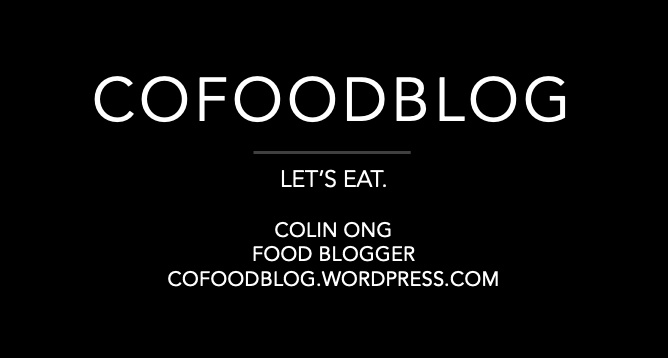
Based on the inspiration from Satoru Iwata’s opening line at the GDC 2005 Keynote address (“On my business card, I am…), YCISL added a Business Card exercise as part of the Who am I? effort in workshop programming. This exercise was launched with university students from China in Summer 2018 with the idea to help them develop & clarify their integrated personal profile.
The first step was to analyze the Stanford template for Business Cards in the Identity Guide (https://identity.stanford.edu/print/business-cards/).
Then we listed the required and optional information for the business card design that the students would create:
REQUIRED
Name
Profession, Title, or Function
Primary Contact Method & Information
OPTIONAL
Address
Logo
Web Site
LinkedIn URL or QR Code
Organizational Information
Secondary Contact Information
Qualifications & Certifications
Students then received a blank business card (from the printer-compatible 10-per-sheet perforated edges type) to draw on. We provided a variety of colored pens/pencils. This was a creativity first-draft exercise so a high quality product was not needed.
The students were then asked to come up with an oral self-introduction to go along with the presentation of their business card…then they did an actual self-introduction to another student which including exchanging of their business cards. After the initial self-introductions, students would then hand the business card they received to another student accompanied with some remarks to introduce the student whose information was on the business card. This was to see what kind of impression was made by the initial self-introduction when being forwarded to a third person. This essentially simulated the memorable impression that a self-introduction has to have.
TIPS:
1. The self-introduction should be like an elevator pitch. Remember how a YCISL elevator pitch has 9 components? Design think how these components can be supported by visuals on the business card.
2. The business card should reflect your persona & be a resource to learn more about you. In this way, it is like a invitation to “research” more about you or contact you directly to learn more. A successful self-introduction typically induces follow-up actions.
3. Sometimes, the person you meet & self-introduce yourself to is a “scout” such that another person becomes responsible for learning more. That is why the self-introduction & business card should be well-supported by second tier information which might include your LinkedIn profile, or your website.
4. Our exercise only requires one primary contact method. This is guided by your personal preference & convenience, but also should be a part of the design thinking whereby it is your chance to lead a person to a strategic perspective.
5. Choose words & phraseology to conjure vivid imagery. Spin a story that connects with the other person. This is reflected in the business card through the title, profession or function. This is based on my personal experience where the most memorable business card I have ever seen had “Bug Squasher” as the tagline under the person’s name (the person was a QA Engineer).
As with every YCISL exercise, the method involves iteration & practice such that design thinking evolves. If anything, it helps you answer the question “Who am I?”
Thoughts: YCISL-Style Interview Questions
[I “retired” from Stanford in 2022, but I continue to develop the YCISL program. I haven’t posted to this Wiki in months because of the retirement, but I continue to be involved in activities related to YCISL.]
I volunteered as a mock interviewer for a career fair organized by the Sequoia Union High School District. The event will take place in a couple of days. From the information I have received about the event, mock interviewers will (1) need to find an agreeable job scenario to discuss, (b) review the resume together with the student, and (3) engage in Q&A to help the student develop interview skills.
In preparation, I came up with a list of interview questions based on the Life Lessons in EQ-mindset of the YCISL.
1. Can you name one or two work places you would like to get your first job? What role or position would you like to have?
Hopefully, this is a good lead-in question. In a way, it’s a quick divergent-convergent thinking question based on waggle-dance reasoning fast thinking. I might ask what other work places came to mind, but were edited out.
2. Could you recall one or two experiences that have prepared you for such a work scenario?
This question relates to the “A Message to My Past Self” exercise where we reflect on our history including positive influences, decisions & circumstances. This forms our “bibliography” of support & evidence, & initiates our positivity starting point that we learned from Alison Ledgerwood.
3. What would you enjoy contributing to that work place? Can you give an example of where/when you have been a contributor?
Productivity & proactivity are basic expectations of any work situation, and remind me of our Lego exercise, the Spaghetti Tower Marshmallow exercise, the Egg Parachute Drop exercise, Human Knot exercise, and so many more. In YCISL, we look for teamwork, team-building and leadership as the EQ-action elements in developing our growth mindset.
4. What would you do to grow in that work position? Is that consistent with your educational mindset?
A discussion about education is certain to arise in a first job interview. But as Sir Ken Robinson story-told in his epic TEDTalk: “…but if you ask people about their education, they pin you to the wall.” This question would explore the propensity for growth with a growth mindset, but also a balanced understanding that a fixed mindset is sometimes appropriate (and expedient).
5. What traits or habits do you have that make you an outstanding candidate for the role?
This question is a request for the student interviewee’s feature list. We look for 3 soft skills features that will match the preferences & satisfy the needs & requirements. This is about using competitive advantage in the elevator pitch. Compatibility & work quality are also involved.
6. What are your strongest skills? Which weak skill would you most like to improve?
In the early YCISL years, we collaborated with Chris Pohalski on using SkillScan. This exercise lays out the skillset and identifies strengths as well as weaknesses that the person would like to improve upon. This touches on feature list & growth mindset.
7. Do you thrive most working independently or in a team? Explain.
This question relates to our Spaghetti Tower Marshmallow exercise with respect to group interpersonal dynamics. We can also think about the analog-digital model described by Austin Kleon where independent and team work are necessarily interconnected and balanced.
8. Have you worked on a project at school? Were there any challenges? How did they get resolved?
With this question, we can explore the structural approach to problem solving. With the initial response to this question, we can journey through the project experience using (a) the phases of the YCISL Simple Innovation Framework of Brainstorming-Prototyping-Building-Test & Readiness-Rollout, or (b) the Gamestorming framework of Open-Explore-Close.
9. Have you ever experienced a setback? If yes, could you share what you learned from it?
Failures or setbacks are explored in YCISL through our Spaghetti Tower Marshmallow exercise, and the lesson “Fail Early, Fail Fast.” This question would reveal EQ with regards to responding to a setback. Is there ownership? Was there value gained from the setback experience? Was there interest in learning what caused the setback or failure? Was appropriate closed loop-corrective action taken?
10. Imagine yourself in the future at the workplace. Describe the scene.
Of course we need to look at the third stage of our Your Personal Story series: “A Message to My Future Self.” Through this scene setting question, we look at the design thinking details of the potential result of hiring the interviewee. The imagined scene is as much a useful picture for the interviewee as the interviewer.
11. What makes you happy? What motivates you?
Most work places would prefer having a positive environment. We know that a single negative point can trigger a contagion and cause a diversion or distraction. It would be wonderful to learn how intrinsic motivation boosts the interviewee’s state of mind.
12. How do you make decisions? If I ask you to find and choose a location for a meeting at your school, how would you go about making that decision?
We’re making decisions all the time. Sometimes, it’s using fast (creative) thinking and sometimes it’s slow (reasoned) thinking. And sometimes, it might be that “5-second rule” from Mel Robbin’s about not making decisions. Or worse purposely avoiding having to make decisions. For work place decision making, ethics, honesty & trust may become involved.
Well, I hope these question ideas based on my YCISL experience will serve the purpose to educate these high school students in interviewing skills.
