
WSJ: Feeling Stuck? Write Yourself a New Job Description
In the Personal Journal section of the Wednesday August 12, 2015 issue of the WSJ, Sue Shellenbarger wrote the article “Feeling Stuck? Write Yourself a New Job Description” which touches on a “sense of meaning and purpose” – thus connecting to this year’s YCISL workshop theme of Purpose. The article also mentions “intrinsic motivation” as a “hiring draw” for employers. This fits in well with what I have learned from Daniel Pink’s description about intrinsic motivation. The article also contains other YCISL keywords such as “coaching” and “fulfilling.”
The takeaway lesson from this article for YCISL is about the process of redesigning what we do – and to put this in the youth context. In the workplace, adults can discuss changes with supervisors – but the opportunities to do this are likely quite spread apart (e.g. at annual performance reviews) and need a good elevator pitch behind it (and a supervisor with the requisite understanding and influence). Focusing on youth though, we can develop YCISL exercises to practice the work redesign process – as training as well as in school or at home. What if our students could discuss a personal redesign with their parents, bringing up things that they really want to do and managing tasks that are less fulfilling? What if school counsellors actually took personal interest in students and discussed changes needed to heighten sense of meaning and purpose in school? What if schools tapped on intrinsic motivation to make education more intrinsically motivating?
For the YCISL workshops, we could add this as a topic (or a feature) to the elevator pitch exercise and have our students show emotional leadership to the idea they pitch.
Feature List Exercise: Water Bottles
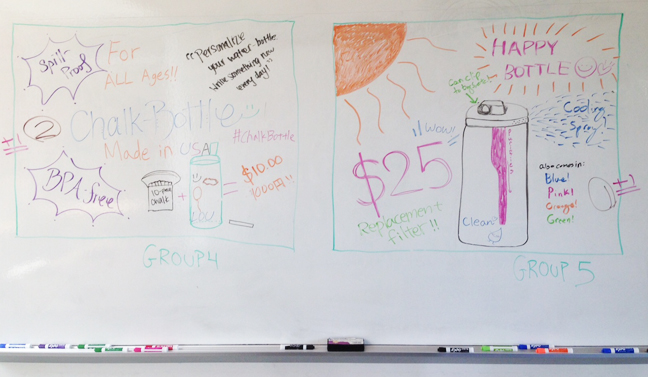
In the YCISL workshops, you worked on a project and made a rollout presentation. Sometimes, I have asked students to focus on just the top three most compelling features of the project and emphasize just those three features in the presentation. We have now designed an exercise just to demonstrate the process of brainstorming and selecting these primary features. We start with a group of water bottles, each with different features. Then teams get to examine each water bottle and create a list of all the features they notice. They then are asked to design their own water bottle. They start by selecting three features from the list they created (or they can choose features that they already know about but are not listed). Next, they have to come up with a special/crazy/extraordinary feature which would potentially differentiate their bottle (remember Competitive Advantage?) After that, they select a sustainability feature. The fun really begins as they create an advertisement on the whiteboard for their water bottle; and only three features can be listed (so two will get tossed in the end) – this requires a few prototyping iterations. An outsider gives feedback and modification can be made to the ad. Finally, everyone votes on the water bottle they would want. This is proving to be a good lesson in focusing on the feature list to promote a compelling creative idea. Try this yourself. You can do it as an exercise for yourself or with others. In the end, think about how your “personal” features stand out when you introduce yourself to others. It’s a very similar process.
[This entry was originally posted on the YCISL LinkedIn Group Discussion board]
Amazon Prime Day: Case Study in Overpromise, Underdeliver

Today, Wednesday July 15, 2015, is Amazon Prime Day. It was supposed to be a “Black Friday”-type special shopping day for those signed up for the Amazon Prime service.
Our household has been an Amazon Prime subscriber for a few years and so far it’s felt all right – mainly for the fast delivery. The excitement over Amazon Unlimited Prime Instant Video has long faded into irrelevance. My spouse and kids nibble on Netflix during the holidays and I have found all I care to consume at DramaFever. Then again, fast delivery was the Amazon standard before they introduced Amazon Prime, so service took a step back first before taking a step forward – and they basically are coming out $99 richer every year without doing anything extra. Well believe it or not, there are worse deals out there where people have figured out how to get your money by providing you the same or less service than before their fees.
Let me also say though that there are a number of things I do like about Amazon and it is #3 only to my shopping at Costco and factory outlets. I do really like their no-fuss return process as well as the customer reviews service. Pricing is also seriously competitive most of the time (wish it was all of the time).
Anyway, back to Amazon Prime Day. This was a seriously bad day for customer experience. Where the expectation was to find compelling shopping deals (like on Black Friday), there was more disappointment than satisfaction to be had. Up front, let me say that I think deals disappearing quickly is not entirely Amazon’s fault. There has to be some stock limit and it really depends on demand and the quick shall have it. The problem probably was that the quick were people looking to re-sell items later at regular prices and make a quick profit (and hence the positive PR about sales on this day) – it probably wasn’t as much to end users as to prospective profiteers.
I take issue more with the plethora of different third-party Sellers engaged in Amazon Prime Day and the inability to tell if there was any real discount because of Amazon Prime Day. We know from services such as CamelCamelCamel that Amazon prices fluctuate regularly, but we could not really tell how good the sale price was unless we checked something like CamelCamelCamel. This was just a jumbled presentation and the air quickly left the balloon. Our household did not buy anything on Amazon Prime Day.
With this in mind, I judge Amazon Prime Day to have been a case of overpromise and undeliver. A pretty nasty blunder in mismanaging expectations and presentation. They lost our attention within about 2 minutes.
In YCISL, we coach using a grab and monitoring “eye contact” to ensure that attention is not lost. Amazon.com, once the premier example of user persuasion, failed badly this day. Let’s move on. Accidents happen.
Related News Stories:
Amazon Prime Day Recap: Sold-Out Kindles, Wait Lists, Facebook ‘Fail’
Amazon Gets Defensive As Customers Criticize Prime Day
Parent Thinking: Indications that “Educators” Still Don’t Get It
As a parent, have you tried helping your child with a math problem? If so, you might have seen something like this…
“At an appliance store, the regular price of a refrigerator is $700. How much money is saved by purchasing this refrigerator at 30 percent off the regular price rather than buying it at 15 percent off the regular price with an additional discount of 15 percent off?”
I am reminded about the disconnected mindset that some “educators” have when it comes to posing questions for young students to solve. I remember the “bathroom tile”, “farm fencepost” and “bus fare” questions in the math textbooks that my children had in elementary school. These types of questions demonstrated low emotional intelligence within the context of education and perpetuated the mistake of forcing youth to focus too far in the future instead of the present.
How hard would it have been to just use “a pair of shoes” or “a cell phone” instead of “a refrigerator” so that the student could relate to the problem? Further, the outcome (i.e., determining an answer) is unlikely to provoke any satisfaction so motivation is also absent.
I am also slightly amused by the context of this problem in which one has to discern the savings difference between a single discount versus a pair of discounts. This is one of the biggest tricks going on in marketing – obviously invented by adults for the purpose of deception. Don’t youth get enough exposure to adult idiocy already? Why not give them a mortgage-backed securities problem then?
So, to be fair: not only do “schools kill creativity”, so do today’s educators. They still don’t get it.
What Makes You Happy? Keeping Your Personal List.
On of the KDramas I am watching presently is Hotelier (호텔리어). Towards the end of episode 4, Frank asks Leo “What does happiness mean to you?” Leo’s ‘serious’ reply includes “Good pay, good food, good social status.” Frank is reflective about his pursuit of happiness. [I am noticing “happy” and “happiness” spoken many times in this series]
This question may be of value in the YCISL journal. So we’ll have students title a page with this question, and initially have them create a list of things they think make them happy. They should also keep another list of things which do make them happy (as they experience it). This may be a useful reference in positive thinking as well as thinking of the future and the pursuit of happiness in the personal story.
I searched on the phrase “What makes people happy” in Google and the top-most results generally refer to studies pointing to research conducted in the US and findings that social connectedness is most vital to happiness. More interesting to me was the result pointing to the article “How our view of what makes us happy has changed in 80 years” published by the British Psychological Society in which a happiness index is updated. Given our age of informatics, it may be more valuable to have a multidimensional index that crosses age as well as cultural or even social status lines. For YCISL, we could compile data based on our group profiles, but more impactful maybe to design a method to design, fill and update our own personal happiness index. Above, I mention a simple entry list into the journal, but what if we could create an app to maintain ones personal happiness list and provide valuations so that the list is indexed? How cool would that be?
A Model for a Well-Being YCISL Workshop
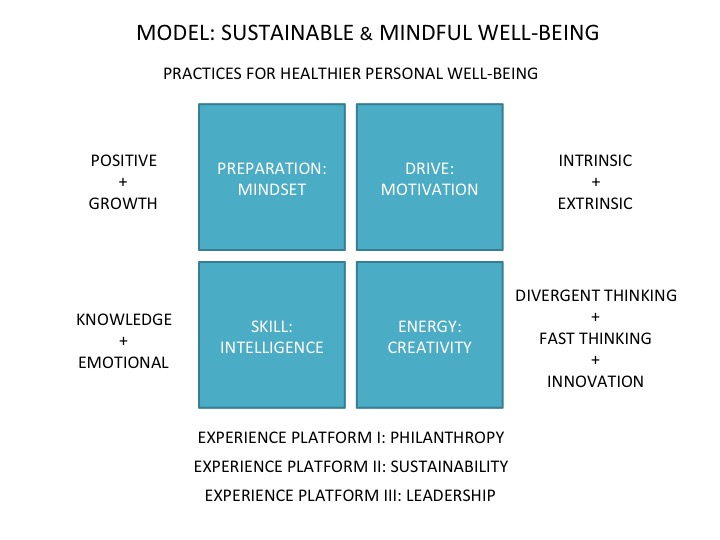
I recently had discussions with two parties interested in the YCISL program. One was with a group of high school administrators/teachers concerned with student wellness and well-being; this ties in with the mindful aspect presented in YCISL workshops by Stephen Murphy-Shigematsu. The other discussion was with the President of a Teen Volunteer organization who offers philanthropic activities for youth; I have had previous communications on philanthropic lessons through YCISL. As an exercise, I have “prototyped” a model for a prospective well-being workshop and it adds philanthropy as an additional layer to the underlying platform of the workshops. This model selects four main emphasis areas, each of which uses a pair or triplet of sub-topics to demonstrate the emphasis area. Each sub-topic is a skill element and demonstrable by a workshop activity, exercise or discussion. The emphasis areas are intended for reflection and performance evaluation. Put together, this model should promote development of “Your Personal Story.”
Mentor Exercise: Map Our Workshop
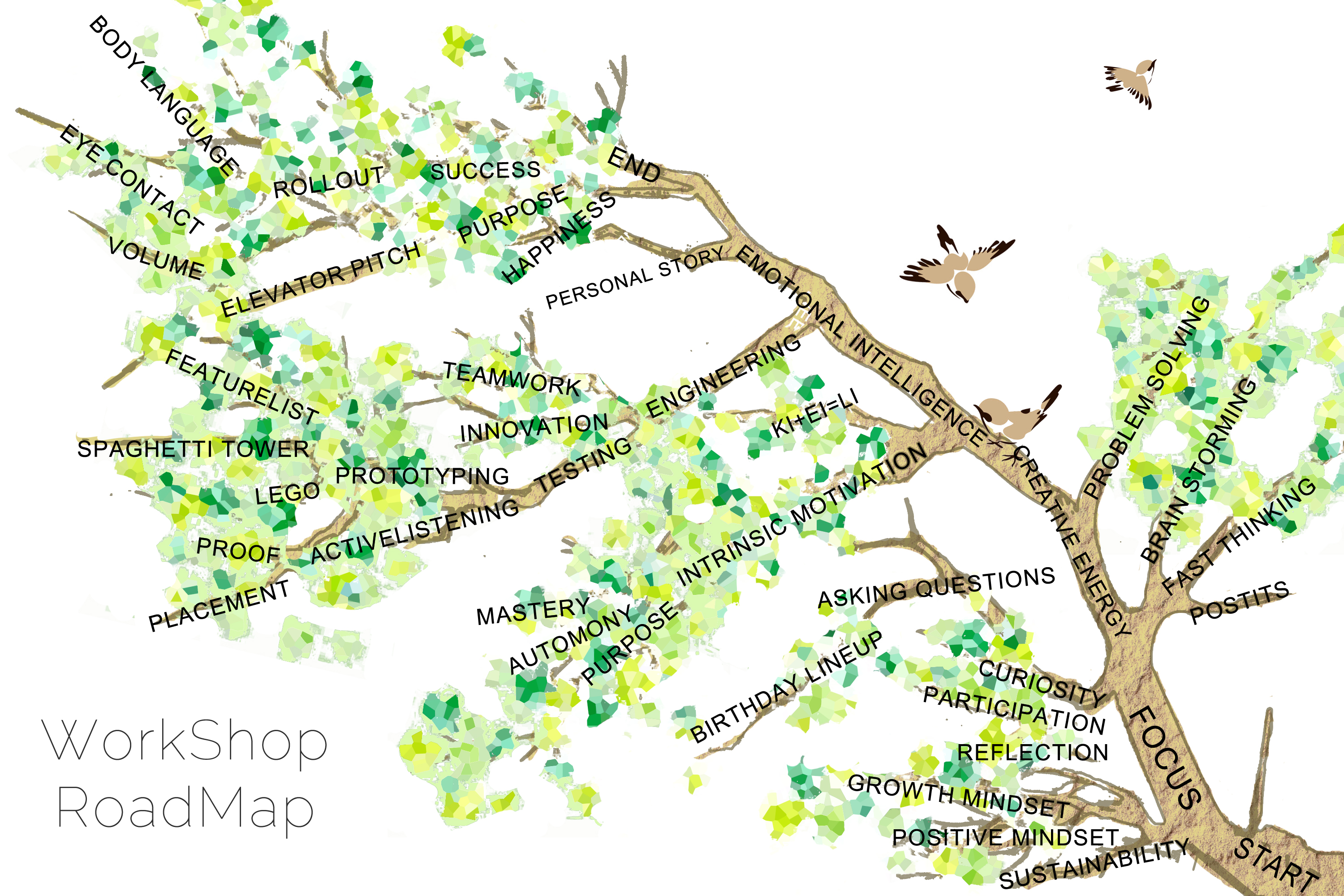
The main idea is to graphically list all the topics (life lessons, messages, activities, etc) into a map and perhaps show connections to our themes. Mentor Sophie designed the following based on the Wasedajuku March 2015 YCISL Workshop.
WSJ: Does Technology Belong in Classroom Instruction?
In today’s (Monday March 11, 2015) edition of the WSJ, there is a Technology section with an article addressing the question “Does Technology Belong in Classroom Instruction?” with the Yes argument provided by Lisa Nielsen and the No argument provided by José Antonio Bowen.
Let’s reflect on this question in the YCISL context especially our problem (that schools stifle creativity) and our program emphasis areas.
The prime question is whether technology, as it is applied in schools, enhances creativity and provides opportunities to develop personal skills. Let’s focus on five electronics-enabled technologies that are in current adoption in schools:
1. Computers. Out of the five selected (electronic) technologies, computers have had the longest run in schools so far. Computers are major investments in terms of initial capital as well as ongoing maintenance. Early on, computer companies often donated computers to schools and parents volunteered to maintain them. Their impact on creativity is mixed. On one hand, they are big-pipe sources of knowledge and viewpoints; on the other, they have become tools on which we lay and express our thoughts and ideas as well as analyze data.
2. Tablets. Lighter backpacks are the main benefit of tablets. With respect to creativity, I think they are at a disadvantage to computers because of their smaller screen and higher difficulty in user input (much easier to swipe and tap, than to draw or type). Obviously so, they are handier for searching/researching big-pipe sources of knowledge and viewpoints; although not a particularly good solution as an alternative to printed textbooks because of their limited screen size.
3. Interactive Whiteboards. In concept, this technology certainly belongs in classrooms. However, their performance and ROI is so below potential. Remember “Under-promise and Over-deliver”? Compared to modern whiteboards which can be as long as the length of walls in a room, the limited screen size of interactive whiteboards is a disadvantage when it comes to promoting creative exploration in a classroom. Sure, interactive whiteboards are useful when putting up PowerPoint presentations and annotating them, but can they replace the analog alternative altogether? No, they can’t. So the result is an additional expense rather than an alternative expense, and a significantly higher maintenance cost – all with a limited lifetime and shorter replacement cycle. And there are the health issues.
4. Class Web Portals. As a parent of school children, I have used a few Class Web Portals before. I think they have gotten better in terms of learning curve. The early problem was that schools and teachers only half-committed to these portals so information was split and not replicated between paper and web. So students and parents had to check two sources of classroom information and collate on their own with no way of being certain of full-picture accuracy. So assignments were missed or students needed twice the time to get homework done. My guess is that the learning curve has gotten easier as more HCI technique is incorporated as well as teachers, parents and students becoming more accustomed to interacting with classroom web portals. I have also experienced Stanford’s Coursework portal which is quite good and useful; I especially like that students can upload assignments and the server clocks the time that an assignment was submitted. However, with regards to creativity, I have not yet detected any features that help educators or students interact creatively. Maybe in the future.
5. eBooks. There are eBook devices whose clarity and readability are great advantages. But these devices are not making headway into schools. Instead, tablets with eBook apps are common. eBooks as data downloads are also growing. eBooks tied to publisher web portals are also an interesting concept and have potential to enhance creative and critical thinking. The barrier is the monetization: eBooks (especially textbooks) are not cost-effective and do not possess the advantages of printed books. Like tablets, their main advantage is lighter backpacks (and fixed space requirement) but they are not fully-competent replacements for printed textbooks. That is why I purchase the printed textbook (use at home) in addition to eBooks (use at school) for some school subjects such as history and biology.
In my view, technology will “belong” in the classroom – one day in the future when it is more mature. Presently, it has too many kinks and disadvantages and the expense is unjustifiable because product developers are in the early stages still. Remember when a 20 MB hard disk cost $1,000+? We can get a more reliable 120 GB solid state drive now for around $100.
Let’s gather educators to brainstorm ways to leverage creativity from classroom technology first then develop and reveal a true solution with the promise of replacing paper and pen, chalk and chalkboard, printed books and handouts. Let’s innovate.
WSJ: It’s Really Here: TV for 6 Month-Olds
The WSJ article “It’s Really Here: TV for 6 Month-Olds” by Joe Flint (published in the Business & Tech. section of the March 30, 2015 issue) describes television programming for infants. The article describes the programming, technology, the business prospects and viewpoints.
It saddens me. For someone to provide a cheap, low-quality substitute for personal parental attention wreaks of negligence. And to the idea that “Education Stifles Creativity,” this exacerbates the problem. It is another form of knowledge pollution brought about by technology that sets back a person’s personal story.
“BabyFirstTV…is aiming its programming at children as young as six months.” “It launched in 2006…and now reaches more than 50 million U.S. households.” Got that, parents? Better get your shields up because we all know that much of television programming is a weapon of mass (mind) destruction. Short attention spans, addictive behavior, myopia, obesity, and an overall lack of interpersonal skills.
“What is important is what we put our kids in front of and we think we are offering the cleanest, safest alternative.” After the spin slows down a bit, look through your list again just a little harder. The cleanest, safest alternative is parent attention. And “In 2014, advertisers spent $1.2 billion on kids channels.” Hmmm, who exactly is the winner here? And is there any trace of intrinsic motivation?
“I know there is a lot of criticism about babies and and young kids watching TV, but I think in moderation and with parent supervision it can be a great benefit.” You might compare the benefits list to the detriments list. And which effects are more long-lasting and influence future behavior? I would mostly recommend physical interactive activity but in those depleted energy settings when we want to rest and relax, can we not make a better choice and fill the time with mindfulness activity (which involves closing the eyes) and perhaps even enhance it with music?
All in all, I view such developments as presenting greater challenge to the YCISL mission. Let’s hope enough parents recognize it as negative innovation – that is, one that promises undesirable influence and impact.
On the Combination of Knowledge Intelligence with Emotional Intelligence
In YCISL, we postulate that Leadership Intelligence (LI) arises from the combination of Knowledge Intelligence (KI) and Emotional Intelligence (EI). Our viewpoint is succinctly expressed by a chemical reaction:
KI + EI -> LI
In general, EI is a limited-quantity reagent which results in a low LI yield. KI is the information capital that one possesses and is largely related to formal education. EI is the ability to configure KI so that it is useful and effective. Essentially, EI bonds with KI and forms LI, a valuable product and resource.
In another article, I have discussed how EI is lost just as creativity is stifled through formal education and societal influence. So as KI grows, EI can greatly diminish. So the challenge is to protect, preserve and restore EI so that it is ready to produce LI.
This model explains why LI is rarely demonstrated in modern society and why YCISL focuses on opportunities for and examples of youth leadership; we expect to be able to yield high LI in youth and not adults. It will take high quality/purity KI as well as potent EI to produce the LI that we seek.
The hope is to ignite the production of LI at an early (prime) age so that adults have the youthful experience to sustain high LI. Overall, this helps explain why the best (adult) leaders are those who draw from their youth experience.
This is one of YCISL’s purposes.
