
Lessons: Using the Ideo Method Cards
These are an excellent resource for facilitating group interaction. The cards could be used for encouraging discussion or planning projects or simulating situations. The cards are focused on the design process and describe how creativity was used to overcome challenges. Especially useful are the four categories of: Learn, Look, Ask and Try.
Learn gets people to access or create knowledge to help determine outcomes. It is a proactive approach to problem solving design.
Look uses observation and list creation. The user or activity is usually that of another person and the designer is the observer. There is minimal interaction.
Ask involves direction of an activity. The observer provides the direction and the user responds with their behavior. The interaction is unidirectional.
Try makes the user and observer the same person. It involves personal experience and articulation.

Idea: Another Game Adaptation Example – Boggle
Thought of another straightforward way to adapt a game to the sustainability theme. This time using Boggle which is a game enjoyable at all ages (I hope this adaptation doesn’t take the fun out!). The idea is to create a list of words related to sustainability (or some other theme) that are worth double- or triple-points when listed in a round of Boggle. It could start with simple words such as “solar”, “water”, “recycle” or “save”. Then the list could grow. Perhaps this list could be kept on a website for download, and people could submit new words for the list over time.
PLUS: Just found an online version of Boggle! http://www.fun-with-words.com/boggle.html. Also found online variations of Boggle. And yes, there is an iOS version. However, I am not sure how this adaptation will function with an online version.

Idea: Simple Demonstration – Crossword Puzzle
I was thinking about how to put across the idea of adapting a game to a sustainability (or other) theme – for the purpose of the Project Studio. I wanted something simple to create and simple to understand; something quick to demonstrate and obvious how to expand. So, a crossword puzzle came to mind.
I could create a small crossword puzzle with just a few clues as the starting point. The students could then be challenged to create a larger grid crossword puzzle.
For a younger audience (eg, primary/elementary school), we could use a word finder puzzle format instead.
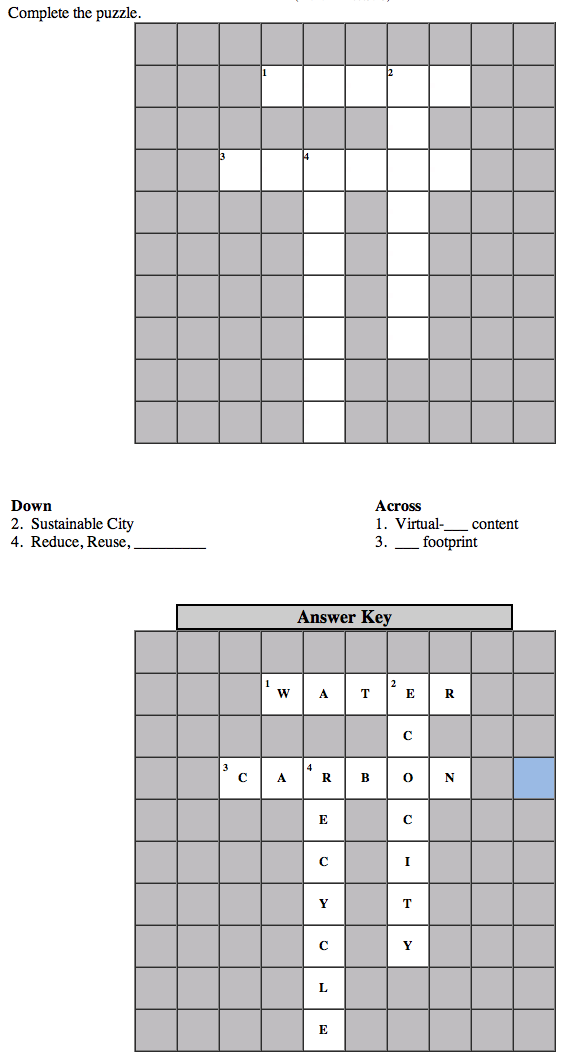
Puzzle created using Build a FREE Crossword Puzzle! at http://edhelper.com/crossword_free.htm
Lesson: Features – Used, Unused, Forgotten and (worse!) Avoided
Have you heard anyone tell you that they use less than x% of the features in [your software here]? x is usually somewhere in the range of 10 to 50.
Part of the reason may be that the need is limited [and therefore, there is a poor fit of the software to the need], or there may be several other reasons related to the usability design of the software. I imagine not many people recall how well MacWrite (or even WordStar) met our word processing needs. Most software today is bloated with features and impossible to master. And even with all the revisions, the structure and utility of some documents from the paper & pencil days are still not easily reproducible on a computer. There are some features we know are unused, there are some that we learned but never stayed in our workflow and we have forgotten, and there are those that we avoid (but tolerate their existence) because there is distrust or incompatibility.
Thus, we could have an exercise focused on “simplicity in design” where we list all the features and cut the ones in the lower priority half of the list – then see what we have left. Would we have something that more people would prefer? Would we gain a competitive edge? Would we get greater user satisfaction? Could we get greater product quality by having less buggy features? Would the persuasive message be simpler? Would be have to spend less on product development?
Tool: The IdeaPad
I really shouldn’t call this an IdeaPad since the label is used by Lenovo for its products, but it kind of fits well with what I have in mind for the creativity workshop.
The challenge would be for a participant to doodle ideas on one sheet of paper in a notepad. Each idea on the sheet could be related or unrelated. It would just be interesting to see whether a single sheet of paper is limiting or inspiring.
So for example, let’s provide each participant with a piece of art sketch paper then have them draw an object (eg, a building, maybe even specifically a hotel) then have them come up with solutions to problems commonly associated with buildings (eg, climate control).
Remember that ideas could be vertical or in-plane.
Brainstorming Aid: Using Hints
At the very least, a hint (or a “seed” might also be an appropriate term) is a useful way of providing a context from which to generate discussion and ideas. The use of hints could also be expanded to integrate multiple facets into a brainstorming exercise. The hint might be incidental (contact in an unintended manner) or purposeful (part of an agenda).
The Incidental Hint: this is more likely the case for teaching moments where spontaneous and freeform brainstorming is desired, and there is freedom to explore. We might just gather a group together, state an unexpected topic (and objective) and let everyone interact. An incidental hint, for example, might come from listening to the radio or reading a magazine.
The Purposeful Hint: in a research or business setting, there is probably a framework from which one would select a hint. For example, in order for a company to design a new product, it would be useful to know what current technologies are available (mobile devices, eg), or what the customers are asking for (pharmaceuticals, eg).
The hint contributes greater definition to an idea and is tied to a scope. A series of concurrently developed products with similar hints might constitute a product family.
Thoughts: Questions About Change
Sometimes, the best point from which to start brainstorming is with a question (other times, it might be with a problem definition). The question could be self-directed such as…
If I could change one thing at [work, home, school], it would be… Then we would probably want to add “…because…” just so we understand the motivation.
We could also make this question a little more sophisticated (maybe follow our innovation theme) and ask…
I could make [this, that] significantly better by…
The issue with self-directed questions is that they may hinge on one’s focus on personal limitations. It would be an interesting comparative exercise perhaps to also ask the question…
They could have done [this, that] better if…
Perhaps we could roll this into a quick creative exercise where one gets to critique someone else’s work as well as their own.
Here’s an idea: create a new label for a drink (I’m drinking a Tejava at the moment). OK, let’s expand on this idea. We could have a selection of beverages and each team could select one. The team would taste the beverage themselves, then brainstorm and design a new label, attaching it to the bottle. Another team, acting as a focus group would taste the beverage with the new label on it then comment on how well the new label works.
After such an exercise, we should discuss how such an understanding of labeling could be applied to a sustainability-themed product.
This might seem like a marketing exercise, but it really is about persuasion (psychology) – and psychology is really the most applicable tool in advancing sustainability (or most issues for that matter). Sometimes, sustainability isn’t a large enough issue to persuasively alter behavior (on a dominant scale) so it might have to be associated with something else (money, prestige, health, eg).
Life-Action Planning
One of the things I learned from Amanda Itliong when she was with the Haas Center for Public Service at Stanford was the need for an “individual learning plan” which charts out a person’s steps towards leadership objectives. Here is some text from the Haas website (http://studentaffairs.stanford.edu/haas/principles/document)…
Reflection Questions
What does your personal plan for preparation look like? How might you creatively build preparation into your program design? How has your academic work prepared you for this experience? Where do you see connections between your academic/intellectual background and practical application? What have you not been prepared for in the past and what did you learn from that?
I picked up the book “Me: Five Years from Now” by Sheree Bykofsky. It provides some ideas on areas of life to focus on for life-planning. This showed me that there are at least two approaches: (a) we could discuss how a learning plan is comparable to strategic navigation and risk management, or (b) we can keep it at simple by just asking “Where will you be 6 months from now?”, “…1 year from now?” or “5 years from now?”
I favor the latter for youth but it should be framed as an action plan where not only are there places/positions listed, but also actions/directions to get there (addressing the getting from point A to point B problem we often see). From Bykofsky, we also learn that we should ask ourselves “Which actions can we start today?” and “Which tasks will take time?” There should be a forward-moving tendency to the action plan and minimal chance of inertia.
The Three Main Ideas
I stumbled through making a video of myself introducing the YCISL program. It took about 4 hours to create 3 minutes of usable video. I only now realize the significance of the bloopers clips we get to see.
Anyway, this video outlined three main ideas behind the program workshops:
1. Stanford serves as a neutral ground and clean slate which frees them from their everyday constraints and allows them to build on their ideas organically.
2. Creativity is an innate resource which we can utilize to generate innovation. The ability to be successful and adept at innovation should be viewed as leadership. Creativity, innovation and leadership comprise the program’s skeletal framework.
3. Youth leadership objectives can be differentiated into age stages. These objectives are different from those for adults (professionals) – as opposed to youth.
Lesson: What they need is…
After another KFC mix-up today (always confusing original with extra crispy and now grilled!), I was starting a sentence with “What they need is…” Variations on this include…
– What they should do is…
– They should have…
– Why didn’t they…? or even
– There ought to be a law to…
These are all the start to instant brainstorming. Of course, this is usually in response to some instigating event.
If we focus on schools, we could look for areas for improvement.
