
NewSchools Venture Fund: A YCISL Perspective
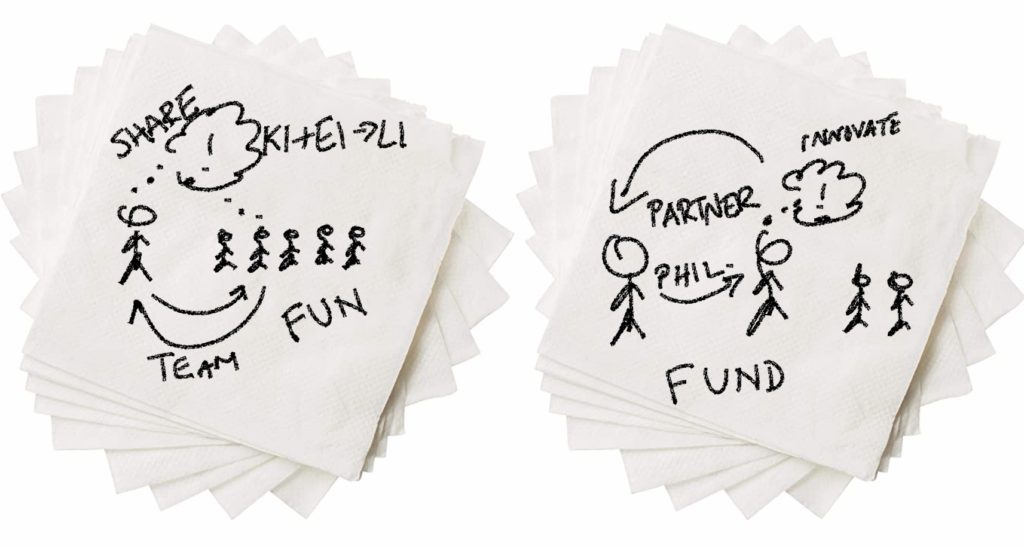 Last week, I sent in a job application for the position of Associate Partner, Innovative Schools at the NewSchools Venture Fund. My cover letter stated that I was seeking flexible part-time activity that would complement my Stanford youth creativity project. Apparently what I was offering was a non-starter which is not a big surprise. But since I found what they were doing quite interesting in the education space, I will write a brief entry here to share my views of their mission and strategy.
Their “Our Model” statement is quite compelling. The words “philanthropy”, “partnership” and “innovative” are the three keywords that I would pick out for their main feature list. To choose one sentence that I feel represents the overall effort, it would be “We seek out promising innovators from around the country, and invest in those with the greatest potential to improve student learning and make a positive impact.” A highly revealing design thinking statement. It has the Who? Where? What? How? and Why? that I ask for in the YCISL Asking Questions Design Thinking method. There is no When? element here or elsewhere in the Our Model statement. I think it should be added.
On their Core Values page, they list Bold, Passionate, Connected, Inclusive and Accountable. This reminds me of my visit with the Lili`uokalani Trust – in several respects. Admirable. In terms of a YCISL review of the core values, I think of Satoru Iwata’s GDC Keynote statement about his business card, mind and heart, and there is a fairly good connection with these core values: Accountable->Business Card, Connected & Inclusive->Mind, Bold & Passionate->Heart. YCISL-type words that may work better in characterizing the needed effort include: Mindful, Uplifting & Optimistic (reflective of our fondness for emotional intelligence and positivity).
Actually, even beyond the inconvenience of the flexible part-time condition in my application, there is admittedly sparing overlap of interests. Awkward momentary silence. The YCISL program is based on a premise that there is a universal lack of creativity in education and that leads to educational misses. The YCISL program is open to all and we have hope to assist any young person at any interface who will take personal ownership and has a desire to improve their own life. Let’s just say our napkin doodle may be quite different from their napkin doodle. Still, we can learn from each other.
LinkedIn: The Lego Data Story
You know, YCISL and “Lego” (the pieces) have been together since the start. We’ve had our Lego Exercise since our first workshop in 2011. We’ve used it to demonstrate creativity, visualization and team collaboration.
In my LinkedIn newsfeed this week, I saw a graphic that uses Lego pieces. I managed to trace it back to a company called Hot Butter Studio and a photographer named Brandon Rossen. The LinkedIn version is an extended modification of the original and I found yet an even more extended version on Reddit in an article titled “The Lego Data Story, adapted from original image by Monica Rosales Ascenio.”
I find the LinkedIn version thought provoking when it comes to design thinking. In our YCISL ITW-DTI design thinking workshops, we are using an asking questions method to acquire pieces of information that subsequently get architectured into a story worldview. This model also fits well with our Divergent-Convergent Thinking Feature List exercise where we gather as many options as possible, categorize them into priority levels, and use select attributes to differentiate for innovation.
I feel the “Explained with a Story” step enters the emotional intelligence realm by applying resources with purpose and meaning. The prior four steps (data, sorted, arranged & presented visually) are essentially analysis steps and would be considered part of the knowledge intelligence …and as per the YCISL KI + EI -> LI formula, we need to flex our EQ to achieve leadership and success.
If we also remind ourselves of Sir Ken Robinson’s thought that “In fact, creativity — which I define as the process of having original ideas that have value — more often than not comes about through the interaction of different disciplinary ways of seeing things.”…we also can appreciate the Actionable (Useful) extension of this graphic because the energy we put into our own creativity is intrinsically motivating when we receive feedback that we are serving something of value (further credit to Richard St John’s thought “…you’ve got to serve others something of value.”)
CNBC: “How Common Core Broke U.S. Schools”
My YouTube feed today presented a video posted by CNBC titled “How Common Core Broke U.S. Schools.” The description for the video reads “First implemented in 2009, Common Core was an ambitious initiative to revolutionize the American education system. National leaders from Bill Gates to President Obama supported the idea and it cost an estimated $15.8 billion to implement. Years later, research showed the new curriculum had minimal impact on student performance. So why did Common Core fail? Can a common curriculum be successful for all students?”
Around 2010, my kids were in middle and high school. Race to Nowhere was making headlines with special screenings in communities and raised awareness about stress and anxiety in schools. I also recall two other programs with imagery-filled titles, “Race to the Top” and “No Child Left Behind,” that were adding fuel to an already burning problem. They were both huge funding efforts which by-passed Rory Sutherland’s fourth quadrant and the Ministry of Detail. Common Core apparently was also a product of this funding movement and, according to the CNBC report, failed to gain traction…ever.
The video reports on resistance to change (probably resulting from a poor elevator pitch) as well as crosswinds such as adoption of computers, e-textbooks, cultural shifts, and socioeconomic tides. This was the time when educators were discussing teaching framework alternatives that were working, but policymakers were fixated on testing, test scores and accountability. While Common Core didn’t really cause more damage to an already hurting K-12 educational program, it essentially helped the education industry grow at the expense of student learning…quasi-equilibrium so to speak. Entering college students were less well-prepared and colleges started having to offer more remedial catch-up courses (related to tuition increases?). Degree programs of study either got extended because instructors were stretched or terminated early because students couldn’t get past lower division courses. On top of this, government policy was driving increases in college enrollment and the value of an undergraduate degree declined (supply & demand, I guess).
The Common Core isn’t necessarily a bad idea. In fact, it’s a great idea. The issue may have been with the innovation & design thinking process. In YCISL-speak, the Common Core did not seem to possess emotional intelligence or intrinsic motivation. SAT/ACT, Subject tests and AP tests were the de-facto standards of achievement…and not interfaced with actual school learning. The knowledge gaps that Salman Khan had referred to were going to get worse.
Standards-based examination tied to school learning is in place almost everywhere in the world…except in the US. Standards-based education programs even have overseas influence (that is, outside the country where it is the national program). We also have the International Baccalaureate (IB) program which is standards-based and intentionally available by design for adoption internationally.
A greater disappointment lies in the poor outcome of the Common Core despite the sense and awareness that was sparked by Sir Ken Robinson’s TEDTalk “Schools Kill Creativity.” Maybe the next challenge should be Common Core 2.0 for 10% of the cost of the original Common Core. Some thriftiness might get some wiser moves.
Thoughts: 3 Rubric Statements for YCISL Leadership
YCISL is anatomically a leader-shaping youth program. It started 10 years ago. In that time since, what have we learned from our interactions and programming? Here are three rubric statements about the YCISL sense of leadership.
- The Person (30 points).
- Is the person self-aware? How do they answer the question “Tell me about yourself“?
- Does the person see themselves as having an ability for self-improvement? Does the resume show a history of self-improvement? What did they do today that supports their growth? What is on their skills roadmap for happiness and success?
- What is the person’s worldview? Can the person describe their worldview using the asking questions design thinking method? Is there attention to detail in this worldview?
- What are the dynamics in the person’s worldview? What verbs describe the actions? What adverbs?
- The Personal Story (30 points)
- How many profound experiences from a past age can the person recall? Can they share a positive lesson from each of those experiences?
- How many chapters would there be in this person’s biography? What are the headings of each chapter?
- How does the person want to be remembered?
- What would go on the person’s business card? What is in their brain? What is in their heart?
- The Senses & Sensibilities (30 points)
- Can the person express a sense of purpose (and be honest about it)? Is the person comfortable with expressing their sense of purpose? Is the sense of purpose simple & authentic (no acting) enough to follow?
- What does the person prescribe to build a sense of motivation? What self-motivation practices does the person use? Can the person describe some intrinsic motivation social experiments? [Automatic fail grade if the person thinks money solves problems.]
- What energizes the person’s life senses? Can the person switch modes according to energy demands such as for quick bursts, peak periods, resistance, resilience & recovery? Does the person have renewable energy resources?
- Bonus Category (10 points)
- Is the person a scholar? Do they read? Do they listen? Do they ideate? Do they think critically? Do they interpret (data & information) fluently? Do they feel the freedom to explore? Do they learn from failure and clean up their worst mistakes?
- Does the person inspire others to (try to) do great things? Are teamwork, team-building, and collaboration featured in the person’s activities?
As part of my Stanford work, I frequently advise new course instructors on how to compose a grading rubric. A well thought out grading rubric makes the simple task of evaluating work easy by providing focus & awareness. Yet, a great grading rubric maintains reserved flexibility to recognize statistically abnormal results. So here I am sharing some notes on how we can evaluate our leadership skills, record and future.
WSJ: Making Senses
There was a special insert in the Friday July 8, 2021 issue of the WSJ titled the “Future of Everything.” In the center spread was an article titled “Making Senses” by Angus Loten & Kevin Hand. The article widened my mind scope on the “smart” and “eco-smart” project themes that are a part of the YCISL ITW-DTI workshops being offered this summer. Advances in sensory devices and dataset building with the alignment to human preferences should find amazing applications in sustainability design thinking.
Transparency. We are very familiar with computer vision and image recognition, but most of this is with regards to shapes and little else in terms of physical characteristics. The advancement described in the article about transparency will lead to better depth perception and recognition of vessel contents.
Taste. The need for sensory systems in food storage (eg, refrigerators that can detect bad food) is taking a long time. Let’s hope the advancements in “electronic tongue” technology means we are near the point where we can greatly reduce wasted food. A premium market for this may be in wine since wine can improve or decay depending on various factors.
Touch. I have seen many fascinating videos of product assembly lines and food production lines to know that there is a lot of mechanical tools involved. Upgrades to these and other applications could help healthcare as well as more common needs.
Smell. The AI sensory application to robotic noses and identifying vapors can be used in enhancing or neutralizing odors. There are so many places where pleasing odors could enhance productivity and removal of objectionable odors could reduce distractions.
Hearing. Noise cancellation hearing devices are quite popular presently. Ever tried using one during air travel? Isolating voices using AI could process sounds so that no idea is lost among the “chatter” and everyone is heard. Ever been to a call center?
The common thread in these advancing areas is the collection of reference data. Even so, there is so much variability that it is challenging to consider anything as a reference. Things change very quickly and conditions can tweak channels. For example, in the food waste application I mentioned above: how much reference data would be needed to tell whether it’s time to discard your jar of sauerkraut?
Activity: Mentoring Short Essays
I have asked the mentors who have participated so far in the current season’s ITW-DTI workshops to compose short essays reflecting on their experience interacting with students and the life skills involved. The opportunity to mentor in a creativity setting is as significant to the YCISL program is as the opportunity to participate. The concepts of design thinking are as relevant to mentoring as they are to ideation and product realization.
This short essay collection assignment for the mentors is an additional chance for me to inspire these few students to be leaders lifted by emotional intelligence and deep thought on their journey. I have a few ideas in mind on how to fulfill this request:
(1) Storytelling. Through our YCISL technique in storytelling, we paint world views which detail the setting and circumstance, and enliven it with actions.
(2) Elevator Pitch. Using our YCISL “The Art of the Executive Summary” technique, we edit scenes and storyboard them in different orders to check for flow and meaning.
(3) Your Personal Story. Using our 3-part YCISL Your Personal Story technique, we build a resume-like chronicle of our past experiences, our present mindsets and behaviors, and ideas on our aspirational pursuit of meaning and fulfillment.
This could turn into one of those procrastination-type endeavors, so I am setting a 30-day goal of completing this assignment. Better this way anyway as the ITW-DTI workshops are still quite fresh in memory.
Activity: YCISL Design Thinking Incubator
In June 2021, the first YCISL ITW-DTI (Design Thinking Incubator) was launched. The second was just concluded yesterday. The ITW-DTI focuses on design thinking iteration in order for students to get the feel for revisiting design ideas in a fast succession prototyping manner. This gets the “raw-ness” out of the ideas which we thought would be a useful lesson for design thinking newbies. Previous to the ITW-DTI, we had the ITW (Innovators Toolkit Workshop) which was more broadly skills-based and ended with just one presentation. In the ITW-DTI, students have had to give their presentations three times where each time there was a blast of experiential learning.
| Innovators Toolkit Workshop (ITW) | Design Thinking Incubator (ITW-DTI) |
| 4 days (2 weekends) Skills: Asking Questions, Fast Creative Thinking, Divergent-Convergent Thinking, Filling & Crossing Gaps, Positivity Project: Smart-ified Space or Object Presentation: 1 Group Pitch Exercises: Design-a-Tent, Invent-an-Ice Cream Flavor Core: Out-of-Box Design Thinking |
4 days (consecutive) Skills: Asking Questions, Brainstorming, Divergent-Convergent Thinking Project: Design-a-Club, Design-a-(Smart) School Space, & more… Presentations: Team Practice, Group Practice, Faire Exercises: Problem Statement, Solution Concept, Feature List Core: Asking Questions Approach to Design Thinking |
The ITW-DTI is a much faster program, but also attends to the “5-second Rule” phenomenon that was dragging the ITW program. By this rule and the more highly packed ITW-DTI schedule, the design thinking brainwork stays in the fast lane. Quick acceleration is key, but only needs to be pushed once. Making incremental improvements is a lot simpler too.
Compared to the earlier YCISL workshop programs that were on-campus and totaled many more contact hours, the ITW-DTI is an effective means of experimenting with design thinking with the potential to connect presence with action (EQ-talk). So long as the ITW-DTI experience along with all other YCISL programs spring the Aha! moments for students, I think we have something worth pursuing.
SCMP: Chinese university professor complains ‘lower IQ’ daughter is ‘mediocre student’ due to poor primary school results in viral video
PRNT 101: Introduction to Parenting. Introduction to the parenting of children emphasizing modern soft-skill engineering principles: object-oriented design, decomposition, encapsulation, abstraction, and testing. Emphasis is on good parenting style and the built-in facilities of parenting languages. No prior parenting experience required.
This is a YCISL analysis of the article “Chinese university professor complains ‘lower IQ’ daughter is ‘mediocre student’ due to poor primary school results in viral video” written by Alice Yan and published by the South China Morning Post on June 1, 2021. This article refers to a video showing a person, presumably Associate Professor Ding Yanqing, sharing his experience parenting his daughter and lamenting her school performance. A video of a news broadcast on this story is posted on Baidu.
I am relying on the translation into English that is reported as quotes in the SCMP article.
“I tutored her every day. But she still finds it difficult to study. There is a big gap between her scores and that of the second-last student.” This reminds me of Daniel Pink’s TED Talk “The Puzzle of Motivation” where he said “When I got to law school, I didn’t do very well. To put it mildly, I didn’t do very well. I, in fact, graduated in the part of my law school class that made the top 90% possible.” The question that should be asked is whether the student was (1) in a class that would allow her to succeed; was she placed correctly? (2) in a school that would allow her to succeed; was the teaching a good fit for her learning? (3) in a place that would allow her to succeed; are there any non-academic co-factors?
“I am at a loss: this is destiny. I can’t do anything about it.” So he might be at the bottom of the parenting class? If anything, this should raise empathy. The other possible thought is that he is actually responsible for this outcome. Was there any attempt at prototyping? – “fail early, fail fast” as I like to suggest during prototyping – to consider several promising candidates and invest energy and resources wisely. I would also suggest that he reflect on what successes he encountered in this experience. Finding the positivity in failures is crucial to avoid worse outcomes.
“…force her to study or do homework.” In the YCISL, we use the idea of oblique change forces as well as setting up for an exploratory time period (Gamestorming framework). Is his daughter in peak mental and physical health? Are there distractions? The parenting question is what can you integrate with the need to study and do homework that would have a better chance at better learning? A 15-minute nap? A nutritious snack? A caring “how was your day?” chat? More information is needed to analyze this properly…perhaps she has a love of learning for certain subjects, but not others? How much sleep does she get? Does she have active listening filters?
“My daughter is definitely not a wonder child. Her IQ is far lower than both of us.” Any idea about her EQ? And have they all really been tested for IQ? Is it possible that he has a parenting bias because he has a daughter, not a son? Reminds me of the story about Gillian Lynne told by Sir Ken Robinson in his “Do Schools Kill Creativity?” TED Talk.
“No matter how outstanding you are, your child may be just an ordinary person.” Hmmm…humility appears not to be one of his strong points. I wonder if cultural toxicity is unusually high in his worldview.
“Ding admitted it was 95 per cent likely that his daughter would not be able to achieve scores good enough to be admitted to PKU in the future.” Ummm…did you ask your daughter whether she wanted to go to PKU? You also never know. I am at Stanford now…but I am quite “ordinary” and happy.
“Parents should identify their kids’ unique qualities in different aspects other than academic studies. They should find a path suitable for the kids to develop and assist them in that direction.” Finally, some good advice. But let’s add some design thinking to this statement. Who? What? Where? When? Why? How? The Who? should be more than just the parents and kids…it needs at the core to also include the school community as well as social support network. The Where? needs to identify the places where the love of learning thrives. The When? should be addressed through optimized time management that promotes well-being. The What?, Why? and How? is up to each family to explore in their own worldview.
Here is a suggestion for parents in similar situations: Find a list of careers. Imagine your child in those careers. Are you able to accept that your child may be in that career? Can you imagine them being happy in that career? This is just a conditioning exercise. Whether the careers are feasible is not of concern for this purpose. Let’s try to picture a worldview with our children succeeding in each of the ways told to us by Richard St John in his TED Talk “8 Secrets of Success.” Another one of the YCISL “Simple, but not Easy” practical designs.
I will also share a thought that Assoc. Prof. Ding shared this story so publicly because of his academic interest in “reforms of Chinese compulsory education” (listed on his PKU web page) and was actually trying to stir and spin with connection to recent governmental reforms in education. This might explain the narrow thoughts early, and the final “good advice” thought.
Los Angeles Times: UC explains admissions decisions in a record application year of much heartbreak, some joy
There is some soul-searching going on now that college admissions decisions have been made at most US universities for the next entering class of students. The LA Times article “UC explains admissions decisions in a record application year of much heartbreak, some joy” by Terese Watanabe published on April 12, 2021 explores reactions, emotions and explanations for the seemingly heightened competitive feel in this round in the University of California system, particularly in the time of Covid-19 and removal of standardized test scores from consideration (among other things, it’s worth making sure we understand).
First, let’s revisit UC’s Statewide Guarantee and Local Guarantee. The Local Guarantee focuses on the top 9 percent of students in a graduating class of participating California high schools based on GPA in UC-approved coursework completed in the 10th and 11th grade. The Statewide Guarantee relies on an admissions index which in the past considered GPA and standardized test scores. However, the Statewide Guarantee was not in effect for the current admissions cycle because of the stoppage of standardized test scores in admissions decisions (yay!). So numerically, admissions decisions were based on GPA, but at the same time, more weight was placed elsewhere – possibly on extracurricular activities or the personal story. The PERSONAL STORY. In the YCISL program, we have been offering workshops that include Your Personal Story assignments and connecting story components to emotional intelligence.
But let’s get back to the LA Times article. There are a few lines of thinking worth exploring for the YCISL platform.
“200,000 students were vying for about 46,000 spots” First, there were probably fewer spots available for the next academic year because of a significant increase in deferments from the previous admissions year due to virus impact. Remember too that 200,000 students includes out-of-state and international students. This means that about 1 in 4 students potentially would find a spot in a UC. Twists include students who get two or more spots offered, and those who participate in the wait-list. And the factor that does not change is clusters of applicants interested in impacted majors (hence the undeclared strategy – if you just want to be at a UC regardless of major). So let’s say the competitive scale is that you have to position yourself in the top 20% if applicants (remember this is applicants, not all senior high school students). So your personal story has to have a similar uniqueness factor; that is, an admissions officer should not be able to recall another 5 applicants with similar stories. Which brings us to the next item…
“4.3 GPA, eight AP and honors courses and a host of extracurricular activities” How unique is this? Not very if there is not much else to tell. The 4.3 GPA would be competitive if it came with valedictorian or salutatorian status. What if the top student in the school had a 5.0 GPA? Remember to use the Freshman Admit Data as guidelines in deciding whether to apply and not as criteria that would ensure admission. Sure, students did get admitted with the published GPAs and standardized test scores, but the lower cut-offs probably had special circumstances such as athletic ability. AP and honors courses don’t necessarily correlate with college-readiness either. Extracurricular activities? Just how far did these interests grow and affect? Again, these are all details (think like a Chief Detail Officer) that need to be crafted into a personal story. It’s a communication exercise that most college applicants are not very aware about.
“Majors matter, they say.” This is old news in the UC system (and most other universities). Through your personal story, develop a narrative to tell how you will make an impact on society, the future, and the professional field. Design thinking comes in handy here so that you connect worldviews. Apply divergent-convergent thinking to major selection as well as outcome scenarios. Find the one that would make your story stand out.
Another dynamic is in the university rankings. UC Berkeley and UCLA are in their usual top 25 spots according to US News & World Report. But notice how UC Santa Barbara, UC Irvine, UC San Diego and UC Davis are now all ranked top 40…so these have become targets for top applicants. The safety choices of UC Riverside, UC Riverside and UC Merced are all now top 100 (UC Riverside and UC Merced were top 150 just a few years ago, so BIG moves). So the lesson here is that expectations need to change often. If a parent is an alumni from 20 years ago, the admissions demographics have surely changed. With the start of internet applications, the number of schools that a student applies to also has increased. As with good stories, think about adventure. Out-of-state and international students have a natural advantage as their adventure has a far, far away element already built in. For California students, it’s possible for some to tell a far, far away story, but for many, it’s a huge challenge. You’d have to do a lot of prototyping of your personal story.
Yes, Your Personal Story exercises and workshops have a lot of potential to make college applications more aware and accurate (as opposed to precise). Presently, there is no demand for such assistance because the “free” options of college counselors and parents focused on the grades/scores/extracurriculars data make the hard work to develop and tell a personal story only a nice-to-have. That said, there is an element of natural selection in play since many of the raw college applicants are in it for the promise and not the ask.
LinkedIn: Post by Anthony J James of “Fluidity” by designlibero
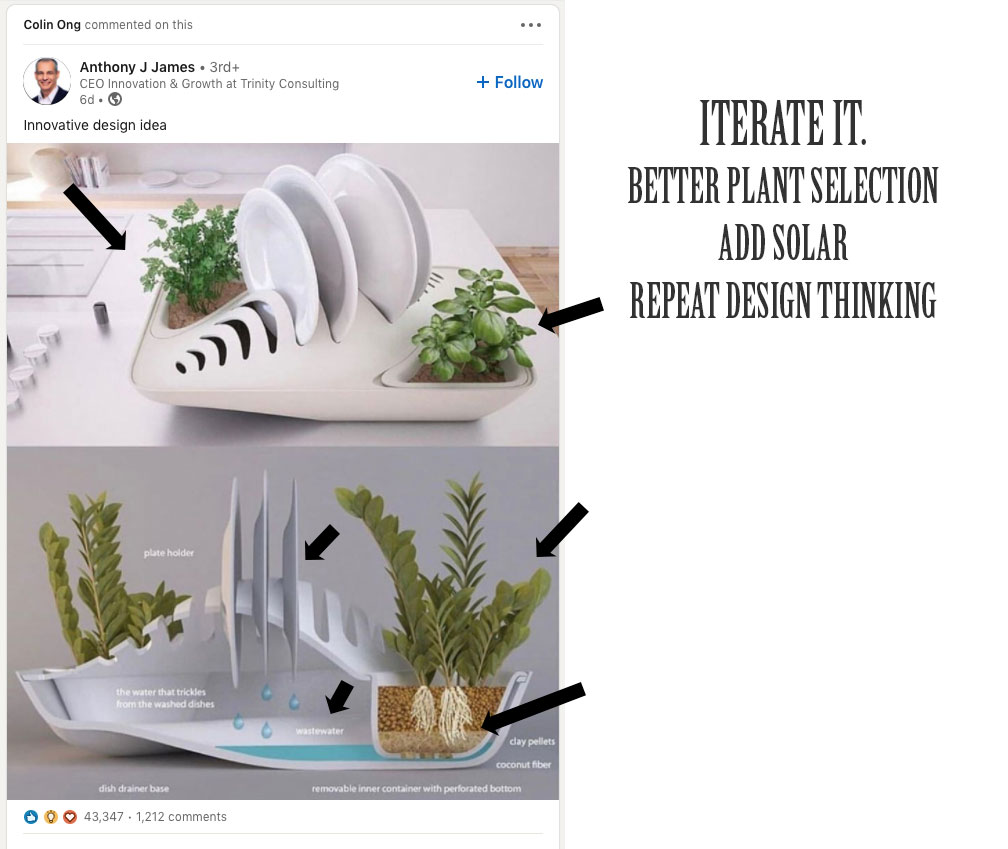
In my LinkedIn feed today, I noticed a post by Anthony J James commenting “Innovative design idea” about a dish drying rack with sections for small plants that would be watered by water that drips from the drying dishes. My reaction was “cool” idea and a wonderful idea using the convergence technique we use in the current YCISL ITW program.
But wait! There was more… There were negative comments aplenty. Many comments were based on lack of understanding and a resistance to the product idea being able to replace the traditional dish drying rack (fixed mindset, I would diagnose). Here are a few examples:
“What about the soap? Would that not be toxic to plants?” Careful how you use the word “toxic” because there are several beneficial plant applications for soap. You can also discard lightly soapy water into your garden (ever washed your deck or patio stone?) without harming the plants.
“Nice try, quite ingenious except lots of plants grow spores, mold, fungi, and insects larvae form their ecosystem and not ours.” Ummm…are you suggesting not having houseplants at all? Or would you like to have a 6 ft social distancing requirement from any plant?
“The person who designed it doesn’t wash dishes.” One of those responses that is most likely incorrect. Perhaps not the way you wash dishes.
“No herbs raised on detergent water will ever taste good or be good for your health.” Reminds me of the Mister Boffo phrase “Unclear on the concept.”
“It is likely that there will be trace of chemicals present in water, that might affect the plant?” Tip: The water you use has chemicals in it. Be it from water treatment, natural atmospheric dissolved gases, dissolved minerals from aquifers, etc.
There were many encouraging comments too. Mostly on the external form design which I agree is cool.
But what struck me is the lack of productive commentary. I don’t usually comment on LinkedIn, but since this product touches on so many personal and YCISL interests, I wrote:
“Iterate this idea. Forget hydroponics. Many houseplants (ie, indoor plants such as the ZZ shown) need humidity rather than constantly wet roots. The LECA balls would provide support and a porous way for humidity to rise to plant. Would suggest removeable bottom tray for periodic cleaning. Other applications would be micro greens or seed starting using seed starter mix where constant moist but not wet needs to be maintained, but would recommend pre-filter such as activated carbon.”
The idea is to collaborate, not object or discourage. Use your expertise, if you have it to share. Wonder out loud, if you like – but imagine the possibilities rather than close your mind. The surprising thing is the LinkedIn titles the negative commenters had; eg, Concept Designer, Team Builder, Entrepreneur, Consultant, and so on. Evident absence of growth mindset.
I would also further share that this product is called “Fluidity” and a full description can be found on the designlibero web site. First, note that the design is dated 2012. Then now also note this article dated November 23, 2020 “Scotts Miracle-Gro completes acquisition of company that makes home-grow kits” which reports how AeroGrow, the maker of the well-known AeroGarden, was acquired. The hydroponic countertop product was already finding a place in kitchens and other places around the home (let’s also remember the countertop composting worm bins!) where nature is succeeding over germaphobia. So I do feel there is a design genius within Fluidity. It just needs iteration based on constructive feedback and focus group testing.
If this was a YCISL DEZIGNBLÄST design project, we would be fully supportive and encourage iteration through further design thinking and divergent-convergent thinking. In the feature list exercise that we do, we would build Smart-app support, sustainability factors such as use of solar cells, and positivity in form and function. Then our students would craft a story to go along with this must-have product.
Just think…if this was made for college students living in a dorm. They would have just a few dishes, want late night snacks, and stress-relieving plants to look at and take care of. Find that early adopter to help you tell your story in a positive worldview.
PS. The other lesson is not to take criticism too harshly unless you have found reason to trust your critic. Do they have growth mindset and positive mindset skills (remember, it takes work)? Do they have emotional intelligence and an ability to brainstorm self-edit-free? Test their ability for active listening and mindful push/pull/centering.
