
WSJ: Standardized Tests, Ancient and Modern.
Back in 2018, I wrote a comment about a WSJ article titled “The Gatekeeper Tests.” Today, I read an article in my March 13, 2021 print copy WSJ titled “Standardized Tests, Ancient and Modern” (it is titled “The Ordeal of Standardized Testing” in the WSJ online edition; strange as this is reverse of the positivity in titling lesson that TED has followed) by Amanda Foreman.
The article tickles me a little because it tries to show a history of standardized testing systems – set in wholly negative circumstance. And it’s more of what is not mentioned as parallels in testing historically that bemuses me. Even today, the SAT (and ACT etc) are obviously more Big Business than Education in a present when superior alternatives are readily available. If the motivation (or better put, raison d’être) for standardized testing is actual academic ability and accomplishment, then the purpose works, and the autonomy and mastery elements join in too. This is consistent with the various historical settings described in the article.
It’s a tool. And if used correctly and applied correctly, can be quite valuable. And like most tools, they need periodic improvements and refinements. And if I use the YCISL idea of precision vs accuracy-based education, standardized testing could use the same paradigm shift.
Think about all the forms of testing that exist today. Would anyone think their test would improve if they followed the SAT model? From tech QA to chemical analysis to sports performance to transportation to whatever else…, the SAT model is the one you need to face away from.
Thought: How many chucks can a woodchuck chuck?
Actually the question that came across my mind is “How many students in a class can a teacher teach?” This follows on my earlier idea of precision education versus accuracy education. This also connects the idea of preparing for classroom teaching with emotional intelligence and design thinking.
Let’s make this an estimation exercise.
If we define “students being taught” as those who get a C grade or better, then perhaps we could estimate that 3/5 of a class is taught successfully (Salman Khan might twitch at this point since this would mean there are a whole lot of gaps).
When I teach a Stanford class, I have a cut-off where a B or A grade means the student should be allowed to exercise that knowledge professionally. So that might be 2/5 of a class (no, not really as you have to try really hard to get a C, D or F from me).
How about we consider only the students who have negligible demonstrated gaps? Let’s say those scoring 98% or above on tests? In my experience (and depending on several circumstantial factors), that’s around 10/100 of a class. Or how about those who get an A+ for the class? That’s anywhere between zero and 5/100 depending on the instructor’s mood.
And if we want to look beyond the tests? How many students who complete a course could actually engage in an intellectual conversation involving the subject just after the end of the course? How about the same conversation a week, a month or a year later? Of course, the answer is “depends” but if we were to keep this to estimation, the range would be none to a few.
The idea I would like to share is about judging students for their expandability as much as expansion. A teacher’s mission should be to cultivate a wholesome love for learning and propensity for connecting one thought to another. And they should be praised for being able to accomplish these. This is a low-cost/big impact idea that falls in the “Chief Detail Officer” and “Perspectives” action items imparted to us by Rory Sutherland in his TEDTalks. As Sir Ken Robinson told us in his epic “Do Schools Kill Creativity?” – “…it’s put us in a place where we have no idea what’s going to happen in terms of the future. No idea how this may play out.”
Maybe it’s time to give teachers quizzes, homework and exams so that they can review what they have learned from their class each day…and identify the gaps.
Activity: LwL The Principal Dialogues

I’ve been partnering with Learn with Leaders (LwL) on YCISL programs for about 8 months. It has inspired and enabled me to reach out to new horizons and focus on Zoom-enabled coaching. It’s been a fun challenge.
A couple of weeks ago, I participated in an event called “The Principal Dialogues” where LwL invited a group of school heads/principals for a Popcorn with Colin-like online Zoom discussion group. The event came about as a result of discussions about how to partner with schools with our new series of online programs. As reflected by my organizing partner in Japan, it may be that (1) schools are still putting their focus and energy into re-grouping from the virus-induced disruption and concentrating on curriculum continuity, or (2) the on again-off again switches creates too much uncertainty to make commitments. To find out more, we thought we would ask the school leaders.
We came up with an agenda where everyone took a turn to warm-up the discussion by sharing their reflections as an educator in 2020. For my part, I mentioned the ITW program and the five skills being coached, the NIFTI-SEWSS Scholars Program seminar series, and the in-progress NIFTI Roundtable planning activity. The uncertainty about whether we would resonate quickly dissipated as we found several in-common areas of thought. And we did this despite varying levels of disruption – or even non-disruption as described by Guy (Presbyterian Ladies’ College, Perth WA). Here are a few “bites” from the discussion (what I managed to jot down):
- Awareness. We heard from Caroline (Liger Leadership Academy) about the importance of self-awareness. Mark (The British School, New Delhi) connected this to metacognition and the “snowflake” condition. To me, this fits well with my YCISL interest in emotional intelligence and the application of design thinking to developing a personal brand identity through our “Your Personal Story” exercises. I think the issue is that there is a common belief that one’s awareness and brand identity is already naturally present and needs no additional investment or work. The problem is in the form and function being absent of EQ.
- Playfulness Quotient. Many of the participants identified social isolation as a front-line issue during the current educational rollercoaster ride. This isolation has inhibited in-person social interaction as well as creating new connections. Like a neural network, there is a decay going on. Monica (Shiv Nadar School, Gurgaon) raised the term “Playfulness Quotient” which piqued my interest as it resonated with the YCISL activities (eg, ping pong game) emphasizing play as a means for sparking creativity. This “PQ” idea extends well from Tim Brown’s “Tales of Creativity & Play” from which we learn that interventional action is needed during the school years to ensure happiness and well-being for life.
- Thinking Skills and a Culture of Creativity. I am 100% sure that everyone present has “thinking skills” as a top priority. I specifically recall Meenakshi (Modern School, Delhi) bringing up the topic. This is one of those “simple, but not easy” areas because teachers are broadly accountable for the answers students give, but not the “thinking” route that led to the answer. At this point, I believe everyone jumped in to wonder whether teachers need to join this discussion. For my YCISL contribution, I offered the recommendation to visit Jef Raskin’s article “Holes in the Histories” to find a list of ways people mis-lead themselves as well as others with information that is mis-understood or mis-interpreted.
I would also like to acknowledge Kai (British School Muscat), Dominic (Liger Leadership Academy), and Gerald (North Jakarta Intercultural School) for their shared insights as well; my note-taking just wasn’t quick enough. Regardless, the international scope of the present challenge is clear.
Thoughts: Science & Facts
A dilemma of sorts has arisen for one of the students in my NIFTI-SEWSS program. She is looking into the benefits of houseplants in indoor spaces. Could a houseplant make your bedroom space healthier? There was a study ca. 1989 called the “NASA Clean Air Study” which reported quantitative data on the removal of certain airborne chemicals in the presence of certain plants. There is also a TED2009 Talk titled “How to Grow Fresh Air” by Kamal Meattle. But there are also thoughts that plants may be chemically harmful indoors because they stop producing oxygen in the dark and actually net consume oxygen in the absence of photosynthesis. Further, there is competing literature (scientific and non-scientific) on whether plants have air purification abilities. Sorting through this controversy is a great experience for any student…especially a YCISL student. Believe it or not, this type of controversy is woven into science. The prime examples are climate science and currently virus science (this term is intended to include virology and all other connected sciences).
There are three YCISL skills to remember in such a context:
- Remember Jef Raskin’s article “Holes in the Histories” where we have to trust our own instincts and interpretations and not ride the wave. We look for evidence of “sloppy scholarship”, “mis-representation” and “the halo effect.” In science, we have to trust original sources and understand that the “facts” can get distorted the farther away and as the volume gets turned up.
- Recognize that there are knowledge gaps everywhere (remember Salman Khan’s TEDTalk?) and that science is about interpreting data and phenomena…with a hint of well-intentioned speculation. There may be gaps in the original study; we just have to consider them when deciding how to use that information. Subsequent interpretations or even studies probably have gaps as well. This does not make the original study fully false. Bottom line here is whether NASA would trust the original study enough to include certain plants in the payload for the trip to and settlement on Mars.
- There is an element of “glass half-full vs glass-half empty” here. Refresh your understanding on the benefits of positivity from Alison Ledgerwood’s TEDxUCDavis talk “A Simple Trick to Improve Positive Thinking” from which we learn to avoid loss frames. Stick with gain frames. That is to say to interpret the available information in a gain frame – what can we do with the information? “Nothing” is not an acceptable answer.
Ideas: YCISL & the IB Extended Essay
I received my IB Diploma in 1981. The Extended Essay was one of the highlights of the program, and it still remains a fixture for IB students around the world. My Extended Essay on crystal growth is connected with my geochemistry interest as well as research into evaporite minerals. The folder containing a crystal sample from experiments attached is still with me today.
And so I would like to connect my YCISL program to the IB program, especially the Extended Essay – and even ToK and CAS. Here, I am going to lay out 5 process tips for the IB Extended Essay so that it embraces creativity, curiosity and impact.
Planning. Make a plan. Start with a napkin plan. Then expand it to a 1-page summary of what you want to do and accomplish. Capture your inspiration and vision here. Include goals and tasks if space allows. Remember, just one page for your initial plan. Subsequent plans can get longer (just a little).
Design Thinking. Another human being (or two) is going to read your Extended Essay. So use the human-centered mindset of design thinking to connect yourself with your reader via your extended essay. Focus positive attention on shared perspectives, engagement and benefit. Show and apply intrinsic motivation to promise empowerment.
Connect-the-Dots. “Again, you can’t connect the dots looking forward; you can only connect them looking backward. So you have to trust that the dots will somehow connect in your future. You have to trust in something — your gut, destiny, life, karma, whatever. This approach has never let me down, and it has made all the difference in my life.” – Steve Jobs, Stanford Commencement Speech 2005. Show how all the work you did for your Extended Essay is connected. Also connect it to your other experiences and web of knowledge.
Storytelling. There are many ways to tell a story. You just have to choose one. You are the author of your Extended Essay, plus you are the producer and director of this story that the reader will want to visualize. Focus interest on the main character, but also provide details in terms of other characters, objects, thoughts and actions that reveal the full story.
Feature Set. Your Extended Essay will have many features, You will also consider many features that your Extended Essay could have, and trim away excess (at least you SHOULD trim away excess). Think of features that at least half the other extended essays would not have. Then select just three of the features for you to distinctively highlight in your Extended Essay. Put them in the foreground in front of everything else. Put a spotlight on them. Make them shine. And the analogies go on and on. Your goal is to have the reader remember and be impressed by one or more of these distinctive features. This would help your work stand out in a crowd of Extended Essays on the same or a similar topic.
Events: YCISL Innovators Toolkit Workshop (ITW)…Cartoon Examples
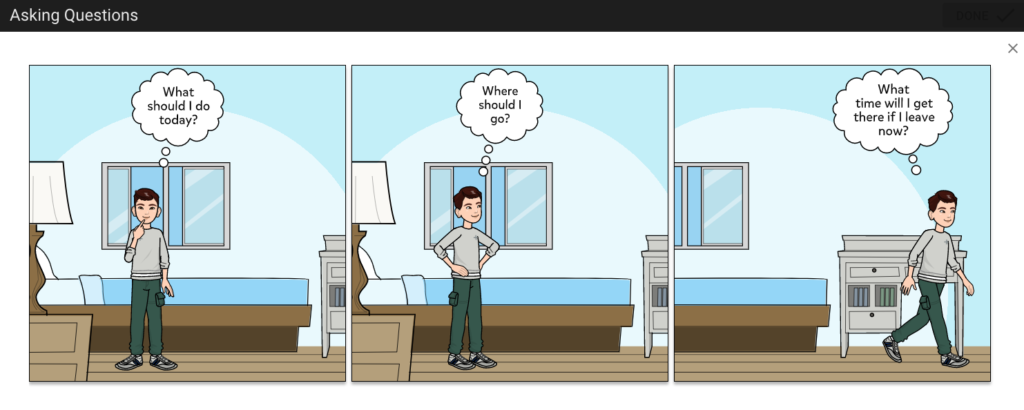
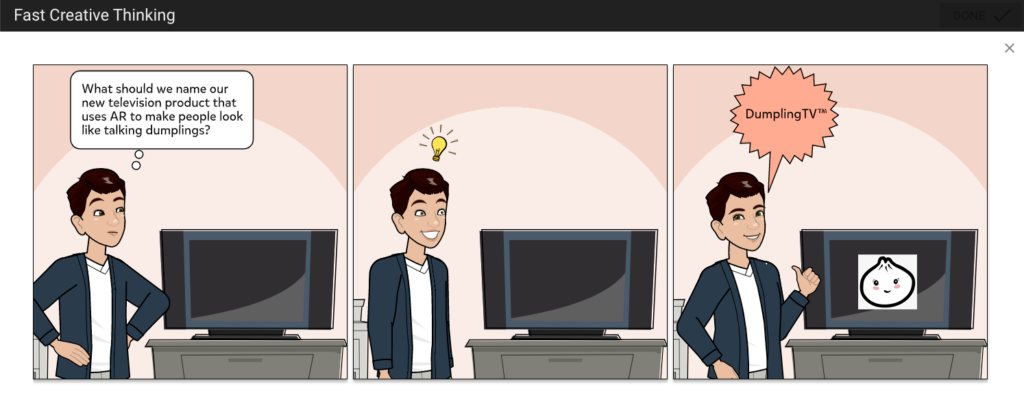
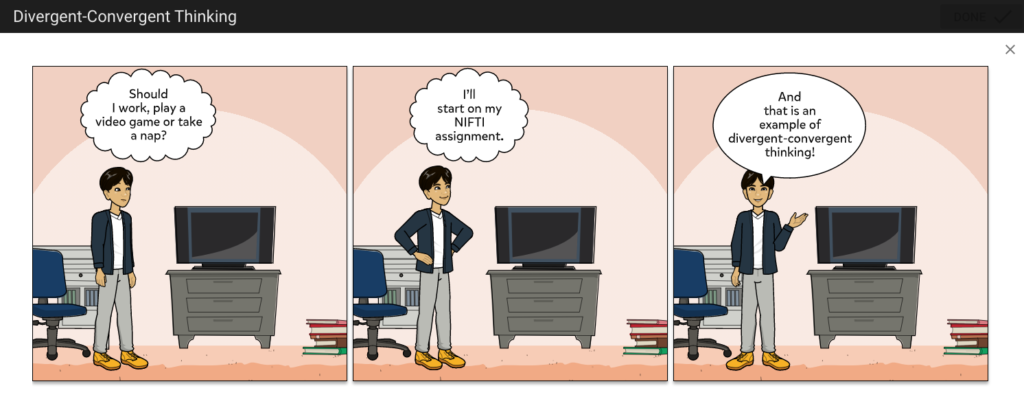
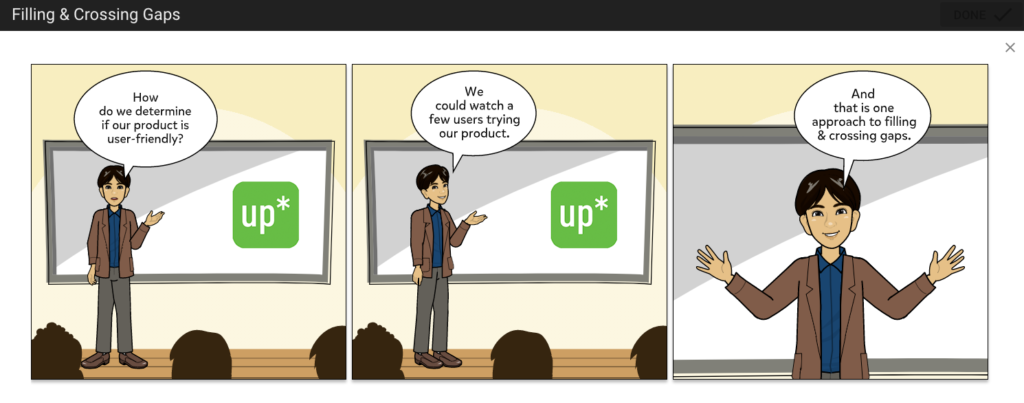
Here is a set of cartoons made in Pixton on the five YCISL Innovators Toolkit Workshop (ITW) skills that we focus on. Do these help the explanation of these skills?
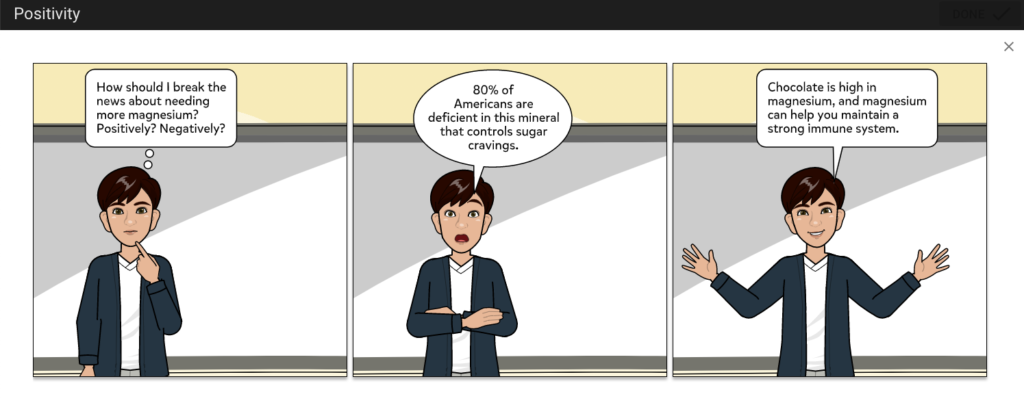 *Source credit for magnesium-chocolate story: https://www.eatthis.com/news-americans-deficient-this-mineral/
**Dumpling image downloaded from https://www.clipartkey.com/
Activity: Pixton for YCISL Cartooning
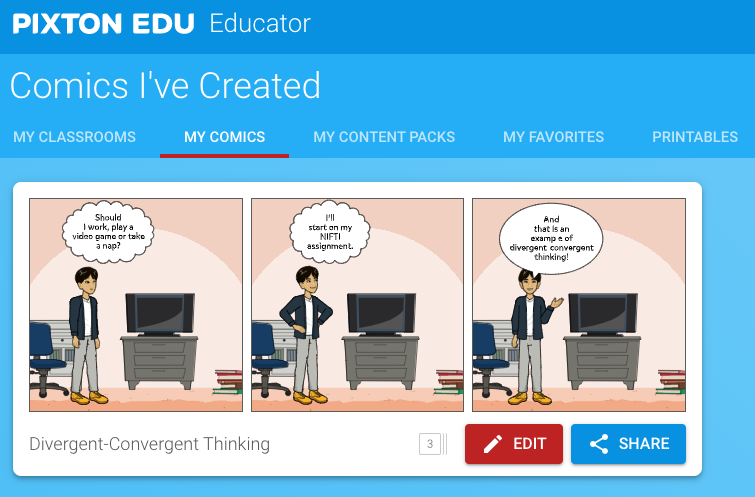
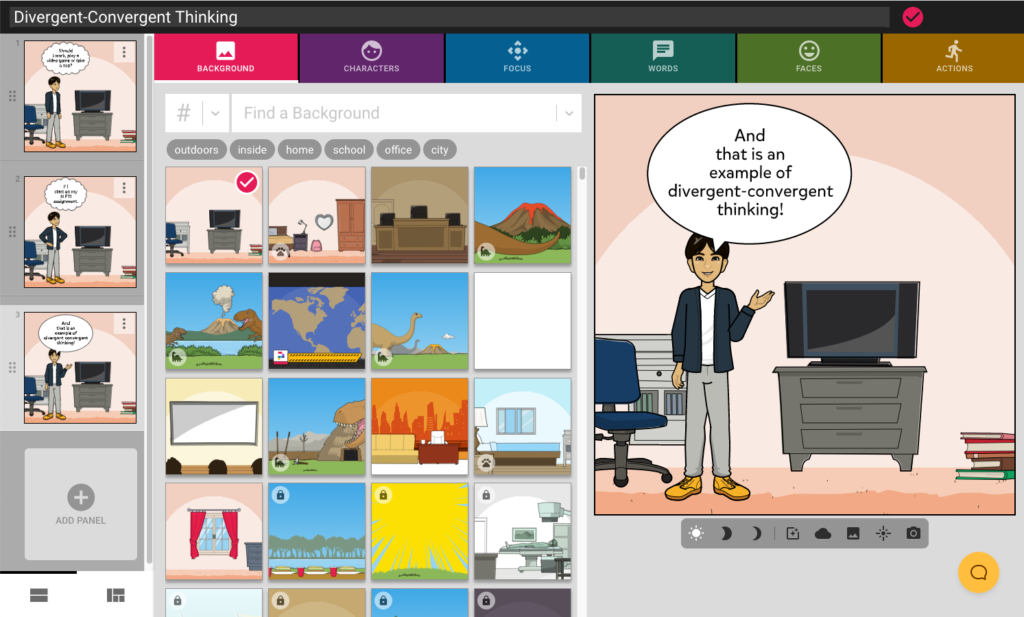
Once in a while, I try to change up the style of my presentations. Usually I work on the color palette, typefaces and (more recently) adding slide animations. Canva.com has been a favorite and I have made quite a few flyers and slide backgrounds there. Today, I looked up cartooning tools and came across Pixton. In about 20 minutes, I produced a cartoon about divergent-convergent thinking. There were some things about the experience I really liked (eg, postures and facial expressions) and a couple of things that were somewhat limited. It was fun! Now I have to think up other storyboards.
Plan: Divergent-Convergent Thinking (Popcorn Series)
The Popcorn with Colin (PwC) series started in mid-2020 as a means of connecting with students in the virtual space to chat about creativity and developments in the YCISL program. Each PwC meeting, a short 60 to 90 minutes with a small group of 5 to 12 students, is designed to create engagement and the sharing of viewpoints (where you are) and perspectives (what you see). I’ll write up more about it in another article; it’s been going well and should have good future pick-up.
This wiki entry focuses on an upcoming PwC meeting where I would like to discuss Divergent-Convergent Thinking (DCT). I will probably follow-up that PwC with a YCISL White Paper to share action items that “pop” up. DCT has been a part of the YCISL workshops for about 5 years and more recently it was included in the Innovators Toolkit publications on the YCISL web site and the Innovators Toolkit Workshops (ITW). And I just made a short presentation last week on DCT in the NIFTI-SEWSS program; the response from students has been fantastic.
The tentative agenda for that PwC is:
DIVERGENT-CONVERGENT THINKING
– What is it and why is it a useful creativity skill?
– Checking our divergent thinking (brainstorming) skill…an exercise.
– Applying divergent-convergent thinking to a research project. A group discussion.
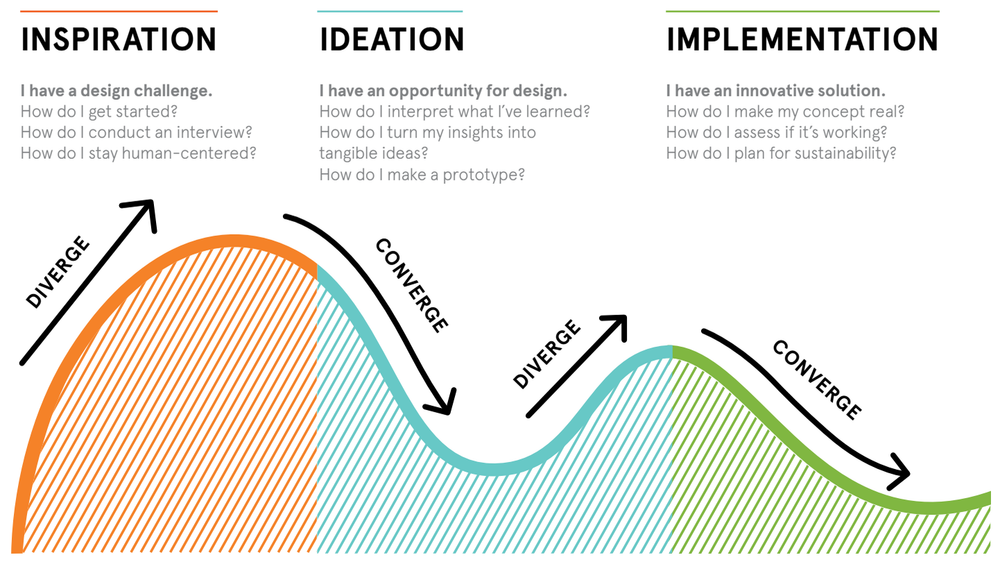
The new part that needs development is the connection of DCT to research methods and skills. I’ve heard from many YCISL students that they would like to improve their research skills and find research opportunities. I found the figure below which I think could lend structure to a presentation on research applications of DCT. Inspiration, ideation and implementation are practical stages to step through in all aspects of research (I will focus on proposal writing, experimental design, and reporting). I will need to remember to embed this in a design thinking teamwork and collaboration context because research needs to be people-connected.
That’s all I wanted to share for now about the PwC DCT plan.
Thoughts: Do Governments Kill Creativity?
 As a spin-off thought from the most famous TEDTalk “Do Schools Kills Creativity?” by the late Sir Ken Robinson, I wondered whether other factors could be pushing creativity backwards…in particular youth creativity.
So how about government? Given how some governments have sacrificed education due to pandemic fears and others have solidly maintained educational standards (UN Policy Brief: Education during COVID-19 and beyond), how much does government actually value education? Is educating youth with creativity skills even on their roadmap? I question this regularly every time I think about lemonade stands in California.
The immediate connection is that many schools are government institutions and follow government policies and are budgeted by government. I don’t know whether any government policy specifically encourages creativity in education, or if there is a budget line for creativity, but it appears that those students who succeed because of their creativity do so despite government and education, and not because of.
What do you think? Does your government genuinely encourage youth creativity or does it effectively squash it?
Idea: The Résumé and the Art of Storytelling Your Personal Story
Over the years, the Emotional Intelligence topic in YCISL workshops has developed into a 3-part exercise feature called Your Personal Story. Inspired by Satoru Iwata’s 2005 GDC Keynote speech opening, we have also had add-ons involving creative business cards and LinkedIn profiles. In 2021, we plan to roll out a résumé-focused activity where the student builds a résumé entry that reflects their YCISL workshop gains.
The résumé is a weak part of most people’s personal story. Areas of weakness may be in the substance, style or flow. While many résumés are scanned by computing systems looking for keywords, the best opportunities are usually from person-to-person contact. And at the interview stage, that narrative in the résumé is going to come back into play. This is where feedback loops are an essential part of résumé preparation – and these feedback loops vary widely in quality. I heard recently that some school counselors do not recommend their students to get feedback from anyone but them. Job security. I understand. Students who hire private counselors may feel that their résumé could not get any better since their résumé was written by a professional. Do you see what’s wrong with this picture? Parents: encourage your child to maintain a résumé. Help them make a start and keep it updated. If your child is already in high school and has not yet started a résumé, do it now.
Our prototype for workshop résumé entry crafting will involve having the students submit a résumé before the workshop start, and use an entry-building template at the workshop end to attain the entry. The template would be in a quick-start style and students would tailor the intermediate to fit-to-suit the original résumé.
Our purpose of adding this activity to YCISL workshops is to remind students of the real value they are gaining from their workshop experience. It will be an outcome to remember.
