BOOK: Show Your Work by Austin Kleon
Highly recommended book. Watch his TED Talk too.
This is one type of book I very much enjoy to read. Very much to the point with touches of personal revelation. What makes it a great read is the resonation of ideas – there’s no mire of detail (or a need for it) to justify the points he makes. It’s essentially a list of life lessons he feels worth sharing and presents in a takeaway message format. I am going to try to fit several of the things I learned from this book into the YCISL workshop. Note that I also have his book “Steal Like an Artist” and expect I will learn more useful things from that.
Remember that quite a bit of YCISL comes from self-help writings aimed at adults and I try to transfer to a youth context. Here are some of my favorite parts of the book that work with the YCISL program…
– THINK PROCESS, NOT PRODUCT. This is his chapter 2 title and it coincides exactly with how I coach innovation – train for innovation as a process (way of doing things) and not as a product (an outcome that may or may not happen).
–Become a Documentarian of What You Do. In this section, he writes “Write your thoughts down in a notebook, or speak them into an audio recorder. Keep a scrapbook. Take a lot of photographs of your work at different stages in your process.” In YCISL, we promote these ideas through our photo essay and personal journal activities.
–Always be sure to run everything you share with others through The “So What?” Test. I think this is good advice EXCEPT during brainstorming. In brainstorming, treat all ideas as equal and let them all out. It’s like the voice drills of ridiculous noises one might make before singing or making a speech (yes, I’m thinking High School Musical). But get that “So What?” filter running in all the other processes. Use it in prototyping to find the tracks you may want to run on. Use it in testing to empathize with users and anyone else who will be in contact with your product. I will also add that you should use it in user support.
–Every client presentation, every personal essay, every cover letter, every fund-raising request––they’re all pitches. In YCISL, we follow this perspective through our “Your Personal Story” and elevator pitch activities. Not only is there a lot of possible uses for pitches, there is a lesson about readiness and anticipation, an elevated (and hopefully excited) state for ideas and work. In this state, it is waiting for the opportunity to become part of a longer chain of events.
–Teaching people doesn’t subtract value from what you do, it actually adds to it. Teaching doesn’t have to be a career. In a creativity and innovation context, teaching is the core of leadership. It is part of a growth mindset.
– Yet a life of creativity is all about change––moving forward, taking chances, exploring new frontiers. Change isn’t always about moving forward but it is about being willing to be agile and applying divergent thinking to complement logical deductive convergent reasoning. Sometimes, you have to retreat a little to find a strong base (think lessons from Jeff Raskin about citation). Sometimes, you have to look left and right before crossing. And occasionally look behind you. Also, remember the movement pattern within the exploration section of the Gamestorming framework.
Note too that the style of this writing is worth promoting as a YCISL Your Personal Story style in that the personal story is interwoven with snippets from other personal stories.
WSJ: “Test Shows U.S. 12th Graders Aren’t Improving in Reading or Math”
There is a WSJ article (“Test Shows U.S. 12th Graders Aren’t Improving in Reading or Math” by Carolyn Porter in the WSJ, May 8, 2014) describing how there isn’t much progress towards boosting test scores. The news is about a widespread muddle in education and illustrates the continuing confusion surrounding what to do. This article and others like it are indicative of an experimental design that no one wants to shut down and shift resources to a better experiment. Stagnation.
Let’s apply some lessons from YCISL…
– Apply innovation thinking. Education needs to re-designed from start to finish. Apply an innovation process so that all parts are optimized. Put everything in the current scheme up on the chopping block. Assemble an innovation A-team and go for quantity-not-quality brainstorming.
– “Fail early, fail fast.” Look for better models and not just band-aids. Rapid prototype to uncover showstoppers.
– Start from scratch applying “game storming.” Set new rules that are customized for your users (i.e., the students), allow opportunity for exploration and experience, and conclude with a point that motivates. No judgement allowed during the exploration phase.
– Adopt Dan Pink’s Intrinsic Motivation (Mastery, Autonomy, Purpose) into the educational process. Make the purpose clear and accessible. Tune autonomy for maximum performance. Define mastery in meaningful ways. Remove the money factor. And do this for all stakeholders.
– Adults fear failure more than kids. Adopt a fear-less culture.
– Adults need to listen to kids. As Adora Svitak says, “Learning should be reciprocal.”
– Engage in a growth mindset. In a growth mindset, we develop a love of learning. We should analyze academic growth as much as academic attainment. Together, you will get a measure of academic achievement – a more complete sense of accomplishment.
Jennifer Senior: For parents, happiness is a very high bar (TED Talk)
This talk shares Jennifer Senior’s thoughts on emotional ups and downs of being a parent. This touches on our YCISL framework where part of our objective is to deliver messages via proxy that are often filtered in direct parent-child communication.
Jennifer Senior introduces herself as the mother of a 6 year old. She advances thoughts specifically about feelings of anxiety that overcome parents. It is unfortunate that she positions this situation as a crisis – signs of a fixed mindset as opposed to a growth mindset. With a growth mindset, she might perceive the situation from a more positive standpoint. Consequently, she might understand that this is a learning experience and with a love for life-long learning, she will find intrinsic motivation (remember Daniel Pink’s mastery, autonomy and purpose?) which might make this responsibility less inconvenient.
There is no single correct interpretation of this situation. I am confident approximately half of ALL parents (regardless of class, culture and means) feel that they are in varying degrees of a crisis or close to it – the cohort that this speaker has identified. But that is to say that there is another half that is finding sensibility, fulfillment and unparalleled joy, and want more! Having and raising children is the ultimate life experience, and one should not expect a categorically unified experience for all parents. There is no comparison to the “stress” level of non-parents – an apple and oranges comparison.
To borrow a thought from another TED Talk title “Should you live for your résumé … or your eulogy?” by David Brooks: parenting should not be judged by day-to-day results but the outcome with which the parent will be remembered. It is the long-term effect of communication and active listening that makes parenting so vital and distinctive. We emphasize this through our YCISL program. Parenting is a leadership role where KI + EI = LI is as relevant as anywhere else.
WSJ: “SAT Reboot Revives 1600, Encourages Guessing”
Recently, I commented on an article about a group of colleges not requiring SAT and/or ACT test scores as part of the application process. And today (March 6, 2014) in the Wall Street Journal, the article “SAT Reboot Revives 1600, Encourages Guessing” by Douglas Belkin, Caroline Porter and Stephanie Banchero reports on a monumental reshaping of the SAT – under the influence of several forces including (1) competition from the ACT, (2) shifting demographics of test-takers, and (3) demand for alignment with school learning.
One major change is no longer requiring the essay while also redirecting the essay focus. This reminds me to recall the paragraph from the Wikipedia entry for the SAT which tells how meaningless the essay portion of the SAT is.
Other changes are planned for focus and scope of SAT questions, and adjusting scoring so incorrect answers does not result in a deduction. In general, these are welcome changes and hopefully positive in its purpose for college admissions screening.
The College Board appears to be forecasting that its future lies in less competitive regions and school districts – an attempt to extend scope perhaps to the fast growing segment of borderline students. That is how the marketing features of this new product seems to line up.
Therefore, top universities should now feel more free to de-emphasize the SAT in favor of the personal statement and perhaps add a soft skills component evaluation (possible because of the lower stress one might expect from a less challenging SAT). Stanford already is doing this – it already expects valedictorian status, leadership experience and world view. Perhaps this is an opportunity for top universities to collaborate on a SAT replacement – one which seeks the personalities and mindsets of those who have been successful at the top end of intelligence and intellect – and will be the workforce leaders of the future.
Wouldn’t it be interesting to have students design such a test?
Perhaps for YCISL, we could have students design a test that they think would be most useful for college screening… by students, for students.
“Defining Promise: Optional Standardized Testing Policies In American College And University Admissions”
This is a quick acknowledgement of a paper by William C. Hiss and Valerie W. Franks (http://www.nacacnet.org/research/research-data/nacac-research/Documents/DefiningPromise.pdf) as well as a KQED audio interview hosted by Michael Krasny (http://www.kqed.org/a/forum/R201402210930) which suggests that applicants to colleges should have an option to not submit SAT and/or ACT scores as part of their admission application.
I highlight this work because it is a fact that SAT and ACT testing are of little educational value and, as concluded in the study by Hiss and Franks, have little relation to a college student’s graduation success. However, this conclusion is of no surprise and the study would have perhaps been more enlightening if it had used a null hypothesis instead where they look for zero correlation between SAT/ACT test scores and college academic outcomes.
I view SAT and ACT testing organizations simply as businesses that provide an increasingly obsolete service and are fighting for survival (in the same vein that Kodak went through) – although test prep is rising as a new mass production business with significant financial stakes; a symbiosis of sorts. Historically, the analytics these tests provided were useful but we now know that a portion of test takers are able to game this system and measurement of academic strength needs to also include soft skills. An agreeable facet to the discussion on the KQED radio show is that college admissions offices should feel free to treat SAT/ACT scores as they see fit. There should be no hard and fast rule that SAT/ACT scores should be a specific part of the admission decision. Perhaps these testing organizations could rise to the occasion and offer analytics of the applicant’s statement of purpose or interview.
This study also focuses on the use of SAT and ACT scores in the college admissions process. But standardized testing has also infested the rest of primary and secondary education in the US and one can simply view the SAT/ACT tests as the final episode of pre-college educational assessment. I view this as the result of testing organizations trying to appear relevant – how else can one explain that a sensible examination system has not arisen in the US when it exists in many other parts of the world? So in order for SAT/ACT to become a non-factor and allowed to fade into memory, it needs to be cleared from the entire educational chain.
Actually, I can accept SAT/ACT as a fixture in the Proof stage of youth leadership development. Not requiring these scores for admission applications can be a distinctive marketing feature for the colleges that choose to go that route. However, such a feature does not seem to me to have any competitive advantage because the upside for admitted students will balance with the downside for the peer group. The argument that High School GPA would be a more reliable filter is not convincing since this statistic is cumulative and does not account for learning styles and differences (especially where a student’s learning style does not match what the school offers).
So, perhaps the best approach would be for high school educators to insist that testing agencies supplement the tests with personality and soft skills components, so that each student can decide which post-high school path is the best one for them. Use the SAT/ACT to create opportunities, not limit them.
Viewing Education as a Parent
One of the things that I am able to do is look at education from more perspectives and with more experience than most people. I have been in an educational setting for all but a few years of my life – as a student and an educator. I would also add the perspective I gained as a science fair judge. I also have been viewing education from an involved parent perspective – all the way from pre-school to university. Pulling together my thoughts on education has been one of the main drivers for me developing the YCISL. In this entry, I form a compare and contrast perspective on education.
Like most things, education is average and that is what it aims for. In a broad generality, educational quality seems to be stretched out along a gaussian distribution with a peak mostly around the middle (I am not stating this as a fact, more of a likelihood based on personal observation). And I am not referring to just the US educational system but inclusive of all education around the world. If one isolated just the US, I would also guess that it would have its own gaussian distribution (i.e., bell curve too but perhaps shifted along the x-scale).
An interesting dynamic though is that the distribution isn’t just ordinarily diffusive with socioeconomic forces at play, but there are temporary forces that push the quality up and down. One current up-pushing force is the budding growth of online content providing supplementary learning and reinforcement opportunities; this force will continue as we try to figure out how to make it better and format it for better learning. One down-pushing force is the emphasis on flat standards.
BOOK: How to Fail at Almost Everything and Still Win Big: Kind of the Story of My Life by Scott Adams
This book was quite different from the others I usually read and comment on. I liked it because it contained the author’s own personal experiences and these experiences were things that I am interested in. Well, at least the first half of the book did (and I would recommend reading this book for this part). The second half felt – let’s just call it – less personal, more library-like.
The topic of failing and still finding ways to succeed (and find fulfillment and happiness) is a major premise in YCISL. Scott Adams in “How to Fail at Almost Everything and Still Win Big: Kind of the Story of My Life” (2013) tells his personal story about the various paths he has taken, and analyzed what has succeeded and what has failed. He relates personal conclusions from his first-hand experience which I found substantive in life lessons. I would assume his messages are aimed at an adult audience but I think with a little reflection, they would become valuable messages for youth.
Here is a list of notes from my reading (selected 17 points from 115 total highlights – just too easy in the Kindle format):
1. “The most important metric to track is your personal energy.”
2. “It seemed as if other people were benefiting greatly from the wisdom of their friends and families.”
3. “Realistically, most people have poor filters for sorting truth from fiction, and there’s no objective way to know if you’re particularly good at it or not.”
4. “Failure always brings something valuable with it.”
5. “My hypothesis is that passionate people are more likely to take big risks in the pursuit of unlikely goals, and so you would expect to see more failures and more huge successes among the passionate.”
6. “Success causes passion more than passion causes success.”
7. “Good ideas have no value because the world already has too many of them. The market rewards execution, not ideas.”
8. “This was about the time I started to understand that timing is often the biggest component of success.”
9. “The systems-driven people have found a way to look at the familiar in new and more useful ways.”
10. “I know from experience that trying to be creative in the mid-afternoon is a waste of time.”
11. “One helpful rule of thumb for knowing where you might have a little extra talent is to consider what you were obsessively doing before you were ten years old. There’s a strong connection between what interests you and what you’re good at.”
12.”Small successes can grow into big ones, but failures rarely grow into successes.”
13. “Several years ago I gave a talk to a fifth-grade class. I started by asking them to finish my sentence. The sentence was ‘If you play a slot machine long enough, eventually you will…’ The class yelled out in unison ‘WIN!'”
14. “Positivity is far more than a mental preference. It changes your brain, literally, and it changes the people around you. It’s the nearest thing we have to magic.”
15. “Try to get in the habit of asking yourself how you can turn your interesting experiences into story form.”
16. “Another common trick is to hum the first part of the ‘Happy Birthday’ song and then speak in your normal voice right after.”
17. “The only reasonable goal in life is maximizing your total lifetime experience of something called happiness.”

Stanford Report: Stanford’s Gardner Center partners with California schools on new reform plan
The January 29, 2014 Stanford Report carried an article titled “Stanford’s Gardner Center partners with California schools on new reform plan” by Brooke Donald. Mention of “social and emotional learning” in the by-line was the grab for me. I certainly agree that coaching social and emotional intelligence in school is a commendable thing to do. Whether this would lead to academic performance parity would seem uncertain but a place in an accountability system seems appropriate. Remember too that the education time-scale is finite as is the student attention span, so any shift in school-time use will cause something from the memorization end to fall out. It’s a law of conservation.
In light of my recent article on Teacher EQ, it seems a better and more productive place to start is to coach educators on developing their own EQ. The questions that I think need to be answered first is whether educators empathize with students and whether when they are introduced to a new class of students they have their EQ-expectation calibrated with the range of EQ among the students. An EQ-mismatch generally spells disconnect with the students and stress/strain.
The YCISL message is to equip educators with EQ-enhancement tools for personal development as well as classroom application. Adopt curriculum which support EQ-development (most textbooks are light on EQ; standardized tests too) and give educators a more intrinsically motivating teaching goal than test scores.
There’s no secret. If you’re in the classroom, your EQ needs to be developed just as much as the next person’s whether teacher, student or administrator. How do you do that? Try teaching or learning outside your comfort zone and daily routine – choose something that you feel you might be good at but may not have done in quite some time – ASL, Music, Drama, Woodworking, Customer Service… It’s like that experiment where company executives switch roles with front line personnel for a day (e.g., CEO<->receptionist). As a thought experiment for teachers and school administrators, insert into your schedule a quiz or test every couple of days for every one of your key functions. What does this do to your thought process and workflow? Also, memorize all the work you have to do the next day during the night before. If you have a meeting, memorize the agenda and any PowerPoint that will be shown. Do you think you will forget 90% of that total material after the meeting? Welcome to the student’s world. Feeling any EQ now?
To tie in a positive thinking note, students: be able to recognize teachers who demonstrate high EQ and show them respect for that. Know that high EQ teachers are worthy role models and that they can help you build, define and refine your EQ. This will give you the answer to why you are learning and what you will gain from it.
Thoughts: GREAT Teachers Have High EQ.
Do you recall the worst teacher or professor you ever had? I remember the worst professor I had as an undergraduate. He taught organic chemistry and obviously was not interested in teaching. He would write all the reactions on the board and mumble as he went along (he even used notes in his left hand while writing on the board with his right – basically transcribing) and never considered whether the material was being understood…and it wasn’t – means on mid-term and final exams were around 35%. This was a new assistant professor who had recently graduated from Stanford and I am quite sure was more focused on getting his research going so he could earn tenure. I have now come across a Biology teacher in my son’s high school who appears to similarly lack skill, talent, understanding and passion for teaching – lacking in both form and function. Thank goodness this teacher is the exception rather than the rule at this school.
Here is how my current experience is going. Teachers who test but don’t teach (sound familiar to you?) My son’s high school biology teacher (actually this department as a whole, but not the rest of the school) has a policy of not returning tests with the questions (this department also does not return quizzes or homework in a timely and useful manner). They simply recite in lecture and test without review, part of the education by single-exposure memorization clique. Oh, and memorize within a day or two a set of (teacher-centric talking point) PowerPoint, the textbook chapter and a study guide that does not get checked. Oblivious to effective teaching style and technique. Thwarting learning and a liking for the subject. Perhaps some teachers think this is defensible, but as a parent I am appalled at this disregard for teaching quality and wasteful attitude towards the opportunity and responsibility to support a student’s learning development. It’s a flaw in an otherwise fantastic school but it’s a painfully sore flaw. The philosophical dilemma is how to remedy this flaw? No, I don’t have an answer. I am hoping for sensibility to rise.
To have this flaw in high school is worse than in college. First, college professors in the US are allowed to choose their grading scheme: some apply a curve with standard deviation distributions and some look for observable cutoffs (I grade using the latter). The elementary and high school teachers I have known apply fixed cutoffs. Therefore, colleges have a way of taking this into account. In elementary and high school, BAD TEACHERS = BAD GRADES – although GOOD TEACHERS does not always nor necessarily correlate with GOOD GRADES. In college, a bad professor experience usually only lasts one quarter or semester. In elementary and high school, it’s usually a whole academic year. Also, college offers teaching assistants and other resources that may potentially make up for poor quality lectures. At Stanford, instructors are reviewed for their teaching ability by the students; I have not seen student reviews conducted in secondary schools (they should but I suspect they are worried what they might discover).
With the gaussian distribution outlook that I usually view things with, BAD TEACHERS are rare (although not non-existent) but so are great teachers. Most teachers are likely one standard deviation within average – there are several possible reasons for this: (a) the teacher is new and gaining experience that will make them better in the future, (b) the teacher gets administrative responsibilities on top of their teaching load and is distracted, (c) there is satisfaction being average (complacency), and (d) the teacher is cruising to retirement and no longer is concerned about their own performance.
What should a parent do in situations like this? There is no easy solution. Sorry if you thought I had one.
Case in reality point for compare and contrast, my son presently has two GREAT TEACHERS, three AVERAGE TEACHERS and just the one BAD (Biology) TEACHER. My son’s Geometry teacher is outstanding and counts as one of the GREAT teachers. He periodically emails parents letting us know how the class is going overall and when to expect gear shifts. He returns corrected tests promptly and has students submit corrections. He also only grades homework for completion rather than correctness and provides access to the answer key after the homework was submitted. He responds to student and parent email quickly with thoughtful feedback. He is accessible for office hours. He offers extra credit work in terms of a challenging problem that students can collaborate on and completion of ALEKS math problems. He appears to be in tune with facilitating and promoting learning across a range of student abilities: group leadership skills and high emotional intelligence. This is a teacher who has passion for his subject as well as teaching for learning. This is college prep.
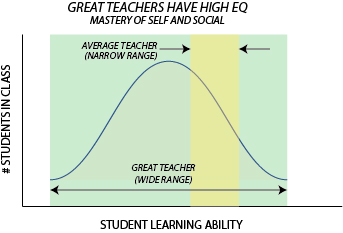
As for the YCISL interpretation of all this, we realize there is a designed difference between YCISL coaching and the mainstream/mainline education. Through YCISL, we want to raise everyone’s learning ability, skill and confidence – not just the most harmonic. We focus on building an appreciation for EQ in both self and social regards. We hope this leads to personal success and happiness.
This will make a fascinating and revealing case study discussion in the YCISL workshop. Maybe we could also do a BAD TEACHER-GOOD TEACHER EMPATHY SKIT EXERCISE? It will be interesting to see whether the students can identify any bad teachers or good teachers to impersonate.
Thoughts: The Feeling of Stress and Strain
In my previous post, I developed thoughts using chemistry terms. In this post, I will use terms I learned in geology. “Stressor” is also a term used in environmental toxicology and some terms from this area will also be used.
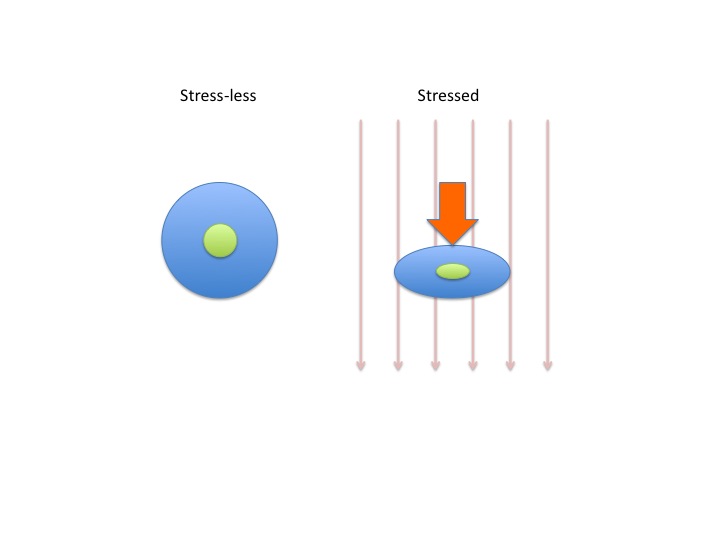
Adults often talk about their stress. Stress from work especially but there’s also major stress from money (all the way from lack of to an abundance of), relationships, etc. How can we define stress? Geology.com (1/27/14) defines stress as “A force acting upon or within a mass or rock, expressed in terms of unit weight per surface area such as tons per square inch.” So the thing to remember is that stress is an external entity to the object being stressed (i.e., you) and that maximum stress occurs when the force is perpendicular to your surface. Another thing to remember is that stress is typically a field meaning other objects in proximity are feeling the same or similar stress. Stress can be sudden (acute) or chronic. Would you like to be stress-free? What do you think of products that promise to be “stress-free”?
Then there’s strain. We commonly hear about muscle strain, mental strain and eyesight strain (I’m sure you have other strains you are personally familiar with). Geology.com (1/27/14) defines strain as “A change in the volume or shape of a rock mass in response to stress.” For our YCISL discussion, strain is the feeling we experience of change due to external stressors, and sometimes it may be well-intentioned but misplaced or misguided stress. In one case, strain results in a multitude of deformities – in people, it can be psychological as well as physical and physiological. But understand that not all stress results in strain and deformity. We usually have stress thresholds below which there is no change (or at least noticeable change).
In terms of personal development and heightened emotional intelligence/awareness, we could think of stress and strain in terms of our own susceptibility, resilience and recoverability (borrowed from the terminology use in environmental toxicology).
1. Susceptibility describes the relative amount stressor required to cause an effect. Have you ever used a magnet and see an object move only within a certain distance? That’s magnetic susceptibility; the magnetic field had to be within a certain threshold distance to cause a magnetic effect. How close do you need to be to someone who sneezes to catch their flu germs? How close do you need to be to a fire to be bothered by the smoke? At what temperature do you feel cold/hot? Odd thing though is that the answers vary – even with the magnet. Therefore, it is good to know one’s own susceptibility to the various stressors that we each experience – and to deal with it with that knowledge.
2. Resiliency describes the quickness with which we can “bounce back” from being strained. Often, we would like to return to our initial state as quickly as possible but factors such as age might affect our resiliency. If we are already weakened by some other strain, resiliency towards another strain might also be less. If you’re a teenager, how long does it take to get over an ankle sprain? How long does it take for an adult?
3. Recoverability describes whether we have the means or mechanisms to even return to the original state. If these recovery paths are not present, then the effects of the strain will continue.
In order to get these concepts understood, I have framed stress and strain in their usual negative sense. We deal with it – usually youth do better at it than adults (just one of the YCISL program’s premises). But at the present time, I am thinking of stress being that of school education and how it is a stress field over numerous objects (students). This stress field is extremely complex as numerous nodes are contributing to the field strength and pattern (it might help to think of having a handful of magnets over a cupful of ball bearings). Are students helpless in this stress field? What if you lie in a shear plane – the interface of two dissimilar, possibly opposing, stress fields? What should or could be done about optimizing the stress field (after all, the aim is to educate)?
This is just as much a message for parents and teachers as it is for students. Share your thoughts with each other about the stresses being imposed and experienced. Understand the susceptibility of the student to strain and measure your imposition of stress accordingly (yes, stress can often be necessary to make progress). Discuss how positive thinking is the best stance with which to cope with stress and strain. Identify recovery paths and keep them at your disposal. In the infamous words of Douglas Adams from The Hitchhiker’s Guide to the Galaxy, “DON’T PANIC!”