
Idea: Can OOBE design count as a skill?
Opinions about anything (people, places and products in the broadest sense) are formed quickly and the most influence on that opinion occurs on the order of seconds to minutes. It’s part of our rapid filtering process because there are so many things being sensed. And that initial opinion (bias) can never be completely erased. One of the things that goes on during product development is OOBE (out-of-box experience) design which is intended to craft the customer/user experience from the initial contact with the product until it is in basic operation mode. Apple is the best known in OOBE design especially from package opening to activation. Perhaps one of the most famous OOBE features is in the original Macintosh computer with its power-on sound. It gently provided the user assurance that the system was receiving power (the unplugged cable was a huge technical support issue back then) and that the user-friendly experience was about to begin (too bad for the Sad Macs). I learned about and worked on OOBE for a little while at Handspring. Before that, I had to be familiar with BOMs and the marketing requirements that went along with it. A Product Marketing Manager with an MBA qualification was the OOBE Lead but really it required a scientific approach to determine and achieve optimum OOBE. Careful research is required. We were focused on both external and internal factors but usually ended up being most selective with just a top few factors of what we thought would be the most influential. Funny story: I remember when a sticker would get attached to the product when a serious OOBE flaw was discovered after production. OOBE is more so important in product innovation because users will generally be having a first-time experience with the truly innovative feature and OOBE frustration could quickly become negative opinion. So in YCISL, where we take a guerrilla approach to innovation, OOBE design is a skill that should be coached to youth in order to optimize the minimum cost-maximum impact as well as competitive advantage. And since YCISL is a small group, we may be able to collectively analyze OOBE and practice it as a skill relevant to creativity, innovation and leadership. Even moreover, it would seem that excellent OOBE design could change the perception of sustainability as sacrificial as opposed to sensible organic growth.
Basic Introduction to OOBE (practice for YCISL activity mentors):
1. Choose a product.
2. Simulate user experience, taking photos at every step.
3. Evaluate each step with respect to visual, tactile and interaction experience. Also evaluate waste impression.
Outline of OOBE Evaluation Activity for YCISL:
1. Choose a product. Product should include packaging and collateral as well as the product itself.
2. Simulate user experience for 5 to 15 minutes (longer may be needed for multi-step set-up).
3. Evaluate visual, tactile and interaction experience and impressions of all materials. Were any sustainability features part of the OOBE experience?
4. Rate the overall OOBE experience including non-critical materials.
5. Repeat with a competing product. Compare.
Outline of OOBE Design Activity for YCISL:
1. Choose a product. Remove packaging and collateral, keeping only the main product and any required accessories.
2. Examine the product’s form and function.
3. Design packaging and collateral for the product. Add a sustainability highlight to the OOBE, if possible.
4. Evaluate the features of the OOBE design.
5. Have someone else evaluate and provide feedback on your OOBE design.
WSJ: “Revisiting Teenage Dreams”
In the Personal Journal section of today’s WSJ (Wednesday August 20, 2014), there is an article by Sue Shellenbarger titled “Teenage Dreams, 10 Years Later” (http://online.wsj.com/articles/advice-to-my-teenage-self-1408490144#) which describes lessons learned from people watching videos they made during their senior year in high school – about their goals. In the article, this is called a “message to to my future self” and the students view their videos 10 years later.
We use videos of “graduating” students in YCISL too. At the end of every YCISL workshop, the students are provided a video camera to record thoughts from their visit – from the time they arrived at Stanford and through the workshop. Each student is allotted 15 seconds. All instructors and mentors move out of sight and earshot. The main purpose of the video is to remind the students of the parts of the experience that excited them. It is intended to serve as a reference point for them.
Somewhat in the vein of Tina Seelig’s “What I Wish I Knew When I Was 20,” this WSJ article lists several “wisdoms” that the alums shared after watching their videos including:
– “Broaden your definition of success.” This is not as easy as it sounds. “Hindsight is 20-20” comes to mind – it is relatively easy thinking of regrets but how easy is it to think 10 years (or even days) out from now? Just as Richard St. John’s TED Talk title advises us “Success is a continuous journey” – and one should look for success (and happiness as well as opportunities for gratefulness) all along that journey.
– “It’s OK not to know what you want to do.” This should not mean that one does not have to think about their direction, strategy and goals. It basically recognizes that a change of plan is all right. A better way to put this is to “Think about what you want to do.” In YCISL, we recommend engaging in the elements of Daniel Pink’s Intrinsic Motivation – pursuing mastery, allowing for autonomy, and embracing a purpose. To address the article’s statement that “Often, young adults don’t find a clear purpose for years after graduating,” you don’t find a purpose (you find a passion), you define and embrace your purpose. And you start at the placement stage of the YCISL leadership model.
– “Don’t worry too much.” The article mentions that “a positive attitude helps.” in YCISL, we believe that positivity accelerates creative thinking and discuss how kids worry less than adults using Tim Brown’s TED Talk “Tales of Creativity & Play.” If high school students are worrying too much, they learned it from adults (see “The Importance of Childs Play” by Lenore Skenazy, WSJ 1/27/12).
– “Focus less on success and more on failing well.” There are more factors involved here than a simple thread of failures leading to success. There are support and timing factors, as well as competitive advantage and opportunity. A connecting-the-dots (successes, failures and corrective actions) agility is needed.
Training: Problem-Solution Attributes
From this summer’s youth workshops, I learned to appreciate more the connection between problems and their solutions. Specifically, I learned to appreciate “attributes”, a term used by one of our docents at the Cantor Arts Center when she was asking students to look for visual clues in artwork.
A new skill that we will incorporate into our 2015 workshops is problem definition and problem statement development (it is a project rate-limiting step that takes a while to activate). For our training approach, we will use a reverse (people usually think of a problem first then the solution) thinking method where we choose a solution (they’re all around) then work out the problem they were intended to solve.
1. Look around you and pick an object to observe closely.*
2. What are its attributes? Think of both its forms and functions. Think of how you interact with it.
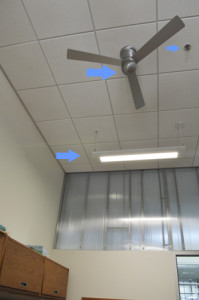
3. Describe the problem that this solution addresses. Remember that this is a trained skill so initially the thoughts may be slow to form, but we still want to use our creative thinking so do this step fast – within 30-60 seconds.
Repeat these steps as part of your training. Increase the detail of your problem description gradually – without becoming complex. You can develop scoping as well as depth skills. Apply your EQ as well so that others can empathize with the problem.
Bottom line: Practice this regularly. It should take no more than 3 minutes each time. Eventually you will understand how to form an effective problem statement by observing a problem that needs to be solved.
*Need a hint to get started? Pick something on you or in your pockets. Or look in your bag/briefcase. For something more challenging, choose something that you probably see often in passing but don’t really think much about it.
Supplement: Prepping for YCISL (White Paper Series)
This is a supplement to the YCISL White Paper titled “Prepping for YCISL: Go for Breadth” which was recently posted to the CSDGC Youth Leadership web page. That white paper discusses the YCISL Leadership Objective of “Placement” and how prospective YCISL students can get ready for a future workshop at Stanford which focuses on the Leadership Objective of “Proof.”
This wiki entry shares some ideas on candidates for “Placement” and hopes to demonstrate a systematic seed and branch approach to surveying the opportunity landscape.
EXAMPLE 1
Seed: MUSIC
Primary Branches: Piano, Violin, Viola, Cello, Guitar, Flute, Singing, Songwriting, …
Secondary Branches: Musical genres
Tertiary Branches: Solo vs Duet/Quartet/Band/Chamber Orchestra/Symphony/Choir…
Quaternary Branches: For fun, amateur performance, competitive performance, professional performance.
EXAMPLE 2
Seed: SPORTS
Primary Branches: Swimming, Basketball, Soccer, Tennis, Golf, …
Secondary Branches: Self-taught, Lessons, Matches, Competitions, Leagues
Tertiary Branches: Spectator, Solo Participant, Team Participant, League Participant, Commentator, Writer, Coach, Referee/Umpire/Official, …
Quaternary Branches: For fun, amateur, competitor, professional
EXAMPLE 3
Seed: FOOD
Primary Branches:
Traverse these trees and you may come up with a compelling scene in your personal story.
Are You a Supportive Role Model-Parent? Your Child is Watching You.
One of the things I often discuss with colleagues and visitors is the importance of a support structure to a student’s success. No one does it alone. Support is an essential success factor. The support structure starts with the home environment and the relationships therein, but also includes the school, community and social environments as influential contributors. This entry looks at the home environment (especially the parent-child interface) and asks simple sample questions to induce parents to reflect on the type of role model they are to their child. The answers to these questions and others similar to them can lead to insight about the nature of the communication filters between parents and their children. These communication filters form whenever your child is watching you – whether you are conscious about it or not.
1. Do you share interests with your child?
A. Constantly.
B. When I can.
C. We have nothing in common.
Reflection: Is there anything that bonds?
2. Do you make any sounds/noise at night after your child has gone to bed?
A. No.
B. Just a little soft white noise.
C. Yes, loud noises including television, radio, laundry machine or hairdryer.
Reflection: Is there sensitivity?
3. Does your child eat your cooking?
A. Yes, and he/she enjoys it.
B. Yes, but it’s a struggle.
C. No.
Reflection: Is there cooperation?
4. Does your child offer to help you?
A. Yes.
B. Sometimes.
C. Don’t recall.
Reflection: Is there opportunity?
5. Do you make your bed in the morning?
A. Yes.
B. Sort of.
C. Who cares?
Reflection: What organizational impression do you leave?
6. When it’s time for your child to do homework, do you…
A. find something quiet to do and help when asked?
B. go about with your usual activity (talk on the phone, watch television, …)
C. interrupt your child about something not related to homework?
Reflection: Is there time management?
7. Do you drive at the speed limit?
A. Yes.
B. No more than 5 mph above the posted speed limit.
C. Never notice it.
Reflection: How do you prioritize?
8. Do you make a complete stop at a STOP sign?
A. Yes.
B. Rolling stop.
C. What’s a STOP sign?
Reflection: What is your attitude?
9. My emotional intelligence is a key factor in my relationship with my child.
A. Agree.
B. Sometimes.
C. What emotional intelligence?
Reflection: Is there anything more important in your life?
10. My parent-child relationship provides me with feelings of deep intrinsic motivation.
A. Agree.
B. Sometimes.
C. Cash incentives work better.
Q: Do you feel organically rewarded?
Note: Treat these questions as seriously as you choose. Laugh at them if you wish (I think humor is an effective way of communicating ideas). Create additional questions for yourself or to share with other parents. Reflect on any time you may be making a observational impression on your child. The questions above are not meant to be scope-defining, definitive, exhaustive, or even generalized. I’m just trying to inspire self-critical thought for continuing professional (parent) development.
Another note: This entry marks the start of the YCISL Parent-Student Toolkit.
ACTIVITY: Filtering at the Early Prototyping Stage
Prototyping is the second stage of the YCISL simple innovation framework. In this stage, you select some of the best candidates from the brainstorming stage and try to construct simple models or simulations of the select ideas in order to quickly identify weaknesses, challenges and problems associated with each of the prototyping candidates. This is in line with the “Fail early, fail fast” mindset we apply in our workshops. The aim is to advance just one of the prototyping candidates to the engineering level.
However, this is also a good time to document the main advantages of each of the prototyping candidates as well. The potential distance and impact of each prototype candidate are valuable considerations and will help maintain a positive mindset as development continues. Therefore, a technique for early prototyping is proposed where the positive aspects (“praises”) and negative aspects (“criticisms”) are extracted and sorted into their respective boxes. For prototyping, we are usually looking for prospective showstoppers, dead-ends and oopsie daisies! These will be dropped into the CRITICISMS box but this box will also contain the lesser risk and lower severity issues – and this whole box should be saved for later in the testing and readiness stages. This late engineering stage will be where the user guide and other “accident avoidance” strategies will be developed to steer the user away from or around known issues – or fixes could be developed if there is an opportunity.
The other aspect of the PRAISES-CRITICISMS filtering is the collection of the positive aspects (“motivators”) which move the work forward. Prioritization is needed for this box but comparative analysis of the PRAISES box for each prototyping candidate will help provide guidance on the risk-benefit and competitive advantage. The PRAISES BOX can be used in the mid-prototyping stage where the team can evaluate how fantastic a feature can be (e.g., battery life which could be good, better and wow!) Remember that the aim of prototyping is to find the most compelling product to solve the problem and invest the most resources in getting the product to be successful and displacing existing alternatives.
In sum, a PRAISES-CRITICISMS filter is recommended in early prototyping to help weight the benefits of advancing prototyping candidates, set the criteria for early failure and build a bank for late engineering testing and readiness.

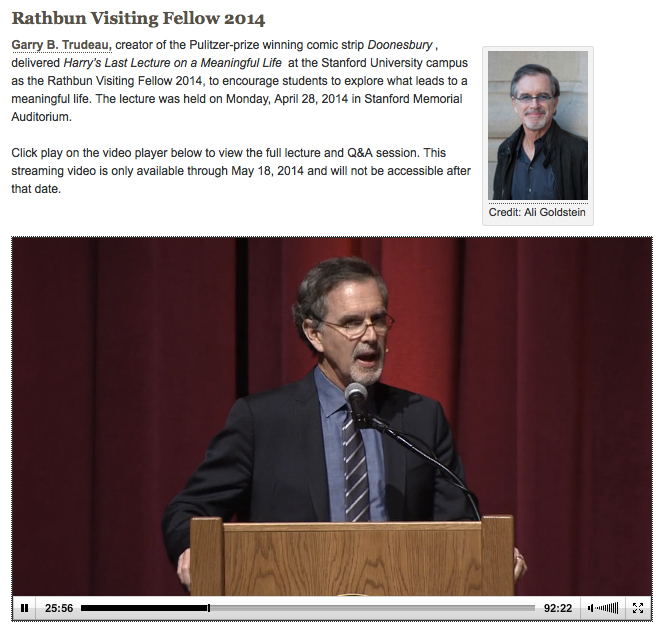
LECTURE: 2014 “Harry’s Last Lecture on a Meaningful Life” by Garry B. Trudeau
On April 28, 2014, cartoonist Garry Trudeau, creator of Doonesbury, gave the fifth guest lecture in the series “Harry’s Last Lecture on a Meaningful Life.” I watched the video at http://www.stanford.edu/group/religiouslife/cgi-bin/wordpress/programs/rathbun/ but understand that it would only be posted online until May 18, 2014. The lecture was reported by Stanford News here. This entry contains a few notes I made while watching the video.
Overall, I found the lecture to be an informative personal story with many agreeable observations about generational change.
– “…I gave no serious thought as to whether the work was either useful or meaningful in any way…” Commentary: “serious thought” would be something that an older person might have come up with which would have resulted in less productivity, satisfaction and success. This alludes to the fear mindset that adults fall into. His youth focused on the intrinsic motivation (autonomy, mastery and purpose) and fear about it as a career did not enter his mind at the start (it might have stepped into his parents’ minds though).
– “…it was my perspective they were interested in – my generational identity…” Commentary: one of the YCISL take-home messages is to use youth (your generational knowledge) as an advantage.
– “I didn’t know any better.” Commentary: Another take on how adults filter out many options because of a pile of prior negative experiences.
– “In college, there’s very little downside.” Commentary: Balance is key in college. If you can manage the coursework that will get you the diploma at the end, then any free time (and there’s quite a lot compared to high school) can be used to get involved in differentiating pursuits – and develop that EQ.
– “…but the whole dynamic has been speeded up.” Commentary: And there are a lot more traps along the way. Speed may also be reducing intrinsic motivation.
– “We start telling stories almost as soon as we speak.” Commentary: Evidence of creative energy in early childhood. Then adults get in the way.
– “…the opposite of comedy is not seriousness, it’s despair.” Commentary: Finding such useful perspectives is probably a key differentiator between people who succeed or fail in the same pursuit.
Exercise: Teamwork & Self-Training
In my workshops, I describe the process I learned to coach the basketball free throw. I use it to frame the workshop goals where I aim to coach techniques and mindsets, and encourage “players” to practice on their own to get ready for the game. In this process, there’s the setup first, followed by the action then the endpoint check; this is how each component of the workshop is delivered.
As a teamwork exercise for the workshop, I am thinking we could have a team free throw contest but allow a period of time for the team to work on their free throwing skills first. The idea is for those who feel they have the better shooting skill to coach others. This will require team leadership as well as coaching skills. Group dynamics will likely also be a factor.
The simple contest will be to see how many shots a team can make in an allotted amount of time (this could vary as well). We could have one or two setups (I am thinking of getting indoor mini hoops with foam balls but we could just as easily do this outdoors with real basketballs on a regular basketball court).
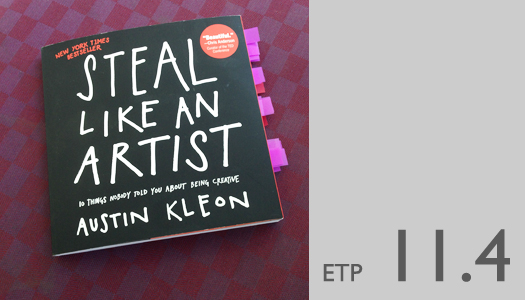
BOOK: Steal Like An Artist by Austin Kleon
In case you want to know, I recommend putting “Show Your Work” at the top of your reading list and adding “Steal Like An Artist” to the same list but not necessarily at the top. The messages in “Show Your Work” just seemed more actionable and resonating – and that’s what I was expecting from books with action-oriented self-help titles.
The format of the two books are similar with enlightening quotes and imaginative graphics. Since I read “Show Your Work” first, “Steal Like An Artist” felt less invigorating. My bad. Certainly not Kleon’s fault since this is how good sequels go. Case in point: sometimes, I start to watch a TV series in a later season, then I start watching earlier seasons (thanks Netflix and Hulu) – sometimes the earlier seasons have rougher edges.
I found the description of his analog and digital division in his workspace interesting and wonder if the YCISL Photo Essay project should have an analog-digital cycle – for the sake of limiting excessive use of DELETE for part of this creative and reflective exercise.
I also liked his Deleted Scenes section of the book which might play in to the PostIt brainstorming part of the workshop.
One quote from the book I will share: “The classroom is a wonderful, if artificial, place: Your professor gets paid to pay attention to your ideas, and your classmates are paying to pay attention to your ideas. Never again in your life will you have such a captive audience.” I think Kleon is talking only about college so I am wondering to what extent I can promote this setting in the YCISL workshops to enrich the high school experience. The aim is to get the students to feel invested but perhaps there are other incentives besides money that could be leveraged. Certainly at the end of the workshop with product rollouts, we have a “captive audience” but is there more I can do to optimize the experience?
Exercise: A Training Regimen for Positive Thinking
In YCISL, we view positive thinking as a requirement in creativity, innovation and great leadership. In our workshops, we watch and discuss Shawn Achor’s TED Talk “The happy secret to better work” (introduced to me by mentor Navid). I also present lessons I learned about smiling from Guy Kawasaki’s book “Enchantment” and the WSJ article “Stress-Busting Smiles.”
From the discussion in “Enchantment,” we can learn to detect the authenticity of a smile on others by crow’s feet. Conversely, we can learn to feel our own smile authenticity. A simple exercise to practice oneself is to associate the “scrunching” of the orbicularis oculi muscle with turning on a (highly) positive mindset. Practice this regularly and see if you can condition yourself to activate your own positivity with the act of a real smile. At the start, perhaps you might need a visual or audio aid that will help you get in the positive mindset, but train yourself to eventually get to the positive state with just your thoughts. A variation on this would be to start off by putting yourself in a mindful or meditative state, then go for repetitions (mindful-positive-mindful-positive-etc) and sets just as if you were working out with weights.
The next level up may be to train yourself to find the positive disposition despite a mixed field of positive and negative stimuli – a real world situation where sometimes the negative drown out the positives or the negative sticks better. The aim of this exercise will be to expose oneself to the mixed stimuli array and be able to filter out the negative so that only the positive remain. For example, if you are leading a team, could you look past all the problems and identify things which are working? Here are a few variations on a drill with this aim in mind:
– Pick a restaurant (or some other business) listed on Yelp. Read the reviews with the mindset that you are going to dine at this restaurant. Make only one pass through the reviews. When you are done reading the reviews, can you list 5 positive things about the restaurant? Could you compose a justification for going to this restaurant? Are you able to block out the negative comments?
– Read a newspaper or listen to an evening news broadcast. Can you make a list of the positive news that was covered?
– Observe how a person is dressed and make mental notes. When the person is gone and out of sight, can you list 5 positive thoughts about what you saw? Variations on this could be how a person spoke or how they performed (e.g., music or sports).
– Go to a restaurant (or any store). After you’re done at the restaurant, can you list 5 good things about the experience?
– After a week of school or work, can you list 5 things that went well or made you feel good?
When you feel you have started to master being able to focus on the positive aspects, try extending your lists so that you can exhaustively include all the positives. Vary the time horizons too – the last one in the list is over a time period of one week and the others are over a few minutes to about an hour. Feel free to customize as well to suit what is going on around you or what you regularly encounter. Try doing this in a quiet place to start (e.g. your room) then try to do it in a busy place (e.g., at a sports event). I recommend mostly training yourself in a quiet place. If you want to make it a competitive challenge, do the drill together with another person and see whose positivity is more focused.
I intend to develop a YCISL workshop module that uses the Yelp setting. Yelp is replete with low-value negative compositions – that is the natural bias – and it takes focus and skill to find the positive comments worth remembering and acting upon. Similar situation with the news which generally feeds on a bad news bias. And for both of these, there is no shortage in the supply of material to sort through.
Remember that the aim is to train yourself to strengthen and more quickly activate your positive thinking mindset. Such things take time so don’t rush it. Understand the purpose, direct yourself and sense the mastery developing within you (yes, I’m trying to get you intrinsically motivated!) With a developed positive mindset, we hope that your decision making and strategizing leadership skills will shine. Your innovation process will also make more progress as a successful innovation result comes from doting on the positive attributes, not the negative ones.
