Book: inGenius by Tina Seelig
Just recently finished reading the book “inGenius” by Tina Seelig. As a follow-up to the author’s previous book “What I Wish I Knew When I Was 20,” this book had contrasting style and voice. inGenius read like a journalistic article (although I know a lot of the content came from personal experience) and felt like a report in narrative rather than the inspirational feel of the earlier book. Actually, the titles of the book suggested as much to me before I started reading the second book. Nonetheless, it was a good read and several useful lessons were found that I have already used in the YCISL.
(1) One of the skills that one has an opportunity to and should develop at a young age is to ask questions. Partly to balance the thinking that goes on in a “give me the answer” school environment but also to be able to frame problems. On page 19, the author relates how two seemingly identical question can lead to very different thinking and answers. If one can conjure up questions like a chess player rapidly conjures up possible chess moves, reframing problems will be a valuable skill and asset.
(2) One exercise that I have already carried out with several groups (even one group of school headmasters and district directors) is the birthday line up exercise described on page 49. I’ve run this with middle school students and high school students as well. It works great as an icebreaker and an example of teamwork. As a kickoff to a workshop, it also helps set ground rules such as “It’s ok to ask questions” and “You only have the instructions I gave you already – nothing else. So listen carefully.”
(3) On page 129, the author writes “Many rules are designed with the goal of improving performance, but they actually do the opposite.” While many of us can probably tell of an instance where this has happened (even at Stanford!), I don’t think a disregard for rules is called for – even when creativity is desired. I consider myself a rules-based thinker and this has served me well. From being a computer and IT expert to a sports player and coach, I know that rules are the means to advance. As an extreme example to balance the initial premise, one could say that “creativity is like daydreaming which is idling.” In my view, creativity needs to be applied to the rules of innovation (the game – reminds me to recommend checking out the book “GameStorming”) in order to accomplish things – decision making, leadership, productivity, and others. Perhaps it is poorly designed rules that are the problem, not simply having rules. Try setting up email filters in your email client to sort and filter, and you might have a good idea of how to set up effective rule sets.
(4) I appreciated the reference to Tom Wujec’s “Marshmallow Challenge” on page 144 as one of my mentors who had done this exercise in Seelig’s class brought it into a YCISL workshop in 2012. I’ve run this exercise three more times – with my middle school students as well as another group of high school students – and have made modifications to the exercise. Perhaps I was buying weak spaghetti but the marshmallow was a massive downer – except when the students wanted to eat them up (better than them eating the uncooked spaghetti!). So, I have modified the exercise such that each team gets a mailing label and has to design a flag on it to attach to their structure – and the height of the tower is measured by the distance between the surface and this flag. The flag lends an opportunity to personalize the tower and represents the focal point of their effort. Of course, the lightweight nature of the label compared to the marshmallow avoided the potential tipping disaster. In my YCISL exercises, I prefer to set the success to failure probability about 2:1 in favor of success. I found that the marshmallow (at least in a timed situation) put failure in 2:1 favor. Another modification that I tested a few times was to make the objective to build a tower that touches the ceiling of the room. I was looking for a change in teamwork dynamics and spatial design. More on that in another entry at another time.

Exercise: Adaptation of the 30 Circles Test
If you’ve seen the video “Tales of Creativity and Play” of a talk by Tim Brown at the 2008 Art Center Design Conference (aka Sound Play) – that is available as a TED Talk at http://www.ted.com/talks/tim_brown_on_creativity_and_play.html, then you may remember the 30 Circles Test that the audience took part in. Following the 30 Circles Test, Brown remarks “And one of the things we tend to do as adults, again, is we edit things. We stop ourselves from doing things. We self-edit as we’re having ideas.” This is certainly something we can apply to youth creativity and in this post, I describe an early attempt to adapt this exercise for youth. But first, credit for the original test goes to Robert McKim, Professor Emeritus of Stanford’s Department of Mechanical Engineering who is credited with being “a pioneer in experiential psychology in design.”
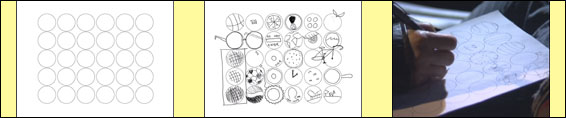
The following is a set of screen captures from the Tim Brown Ted Talk video showing from left to right: the starting sheet of paper with circles pre-printed, an example of a completed sheet, and an audience member working on their sheet.
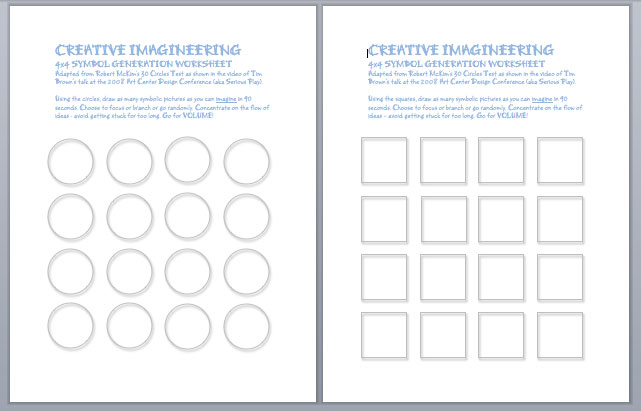
For the YCISL, I have created a sheet that has just 16 shapes (in a 4×4 matrix layout) instead of 30. On one side of the sheet is rubric with the matrix of circles. On the flip side is the same rubric with a matrix of squares. I also left relatively more space between the shapes to allow for extensions to the shape as opposed to only drawing within the shape. Making the shapes in MS Word, each shape is in a medium gray line with no fill and a drop shadow of the same color as the line – this to give a depth feel and encourage 3-D imagination.
Each side is titled at the top “Creative Imagineering” with the subtitle “4×4 Symbol Generation Worksheet.” I borrow the term “imagineering” to show that this activity exercises the imagination and requires some engineering to make it appear on the sheet of paper. The creative part is the participant choosing how to fill in the sheet – in sets or with randomness or with some other variation. I also include “Symbol” to indicate that a detailed and accurate representation is not necessary and rawness to the images is acceptable. Here is the rubric for the circle side of the sheet: “Using the circles, draw as many symbolic pictures as you can imagine in 90 seconds. Choose to focus or branch or go randomly. Concentrate on the flow of ideas – avoid getting stuck for too long. Go for VOLUME!”
Why the reduced number of shapes? It was partly because it was closer to any expectation of the number of shapes that a youth would be able to complete in the given time – thus greater potential satisfaction for the user in doing this exercise. This positions the exercise as a positive achievement and a result of flourishing imagination. The numerical total also somewhat coincides with the youth age range; we could say that a 16 year old or older, with their greater exposure to life, may be able to come up with 16 filled shapes. Then an approximate target of one shape per year of age could be posited to the group as a reference index. Lastly, the symmetrical layout allows for multiple directions in approaching and filling in the matrix with minimal bias – eg, inside out, outside in, diagonally, etc. You get it if you play Bingo.
This sheet may change as I observe the outcomes of exercises with this sheet.
Lastly, I let the students in my class today make paper airplanes with the used sheet of paper which plays into the exercise where students symbolically let their ideas “take flight.” More on that another time.
WSJ: “Higher Learning, Meet Lower Job Prospects”
Today’s WSJ Opinion section (dated February 5, 2013) has an article titled “Higher Learning, Meet Lower Job Prospects” by Jane S. Shaw. Early on in the article, the idea is posed that “The problem, he suggested, might be that many academic disciplines have no real practical applications” and “…state funding incentives should encourage areas of study that align with the job market.” I can see how someone could think this…but they are way off the bullseye. One does not have to think hard to understand that yes, tertiary education involving practical training is needed BUT it should be in a separate stream from the high intellectual achievement institutions. Polytechnics are examples of institutions that serve the practical application market and it fits well with students whose strengths are in practical work. This concept has been around for decades but because of competitive fervor to get into a top ranked university or college, many students are finding themselves stuck in the wrong place partly because of a lack of options to suit their talent. But leave your top universities alone (and let them figure out how they want to address the market demand from both students and the workplace) and promote intellectual curiosity.
This article could be used to help reinforce the following YCISL premises:
1. find joy in learning – adults want to force youth to get as uptight and extrinsically motivated about money as they are – even before they start earning any.
2. embrace opportunity – universities are being held as scapegoats as secondary education continues to deteriorate.
3. focus on the now – universities’ performances are improperly measured in part by their graduate’s employment as well as starting salaries.
Undergraduate education (at least in the US) encourages exploration of new fields of knowledge and finding depth in the wells of knowledge (“Integration” in the YCISL framework). One just has to compare what students get out of high school (“Proof” in the YCISL framework) then are asked to do in college to realize that this is the main benefit of the latter. Graduate school is where critical thinking kicks in where ideas are extended, defended and tested; this is where expertise kicks in (“Propulsion” in the YCISL framework). Don’t complicate the “Integration” phase by introducing the distraction of the job market and careers – which is highly unpredictable. Integration is difficult enough to handle in a new learning environment (where suddenly most students find they are average).
Notes on Coaching the 90-Second Elevator Pitch to Youth, Part One
Spurred initially by the WSJ article “”The Most Awkward Meeting: New Elevators Sort Employees, Foiling Manners And Face Time,” one of the skills that I have been coaching and promoting is the 90-Second Elevator Pitch. During my visit earlier this year to Singapore Polytechnic, I introduced the exercise using the Monterey Bay Aquarium Seafood Watch fold-out card as a starting point. At that time, I learned it was critical to keep myself (the one providing the instructions for the exercise) separate from the one receiving the pitch (so I had the teachers get involved as the listeners). We then conducted a brief 90-second elevator pitch exercise in the June YCISL workshop.
This week, I had the opportunity to include it in the middle school elective I am offering. The students are 11 to 13 year olds. Two weeks ago, I introduced PostIt brainstorming exercises, the last of which was ideas to make their school better. This week, I had them select one of the ideas and elaborate on it so that it could become a 90-second elevator pitch – to the school principal! They have two 40 minute weekly class sessions to work on this then they will present in the third session. This entry includes a description of what we did in the first session, and I will update later on our progress and results.
We started out the session by watching three television commercials on YouTube. I started out with the VW-Star Wars (child in a Darth Vader costume) commercial. Students then chose the Keyboard Cat’s Wonderful Pistachios Commercial, and the ShamWOOHOO commercial (a parody of a real commercial – but this was a great choice as it emphasized the main ideas for the next part). Television commercials are of comparable time lengths and almost definitely contain an attention-grabbing component. And by having students suggest a couple to watch, I hoped that this would activate their attention.
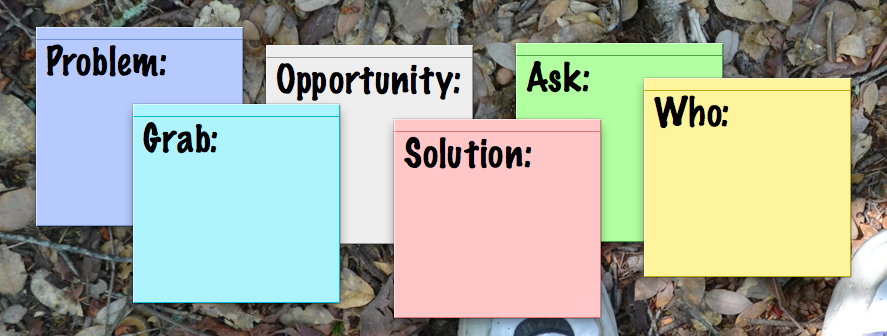
I then listed six words that I wanted them to write separately on PostIt notes: Grab, Problem, Solution, Opportunity, Who, Ask. I extracted these terms from the Garage Technology Ventures’ “Writing a Compelling Executive Summary” – except I substituted “Who” for “Team.” These words were guides for the content they had to create. There was no particular sequence that they had to follow. They could fill in PostIts as the relevant thought came to them.
When they had created their notes on each of the PostIts, they were instructed to play with the sequence and consider the flow. They naturally asked whether they should start with the Grab. We then thought back to the commercials we had watched earlier, and discovered that the Grab did not have to go first. Thus, they were to experiment by reading to themselves various sequences of the notes.
They then took turns doing a stand-up dry run (90-second rule enforced). They were welcome to just read from their notes. Like with working on a jigsaw puzzle, we were checking out how the pieces fit. Feedback from the audience was welcome (at least when I work on a jigsaw puzzle, I usually ask for help/another perspective). Yes, kids can be cruel to other kids (especially classmates) but it is better in this case to get the criticism early (fail fast, fail early) – because there are many options to make the presentation work better and each student did not have time to become too attached to a particular approach and therefore take negative feedback to heart and become discouraged. This reminds me of a couple of books I read in which there are passages describing how a comedian would try out new material in a small, practically informal, group setting first before using it in a production setting. They will return next week to polish their presentation.
WSJ: How to Avoid a Bonfire of the Humanities
Michael S. Malone contributed an article titled “How to Avoid a Bonfire of the Humanities” to the Opinion section of the October 25, 2012 issue of the WSJ. The article describes how disciplines in the humanities are resurgent in necessity to innovation. A specific example is cited with a quote from Santosh Jayaram that “English majors are exactly the people I’m looking for.” The thought continues that “storytelling” is a rare talent and today goes a long way towards competitive advantage. I would actually pose this is as great prospects for the hybridization of humanities thinking with science, engineering and business. We have already seen it in various ways – the graphical user interface (GUI) is a hybridization of art and technology. Usability is a hybridization of engineering, design, architecture and psychology.
We can use the notion of “storytelling” with the 90-second elevator pitch approach as well as the executive summary framework from Garage Technology Ventures. Together, youth can learn to be compelling and noticed.
Exercise: Name Scramble for Warm-up
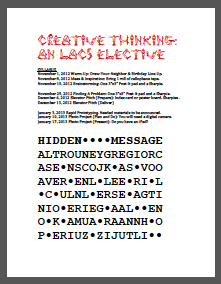 For a middle school elective course on creative thinking that I am teaching, I came up with a (hardly unique) exercise to warm-up the students to the subject.
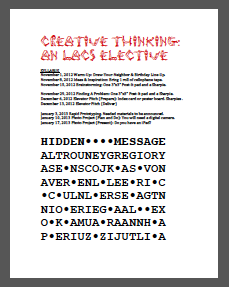
On the syllabus sheet that was waiting for them at each seat was a “Hidden Message” puzzle. The benefit of such an approach is that a student can start on something when they enter the classroom (and when they come in at different times, it is good to have something ready for them to do – I learned this from Challenger School where students start on work that is on the board when they enter the classroom first thing in the morning – they go directly to the classroom from drop-off).
There are no specific instructions; just the title “Hidden Message.” So, as expected, students are drawn to this puzzle (rather than the syllabus) and ask about it. I say that they should try to solve it. Some will ask what they should do; in response, I ask them what they think they need to do. To keep them on task and engaged, I provide hints as needed (maybe every 30 seconds or so).
For this puzzle, I took the name roster and inserted letters that spelled “CREATIVE THINKING.” Then I added dots to make the puzzle into an even-width shape. The name roster uses the possibility that they know each others’ names already or recognize their own name first. For a mixed level class such as this, the students needed a hint that this involved their names; they asked whether they could ask each other for their names and I reminded them there were no specific instructions so were free to use whatever method they could think of. So, they started talking – but the social dynamics provided some foil where some students were not cooperative – so workarounds or negotiation became involved.
The puzzle was solved within 15 minutes which is just right for a warm-up.
TIME: Reinventing College
“Reinventing College” is the featured topic in the October 29, 2012 issue of TIME. It is made up of several articles (some short, some long) where viewpoints and ideas are shared. It pulls together multiple current and thought-provoking elements such as Massive Open Online Courses (MOOC), affordability and purpose (my variation on TIME managing editor Richard Stengel’s identification of “access, cost and quality” as being the “three interrelated problems” in the foreword.)
In my view, the problem is actually over-dilution of traditional college education – not access and quality. I think that cost/affordability is a side-effect of the problems in access and quality. While I was reading the article on MOOCs (titled “College is dead. Long Live College!” and authored by Amanda Ripley), I am reminded of the example of a college graduate who ends up working for a rental car company as a customer service representative, sometimes simply sitting for hours in the booth that checks cars out. This is obviously a position where soft skills are suited – and not the knowledge from a college education. This is a mismatch between the argument that employers are seeking college graduates, and the argument that employers are looking for soft skill talent (see “Hard Unemployment Truths About ‘Soft’ Skills'” by Nick Shulz in the September 19, 2012 issue of the WSJ). In his TED talk on creativity, Ken Robinson identifies this as a “process of academic inflation” where degrees have to become less of a credential over time.
Let’s frame some things about traditional college:
(1) a relatively small proportion of entering college freshmen know what they really want to do after college (let alone, in college),
(2) a relatively small proportion of entering college freshmen today are adequately prepared for rigorous scholarly thinking in college (eg, skill in expository writing),
(3) a relatively small proportion of entering college freshmen will find careers that exactly match the knowledge they gain in college,
(4) relatively few graduating college students can remember even half the knowledge they “learned” in college – at the time of graduation (less so later),
(5) relatively little knowledge gained or work done in college will be re-used in a career.
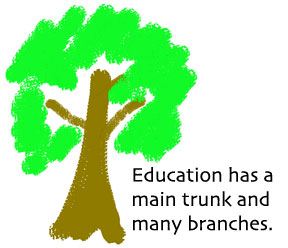 Undergraduate education has been and still is an opportunity to solidify a passion for lifelong learning. It is also a time to tier students into achievement and skill levels – based on their ability to integrate their existing knowledge with new knowledge from other disciplines (some distantly connected, others possibly close – hence, the depth and breadth requirements in the undergraduate degree requirements). University education is about going through phased development of thinking, interpretation and ideation skills; these phases are roughly segmented into undergraduate, masters graduate, doctoral graduate, and post-doctoral. The scope is largely limited to a research basis where a successful outcome would be a graduate who goes on to conduct high-impact research that stretches the domain of knowledge and information – a Professor (or as Ken Robinson figuratively describes as people who “look upon their body as a form of transport for their heads…”) Branching is possible but usually the trunk is research; the branches are the deviations from staying in a university for life.
Here, a short comment on the article by Amanda Ripley on MOOCs (the best article of this feature by far): I very much enjoyed reading this article because it persuasively raises numerous ponderous issues and hints at a solution to the over-dilution problem that I earlier mentioned. I position MOOCs in the evolution line of the continuing education branch where perhaps 40 years ago, people relied on compact self-help books (that’s when I read a book on Automaton Theory) and more recently, people are learning from YouTube (where I have been trying to teach myself to play a ukelele) – and not to forget textbooks becoming e-textbooks or supplemented online texts. The relationship I perceived from Ripley’s description of the Udacity Physics course video featuring Andy Brown was that between fundamental knowledge and an excellent PBS documentary (aren’t they all great?) such as NOVA. It’s accessible, understandable and caters to how the “brain learns” through casual attentiveness. As Ripley put it, it was “like Rick Steves’ Physics.” With this in mind, MOOCs do not replace traditional college education – they create another layer positioned for accessibility to those learners not able to enter traditional college. We know people have different learning methods – the bulk of whom are not suited to a rigorous college challenge. MOOCs thus provide hugely lateral branches for learning but offer little in vertical progression as required in academia. MOOCs should become globally popular for the breadth and accessibility, but users will likely remain in the “proof” level of the YCISL Leadership Objectives schema. If learners begin to select MOOCs as their alternative (note: not substitute) to entering college, then I would hope the over-dilution will ease and the sense of purpose will return.
Overall, this TIME feature has made me more aware of what some thought leaders are thinking, and I appreciate that. However, I firmly believe that the problem is primarily in secondary education where education reform is far more urgent – think about it… are the problems of “access, cost and quality” more dire in secondary or tertiary education?
Exercise Idea: Creativity Flowmeter
In Chapter 2 of Tina Seelig’s book “Ingenius,” the topic of ridiculous inventions is mentioned with particular reference to Japanese “un-useless” inventions. I picked up one such book about a year ago – “The Big Bento Box of Unuseless Japanese Inventions (101 Unuseless Japanese Inventions and 99 More Unuseless Japanese Inventions)” by Kenji Kawakami, Hugh Fearnley-Whittingstall and Dan Papia (Apr 17, 2005). When I first browsed it at a Kinokuniya in San Jose, I felt extremely “tickled” seeing the unabashed inventiveness of Japanese with high focus on their own culture.
Many of the inventions shown in this book and other similar ones could serve as prompts to measure reactions to the unusual creativity. I would compile a slide show of 20 or so of the inventions (perhaps just the image and not include the title/description) and have students fill in a “survey” of their reactions including perhaps: Useless, Ho-hum, Cool, I Could Have Thought of That! and I Wish I Had Thought of That! [<-to be refined.]
The idea is to gauge one’s creative flow as a result of viewing and judging the creativity of the un-useless inventions. This would not work so well with inventions that are familiar to our audience (eg, iPad) or are too complicated to understand the function. The lesson would also expose students to the idea that inventiveness can be derived from converging two or more apparently dissimilar objects, functions etc. This would be an exercise relevant to our discussion about divergence, convergence, crossover, spinoffs and parallelism in product design.
Lesson: Getting Through a “Blunder-Storm”
When I was working at Handspring, we had a fair number of technology blunders such as cheap paint that would scratch easily, dead screen LEDs, electrical problems, wrong software versions getting released, and lost user data. You hope to catch most during alpha development and fix most by the end of beta testing. Always, some things would be let through. As a longtime Apple product consumer, I have seen a similar share of technology blunders which also seemed forgive-able because Apple was a champ at compatibility testing and I knew that it was impossible to test every possible combination of Apple and 3rd party products. But it is with extreme disappointment that I view Apple’s release of iOS 6 for the iPad – and just because I thought Apple had mastered the art of new product experience (sometimes called the out-of-box experience or OOBE). The Map app is one such blunder which has set Apple’s reputation back significantly. It’s received quite a lot of press but I had not realized the enormity of its impact until I actually applied the iOS 6 update. It first begs the question why everyone in the approval line allowed this Map app to get into public release and hands (even a beta test should have revealed this showstopper). Not only is Apple’s iPad engineering group in question here, the management is also is in serious doubt. Is this just an aberration or a sign of an overall cultural degradation? Using Google Maps from a web browser isn’t really a solution because all the 3rd party apps which rely on the built-in Map engine have also been taken down as well. It just so happens that I use quite a few iPad apps that use the Map engine: Yelp, OpenTable, Redfin, Zillow, Hotels.com, TruxMap, TripAdvisor,… and the vulnerability is now clear to developers. I could accept it as an oversight I suppose – if it wasn’t for the Microsoft-esque addition of a VIP “non-feature” in the iPad Mail app. Perhaps the iOS 6 Product Manager went on medical leave at some critical juncture? Problem is I don’t see (at this moment) a way out – except to get my hands on an iPad which still has iOS 5.
Below are screen shots of maps from the Redfin app using iOS 6 (top) and Google Maps from Safari (bottom) for the same neighborhood in Davis, CA. Two areas are mis-spelled – “ALHAMBRE” and “COTTEGES.” For full disclosure, I did find that Google Maps mis-places the pin for the Frontier Fertilizer Superfund site in Davis (right over someone’s home a little to the north; so it’s not perfect) but Apple’s Map app doesn’t locate it at all (useless).


I would characterize this as a “blunder-storm” where enough has happened that it calls a lot of intangible qualities into question. For YCISL, it would be great to simulate such a situation and work out how to approach, get through, get past or get around this problem. There’s probably no shortage of blunder-storms in the news at any given time, so we could do a real world analysis, or create a hypothetical scenario. There are probably good lessons to be learned from this for innovation and leadership.
So if anyone of any influence on this Map app is reading this, take a page out of the NFL Referee “blunder-storm” and do what’s best for your fans.
After-thought: I did experience a worse experience in an update recently. The Bay Area News iPad app, in an update, became totally unusable where the layout became tedious and links went to the wrong article. How does this stuff make it through beta and readiness engineering? And yes, the solution (just as is Apple’s) was to use the web browser version. It looks like this app has been updated and the link problem has been fixed. Layout still awful though.
Update: Just saw an article in the BayAreaNews iPad app titled “Major management shakeup at Apple” by Patrick May (originally published 10/29 /12) which announced the departure of Senior VP of iOS Software Scott Forstall from Apple. I have no idea whether this action will close the loop on the problems discussed, but I hope the culture can be restored and rescued (hint: Airport Utility 6.x).
Thoughts: On taking a position
Today’s story on FaceBook making plans to allow younger people to sign up for accounts is full of cross-opinion.
Think of other issues that the YCISL participants may relate to differently because of their age.