
Thoughts: The Relationship Between Parent, Student and Teacher in Molecular Terms
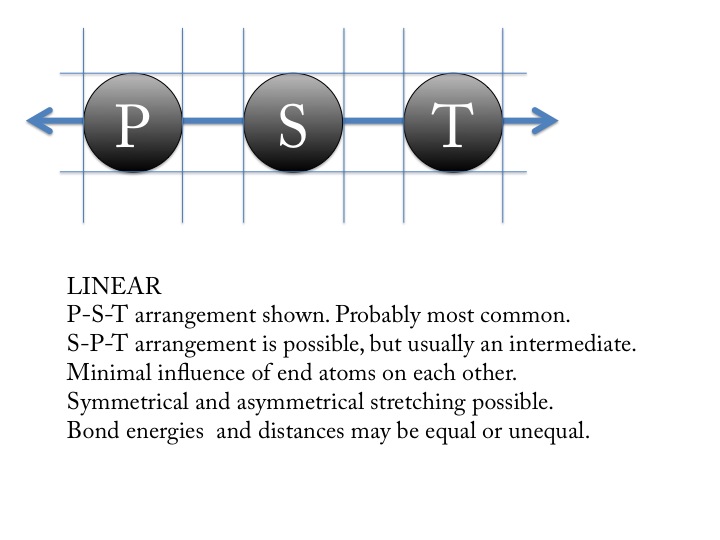
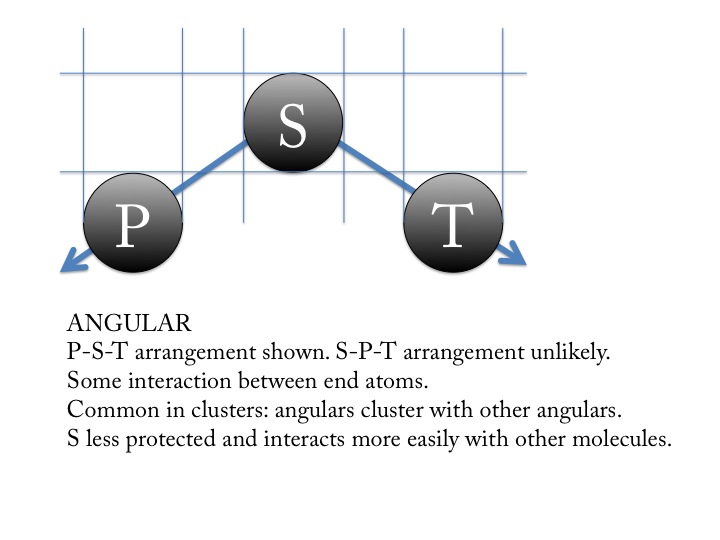
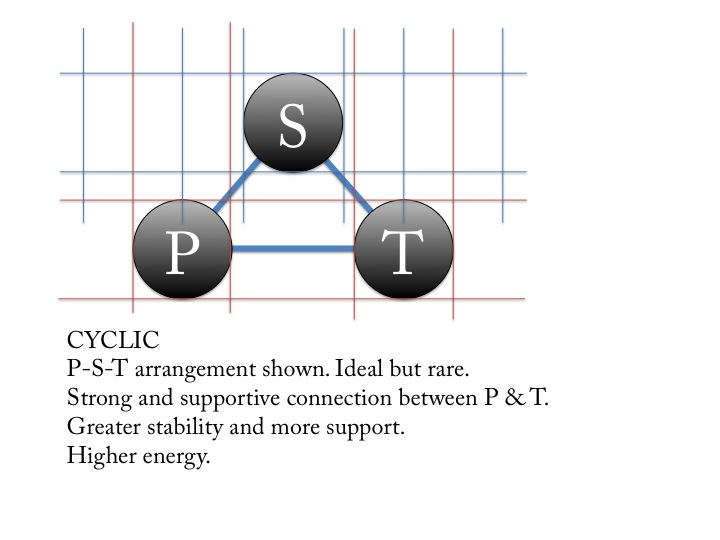
With the view of developing YCISL-derived toolkits to help a student interact better with parent and teacher in order to maintain optimum support from these two resources, I have been reflecting on the structure of the relationship involving student (child), parent and teacher. I feel it meaningful to me that I put it in molecular structure terms which depict arrangement, bonds and interactions.
The three structures applied are (1) linear, (2) angular and (3) cyclic. Imagine these structures with translational as well as vibrational motion. The field or medium in which this structure exists will also influence behavior. One thing we can be sure about is that this is not within a vacuum.
So I offer three figures, each with a few notes. The question for the student, parent and teacher is “Which structure applies to you and does it work well?” With these structures, I hope that all stakeholders can appreciate the stress and strain that is felt (more on this later) by the student. For the toolkits, I will attempt to develop exercises that make preferred and optimum structures more stable and resilient. For those who identify themselves as being in a linear structure, does angular or cyclic seem preferred? If so, would you be able to put energy into it?
Angela Lee Duckworth: The key to success? Grit (TEDTalk)
Like most of the TEDTalk videos that I feel worth saving remarks on in this wiki, the one presented by Angela Lee Duckworth (currently Associate Professor at UPenn) titled “The key to success? Grit” is very thought provoking and warranted being viewed several times – mainly because the causation-correlation relationship was quite fuzzy, albeit interesting. How synonymous are “grit” and “growth mindset”? To put it in terms I have used in other circumstances, “grit” describes the way someone achieves (ie, process) while “growth mindset” describes the condition or state in a particular node. Thus “grit” is a great observation highlighted by Prof Duckworth but it certainly is not the only way. With this in mind, I wonder whether “grit” is the best way – that is, should educators make focused and extraordinary effort to promote “grit”? Or are there better processes to highlight to students given the limited opportunity to have such concepts be embraced and embodied. Duckworth also mentions IQ (several times), social intelligence, good looks, and physical health – some which can be encouraged and others not.
Duckworth describes grit as “passion and perseverance for very long-term goals…having stamina…living life like it’s a marathon.” She also mentions her grit questionnaires (I just tried her online questionnaire) which leads me to think that “grit” is intended to be a catchy catchphrase and what she really is studying is determination and focus (yeah, sounds plain). If so, we need to recognize the headwinds of limited long-term outlook (see http://geert-hofstede.com/united-states.html for the current US score) and shortening-attention spans which are already short. Perhaps there are lessons in sports that can be transferred to classroom learning because we often hear about “grit” in the former.
Is grit the most likely solution to education’s aim to be perfect? Most likely not. It is perhaps a band-aid that provides hope while we search and experiment for more structural progress. The question remains whether the content-teaching-assessment framework will evolve (so far, it has been broadly digressing under the weight of greater competitiveness) and standards become more “human.”
Another “problem” (in quotes as I think this is not a deal breaker but actually a challenge to address) is how to make “grit” an actionable item for parents. Focus and determination are largely played out and influenced outside of school. We also recognize that parent negativity plays a significant role in diluting this positive grit trait.
Would I mention “grit” in a YCISL workshop? I think it would be too challenging to get it understood on a personal level – especially with an Asian group of students. It may be interesting to have the students try the grit questionnaire and see if a group discussion on personal enlightenment can ensue.
Thoughts: 5 Things I Learned from this Summer’s YCISL Workshops
I like to keep lists, especially short lists. I hosted three YCISL workshops this summer and they went great – because I learned a lot. New this year was the addition of students from Japan which opened a new cultural dimension which ultimately will shape future YCISL content.
1. ACTIVE LISTENING is a key youth skill to call out in detail at the start of the workshop. Just before the July workshop, I read “Active Listening 101: How to Turn Down Your Volume to Turn Up Your Communication Skills” by Emilia Hardman. This is a splendid complement to “Understanding Other People: The Five Secrets to Human Behavior” by Beverly D. Flaxington. Where the topics in “Active Listening 101” provides destination nodes for better informatization, “Understanding Other People” details the nature of the internodal connections. Together, they describe a dynamic that helps us appreciate the challenges in teamwork, teambuilding and leadership – and perhaps do a better job at all these things. In this summer’s workshops, I found that active listening is something that needs to be coached – especially so it rises as the default mode of listening among the 8 types of listening described by the author.
2. ENCOURAGING A POSITIVE MINDSET EARLY & OFTEN is key to building momentum for creative and innovative thinking. In my workshop introduction, I include a slide containing a collage of kids smiling and talk about Guy Kawasaki’s point about smiling from his book “Enchantment.” I then use Tim Brown’s sketch-your-neighbor activity to generate those genuine smiles (and also discuss how most adults have built an embarrassment shield). However, I have found that in order to sustain the positive mindset, additional exercises with similar emotional goals need to be placed within short intervals (say one on the morning and one in the afternoon). For example, the Teamwork & Teambuilding exercises used to be scheduled towards day 4 or 5 of the workshop – in conjunction with the leadership theme – but these exercises are far more effective earlier on (eg, day 2) because they are also icebreakers. I guess I just have to find more “games” to meet the needs.
3. TEAMBUILDING GETS CONFUSED WITH TEAMWORK. Teamwork (TW) is a concept that most high school students are familiar with, most likely through sports, PE or school teams or club teams or community leagues. Just as useful are experiences with competitive academic teams (eg, debate), schoolwork done in pairs or groups, musical ensembles, school publications, and community service projects. For those fortunate to be team captains, leadership lessons can be learned. More rare are the leadership lessons in team building (TB) which spans from assembling people for the team to getting team members to work together as a team and continuously improving team efficiency. Therefore, the YCISL approach encourages thought and discussion about both teamwork and team building. TW and TB are standards that team members can strive for. We use emotional intelligence, active listening and (persuasive) elevator pitch to build up team skills.
4. BUILD UP TO THE ELEVATOR PITCH. The Elevator Pitch is a particularly good approach to students making the most of an opportunity to present their idea in a time-constrained yet optimally persuasive manner. Adults tend not to “listen” to youth – that is, they have a filter that serves a small set of fixed channels (eg, is this going to boost their SAT scores?) A lot goes to waste. Normally, an elevator pitch exercise precedes the project presentation in the YCISL workshop. This summer, we built a few additional exercises to take a longer run-up to the presentation. In one exercise, we had students pair up and just look each other in the eye for 2 minutes (it was difficult making eye contact with this particular group of students). Then they took turns saying something brief about themselves while maintaining the eye contact. Finally, they planned a party and took turns saying something about the party (where, when, who, food, drinks, music, etc), again while maintaining eye contact – the party planning part is something I took from a visit to the d.school but combining it with maintained eye contact was our own. In this exercise, we think about active listening and using the eye contact and progressive feedback to encourage commitment in the conversation, an essential feature of being persuasive. In two workshops, we also had the “Advertising” Challenge where students had to come up with a 30-second presentation of a personal item (eg, pencil, camera, etc…) that they had on their possession – they were allowed to create imaginary features as well. We also had another optional exercise where students took this personal item and added a sustainability feature then made another presentation. In the elevator pitch exercise, we examine the Sham Woohoo video on YouTube using the framework of “The Art of the Executive Summary” (credited to Bill Reichert by Guy Kawasaki)) then have students storyboard using PostIts an elevator pitch where they are asking for something at their school or at home. The storyboard contains the various elements in “The Art of the Executive Summary.” This sequence provides opportunities to practice but also develop a technique in making persuasive presentations.
5. ADDRESS THE “BEEN THERE, DONE THAT” MENTALITY. This is mainly an issue about getting into the growth mindset but also touches on one’s understanding about divergent thinking relative to convergent thinking. For any piece of knowledge, we know there are perspectives built on beliefs, facts, truths and falsehoods (misunderstandings, misinterpretations and lies). We also know there are numerous other perspectives that could yet be formed. A “Been There, Done That” mindset prevents a complete analysis by being convergent prematurely and disguises a fixed mindset as a growth mindset. We have been watching the Shawn Achor “The happy secret to better work” TED Talk and I am always finding something new. I view it as a worthwhile challenge to help students build an emotional intelligence supported by a true growth mindset.
NYT: New Guidelines Call for Broad Changes in Science Education
The main headline that caught my attention is “New Guidelines Call for Broad Changes in Science Education” written by Justin Giilis and published on the NYT web site on April 9, 2013 (http://learning.blogs.nytimes.com/2013/04/09/science-teachers-what-do-you-think-of-the-new-next-generation-standards/?ref=science). The article is interesting enough but I also drilled down to “What Do You Think of the New Next Generation Science Standards?” by Jennifer Cutraro and Katherine Schulten published on the same day also on the NYT web site.
It is interesting news because it marks a collection of ideas on how to change education. I can see how the recommendations are aimed at creating improvement, and I particularly appreciate the addition of hands-on learning experiences. From my perspective, it might actually be an attempt to restore some of the ideals of science education from the 1970s and earlier – when science had entertainment value (eg, bunsen burners or small chunks of sodium thrown in water). However, from these reports I have read, it appears that there is substantial sidetracking and these changes will not make US science education any more competitive or attractive to future scholars. While some skill enhancement is incorporated, most of the proposed changes appear to be tweaks in the knowledge compartment.
Specific thoughts:
– Getting away from memorization. Yes, memorization should not be all students are trained to do. However, the classic skill of memorization is still necessary to train cognitive reasoning especially for the purpose of communication. Therefore, let’s be mindful of how much memorization is de-emphasized so that divergent creative thinking can be developed and we can nurture their passion for discovery. The problem actually is that memorization is what is necessary to prepare for standardized tests, and creative thinking isn’t critically tested. So let’s consider how to develop a complementary testing method for the creative skill (many universities do this already but it’s as far from standardized testing as you can get). In addition, a reduction of memorization will likely lower US competitiveness in international comparisons (not necessarily something to be fixated on).
– Implementation. How will the education system adopt these changes? At the user interface level, teachers will have to learn, develop and/or follow new methods to teach, assess and evaluate. Those farther below this interface level will have to adapt and support this new architecture – are they prepared to do so? More importantly, how will students react? We have already seen the pendulum action as a result of shifts in reading and language education – and we may very well see the same in shifts in science education. Is there any reason to believe students will shift from passive to active learners when it comes to science? What will happen to the lower two quartiles of learners? Will hands-on learning help them or hurt them? I like taking lessons from successes where classes can be formatted to suit learning styles.
– Content. The two NYT articles mention “Climate Change” as a controversial sticking point when it comes to including it as a curriculum topic. It’s probably political correctness that is driving this. I really don’t see the educational value in this. Energy should be focused on making science more interesting. As with the YCISL workshops, I promote a broad platform of sustainability to facilitate creative and innovative thinking. Sustainability is a universal theme that everyone can adopt and understand from a variety of standpoints – from sustainable finance to sustainable health to sustainable happiness to sustainable progress. In the end, making any positive aspect of life sustainable is a worthwhile exercise.
Book: How to Deliver a TED Talk by Jeremey Donovan
Just finished reading this book. Thoughts coming soon…

Thoughts: On [Rapid] Prototyping
When you have an idea pop in your head, rapid prototyping is a good way of getting that idea into an object you can toss around. It doesn’t have to be fully functional – even barely functional may be good enough. This note is about two stories regarding prototyping (rapid, in that the objects were hardly functional and focused on look and feel).
The first story is that which Jeff Hawkins (inventor of the Palm Pilot PDA) used to tell – about creating a bunch of prototypes in his spare time – on his kitchen table. In an in-between approach – whenever there was an idea and spare time.
The second story (the one that stands out the most in this book) is from page 387 of “Steve Jobs” by Walter Isaacson where Tony Fadell sequentially reveals styrofoam models of prospective designs. Upshot is that this approach enabled an instant decision in one meeting instead of a drawn out status quo over many meetings.
The second one is the
Thoughts: The 5 “Wisest” Things I Have Heard (A work in progress)
I wanted to build a collection of things that I have heard, read or somehow otherwise learned that I hold closest. Each one is to be tied to a story and together would comprise a “story-based” introduction to these “wisest” thoughts.
The first one is quite easy.
(1) Not all customers are customers you want to keep. I first learned this at a Fred Pryor Seminar on “Exceptional Customer Service.” This was back in 1997 when I had become an IT Manager and provided service to a couple of hundred departmental clients. I thought I needed help with appearing “supportive” to clients but actually managing them to minimize the demand on my time. The seminar speaker emphasized that a positive customer support experience is far more valuable than advertising. Where advertising may generally have less than 30% effectiveness (if you’re lucky), customer retention in the high 90% range or so is quite an impressive performance. So guess which one costs more on a per customer basis? Also, there isn’t anything much better than the happiest customers singing praise of you or your product. But what about those customers who seem to live to be attention-hogs or born-complainers? Lose them – disinherit them, if you can. Tell them outright that you don’t want them using your product or services. If they’re in your department, have them look elsewhere for help. Even if they tell a colleague or a friend, how much damage could they cause? Not much because even their colleagues are already familiar with their negative behavior and don’t trust their opinions (we see this phenomenon on Yelp! today). I became more attached to this principal while in CRO at Handspring. We let go of up to 5 customers during my 22 months there because of their poor demeanor – stopped the support effort, took back the product, processed the refund, and told them to stop doing business with us. This let us focus on the good customers and kept things moving forward. While intentionally cutting off customers seems counter-intuitive at first, it is an excellent option to be robust.
Here’s an interesting related article: http://www.inc.com/magazine/20091001/youre-fired-getting-rid-of-bad-customers.html
(2) Defer the Bug. When you’re creating something, there will often be an imperfection or a bug. If you’re working to a deadline, you need to prioritize the bugs then decide which ones need to get fixed first and which ones (a) get deemed acceptable because the risk of occurrence is extremely low or the outcomes are not catastrophic, or (b) get deferred (i.e., will get carried to the bug list for the next product refresh). From my experience at Handspring, a lot of bugs get deferred and often through more than one product refresh. The lesson here for product developers is that you should do your diligence in seeking bugs but fixing them takes quite a lot of emotional intelligence, otherwise nothing would ever get released.
(3) Timing is everything. I learned this mostly through investing. There are market timing strategies and Value Line has timeliness ratings on stocks it analyzes. I have also seen where new and brilliant technologies were just too early and slow in the early adopter phase and failed to reach widespread adoption. Sometimes, a poorer technology with better timing has succeeded. We also may have heard that timing is critical in acting and even telling jokes. It affects precision and accuracy in sports.
(4) Underpromise. Overdeliver. Seems obvious when you hear it. Not so easy when you have to do it. Competitive fear seems to drive “overpromise” resulting in a huge “underdeliver.” Happens in the movies, in technology, in finance, in business,… If you’re in control of something though, make sure you set expectations appropriately and don’t set your audience up for disappointment.
(5) Men are from Mars. Women are from Venus. This is actually just an example of a collection of statements that refer to how a group that appears to be one may actually be a mixture of two. There are left-handed, right-handed issues – interesting ones being tools favoring the majority who are right-handers, and sometimes you can find tools being made for left-handers. There’s also left-brain, right brain and how different they are; fascinating that within one side, there are sections which control different things – my favorite example is how former US Representative Gabbrielle Giffords went through music therapy and used singing to communicate via language. See http://abcnews.go.com/Health/w_MindBodyNews/gabby-giffords-finding-voice-music-therapy/story?id=14903987. Then one of my personal favorites is that girls play youth basketball for different reasons than boys (and as a corollary that coaching girls and coaching boys at basketball requires two very different plans and approaches).
Exercise: Extension of the Bucket PostIt Exercise
I am in the process of designing a categorization methodology for the results of the Bucket PostIt exercise (described in May 23, 2012 entry) and am seeking a way to make this categorization a participant-level activity in order to quickly reveal the scope of the group’s thinking. Making this a speedy critical thinking exercise would add to the brainstorming-to-prototyping aspect of the workshop.
Richard St. John: 8 secrets of success (TED Talk)
[I discovered this TED Talk from its mention in “How to Deliver a TED Talk” by Jeremey Donovan] In his 2005 TED Talk “8 Secrets of Success,” Richard St. John summarizes what he has discovered when looking into what leads to success and presents his framework of “the eight traits successful people have in common.”
Specifically, the traits include: Passion, Work, Focus, Push, Ideas, Improve, Serve, Persist.
These were filtered from St John’s interviews with many “successful” people and serve as a good platform for discussing “success.” I believe there are similar studies done with youth as well. However, these all required that success be pre-defined in order to scope the pool of people to interview.
I am also reminded of Shawn Achor’s point that Happiness should be placed before success so that happiness is ensured as a result of being successful. Actually, St John touches on a similar point in his second TED Talk “Success is a Continuous Journey” from 2009.
Therefore, something more captivating might be learning about the eight traits that happy AND successful people have in common.
As an extension (and if this were something brought into the YCISL program), we should also look at extrinsic factors and perhaps even consider a pre-disposition to reach levels of happiness and success together. In YCISL, we already consider how family, community and environment affects the support one feels while striving for happiness and success.
Video is at http://www.ted.com/talks/richard_st_john_s_8_secrets_of_success.html.
Additional information can be found at http://www.richardstjohn.com.
Idea: The History of My Life in Photography Terms
Much of my life can be traced along the lines of the history of computers – that is, I can relate many changes in my life in tandem in my use of computers. This is why visiting the Computer History Museum was a lot of fun. Thinking to the start, I won’t include the Casio fx1000 (although that was very cool and a significant aid), I like to think of my TI-55 with its red LED display (how cool was that?) as my first computer – it was programmable!
Back to photography. I like to think of the photographic timeline because of the massive transformation that happened due to digital photography. I remember spending many happy hours in a dark room in high school working with chemicals, photo paper, glove bags, film, tanks, reels, and enlargers. The smell of the chemicals are still vividly in my memory. Then there were the stores or drive-throughs where you dropped off film and picked up a week later (initially) or 1 hour (later). That is mostly in the distant past now, with a trickle of activity at the photo labs of drugstores or Costco.
So what changes best define photography to me? Well, my first recollection is the Kodak Instamatic with its cubic flash attachment. Somewhere in there was the Polaroid although I personally didn’t have one. One of my first serious cameras was the Pentax ME (I think my first hobbyist camera actually wasn’t an SLR). It was good enough for snapshots around school to develop in the dark room. When I graduated from high school, I got myself a Nikon FM and a Nikon EM. Used them on my trips to Sri Lanka and Europe. Then we tried a Canon APS format camera which was used for a relatively short 2 years; it still sits in a drawer but the APS technology didn’t make sense. We went back to regular 35 mm film when my first child was born – an Olympus, I believe. Then we got into digital photography before my second child was born – and the changes were more than I could have ever predicted. We’ve experienced several solid Canon Elph digital cameras, an Olympus which used a flash memory that quickly disappeared, an un-durable Casio Exilim, a hand-me-down Pentax that was tired, a Nikon D50 that drowned in Gatorade and even an Apple QuickTake 150. I’ve also used disposable cameras and even underwater disposables. It’s been fun trying all of them but I’ve learned not to expect too much. I now have a Nikon D40 which has served me well but is now starting to disappoint and a Sony Cybershot (so now I have a lot of fun taking panorama photos). With the D40 I have invested in lenses – finding out my older Nikon lenses were of no use – and lighting equipment including flashes, stands, and a commander. I continue to learn new things – most recently about lighting options for more interesting shadows.
I recognize myself by this history with cameras. They have changed physically and in their emotional effect. They have impacted my routines (as far as processing and archiving photos). I wish that everyone could look fondly at their life with something so emotionally attached. It’s good practice for other things which become a huge and wonderful part of life – having children.
