
Thoughts: A Flurry of WSJ Articles on Innovation
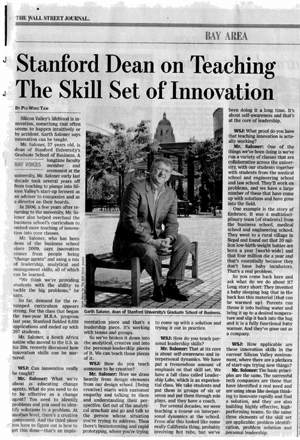
Several articles appeared in the WSJ recently on the topic of “Innovation.” To start, the May 23, 2012 WSJ has an article titled “You Call That Innovation?” written by Leslie Kwoh that describes how “innovation” is an overused term (practically “ubiquitous”) often indicating an intended direction rather than an achievement. Even in the event of accomplished change, the result is usually at best “invention” rather than true innovation (e.g., electricity, flight and my personal favorite, the pencil). The distortion of the term is perhaps understandable with b-schools believing that they can teach innovation (see B-Schools’ Innovation Rush” by Melissa Korn) and stretching the realm to encompass incremental change in order to attract students and provide modern examples for academic learning. Look too at the WSJ May 17, 2012 (Bay Area) issue which has an article titled “Stanford Dean on Teaching the Skill Set of Innovation” by Pui-Wing Tam which reports an interview with Stanford GSB Dean Garth Saloner. The interview discusses the components of the innovation curriculum which is similar on the surface to the components covered by our YCISL program. However, the basic premises and approach are fairly dissimilar. The Stanford GSB approach is based on a belief that innovation is a skill that can be “nurtured.” YCISL treats innovation as a process that can be manifested if chosen; similar to experimental technique. Our YCISL framework also takes a view that creativity, the predominant energy for innovation (our process), is present in everyone and can be made into a journey by anyone who has their barriers lowered. Not focusing on financial outcome is also a key YCISL premise (utilizing intrinsic motivation) and advantage.
Exercise: Uses for a Pail (Multitasking Revisited)
In extension to the entry titled “Unitaskers Bad, Multitaskers Good,” I am thinking that a bucket/pail might be a great object to ponder multitasking. I have several around the house and in the garden.
One approach would be to actually bring one or more pails in. We could do the brainstorming exercise (a) with no visual identification of the object (i.e., just tell them it’s a pail), (b) with an image on a screen or piece of paper (i.e., no 3-d impression), (c) with a pail sitting at the front of the room (i.e., observe from a distance, or (d) actually have participants play with one first or during.
I am also thinking to make this an experiment where we also develop a methodology and collect data for analysis.
We would give the same exercise to individuals not in the workshop to create a reference set of ideas for usage. The reference set would be longitudinal in age, and these references would be used to compare with the results from workshop participants.

Exercise: School Rules
Briefly, the idea is a PostIt type exercise where participants brainstorm changes to the rules at school. Simple targets may be the timetable (including start and end times, lunch breaks, etc) and dress code. How about rearranging the seating style in a classroom (oftentimes in rows)? I am sure we could also examine one or two sets of school guidelines to come up with more. This exercise hopefully mixes feasibility with fantasy, and reality with possibility.

Design Challenge: Paper Planes

In today’s WSJ (Thursday May 17, 2012), there is an article titled “Paper Plane Champ Watches His Record Fly, Fly Away” about a controversy in the competitive paper plane world. This reminded me of a time someone suggested that a paper plane exercise could serve as a basis for a YCISL exercise.
The article mentions an iPad app – which I have downloaded. The base version of the app shows how to fold three types of paper planes: Stunt (flips), Dart (distance), Eagle (hang time).
This also reminds me of a scene where kids throw paper planes off a building where the paper has something written in it.
I am thinking that we would use such an exercise for younger students, or perhaps a preview event. Three attempts? Three paper planes? Team or individual?
Could we use recycled material for this exercise? Would newspaper work? Could we use aluminum foil that has been used previously in the chute exercise?
Perhaps as a parallel type exercise, students could design a trebuchet or crossbow or a stomp rocket or a finger blaster or a mentor rocket (reminder, use eye protection).
Could this be set up as a fundraising competition (like a walkathon) where a person is sponsored by the number of paper airplanes made or the time a plane hangs in the air or the distance it flies?
Article link: http://online.wsj.com/article/SB10001424052702303879604577408194095860860.html
WSJ: School-Test Backlash Grows
In the May 16, 2012 issue of the WSJ, there is an article that echoes once again the frustration felt about education in the US.
The article starts with “The increasing role of standardized testing in U.S. classrooms is triggering pockets of rebellion across the country from school officials, teachers and parents who say the system is stifling teaching and learning.” It describes attitudes towards standardized testing and propagates the image that US education is in a mess, and going in circles – all true, but again lacking in a promising outcome (what does being absent from standardized testing accomplish?)
As I view it, the problem is NOT standardized testing – in the form of an annual assessment so that useful feedback can be gathered – it’s the paucity of design and useful data that defeats the humanitarian purpose of the exercise. For example, why is there not a balance between the current IQ-based assessment and an EQ-based assessment which together would better predict successful and meaningful learning? Why is the focus on how much knowledge/information a student can absorb and regurgitate? That is a recipe for an experiment with no controls, no frame or reference. In other words, production of useless data. Even worse, that useless data influences actions.
Annual standardized testing would be very useful in comparing educational productivity across cultures and other divides; and may direct our attention to systems that work better (although I don’t think anyone is using this method). Rather, I question the need for continuous assessment where every minute assignment has to result in a letter grade – that is what has taken the creativity out of learning, and the trend to grade lower and lower grades (in some cases, Kindergarten now) has made clear that this is educational bureaucracy’s focused goal.
I can accept that schools are knowledge transfer centers and that is what they strive to excel at. What is disappointing is the intrusive nature of the educational system which over-reaches by assigning useless and time-based homework as if intentionally aiming to prevent integration with real life. The school’s job could be better – to inspire students to want to learn outside of school times, to relate to the experience out of school, and to learn through self-awareness and other EQ qualities.
Put in the YCISL framework, it appears that while there is creative and critical thinking being exercise (our energy), it is fettered and too weak to make it all the way through the innovation process to create cases of successful leadership. This innovation step must be in a true quantum nature, and not incremental because of compromise.
Article link: http://online.wsj.com/article/SB10001424052702303505504577406603829668714.html
Stanford Report: Where does that creative spark come from? Stanford’s Tina Seelig has some ideas
This article in the Stanford Report promotes Tina Seelig’s new book “inGenius: A Crash Course on Creativity” and makes connections to her class (possibly MS&E 277: Creativity and Innovation).
Personally, I prefer the title of the prior book “What I Wish I Knew When I Was 20: A Crash Course on Making Your Place in the World” which effused purpose, inclusiveness, accessibility and timing – all important persuasive and attractive elements.
Still, I am optimistic that I will find the new book a worthwhile read. I am looking forward to finding how her new insights can help improve the CSDGC Youth Development Program. My contribution to creativity and innovation through the YCISL program would be to cast intervention to creativity-poor education earlier in the process.
ExploreCourses Course Listing: MS&E 277: Creativity and Innovation
Factors that promote and inhibit creativity of individuals, teams, and organizations. Creativity tools, assessment metrics, and exercises; workshops, field trips, and case studies. Each student completes an individual creativity portfolio and participates in a long-term team project. Enrollment limited to 32. Admission by application. See http://creativity.stanford.edu.
Terms: Spr | Units: 4 | Grading: Letter (ABCD/NP)
Instructors: Seelig, T. (PI)
Article link: http://news.stanford.edu/news/2012/april/ingenius-seelig-creativity-043012.html
Exercise: Team Design Challenge var.1 – Chute Races
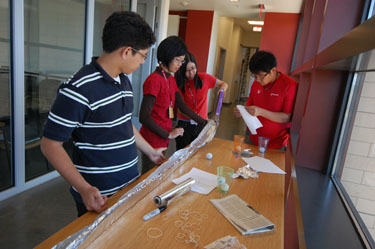
TEAM DESIGN CHALLENGE: ALUMINUM FOIL CHUTE RACES
This is partly a recount of the team design challenge from June 2011. It is also an opportunity to think why we do this exercise, and variations that are consistent with the objectives.
WHY?
To provide engaged team atmosphere.
To test team dynamics under time-constrained conditions.
To experience rapid team idea exchange, design and decision-making.
For the teambuilding lessons.
To create an impromptu structure of leadership and functional responsibilities.
To focus on blend of instant creativity and teamwork.
To work with basic (on-hand) materials.
Sometimes, when you’re given a small window of opportunity to prove or demonstrate something, you have to build that thing with just the materials at hand and with only your instinct about whether it will work. Think MacGyver. Think Top Chef Quickfire Challenge.
HOW?
Students will not be given the details of this exercise until the start of the time slot.
Time slot will be 3 hours: 15 minutes explanation, 30 minutes brainstorming and design, 1 hour construction, 1 hour set-up and execution, 15 minutes discussion.
The aim will be to design a chute using some basic materials.
Last year’s materials: aluminum foil (1 roll), elastic bands (1 box), paper clips (1 box), tape (1 roll), cup (1 ea), golf balls (4 ea), string (1 ball).
Materials are open to variation.
Examples: water instead of golf balls; chute must have Y- junction; baseball instead of golf ball; curvature (spiral, bend or mole-hill); ramp-jump; jump and land in receptacle (eg, a bucket).
Assignment: Photo Essay (Formalization)
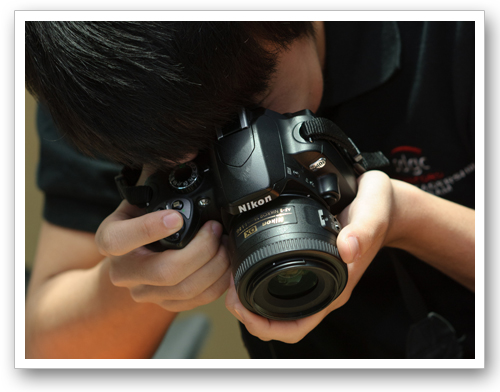
Almost a year ago, I made an entry alluding to Praveena Sridhar’s photo essay and a few ideas of what a Photo Essay assignment could be on. First, I just realized that the entry did not have specific detail on the assignment. Second, I did not elaborate on Praveena’s Photo Essay.
Here are the notes I have shared with my interns:
WHY?
Demonstrate a documentation method.
Encourage reflection.
Use photos to record things that might be missed the first time.
Long-term record.
Pictures are worth a thousand words.
Photos show perspectives.
Use photos to reflect personal viewpoint.
Taking photos is a creative exercise.
A collection of photos can be set along a theme.
A themed photo essay can be persuasive.
The theme can be “vertical” or “lateral” or perhaps both.
The product should be personal and contribute student’s personal identity “un-generic.”
Can be used as point of discussion in personal statements or interviews.
The combination of pictures and words is an effective start for future use. The words capture facts and emotions of the moment. The picture makes the overall exercise sustainable into the future
HOW?
Students will be introduced to the idea of a photo essay.
Students will be shown Praveena’s photo essay as an example. http://www.indiawaterportal.org/blog/praveena/8064
I will show two or three photo essays from last year’s group.
We will discuss the intellectual as well as emotional value of Praveena’s photo essay on Water Loss.
Students will be oriented to the photo essay assignment (separate document).
Mentors may help students develop theme ideas – using questions.
Mentors may only superficially help students with content – again, using questions.
Photo essay exhibition is intended for students to share and exchange perspectives.
Promote understanding. Minimize judging.
Exercise: 90-Second “Elevator” Pitch

I mentioned the 90-second elevator pitch idea in an earlier entry based on my reading of “The Most Awkward Meeting: New Elevators Sort Employees, Foiling Manners And Face Time” that was published in the WSJ (http://online.wsj.com/article/SB10001424052748703509104576331044032063796.html).
Here is an attempt to formalize an exercise that could fit into one of the pre-speaker “mental wake-up/warm-up” workshop slot that have been under consideration.
PURPOSE: to get students to focus on the most important points, to think on their feet, and have a sense of time when they are trying to persuade someone. They need to appreciate that they need to grab attention and that once they have it, they only have it for a short time. [Aside: this makes me think of another WSJ article (April 24, 2012 issue) I just read “What Cocktail Parties Teach Us” by Melinda Beck (http://online.wsj.com/article/SB10001424052702303459004577361850069498164.html) where the term “cocktail-party effect” is used to describe how the “auditory complex boosts some sounds to help the brain prioritize what’s important.” I’ll reflect on the significance of this in another entry but suffice it say that one needs to gain the FULL attention of the listener to have an effective pitch experience.]
1. We will do this in teams. Whether we use the Project Studio teams, or some other team formation (for variety) is up for consideration. For example, if the number of members in each Project Studio team is quite different, it might be prudent to re-sort the teams so the number of people of team is the same – mainly to make sure we have the best chance of getting through the exercise.
2. Put an assortment of products into a box – one for each participant. Each participant will draw out an item and that becomes their product (or idea) to pitch. Perhaps include an option to employ something of their own.
3. What kind of products? Junk? The hottest gadgets? Weird things? I’ll get back to you on this.
4. After selecting the item, the “pitcher” will have 15 minutes to map out their pitch. I would suggest that the pitch includes a grab, a short set of feature highlights and differentiators, why people are going to be enchanted by it, and how there is competitive advantage. Of course, the pitcher should also use visual clues to steer their pitch as needed. For example, if eye contact is not attained or is lost (looks at watch, smiles at someone else), then it might be time to jump to Plan B or the next grabber.
5. The pitch. Will need some sort of timer, probably in view of the audience but not the pitcher (or maybe both actors).
6. Feedback. The pitchee should give a quick , spontaneous and genuine response when the time is up. It could be something like “I’ll take 100!” or “Send me your business plan” or “Come to my office later and tell me more” or …
7. Maybe we should video these interactions on an iPad for later review?
