
Book: Out of Our Minds by Ken Robinson
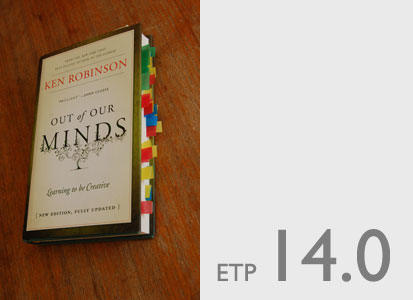
It was slower going through this book (Out of Our Minds, 2011 edition, by Ken Robinson) compared to the time I read The Element. It might have been that there was less for me to “grab on to” or “reach out for” in terms of relatable situations, or perhaps there wasn’t much I was making notes of that would pertain to the youth program. In this entry (at least in the initial draft), I note some notable parts:
– “Creative schools are creative with the schedule”, p. 260. This reminds me of the curriculum at Bowman International School in Palo Alto where there is no strict subject schedule – except for a regular language class where it is essential for students to be feeling immersed in the language and speaking to each other and the teacher in that language. But even so, there is a thought-provoking argument as to whether having schools’ daily schedules suit the traffic schedule, the parents’ work schedule or the teachers’ workload schedule (as opposed to an optimum schedule for student learning) – are detrimental to the desired outcome of learning in depth and to a command level. What do the students in the YCISL workshops think?
– “Digital natives and digital immigrants”, p. 75 and 253. These terms are attributed to Mark Presnky, and are used to denote a phenomenon that moves in the opposite direction of [traditional] cultural transmission. With new technologies and platforms flying out of the idea factories, youth are far quicker to adopt, adapt and embrace these new ways of life, and often end up teaching the older generation (the digital immigrants – those moving out from the non-digital world). In normal cultural transmission, the older generation is typically engaged in trying to pass down traditions and processes that they grew up with in order to preserve them. So, for those youth who feel that they have something to teach adults, how would they do it?
– “The task of a creative leader is to facilitate a resilient relationship between the internal and external cultures”, p. 224. We could think of this in terms of a cell which has several internal components that are somewhat protected as a group by a semipermeable (selective) membrane but nonetheless must interact with the external environment to survive as well as thrive. This makes me think about the layers of a web site where there is an external interface but several layers of hidden internal function, form, design and architecture. The creative leader has to deal with all these layers.
– ” A culture of innovation depends on cultivating three processes”, p. 219. These processes are imagination, creativity and innovation. I don’t exactly agree with how this concept has been structured (including the exact definitions of the three processes in the book). If we are to follow the argument in The Element, imagination and creativity, don’t necessarily need to be “cultivated”, they need to be uncovered – by social or organizational pressures. On the other hand, I think it is fair to say that “innovation” is cultivated. However, I would further the book’s definition of “innovation” to say that this process is a selective one. With regards to the definition of “creativity”, I would not exclude ideas because they are not “original” – the same creative idea could come about by different routes – and it all requires energy and expression. I guess you could think of this as a multi-path chemical reaction with similar reactants but the exact same product (albeit perhaps with different yields, energy of reaction and activation energies).
– “The intellect cannot work at its best without emotional intelligence”, p. 186. Perhaps something Stephen Murphy-Shigemtasu can address? More on Emotional Intelligence on p. 175.
– “Academic ability is based on the two capacities for logico-deductive reasoning and for propositional knowledge”, p. 83.
Speakers: A Focus on Eye-Openers
Advice for Prospective Speakers: Select topics that are eye-openers for the students.
Two possible approaches:
(1) The curtain pulls back on the stage. Describe a setting and storyline that builds from nothing, and makes the viewers eyes dart all over, wanting to take it all in.
(2) Looking at something in a different way. Sometimes, one gets used to how something appears without really looking at new details.
WSJ Article: The Importance of Child’s Play

Lenore Skenazy wrote in the January 27, 2012 issue of The Wall Street Journal on “The Importance of Child’s Play.” In this article, Ms. Skenazy describes how pre-school has been influenced by “fears” – a fear of injury (by corollary, a fear of lawsuit), and a fear of “falling behind.” This has limited the types of activity that pre-school children get to engage in. In the end, children are limited. So, we see that the limitations that we see imposed on children starts even in pre-school. It just creates for a more conditioned attitude through one’s entire youth.
“…play time is sacrificed for academics.” Play time is opportune for several skills such as social skills, planning skills and communication skills. Think about how free time is replaced by tutoring or other taught-activities (e.g., piano lessons) – this reduces the opportunity for children to apply their social, planning and communication skills. Where, when and how are children going to learn these skills?
Our observation that children have less and less opportunity for free play time provides further evidence that adult compromises have encroached childhood – all the way to the earliest group learning settings, and are reducing youth readiness and wasting youth creativity.
This connects with the example we found in the Gamestorming book where a single child who has a football can practice alone and repeat with little need for change. When there are two children, creativity enters where they exchange ideas for how to play together with the football – and take into consideration a number factors to produce “fun.”
It would be an interesting discussion to have with the youth groups (a) whether they are being stifled by adults, and (b) if so, when they think it started. This is a good starting point to approach the topic of sustainable leadership – one that does not get formed by adults but are organic to youth.
News: U.S. Drafts Abdul-Jabbar as a Cultural Ambassador
Interesting news story recently. Here is an excerpt from the NY Times article on it…
“Abdul-Jabbar was named a United States cultural ambassador Wednesday, with a mission of promoting education, racial tolerance and cultural understanding among young people around the world.”
This appears to me to be another interesting avenue in which youth around the world can get engaged in an age-appropriate context. Similar in motive to the YCISL, but a different approach. I hope it doesn’t get over-commercialized or politicized.
Reference: http://www.nytimes.com/2012/01/19/sports/basketball/nba-basketball-roundup.html
Life Lessons from Going Through a Car Purchase Decision-making Experience
I am thinking about a car purchase again – it’s one of those life phases that one goes in and out at fairly regular intervals. There’s a life lesson in there – about making decisions, compromising, prioritizing, and moving ahead. For cars, I rate Safety as #1. Comfort and reliability are the next most important criteria for me. There’s utility, convenience and road visibility as well that I would call priorities. Then, cost-to-own, fuel efficiency, looks and power are towards the tail end – something has to be at the bottom of the list!
It’s tough enough to prioritize these factors, but there are complications/tough challenges still:
(1) How do you match these priorities with the car? Just about every auto manufacturer does not make Safety their #1 priority [they have a list too]. It’s probably somewhere around #5 or so. How do you make a decision when priorities are not in-synch?
(2) If the purchase involves two decision-makers, how do you proceed with a purchase where the priority list does not EXACTLY match?
For the YCISL, we could focus on computers or digital cameras – or anything the participants would care to suggest. There are decision-making lessons in this exercise, but there are various other skills and attitudes to be assessed.
Basic Thinking Question: What are _____ going to look like in x years?
One of the basic questions one could pose to stimulate brainstorming and critical thinking is…
“What is [name your product/thing] join to look like in x years?” The answer could be in terms of form or function or both.
This question is related to another that I would like workshop participants to ask themselves…
“Where do you see yourself in x years?”
For the purpose of sharing insight in the workshop setting, the “product/thing” question would likely be more fun and participants may be more open to sharing thoughts.
So, for example, one could open conversation by asking “What are the streets in your city going to look like in 10 years?” I thought of this question because of the several instances that I am familiar where dirt roads have become busy thoroughfares. For those who experience “dirt roads” presently, I am wondering whether they can imagine traffic lights, pedestrian crossings, street lights, good drainage, no pot holes, cat eye reflectors, handicap accessible curb ramps (including those bumpy pads) pedestrian walk/don’t walk lights, walk chirping sounds, and so on (there are so many amazing things about cutting edge streets these days). Even the transformation to LED traffic lights has been quite amazing. Even if the participant lives in an area where the streets already have these features, what else could be done?
For the YCISL workshop, the question I would ask would have the students think about it for 24 hours, perhaps make it part of the photo blog exercise and look around the Stanford campus or elsewhere.
Perhaps, it could something simple like “staircases” (and they could look around various buildings on campus) or “windows.” On the personal product side, we could do digital cameras or personal computers.
Idea: Build-a-Store Brainstorming Project
The following could be done as a rapid-fire 1-hour brainstorming assignment.
A group of students would be asked to design a store (and this is the only requirement) for KIDS.
Originally, I was thinking about a Toy store but have each group discuss about stretching and staying within this scope. For example, a Toy store might sell what mainstream consumers might consider toys, or they could have collector’s toys, or just a subset of the Toy realm (eg, BoardGames, or Video Games) – or they could have magazines/comics on top of toys – if they think that is what would “drive” kids to their store.
The subsequent idea is to design any store so long as the appeal is to KIDS. Preferably, the store would be something that could be set up at their school – either as something that would open regularly (eg, daily, weekly or monthly) or just once a year (eg, something for the holidays or a school event).
Some of the things that they would brainstorm and pull together are:
(1) Scope of the store – customers (eg, age and male/female/both) and type of goods/wares/services
(2) Sample of actual items they would want to sell
(3) Purpose of having the store
(4) Positioning of the store (how it fits into the proprietors or school’s goals); uniqueness and appeal
(5) Look of the store – design a storefront (real or virtual)
(6) Name of the store, design a logo and create a slogan
(7) Plans for growth and sustaining interest
Since this is just a brainstorming (dreaming) exercise, we would not discuss logistics. The intention of this exercise is for students to express their dreams without substantial practical consideration.
Question: What is wrong with today’s cell phones?
This is a predicament I have found myself in previously on various occasions. A product that you have been using for quite some time – learned it, used it, become quite fond of it, gotten attached to it – has reached it’s end-of-life; and you have the darnedest time trying to select a replacement. What might be so challenging? Part of the problem might be shifting feature sets, but there’s also the issue of build quality (eg, workmanship) and greater complexity (eg, feature-overflow). There are a couple of examples worth mentioning here:
1. Cable Television. When cable television first became available, it was quite straightforward to understand and a good value (compared to getting free over-the-air signals). Things got better as television sets got built-in cable tuners and larger and flatter screens. Next, value began to decline with higher subscription rates and the addition of undesired channels (polluted packages). The polluted packages also led to a decline in user experience and overall user-friendliness. The downswing has recently reached a new low with the switch from analog to digital service. Suddenly, the disadvantages of satellite television were thrown in with cable, and value plunged. User experience was also impacted. But despite this horrible odyssey, a bright clearing has revealed itself – nothing terribly new, but it feels so pure and innocent. Digital Over-The-Air (OTA) signals! The old rooftop antennas miraculously have become of state-of-the-art utility again, and televisions with built-in tuners are no longer handicapped. With a little support from internet television, we find ourselves freed from polluted packages. Sanity has also returned with channels within the two-digit realm and quite straightforward to remember – and it’s generally QUALITY programming. Oh, and it’s subscription fee-free! Simplicity returns!
2. Clothing. What is the matter with the clothing industry? Low cost generally equates with low quality (workmanship and durability) and sometimes, high cost is unjustified by low quality. There are a few high cost-high quality options out there (Timberland comes to mind) but not enough. Lands’ End used to be the model for low cost-high quality but they have lost their edge and are hindered by limited choices. Tailor-made is available but quite set apart from mainstream. Why do low cost clothes have to be ill-fitting?
Not all products have gone through this plunge back to earth. I think digital cameras have been hugely positive (but the addition of HD video makes me wince, and I am saddened by the disappearing art of film developing) and automobile choices are generally on the right track (except the Hummer).
So back to the impetus for this entry…cell phones. There have been several tremendous advancements…most notably miniaturization, but also lower SAR readings. Competing digital technologies such as GSM vs CDMA has also been interesting with neither presently looking to be pushed out (ie, Betamax’d). Sure, GSM is more popular in general around the world, but phone to tower connections are relatively poor (and therefore require more unsightly cell phone towers). And cell phone plans (in the US) also have gone the way of cable television rates with poor value and lack of simple and affordable options. Hardware has also suffered with divergence to low-cost, poor quality units or high-cost, feature-excessive models. If we think about the quadrants model, there certainly is a lack of low-cost pro, and premium consumer models (ie, ones that work well but are not overly complicated).
So, for YCISL this may be a good way to introduce and discuss the use of the quadrants model to identify opportunities. For the hands-on part, we might be able to have students bring their cell phones and we would try different approaches to categorizing to quadrants. Then we could discuss how a model in a presently populated quadrant might be modified to fit into an empty quadrant, and see if that makes market sense.
Exercise: Prototyping with Lego
I am thinking it may be possible (and fun) to reproduce the iPod prototype unveiling experience described in Chapter 30 of “Steve Jobs” by Walter Isaacson. Fadell had designed 3 prototype models whose purpose was for Steve Jobs to inspect (for look and feel, as well as features). Fadell put what he considered the top candidate under a bowl (hidden from view). The presentation started with a layout of the components and then assembling them to show the various ways they could or would go together.
At this point, the book does mention Lego blocks which is something that has previously been used in the YCISL workshop.
The story continues with the unveiling of the #2 and #3 prototype models. Since the actual models were carved from styrofoam, there wasn’t any operational functionality (ie, no “click and feel”) but the creative concept could be considered. In fact, it was probably critical to the iPod’s success that engineering was not considered at this stage. There was a little bit of brainstorming with what-if? thinking as they considered modifications to the models. When the #1 prototype model was un-hidden [important so that it would not attract too much early attention], it seemed that it addressed the creative energy that they had experienced just moments before, and there was instantaneous agreement about the direction to take.
We could do this as a YCISL exercise. Students could build a series of optional base models [selected from the sandboxing phase] and build models using Lego pieces. The exercise would then involve prototyping for look and feel, and the packaged feature set. We would then need one group of students to present their prototypes and another group to be the audience. We would do the what-if? so presenters and presentees have their views in the open. Then the members of the audience would select the best candidate. We could then have a discussion about the presentation, the chosen prototype and whether they felt they could move forward or had to trace back.


Exercise: Your Personal Vocabulary List
This is a straightforward exercise to initiate a short and accessible list of words that one can use in writing. In writing proposals, essays, college essays, etc., one needs to show depth in wording to produce a positive impression (so this most important when making a first impression). The basic idea is that some words more accurately define an action or emotion, and that the reader needs this clarity to empathize with the meaning.
At one end, when “bland” words are chosen, the reader may become disinterested…
Instead of “said”, one could use (where appropriate) “argued”, “pleaded” , “denied” or “explained.” Attaching an adjective would also greatly expand the impact of carefully chosen words. For example, “pleaded vehemently” which creates a scene/action readily imagined.
The words that we hope to include are those that engage/stimulate interest and emotion (eg, hope, sympathy, happiness, beneficial), even empathy. They can also affect the feeling of time and place. We would aim to influence, persuade and take control.
Unfortunately, at the other extreme is the frequent use of words not in the average person’s vocabulary (this harms momentum and perhaps interest).
Now for the exercise – some starting prompts:
1. Imagine your favorite pastime – how would you describe it?
2. What word best describes your hero?
3. What word best describes the most exciting/engaging part of your favorite movie?
4. How does your favorite television commercial make you feel?
5. What kind of books do you like to read?
6. Imagine that you are dancing. How would you describe it?
7. What word would you use to describe a pile of work in front you?
8. What word would you use to describe something very important?
Some of my favorite words:
Positivity
1. efficacious – can be used to describe people, ideas, work and many other things.
2. dichotomy – can be used to describe relationship of ideas; especially useful when debating two sides of an issue.
3. convergence – denotes movement of both tangible (technologies) and intangible (ideas) objects.
4. motivate – can be used to demonstrate an effort to change or a change agent which lends to revealing something new (always exciting to discover something new!)
5. inspiration – can be used to introduce a high-level factor and build a connection to/association with something already highly regarded or promising.
Other candidates: versatile, commendable, amicable, compelling
Negativity
1. ferocious – example of word that conjures thankful feeling of not being in the same situation; describes a personal state (eg, fever) or a stressor (hurricane).
2. fallacy – expresses a strong opinion and position; sets expectation of forthcoming proof/evidence/support.
3. unrelenting – denotes length of time of a stressor in which a subject can go through one or more significant phases/changes such as in mood.
4. tension – if used properly, the reader will start to feel tense in a physical reaction/manner; builds empathy.
5. perfunctory – can be used to influence the reader that something is not worth thinking of in detail; comes across as robotic/programmed or void of emotion.
Other candidates: inconsequential, dimunitive, impediment
