
Michelle Kaufmann Studio
I looked up Michelle Kaufmann because she and her work was mentioned in a Seth Godin TEDTalk. Actually, it was the photo of a home designed by her (or her firm) in Godin’s slide set that caught my eye and moved me to Google her. The Michelle Kaufmann Studio home page opens with the (vision) statement “Sustainability isn’t just about the way we build. It is a state of mind. Good design embodies, inspires and nurtures that way of thinking and living.”
Especially useful to the sustainability theme of the YCISL are the “Eco Principles” at http://michellekaufmann.com/category/green-living/eco-principles-green-living/ which include:
EcoPrinciple One: Thoughtful Design
EcoPrinciple Two: Efficient Materials
EcoPrinciple Three: Energy Conservation
EcoPrinciple Four: Water Efficiency
EcoPrinciple Five: Healthy Spaces
EcoPrinciple Six: Systems Built

Seth Godin: Standing Out (TED2003)
In this TED Talk, Seth Godin ponders “idea diffusion” – the way that ideas spread and become successful products. He described how the TV advertisement-driven idea complex (mass marketing, “average products for average people”) has faded and is being taken over by creating “remarkable” products (from remarkable ideas, of course) and to “market” to the segment of the market containing innovators and early adopters. In this talk, Godin provides numerous humorous examples that get his point across – most notably including the purple cow, the Water Salad from Japan, and the town-center 55-foot high lava lamp in Soap Lake, WA.
His points about “idea diffusion” and “being remarkable” are extendable to youth creativity (although his examples are drawn from marketing and tend to be adult-oriented where success is measured by profits). In a culture where idea flow is usually from adult-to-student or parent-to-child, it is useful to promote the strategic concepts of “idea diffusion” and “being remarkable” to enable reverse flow and to be heard. It is also likely that these concepts already exist in the youth context (ie, from youth-to-youth), albeit in low volume, and it could be applied youth-to-adult as well. Raising the volume in the youth-to-youth (shall we call this Y2Y?) context would be consistent with the YCISL lessons, and we could look for opportunities and appropriate ways to accomplish this.
The video: http://www.ted.com/talks/seth_godin_on_sliced_bread.html
Seth Godin web site: http://www.sethgodin.com/sg/
There’s another Seth Godin video, this time from TED2009, at http://www.ted.com/talks/lang/eng/seth_godin_on_the_tribes_we_lead.html titled “The Tribes We Lead.” In the latter part of this talk, Godin says “You don’t need permission from people to lead them” and “They’re waiting, we’re waiting for you to show us where to go next.” He also says that “Being a leader gives you charisma.” These are powerful and persuasive notions, and are worth exploring in the YCIS context.
Book: Understanding Other People by Beverly D. Flaxington
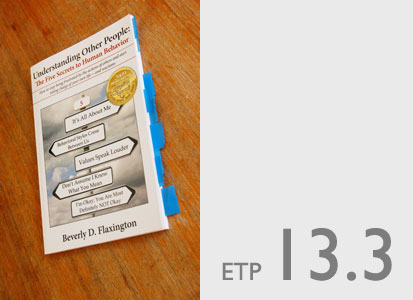
Just finished reading the book “Understanding Other People: The Five Secrets to Human Behavior” by Beverly D. Flaxington. The byline on the front cover says “How to stop being frustrated by the actions of others and start taking charge of your own life – and reactions.” It seemed like a promising resource with potential lessons for youth, especially those who may be encountering significant adult pressure. Can you imagine a youth trying to communicate with their parents or teachers, but having to deal with the “filters” described in this book? (Note: I think “filter” is not the best term since it implies a consistent loss of information processing whereas I feel it may be more a matter of translation or interpretation fidelity/efficiency at play). The premises from this book are:
1. It’s All About Me. To be able to view things from different perspectives is very important, especially with regards to innovation and leadership. However, there are times when “me” is an essential motivator and the “me” (or “us”) perspective matters the most.
2. Behavioral Styles Come Between Us. Recognition of behavioral styles is essential in any new situation. In a negotiating or mission critical scenario, it may be necessary to put aside prejudice against a certain behavior type; but an appreciation for behavior compatibility is crucial for healthy and productive teams.
3. Values Speak Louder. Values tend to intangible and difficult to identify accurately. Therefore, some latitude or additional data to analyze may be necessary before trying to rationalize a reason for a conflict. A values difference is quite easy to imagine as being an impediment in a youth-adult situation. Even if the youth has role models, it is difficult to list accurately the values that are being adopted.
4. Don’t Assume I Know What You Mean. Youth may be so anxious about being in the presence of adults that they don’t invest much time in setting context. They either want to get the encounter over with as quick as possible because of shyness/fear, or they want to get back to their friends or something they would rather be doing. It may therefore fall on the adult to encourage the youth to provide context.
5. I’m Okay; You Are Most Definitely NOT Okay. This is perfect advice for the adult who is interacting with youth. Critical judgement is definitely not the right message to send to youth when they are making their best effort. Makes me think about the frame of mind judges in a Science Fair should be in (they’ve already invested much of their time into the project before presentation day).
For the YCISL program, I think the above premises can be used to design an exercise (to be described later) to help youth become more confident in asking questions (a skill that should be nurtured as early in life as intelligently possible, but as we know often gets suppressed in school and at home ). Skilled question-asking is a powerful mode of communication and enables highly interactive discussions. Questions allow leeway in interpretation and (in network-speak) error-checking, and promote interaction continuity. It also has utility in innovation and leadership.
http://www.understandingotherpeople.com
Education Nation 2.0 (Roundtable at Stanford)

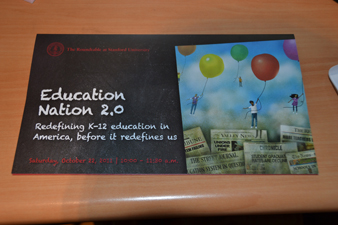
I attended a Roundtable discussion at Stanford titled “Education Nation 2.0: Redefining K-12 education in America, before it redefines us” on October 22, 2011. There were 6 panelists (John Hennessy, Cory Booker, Reed Hastings, Salman Khan, Kim Smith and Claude Steele). and 1 moderator (Charlie Rose). It was held in conjunction with Reunion Homecoming which resulted in (what seemed to be) the majority of the audience being alumni. I was interested in the direction that the education reform movement was taking. The discussion was generally a high level discussion of trends in the reform movement (charter schools, technology, improved teacher education) and therefore gravitated towards solutions and visions. Each panelist brought a unique perspective but the most interesting was from Salman Khan whose vision has obviously kept pace with the adoption of his wares; he suggested promoting customized individual learning pace (which really extends to an individual learning plan) and access to topics not traditionally found in the classroom (mentioned proteonomics). Khan’s contribution has immersed him in education and it is now extended globally (presumably where web access is available). He made one spot-on comment about the true universal purpose of education and that was to enable a person to pursue a “productive and happy life.”
Overall, there was an interesting exchange of viewpoints, ideas and anecdotes, but I felt the problem was incompletely defined in scope so the discussion felt quantized. The panelists were mostly looking inward (the “me” issue that I am reading about presently in Understanding Other People: The Five Secrets to Human Behavior by Beverly Flaxington) and did not seem to have an outward view where they could identify reasons other countries were more “successful” than the US. Also, private schools and home schooling were not specifically in the scope of discussion (although the proposed solutions were actually close parallels: private schools<->charter schools and self-paced learning<->home schooling.
How could this information be applied to YCISL? We could talk about the use of technology and even that of Khan Academy as a resource model (especially as an innovation in education – perhaps extensible to sustainability education albeit interactive and responsive). I could also mention that youth need to drive the issue as well be the innovators in education – because, as YCISL teaches, adults are restrained in their creativity. We could have an exercise where students create a new protocol and purpose for schools – dreaming of a school where the pursuit of a productive and happy life is championed (this is the global scale problem).
http://www.stanford.edu/roundtable/
http://www.stanford.edu/roundtable/webcast/
Sunni Brown: Doodlers, Unite! (TED Talk 2011)
Just watched the TED Talk video by Sunni Brown (one of the authors of the book “Gamestorming”) about the benefits of doodling. They key point is that it helps retention and promotes creative thinking. According to Brown, this is an instinct that gets suppressed with age (social pressure) – sound familiar? This somewhat relates to the face-sketching and Lego Design-Build exercises we already have, but I think we could come up with a true doodling exercise to fit into our YCISL program. Specifically, we should encourage students to doodle (sketch) while listening to something (possibly unrelated). One idea is to have them doodle while listening to a TED Talk video. I would like to have them possibly sketch a map of their Stanford tour, then while listening to something else have them doodle on their map – in the hopes of creative embellishment of the map.
TED Talk Video: http://www.ted.com/talks/sunni_brown.html
Sunni Brown web site: http://sunnibrown.com/
Lessons Learned: Singapore Polytechnic YCISL 2011
“This is just the beginning.” This is how I started the first meeting in the Stanford classroom for the group of YCISL students from Singapore Polytechnic. It was the beginning of their Stanford experience, of course, but it was also the beginning of the CSDGC YCISL program and they were a part of it. That point of time was also the beginning of their journey towards a greater appreciation of their creativity and potential for leadership through realizing innovation projects. This journey would continue, I insisted, past the workshop end through maintaining contact and actively expanding the network of YCISL alumni for future idea exchange and discussion.
Here are some of the LARGE lessons learned (for me) from this recent workshop program (June 12-25, date of arrival to date of departure):
(1) Conversation is a primary objective.
(2) Buried with creativity may also be personal ambition. Look for it.
(3) Sometimes, you let the moment speak to them.
Exercise: Ball Conduit (executed)
I managed to insert the ball conduit exercise into the SP YCISL program. And I am very pleased that I did. I decided to do it because I noticed how well they responded to the Lego-PostIt exercise. I placed it over the slots for youth leadership and teamwork/team building.
I did the almost all the shopping at Target: golf balls (real and plastic practice), aluminum foil, elastic bands, paper clips, …
This will need to be refined for the future, but in the meantime, it did provide valuable experience in teamwork, execution and communication.

Rory Sutherland: Sweat the small stuff (TED Talk)
This is the second TED Talk by Rory Sutherland I have seen. One of the key points is that those who are focused on the “strategy” (ie, the large, expensive stuff) tend to forget the details – partly because it is beneath them to work on the details. The result then is (often) that grand solutions are created that do not work. I particularly like his simple graphic that places “Stuff that costs a lot of money” vs “Stuff that has a big effect.” His main point is that not enough attention is given to the quadrant that is high on “Stuff that has a big effect” and low on “Stuff that costs a lot of money”, and that this poses a lost opportunity. In general (and what is signified by the quadrant large in both these aspects), large organizations look for large projects that depend on large projects – but they don’t bother with the details ending up with wasted effort. Then there are the large budget things with little impact – consultancy. He argues that we need to dedicate more energy to low cost-big effect quadrant.
Just how does this mesh with the YCISL? Actually, low cost-big effect is the perfect focal point for youth [How many youth have large budgets?] Not having had a big budget project previously is an advantage that youth have large claim to, and youth in general have not yet learned to spend on a big budget. If we focus youth creativity, we can increase the chances of reaching a big effect without the big budget.
This video: http://www.ted.com/talks/rory_sutherland_sweat_the_small_stuff.html
Previous video: http://www.ted.com/talks/rory_sutherland_life_lessons_from_an_ad_man.html
Programming: Summation Using Video
For the SP YCISL program, we went to a finale dinner. Before we sat down to dinner, I had the students take my video camera and record each other [important feature is that I did not do the video recording so that they weren’t directly talking to me – hopefully, their statements were spontaneous] make a short statement about (a) what they liked most about the workshop, and (b) what they liked most about the whole trip. They also had to state their name and which school they were from – for future reference. I plan to make this available to them in the near future. This is firstly, good feedback for me; it also pushes them to recall and set a memory before the moment has passed and become fuzzy; lastly and perhaps foremost in usefulness, it can be used as a discussion point when we meet in the future to see if they have acted on the lesson – and I have a way to recall name with face.
Project Idea: What is the pH of…?
It occurred to me that I don’t have a good idea what the pH of certain things are. I know Coca Cola is highly acidic, and that vinegar is quite acidic. I know the pH range of rainwater, common laboratory chemicals, soils, my aquarium (and so on). But there are also a lot I do not know. So perhaps it would be a good idea to start a collection of pH values based on contributions from the students. I could equip them with pH paper (standardize the method) and have them spend a half day going around measuring the pH of anything that catches their curiosity.
